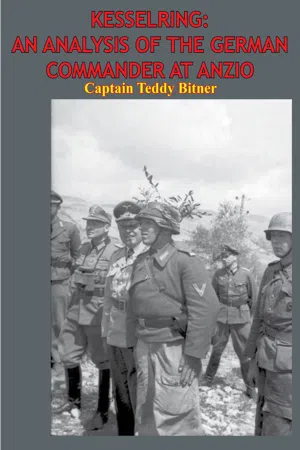
This study attempts to analyze the decisions made by Field Marshal Albert Kesselring prior to and during the battle of Anzio in February 1944. The focus of the investigation is on Kesselring's decision to shift Army Group reserves from the Rome area prior to the Allied amphibious assault at Anzio on 18 January 1944, then his involvement in the development and execution of the German counterattack against the Allied beachhead conducted on 16 February 1944.
The investigation reveals that Kesselring, the Army Group Commander, made a proper and effective decision in committing the Army Group reserves to the German defensive line prior to the invasion, and that his involvement in the development and execution of the German counterattack at Anzio was doctrinally sound and generally effective.
- 78 pages
- English
- ePUB (mobile friendly)
- Available on iOS & Android
eBook - ePub
About this book
Trusted by 375,005 students
Access to over 1.5 million titles for a fair monthly price.
Study more efficiently using our study tools.
Information
Subtopic
European HistoryIndex
HistoryCHAPTER ONE. INTRODUCTION
On 21 November 1943, the German High Command appointed Luftwaffe Field Marshal Albert Kesselring to the position of Commander in Chief, Southwest and Commander, Army Group C. Hitler's decision to give this job to Kesselring was the culmination of a historic debate between Kesselring and Field Marshal Erwin Rommel, who shared a divided command in Italy, about how best to defend the Italian peninsula. The divergent proposals for the conduct of the war in Italy, as solicited by Hitler, represented the strategic and operational concepts of the two Field Marshals. When Hitler finally made his decision about who was to command the theater, Rommel was transferred to prepare for the inevitable Allied landing in the West, leaving Kesselring to put his ideas into reality.
The job in which Kesselring found himself in November 1943 was really not new, but a continuation of his responsibilities since his appointment as Commander in Chief, South, in November 1941. At that time, he was given the responsibility to supply Rommel in North Africa. Later, in October 1942, he was made responsible for the defense of all German occupied Mediterranean areas except those under the control of Rommel. Because of his experience, Kesselring was intimately familiar with the situation in Italy and had extensive working relationships with his Italian counterparts. It would seem, on the surface, that such an assignment would not be unusual for a Field Marshal. Yet, in this case, there were at least three unusual aspects to Kesselring's job.
First, Kesselring was responsible for all German forces in his area of operations. When earlier appointed Commander in Chief, South, he had also been given responsibility for all German forces, thus organizing the only command outside of the German High Command (OKW) which controlled forces from all three services. Secondly, Kesselring was an Air Force officer. Aviators like Kesselring were not given long term ground assignments, and no other senior Luftwaffe officer was placed in the position of a theater command. In this sense, Kesselring's position was especially unique. Finally, during the months prior to his appointment, Kesselring was not primarily responsible for the defense of the Italian peninsula, the Italian High Command had that responsibility. Kesselring operated on a coordinate level with the Italian High Command, being directly responsible for the conduct of coalition warfare with the major German ally in the European theater until their capitulation to the Allies in September 1943.
Kesselring was therefore, a man in a highly responsible and unique position within the German command structure. Despite this uniqueness, there is currently very little material published concerning Kesselring as a commander. Aside from his own memoirs, a biography and a magazine article, Kesselring is mentioned in published material only incidentally to specific combat actions or decisions, biographies of other leaders, or discussed in relation to larger force developments during the inter-war years. Additionally, there are postwar historical documents prepared by German officers under the supervision of military historians, a significant portion of which was prepared by Kesselring himself, which relate to his operations, but are not synthesized in any way. Our failure to carefully analyze Kesselring's situation and approach to command, particularly in the area of decision making, leaves a considerable gap in our historical knowledge of the campaign in Italy from the German perspective.
Purpose
The purpose of this thesis is to provide an analysis of Field Marshal Albert Kesselring's decisions as the Axis theater commander in control of German forces at the battle of Anzio, January-February 1944, specifically, his decisions regarding the commitment of his Army Group reserves to the Gustav Line on 18 January 1944 and the development and implementation of the counterattack plan which led to the German counterattack of the Allied beachhead at Anzio beginning 16 February 1944. As an introduction to a wider study of Kesselring as a commander, this evaluation is intended to focus on a single, well definable crisis faced by Kesselring during the defense of Italy, thus providing a vehicle for evaluation. This paper will not provide an in depth evaluation of the battle of Anzio.
Anzio, a coastal town on the Tyrrhenian Sea, south of Rome, was the scene of 9 major amphibious assault by the VI Corps of the Fifth (US) Army in late January 1944. The resulting series of battles, fought in late January through May, were a desperate struggle for control of the beachhead and the routes leading from it. The Allies intended to outflank German defenses of the Gustav Line located further south, and open the way to Rome. The Germans sought to contain and destroy the Allied forces in the beachhead while preventing breakthrough along the Gustav Line. For Kesselring, this crisis meant that he had to balance forces and threats between the beachhead and the line further south, in order to achieve his objectives at both locations with his carefully husbanded resources. Consequently, Anzio can be viewed as a single, important crisis in the context of the larger defensive consideration, and an opportunity to examine Kesselring's decisions within that larger framework.
Need
As stated earlier, there is currently no definitive evaluation of Kesselring as a commander. This lack points to a need to evaluate the conduct of the Italian campaign from the perspective of one of the single, most important figures in the theater, the German commander in Italy. It is almost incomprehensible that to date, of the many pages written about the conduct of this campaign, that the perspective of Albert Kesselring as a commander has not truly been uncovered. Among the many needs generated from this critical one, is the need to understand the decisions made by Kesselring at Anzio. Current material does not thoroughly evaluate his decisions nor the factors considered by Kesselring in the three critical decisions affecting the outcome of the battles at Anzio; his commitment of the Army Group reserves to the Gustav Line, his involvement in the development of the !6 February counterattack plan, and his role in the conduct of the counterattack. It is the need to fill in the details of these aspects of Kesselring as a commander that this paper addresses.
Further, professional soldiers are interested in our military past for a variety of reasons. We can learn from the experiences of others, as we discover that perhaps new ideas are not so new, and how to avoid improper applications of combat power. As to the latter — historical accuracy and accountability demand a proper, professional approach to the facts in reporting and interpretation.
Finally, there is a need for synthesis. Parochial views of history are dangerous, particularly when placed into practice as a part of military science. As we form opinions of individual leaders, the views of many are needed to prepare an objective assessment, regardless of the difficulty of reconciliation. Reports on Kesselring are a case in point. Aside from the biography by Kenneth Macksey, most material written about him is from various personal perspectives, little of which appears to be objective. These views need reconciliation and evaluation for a proper portrait of Kesselring as a commander. I do not propose to do this in a comprehensive way, but do propose to provide a synthesis and evaluation in respect to the stated purpose of this paper.
Method
The primary research method used in this paper is the historical approach. In order to preserve objectivity, I will approach the task through the use of research questions, then will seek to answer those questions through research and evaluative conclusions. The research questions are these: “Do the decisions made by Kesselring immediately prior to and during the battle of Anzio provide an indication of his ability as a commander?” “If so, how effective were those decisions in achieving his intended objectives?”
These questions lead to further subsets of questions which will be specifically addressed in the evaluative portion of this paper.
Preview
This paper will generally follow a chronology leading to the battle of Anzio. Chapter Two will provide a background to the situation in Italy through Hitler's decision to appoint Kesselring to the post of Commander in Chief, Southwest, a brief sketch of Kesselring’s career to the same point in time, and a discussion of Kesselring's personality. Chapter Three will discuss Kesselring's key decisions under evaluation in a narrative format, set in the discussion of the Anzio operation. Chapter Four will provide an analysis of the decisions through the use of a series of research questions. Following the evaluation, Chapter Five will draw some conclusions and make recommendations for future research. A bibliography will also provide further information concerning sources used in the preparation of this paper and for further reading.
CHAPTER TWO. BACKGROUND
The purpose of this chapter is to build a background of information concerning both the career and personality of Albert Kesselring, and the events in Italy leading to the development of the Anzio landing. Both discussions will be brief, but will provide essential information for consideration of Kesselring's actions at Anzio in the next two chapters. The first section of this chapter will be concerned solely with Kesselring's background through his duties until the fall of North Africa. Then, the focus will shift to the development of the defense of Italy, beginning with the invasion of Sicily and ending in December 1943 on the Italian mainland. Finally, some reflections of Kesselring as a commander under construction will end the chapter.
Background: Albert Kesselring
Albert Kesselring was born at Marksteft in Bavaria on 30 November 1885. He entered service in the 2nd Bavarian Foot Artillery in 1904 as an officer in training and was later commissioned a lieutenant in that regiment and posted to the German-French frontier at Metz. Among his various duties at Metz came his first flight experience in testing observation balloons used to adjust artillery fire. During World War One, Kesselring served the bulk of his time as the adjutant of the 1st Bavarian Foot Artillery and of the 3d Bavarian Artillery. In the spring of 1917 when the British and Canadians began a drive at Arras, Kesselring was instrumental in preventing a rout of German troops and helping to stabilize the situation over a period of several days. He repeated the performance again a few months later at Messines.{1} The result was his direct appointment to the German General Staff, without the formality of the requisite attendance at the Kriegsakademie. The indication for the future was an officer who could effectively organize and conduct defensive operations under less than optimal conditions.
Following the First World War, Kesselring was selected as a member of the 100,000 man Riechswehr and for appointment to the Truppenamt, the thinly veiled successor to the German General Staff, which was now prohibited under the terms of the Versailles Treaty. About sixty other officers were selected as well by the new architect of the Reichswehr General Hans von Seekt. The work of these officers was absolutely essential to the future recreation of the German armed forces in the 1930's. At one point, Kesselring was responsible for writing the first memo dealing with the organization and development of the future Wehrmacht General Staff.{2} Additionally, Kesselring spent a significant amount of time with weapons development and the associated logistical development to support these new weapons systems. Seekt moved officers, including Kesselring, from job to job in the Truppenamt in order to expose them to various tasks and allow them to gain expertise in several areas. This approach proved invaluable to the development of these officers in preparation for the future expansion of the German Armed Forces.
On 1 October 1933, Kesselring was appointed Chief of the Luftwaffe Administrative Office. At this time, the Luftwaffe existed unofficially because of restrictions of the Versailles Treaty. Consequently, Kesselring found himself out of uniform for the first time in nearly 30 years and no longer considered a soldier, but an airman. In his new job, however, he found that it was basically a continuation of many of the things he had been doing at the Truppenamt. As the Chief of Administration, Kesselring was instrumental in the force and material development of the Luftwaffe. By 1936 Kesselring held the rank of Lieutenant General. In that year, the Luftwaffe General Staff was formed officially with Walther Wever as the first Chief of Staff. Following Wever's untimely death in an airplane crash, Kesselring was appointed as the Luftwaffe Chief of Staff on 15 August 1936.{3}
As the new Chief of Staff, Kesselring used his influence to resolve the strategic versus tactical debate then current in the Luftwaffe. Some, including Wever, felt that the Luftwaffe should develop into a strategic force with long range bombing capability which required technologically sophisticated and expensive equipment. Kesselring, on the other hand, saw the Luftwaffe as a tactical support system oriented on supporting the ground forces in close coordination and using less expensive, but very accurate attack aircraft such as the JU 87 (Stuka). With Kesselring as Chief of Staff, the decision to arm for tactical support was assured.
A second issue dealt with by Kesselring was in the area of organizational authority. Herman Goering was the Commander in Chief of the Luftwaffe and the Air Minister on the Reichs Cabinet. Erhard Milch, the former head of Lufthansa, was the Secretary of State for Aviation. Kesselring, as the Chief of Staff of the Luftwaffe General Staff, assumed that he should report directly to the Commander in Chief, a normal organizational arrangement. Milch, however, felt that he should have the capability to intervene between the two in another layer of authority. The problem centered on a lack of definition of Milch's responsibility and authority. Kesselring pushed for limiting Milch's authority and establishing a permanent, official relationship between the Commander in Chief and the Chief of Staff{4} Milch disagreed. Goering decided in favor of Kesselring and the Luftwaffe adopted a new command structure defining the limits of authority of the various officers and establishing official relationships on 2 June 1937. Having accomplished this task and realizing that someone else should exercise the new official relationship, Kesselring asked to be relieved and placed on the retired list.{5} He was relieved by Goering but not retired. Kesselring found himself in command of Luftkreis (Air District) III, responsible for the air defense of Silesia, Saxony and Central Germany. H...
Table of contents
- Title page
- TABLE OF CONTENTS
- CHAPTER ONE. INTRODUCTION
- CHAPTER TWO. BACKGROUND
- CHAPTER THREE. KESSELRING'S DECISIONS AT ANZIO
- CHAPTER FOUR. ANALYSIS OF KESSELRING'S DECISIONS AT ANZIO
- CHAPTER FIVE, CONCLUSION
- APPENDIX A
- APPENDIX B
- APPENDIX C
- SELECTED BIBLIOGRAPHY
- REQUEST FROM THE PUBLISHER
Frequently asked questions
Yes, you can cancel anytime from the Subscription tab in your account settings on the Perlego website. Your subscription will stay active until the end of your current billing period. Learn how to cancel your subscription
No, books cannot be downloaded as external files, such as PDFs, for use outside of Perlego. However, you can download books within the Perlego app for offline reading on mobile or tablet. Learn how to download books offline
Perlego offers two plans: Essential and Complete
- Essential is ideal for learners and professionals who enjoy exploring a wide range of subjects. Access the Essential Library with 800,000+ trusted titles and best-sellers across business, personal growth, and the humanities. Includes unlimited reading time and Standard Read Aloud voice.
- Complete: Perfect for advanced learners and researchers needing full, unrestricted access. Unlock 1.5M+ books across hundreds of subjects, including academic and specialized titles. The Complete Plan also includes advanced features like Premium Read Aloud and Research Assistant.
We are an online textbook subscription service, where you can get access to an entire online library for less than the price of a single book per month. With over 1.5 million books across 990+ topics, we’ve got you covered! Learn about our mission
Look out for the read-aloud symbol on your next book to see if you can listen to it. The read-aloud tool reads text aloud for you, highlighting the text as it is being read. You can pause it, speed it up and slow it down. Learn more about Read Aloud
Yes! You can use the Perlego app on both iOS and Android devices to read anytime, anywhere — even offline. Perfect for commutes or when you’re on the go.
Please note we cannot support devices running on iOS 13 and Android 7 or earlier. Learn more about using the app
Please note we cannot support devices running on iOS 13 and Android 7 or earlier. Learn more about using the app
Yes, you can access Kesselring by Captain Teddy Bitner in PDF and/or ePUB format, as well as other popular books in History & European History. We have over 1.5 million books available in our catalogue for you to explore.