This monograph forms part of the Indochina Monograph series written by senior military personnel from the former Army of the Republic of Vietnam who served against the northern communist invasion.
War and politics posed many challenges to South Vietnam's military leadership. Unlike his counterpart in some countries, the Vietnamese military commander was not simply a leader of men in combat. Depending on the level of command, he had to play his part in national politics, be himself a grass roots politician, or engage in political warfare. To achieve success, he was often expected to possess several qualities not always required of a professional military leader. The requirements of leadership, therefore, sometimes transcended the conventional framework of accepted rules and principles.
Given these requirements and the fallibility of human nature, it had not always been easy to evaluate the total performance of our leadership. The dilemma we faced was that while professional competence during actual combat was a critical criteria, we could not tolerate deliberate aberrations in moral and social codes.
In my analysis of the successes and failures of our leadership, I have endeavored to be fair and objective. If I seem to be laudatory of some officers while critical of others, it is not my intention to embarrass any individual. Performance has been the sole basis for all of my evaluations.
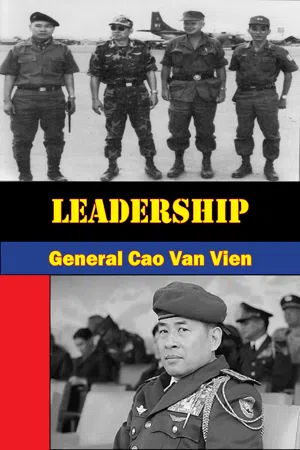
- 170 pages
- English
- ePUB (mobile friendly)
- Available on iOS & Android
eBook - ePub
Leadership
About this book
Information
Subtopic
Military & Maritime HistoryIndex
HistoryCHAPTER I — Introduction
A Millenary Tradition of Military Leadership
The history of Vietnam is a long story of struggle for national survival. During the nine centuries of independence, which was wrested from the Chinese in 939 A.D. and lost to the French in 1883, the destiny of this small nation was shaped by two main stresses: resistance to invaders and southward expansion. Because of these stresses, the Vietnamese were able to develop an indomitable national spirit which was manifested in repeated victories against overwhelming invading forces from the North and the conquest of the Khmer and Champa Kingdoms in the South.
This indomitable national spirit crystallized into outstanding traditions of military leadership provided by such venerated national heroes as Tran Hung Dao, Le Loi and Nguyen Hue who saved Vietnam several times from certain defeat and annexation. These traditions came alive again when France conquered Vietnam. Hoang Dieu, the governor of besieged Hanoi, chose suicide rather than surrender. Emperor Ham Nghi joined the armed resistance which continued after his arrest by the French under the leadership of Phan Dinh Phung. From his jungle redoubt of North Vietnam’s highlands, Hoang Hoa Tham, the legendary guerrilla chieftain, led a desperate but effective fight against the French colonial government for many years. His arrest and execution in 1913 ended a centuries-old tradition of military leadership which seemed unable to make a resurgence among the nationalists of modern times.
Among the military leaders who had elevated this tradition to its glorious peak, perhaps no one could be the equal of Marshal Tran Hung Dao who twice in 1285 and 1288 soundly defeated the invincible Golden Horde of Mongolia. The 200,000-man Vietnamese army under his command was certainly no match for the half-million of belligerent Mongol warriors under Thoat Hoan, son of Kublai Khan, who were swarming down the Red River Valley toward Hanoi, the nation’s capital. Tran Anh Tong, the humane emperor, was undecided; deep in his heart, he wanted to save his subjects’ lives and was inclined to surrender. He confided this idea to his commander-in-chief but Tran Hung Dao urged against such action. When the emperor insisted, Tran Hung Dao imperturbably told him, “If your majesty decides to surrender, you will have to cut off my head first”. Inspired by this unflappable will to resist, the national congress, convened by the emperor at the Dien Hong Palace to debate the issue of submission or resistance, unanimously chose to fight. The entire Vietnamese people thus decided to rally behind Tran Hung Dao’s leadership and throw itself, body and soul, against the mighty hordes.
But Tran Hung Dao knew he could not defeat the Mongols unless his outnumbered army was imbued with the same determination to fight. To exhort his officers and men and mold them into a cohesive combat force, he circulated the famous “Proclamation” which remains a masterpiece of classic Vietnamese literature. In a paternal and compassionate though sometimes reproachful tone, Tran Hung Dao eloquently spoke of the shame and humiliation of defeat, chided those who neglected their military profession for worldly pleasures, and appealed to all to defend the national honor and restore peace by defeating the Mongols. His words immediately stirred the Vietnamese army into unprecedented action. Officers and men alike vowed to fight to their deaths and all tattooed the words “Sat Dat” (Death to the Mongols) on their forearms as an expression of their determination. And in a succession of brilliant victories, the Vietnamese army stopped the Golden Horde and finally forced it back to China.
This was the most brilliant example of military leadership in the history of Vietnam. Tran Hung Dao indeed knew that he had little chance against such a powerful and gigantic enemy; he also knew that the Vietnamese people and his army were utterly confused and demoralized by rumors about the invincibility of the Mongol Army. Yet Tran Hung Dao resolutely rejected the idea of surrender even though it came from the emperor himself. He skillfully aroused the morale of his troops and people and organized them for counterattack; rare indeed had there been any leader as patriotic and courageous. It was his leadership that inspired the Vietnamese people and army to defeat the oppressors and saved Vietnam again from subjection.
How did Tran Hung Dao manifest his leadership? An analysis of his proclamation will provide us a clue. He began by evoking the ancient heroes’ sacrifices as examples for his subordinates to follow. Then he points out the mischievous deeds of the mongols and their incessant demands for tribute which cause him to feel humiliated and outraged; and he vows to avenge the enemy even if it takes his own life. Next, as commander-in-chief, he reminds his men how well he has taken care of them and how together they have shared dangers and glories. He criticizes sharply those who are indifferent or neglect their duties by engaging in games and gambling. He defines the responsibility that every man should take during a national emergency and encourages all of them to devote themselves to studying and practicing the military arts as presented in a manual prepared by himself. Finally, as a reward for success in repulsing the enemy, every man will have his name inscribed in the annals and deserves to be a descendant of our glorious forefathers.
It is obvious that as early as in the 13th century, Tran Hung Dao knew how to apply with skill the following modern principles of leadership:
- Make sound and timely decisions
- Keep your men informed
- Know your men and look out for their welfare
- Set the example
- Develop a sense of responsibility in your subordinates.
In addition, the dissemination of the proclamation which reads like an important order of the day, was indeed an innovative political warfare technique that few people appreciated at that time.
The Vietnamese people were so grateful to Tran Hung Dao that they elevated him to the rank of a saint after his death and erected many temples dedicated to his cult, especially in North Vietnam. In Saigon, one such temple could be found on Hien Vuong Street where annual rites were performed to commemorate his death. The Vietnamese believed that Tran Hung Dao was created by the “sacred spirit of the country.” Born into a royal family, he did not graduate from any military school but studied extensively from ancient manuals on war. He himself prepared a manual on Vietnamese strategy and tactics intended for his officers and men.
Tran Hung Dao was perhaps a born leader. He had all the qualities required of a leader such as behavioral and moral rectitude, courage, initiative, profound knowledge and especially patriotism and loyalty to the emperor. A man who combined talent and ethics such as Tran Hung Dao was unusual indeed. The Mongol invasion made him a “hero of the circumstance”. Faced with the danger of foreign domination, he took up his responsibilities and led his army to success.
It was unfortunate that Vietnam did not always have a Tran Hung Dao each time it was threatened by a foreign invasion. This was perhaps one of the many reasons why in the 19th century, France succeeded in taking by force Cochinchina and turned it into a colony by 1862. And despite armed resistance by the loyalists, Annam and Tonkin finally succumbed to French technological superiority in warfare and both became “protectorates” in 1884.
French colonialism, however, aroused an intense awareness of national identity among Vietnamese intellectuals. Beginning with Phan Boi Chau at the turn of the century and culminating in the Viet Minh led uprising in 1945 during which national independence was wrested back for the first time, this awareness produced several nationalist movements and parties whose activities were met with harsh punitive measures by the French. During the ninety years of its rule, the French colonial government imprisoned and executed thousands of Vietnamese patriots, including the famous VNQDD leader, Nguyen Thai Hoc, who were likely to become future leaders. As a foreign observer has aptly described, “By wrecking generation after generation of potential leaders with their thorough repression, they (the French) contributed considerably to Vietnam’s present political problems.”{1}
Dictated by the constant need to repress indigenous rebellions and political parties, France maintained a sizeable military force in her Indochinese colony. Over the years this force had gone through several reorganizations but remained essentially infantry. There were two categories of infantry. One was regular infantry forces which were responsible for maintaining security throughout Indochina and consisted of from two to three divisions, called Colonial Infantry, made up of French and North African troops such as Senegalese, Moroccans, Tunisians, and Algerians. The Vietnamese called these troops by a derisory term “lίnh khố đỏ” (the red-loinclothed soldiers) apparently because they all wore a large waistband of red flannel underneath the leather belt. These regular troops were later augmented by French legionnaires. The second category of infantry was the territorial forces, called “Garde Indigène” (Indigenous guard), which were made up mostly of Vietnamese troops under the command of French officers and non-commissioned officers. These forces were assigned guard duties at governmental agencies and public installations such as the governor’s office, the courthouse, the treasury, the postal office, water and electricity plants, etc. The strength of the “Garde Indigène” varied according to the importance or the budget of each province. These troops were also called derisively “lίnh khố xanh” (the blue-loinclothed soldiers) by the Vietnamese.
After several decades of repressive French colonial rule, the Vietnamese people gradually lost their ancient military tradition and were more oriented toward the letters. As a result of this and the anti-French feelings, they always had a very low regard for those Vietnamese who volunteered to serve in the “infanterie coloniale” or the “garde indigène” whom they contemptuously called “khố xanh, khố đỏ” (bunch of loincloths). Another reason for this low regard was that most of those who enlisted were illiterate or jobless and, because of French policies, they never made it to officer’s rank.{2}
Things gradually improved with the advent of World War I during which a number of educated Vietnamese youths volunteered to serve in the French Army as “lίnh thợ” (specialists). But they were in fact “ouvriers non spécialisés” (non-specialized workers) or laborers and employed as such. Many of them chose to stay behind in France when the war was over. During World War II, France adopted new administrative policies toward Indochina and allowed the selection of Vietnamese youths having a Baccalaureate diploma to be trained as officers. These selected officer-candidates were trained at two special military schools: Tong, in Son Tay Province, North Vietnam, and Thu Dau Mot in South Vietnam. Those candidates who had French nationality (mostly southerners) might be selected to attend the Saint Cyr Military Academy in France. At the same time, a number of Vietnamese career non-commissioned officers with outstanding service records was also selected to attend the Frejus officer school in France. From that time on, the ranks of French colonial infantry in Vietnam were augmented with a number of Vietnamese officers and NCO’s.
When Japanese forces overthrew the French colonial government in a lightning military coup on 9 March 1945, a great number of Vietnamese officers and NCO’s serving in the French colonial infantry chose to return to civilian life. But some followed their units into China and remained with the French Army. The Japanese occupation did not last long, however; it ended with Japan’s surrender in August the same year.
The Viet Minh immediately took advantage of this political vacuum to seize power and establish themselves as the legitimate government of independent Vietnam on 2 September 1945. In the meantime, France was also preparing to reconquer her former colony because, in spite of President Roosevelt’s strong opposition, the Allies had agreed to restore French presence in Indochina. With the help of British forces, who had the mission to disarm the defeated Japanese in Indochina south of the 16th parallel, and tacit American approval, the French first retook the southern part of Vietnam by force against heavy resistance by Viet Minh-led guerrillas. But to reconquer the North, they had first to negotiate with the new Vietnamese government under Ho Chi Minh. This government had the blessing of Bao Dai, the former emperor who now served as Supreme Counselor, and enjoyed the support of the Vietnamese people. The weak military posture of Ho Chi Minh’s government compelled him to yield to French demands and allow French forces into Hanoi and Hai Phong. But when the French threatened, by ruse and by force, to expand their control from these footholds, the Viet Minh leaders had no choice but to fight. Fighting, in fact, had never ceased since the French returned to Indochina and established its rule in Saigon. But not until France refused to resume negotiations and decided to take over the North by force did Ho Chi Minh resort to armed resistance. On 19 December 1946, he called on the Vietnamese people to attack and oust the French from Hanoi. And thus officially began the First Indochina war.
Birth of the Vietnamese National Army
During the first few years of the war, the French succeeded in occupying most urban areas and key lines of communication. Wherever they established control, they immediately sought collaborators among those Vietnamese who had served under the French colonial regime, such as former mandarins, civil servants, and village officials, to establish a pro-French government. At the same time, they also recruited the veterans of the French colonial infantry and Garde Indigène, assembled them into units, called “forces suppletives” (auxiliary forces) and assigned these units service and support missions.
When the French first set about to reconquer Indochina, they were confident they would succeed with the employment of sheer military force. Politically, therefore, they only sought the collaboration of submissive elements and the local intelligentsia through material rewards. This was typical of French divisive policies which sought to create pro-French political forces and impose colonial rule through these forces. For example, in 1946 the French turned former Cochinchina into a separate state whose government was made up of secessionist, pro-French intellectuals of southern origin. They also transformed the Central Highlands into a French-dominated autonomous state called the Western Dominion and in North Vietnam, they established the autonomous Nung country in the Mong Cay area and the Thai country in the Lai Chau area.
The creation of these autonomous states was immediately followed by the activation of local “forces suppletives.” For example, after the government of autonomous Cochinchina was established, the French created the Ve Binh Cong Hoa (Republican Guard) on 1 October 1946, which was subsequently renamed Ve Binh Nam Viet (South Vietnamese Guard). In rapid succession, the French activated the Bao Ve Quan (Protective Forces) which were subsequently redesignated Ve Binh Doan (Guard Corps) in Central Vietnam and the Bao Chinh Doan (Civil Guard) in North Vietnam. All three forces were subsequently called Ve Binh Quoc Gia (National Guard). During the initial stage of their formation, these forces were commanded by French officers ...
Table of contents
- Title page
- TABLE OF CONTENTS
- Indochina Monographs
- Preface
- Charts
- Maps
- CHAPTER I - Introduction
- CHAPTER II - Leadership Under President Diem’s Regime
- CHAPTER III - Leadership During the Period of the Directorate
- CHAPTER IV - Leadership During President Thieu’s Era
- CHAPTER V - Summary and Conclusions
- Appendix A
- Appendix B
- Glossary
Trusted by 375,005 students
Access to over 1.5 million titles for a fair monthly price.
Study more efficiently using our study tools.
Frequently asked questions
Yes, you can cancel anytime from the Subscription tab in your account settings on the Perlego website. Your subscription will stay active until the end of your current billing period. Learn how to cancel your subscription
No, books cannot be downloaded as external files, such as PDFs, for use outside of Perlego. However, you can download books within the Perlego app for offline reading on mobile or tablet. Learn how to download books offline
Perlego offers two plans: Essential and Complete
- Essential is ideal for learners and professionals who enjoy exploring a wide range of subjects. Access the Essential Library with 800,000+ trusted titles and best-sellers across business, personal growth, and the humanities. Includes unlimited reading time and Standard Read Aloud voice.
- Complete: Perfect for advanced learners and researchers needing full, unrestricted access. Unlock 1.5M+ books across hundreds of subjects, including academic and specialized titles. The Complete Plan also includes advanced features like Premium Read Aloud and Research Assistant.
We are an online textbook subscription service, where you can get access to an entire online library for less than the price of a single book per month. With over 1.5 million books across 990+ topics, we’ve got you covered! Learn about our mission
Look out for the read-aloud symbol on your next book to see if you can listen to it. The read-aloud tool reads text aloud for you, highlighting the text as it is being read. You can pause it, speed it up and slow it down. Learn more about Read Aloud
Yes! You can use the Perlego app on both iOS and Android devices to read anytime, anywhere — even offline. Perfect for commutes or when you’re on the go.
Please note we cannot support devices running on iOS 13 and Android 7 or earlier. Learn more about using the app
Please note we cannot support devices running on iOS 13 and Android 7 or earlier. Learn more about using the app
Yes, you can access Leadership by General Cao Van Vien in PDF and/or ePUB format, as well as other popular books in History & Military & Maritime History. We have over 1.5 million books available in our catalogue for you to explore.