- 32 pages
- English
- ePUB (mobile friendly)
- Available on iOS & Android
eBook - ePub
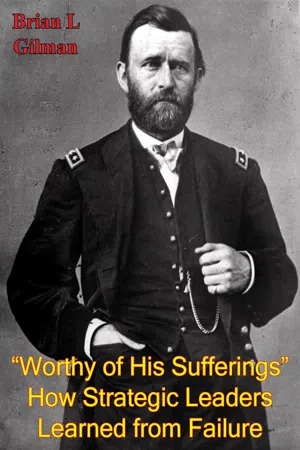
"Worthy Of His Sufferings": How Strategic Leaders Learned From Failure
About this book
History provides numerous examples of leaders who failed at some point in their career, yet went on to become great leaders. Their example demonstrates that experiencing failure does not necessarily equate to failed leadership-leaders can and do recover from failure to become better leaders. But how does this occur? How does a leader turn the psychological trauma of failure into an important learning experience that leads to personal growth? What leadership characteristics and actions are most important in recovering from a leadership failure? This paper examines these questions along several major themes: first, the psychological trauma of failure and the pathways to post-traumatic growth following failure; second, a study of how contemporary leaders grew from failure; and third, historical case studies on two strategic leaders who grew from the experience of failure: Ulysses S. Grant and Dwight D Eisenhower. In conclusion, the paper compares the lessons from these historical case studies to those drawn from the first two themes to identify the key leadership characteristics and actions that enable leaders to recover from failure.
Information
Topic
GeschichteSubtopic
Militär- & Seefahrtsgeschichte“Worthy of His Sufferings”: How Strategic Leaders Learned from Failure
“The way in which a man accepts his fate and all the suffering it entails, the way in which he takes up his cross, gives him ample opportunity—even under the most difficult circumstances—to add a deeper meaning to his life...Here lies the chance for a man either to make use of or to forgo the opportunities of attaining moral values that a difficult situation may afford him. And this decides whether: He is worthy of his sufferings or not.”{1}
On April 11, 1854, Ulysses S. Grant resigned his commission as a newly promoted Captain in the United States Army.{2} Historians do not all agree on what prompted Captain Grant to end what was previously a promising career in the U.S. Army and return to his family a perceived failure. Josiah Bunting and Joan Waugh both write that Grant was forced to resign or face court martial because of his failure in performing his duties due to drunkenness.{3} Pulitzer Prize winning writer William McFeely proposes that Grant resigned his commission and returned home because he was depressed as a result of being separated from his family for too long.{4} Brooks Simpson claims that Grant was forced to resign because his commanding officer, Lieutenant Colonel Robert C. Buchanan, held a grudge against Grant and made “Grant’s life even more of a hell than it already was.”{5} Regardless of why he resigned and left the Army, history records Grant’s resignation as one in a long series of failures that Grant endured between 1852 and 1861. Yet, despite this lost decade that Grant endured, in March 1864 Grant was promoted to Lieutenant General and assigned as General in Chief of all Union Forces, the position from which he would direct the Union’s defeat of the Confederate Army.{6}
In modern American culture, failure, especially when experienced by a leader, can be professionally catastrophic. Americans have little tolerance for failure. Failure is embarrassing, implies a fault in one’s character and/or capability, and is a sign of weakness.{7} However, Grant’s historical example challenges this viewpoint and exemplifies the thesis of this paper: experiencing failure does not necessarily equate to failed leadership—leaders can and do recover from failure to become great leaders. But how does this occur? How did a man, who in 1854 was considered a patent failure by most of his contemporaries, become the most successful Union general of the American Civil War less than ten years later? What did Grant learn from his decade of failure? How did he apply these lessons and how did they manifest into different mindsets or behaviors that enabled Grant to achieve success as a strategic leader? The answers to these questions are profoundly important to any student or practitioner of leadership because they address an essential element of leadership—“the ability to reckon with one’s own failures, make meaning of those experiences, and resolve to lead more effectively in the future.”{8} After nearly two decades of leading Marines, memories of my leadership failures still sting, and they continue to prompt me to reflect on what I learned from them, and how I can do better next time.
To arrive at the answers to these fundamental questions on leadership, this paper will first set the stage by examining contemporary analyses on the subject. This will be accomplished by first briefly exploring the psychological impact of failure and the psychology behind growing from failure. Next, the paper will summarize the findings of a recent analytical study that explored how leaders learn from failure. With this frame of reference established—what happens emotionally to leaders who fail and how leaders theoretically go on to thrive following failure—the paper will then present historical cases by examining the failures and post-failure success of two prominent historical strategic leaders, Ulysses S. Grant and Dwight D. Eisenhower. Based on the historiography of these two leaders, the paper will draw conclusions on how they recovered from failure and went on to thrive as strategic leaders. Finally, it will compare and contrast the historical lessons with the frame of reference established in the first half of the paper and draw conclusions on how leaders “can reckon with…and make meaning” of our failures today, specifically focusing on traits and actions that enable leaders to turn failure into an opportunity to grow.{9}
Contemporary Analysis on Learning from Failure
Failure in the Context of Leadership
Multiple definitions of failure can be found in Merriam-Webster’s dictionary, including: an “omission of performance,” “a failing to perform a duty or expected action,” and “a lack of success.”{10} The Center for Creative Leadership defines failure as “missteps, faulty judgment, faulty or missing information, and lapses.”{11} In her dissertation on an analytical study of leaders learning through failure, Catherine Mulqueen defined failure within the context of leadership as a “lack of satisfactory performance or effect.”{12} While these definitions help to focus the reader’s understanding of failure within the context of leadership, they lack specificity and leave significant room for interpretation on what constitutes a leadership failure as well as how failures and simple mistakes differ. Of all the sources consulted, the most thorough explanation of what comprises a leadership failure is provided by the United States Military Academy. This should be no surprise considering West Point’s mission is to “educate, train, and inspire...leaders.”{13}
West Point teaches that leadership failures consist of 1) failures in what we do, 2) failures of who we are, and 3) failures of who we want to be.{14} The first category includes leadership actions and/or decisions that result in negative consequences for the leader and/or the organization. While the consequences of these failures can be potentially catastrophic, correcting them usually involves improving the leader’s knowledge and skills—tasks that can be accomplished through education, study, and training.{15}
Failures of who we are relate more to the leader’s personal traits and abilities than to the leader’s decisions and actions. While failures in this category can be manifested in w...
Table of contents
- Title page
- TABLE OF CONTENTS
- Abstract
- “Worthy of His Sufferings”: How Strategic Leaders Learned from Failure
Trusted by 375,005 students
Access to over 1.5 million titles for a fair monthly price.
Study more efficiently using our study tools.
Frequently asked questions
Yes, you can cancel anytime from the Subscription tab in your account settings on the Perlego website. Your subscription will stay active until the end of your current billing period. Learn how to cancel your subscription
No, books cannot be downloaded as external files, such as PDFs, for use outside of Perlego. However, you can download books within the Perlego app for offline reading on mobile or tablet. Learn how to download books offline
Perlego offers two plans: Essential and Complete
- Essential is ideal for learners and professionals who enjoy exploring a wide range of subjects. Access the Essential Library with 800,000+ trusted titles and best-sellers across business, personal growth, and the humanities. Includes unlimited reading time and Standard Read Aloud voice.
- Complete: Perfect for advanced learners and researchers needing full, unrestricted access. Unlock 1.5M+ books across hundreds of subjects, including academic and specialized titles. The Complete Plan also includes advanced features like Premium Read Aloud and Research Assistant.
We are an online textbook subscription service, where you can get access to an entire online library for less than the price of a single book per month. With over 1.5 million books across 990+ topics, we’ve got you covered! Learn about our mission
Look out for the read-aloud symbol on your next book to see if you can listen to it. The read-aloud tool reads text aloud for you, highlighting the text as it is being read. You can pause it, speed it up and slow it down. Learn more about Read Aloud
Yes! You can use the Perlego app on both iOS and Android devices to read anytime, anywhere — even offline. Perfect for commutes or when you’re on the go.
Please note we cannot support devices running on iOS 13 and Android 7 or earlier. Learn more about using the app
Please note we cannot support devices running on iOS 13 and Android 7 or earlier. Learn more about using the app
Yes, you can access "Worthy Of His Sufferings": How Strategic Leaders Learned From Failure by Brian L. Gilman in PDF and/or ePUB format, as well as other popular books in Geschichte & Militär- & Seefahrtsgeschichte. We have over 1.5 million books available in our catalogue for you to explore.