This study is an analysis of Confederate cavalry operations in the Valley Campaign-5 November 1861 through 10 June 1862. In a campaign dominated by the leadership of Major General Thomas "Stonewall" Jackson and his "foot cavalry," what role did his mounted arm play in the campaign?
This study begins with a brief review of the historical evolution of American cavalry, explaining the differences between American and European cavalry. The study also includes background information on key issues of the campaign's cavalry leadership, organization, logistics, and tactics. The majority of the thesis discussion concerns the campaign's cavalry operations, including an evaluation of the cavalry's performance.
The conclusion of the thesis is that Jackson's cavalry arm significantly contributed to the Confederate success in the campaign. Cavalry contributions were strongest at the operational level of war. Despite their contributions, the cavalry was inefficient. Organizational turmoil, poor logistical support, high operations tempo, and limited training worked in concert to reduce efficiency. Although completed over one hundred years ago, the cavalry operations of Shenandoah Valley Campaign has some particular lessons-learned that still apply today. Among these are support for the soldier in the field, innovation and improvisation, combat leadership, leadership development, and training.
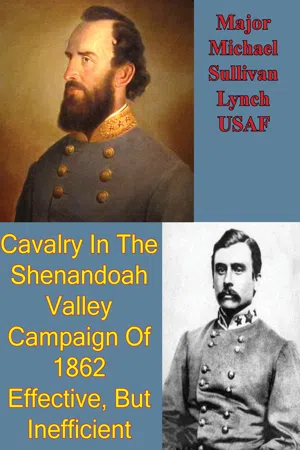
eBook - ePub
Cavalry In The Shenandoah Valley Campaign Of 1862: Effective, But Inefficient
- 191 pages
- English
- ePUB (mobile friendly)
- Available on iOS & Android
eBook - ePub
Cavalry In The Shenandoah Valley Campaign Of 1862: Effective, But Inefficient
About this book
Information
Subtopic
19th Century HistoryIndex
HistoryCHAPTER 1 — INTRODUCTION
If the Valley is lost, Virginia is lost.{1} — Major General Thomas J. “Stonewall” Jackson, Stonewall in the Valley
Jackson shared this thought in a letter to Congressman Alexander R. Boteler on 3 March 1862. In this letter, Jackson explained both the serious threat facing the Confederates in the Shenandoah Valley and the need for additional soldiers to meet this challenge. Expressing an attitude that would characterize the campaign, Jackson anxiously anticipated an opportunity to eject Virginia’s invaders.
Preamble
“Stonewall” Jackson is already the subject of many military histories. In particular, Jackson’s Shenandoah Valley Campaign has been a source of particular interest. Can one add anything more to the body of existing works on this subject? Jackson’s infantry developed a reputation during the Valley Campaign for its mobility and earned the nickname of “Jackson’s foot cavalry.” Considerably less written material about his Confederate cavalry forces in the Valley exists.{2} What were the accomplishments of Jackson’s mounted cavalry? This area will be the focus of this thesis. In particular, this thesis will address one primary question: Did Confederate cavalry operations significantly contribute to the success of the Confederate 1862 Shenandoah Valley Campaign?
Before beginning, it is important to do some foundational work. An understanding of the Valley and its relative significance to both the North and the South is important. A brief overview of the broader context of the campaign is also necessary because it establishes the canvas upon which the Valley Campaign was painted. Additionally, it is equally important to consider, in terms of its purpose, both what this thesis is as well as what it is not. Finally, a firm foundation demands some indication of the relevance of the thesis to military operations of today and to those operations in the future.
Description of the Shenandoah Valley
The Shenandoah Valley is a region that runs along the western edge of current day Virginia. (See Figure 1.) Flanking the Valley are two mountain ranges—the Blue Ridge in the east and the Alleghenies, of which the Shenandoah Mountains are a part, are in the west. Both of these mountain ranges run along a northeastern-southwestern axis. The Potomac River defines the northern boundary. From there, the Valley runs 150 miles southwest to the James River. There are three major rivers that flow in the Valley—the Shenandoah in the east, the Big Cacapon in the center, and the South Branch of the Potomac in the west. Each of these rivers flows northward into the Potomac. Consequently, the southern portion of the Valley constitutes the upper Valley and the northern portion constitutes the lower Valley. Because of the mountains that bound it, the Valley formed a natural boundary between the eastern and western theaters of the Civil War.
During the Civil War, the portion of the Valley between Staunton in the south and Harpers Ferry at the northeastern point was highly contested. In the lower Valley, thirty miles southwest of Harpers Ferry lies the town of Winchester. “By one estimate, Winchester changed hands more than seventy times during the war.”{3} The importance of the Valley began with the burning of the U.S. Armory in Harpers Ferry on 18 April 1861—the day after Virginia seceded from the Union. The Shenandoah Valley’s importance continued even after the final battle in the Valley, Cedar Creek, ended with Union occupation of Staunton on 3 March 1865. After this final Valley battle, Major General Phillip H. Sheridan began a destruction campaign in the Valley similar in scope to Sherman’s March to the Sea. David Martin described Sheridan’s destruction campaign in the following passage.
“He [Sheridan] withdrew down the Valley continuing his devastation, which rivaled Sherman’s in Georgia, though Sheridan did not burn civilian homes....When he was done robbing and burning the granary of the Confederacy, Sheridan remarked, “A Crow would have to carry its own rations if it had flown across the Valley.” {4}”
After Sheridan’s march down the Valley, the contest for the Valley ended.
From the Confederate point of view, the Valley was important for several reasons. Firstly, the region supplied critical resources for the war effort. Therefore, many considered the Valley the “breadbasket” of the Confederacy. Secondly, the mountains afforded the Confederates a concealed approach to the North. The Confederates used this approach for their two major northern campaigns, the Maryland Campaign in 1862 and the Pennsylvania Campaign in 1863. Major General Jubal Early also used the Valley to launch attacks into the North. In July of 1864, Early launched raids into Maryland and Pennsylvania, burning Chambersburg, Pennsylvania. He also launched an unsuccessful attack on Washington, D.C., at Fort Stevens. The concealed approach provided by the Valley constituted a “backdoor” into the North. Throughout the war, the potential use of this backdoor as an avenue of approach on Washington required the deployment of significant Union resources into the Valley or in the region between the Valley and Washington, D.C.
Geographically, the Valley was of less value to the Union, except for the lower Valley. In particular, the last few miles of the lower Valley were extremely important to the North because of the transportation arteries in the area. These arteries included both the Baltimore and Ohio (B&O) railroad and the Chesapeake and Ohio Canal (C&O). The B&O railroad was the major transportation artery for the North, connecting the eastern and western theaters of the war. The B&O railroad, one of America’s major railroads by the 1860s, was primarily east-west oriented and made its way across the lower Valley along the southern bank of the Potomac. The B&O ran from Baltimore to Cincinnati and included more than 500 miles of track. The assets of the B&O Railroad Company totaled more than $30 million—a staggering amount in 1861.{5} Although the majority of the B&O rail lines ran through Virginia, which included West Virginia in 1861, both antagonists laid claim to the B&O railroad at the war’s outset. The Union reacted quickly at the beginning of the war and was able to secure the B&O terminals at Baltimore, Maryland, and Wheeling, Virginia (now in West Virginia). “Thereafter the Confederacy sought to cripple it [the B&O railroad], and the South would damage this line more frequently and more extensively than any other.”{6}
The upper Valley was of less importance to the North because of several reasons. To begin with, any approach down the Valley funneled their forces away from the Confederate capital in Richmond. In addition, Union forces in the Valley could be isolated from other forces in the East because of the limited number of mountain passes.
Throughout the war, the Valley was hotly contested. For the most part, the North was able to maintain control of the lower Valley while the South was able to maintain control of the upper Valley.{7} Apart from the area in the vicinity of the B&O and C&O, both antagonists fought for control of the remainder of the Valley because of the advantages the geographical region provided the Southern effort—the Confederates fighting to gain those advantages and the Union fighting to deny those advantages.
Overview of the Valley Campaign
Several different campaigns occurred in the Valley throughout the war, but Major General “Stonewall” Jackson’s 1862 Campaign in the Valley stands preeminent among them. It was not only the success of the campaign itself but also the period in which that success occurred that rates it so highly. In order to understand the importance of Jackson’s Valley Campaign, one must understand the Confederate situation at the time.
To put it mildly, early 1862 represented a low point for the Confederacy. Confederate President Jefferson Davis used the word “disasters” in his February inaugural address to describe the situation. In North Carolina, the Union had captured Roanoke Island and had begun missions deeper into the state. The situation was even worse in the West.
“West of the Alleghenies, Southern armies were retreating along a four-hundred-mile front. The Confederates were defeated at the battle of Mill Springs, Kentucky, during January. In Tennessee, Forts Henry and Donelson had surrendered to Union Major General Ulysses S. Grant by mid-February, and the defense of Tennessee collapsed with the loss of fourteen thousand prisoners. Irreplaceable foundries and rolling mills fell with Nashville to union Brigadier General Don Carlos Buell. Missouri and Northern Arkansas were lost forever when a Confederate army was mauled at the Battle of Pea Ridge in early March.{8}”
The situation in Virginia was also critical. Faced with the growing number of enemy troops, General Joseph Johnston evacuated the Manassas area in February. The Federals quickly seized Manassas Junction. In addition, laws passed by the Virginia legislature, which granted furloughs for reenlistment, had greatly reduced the numerical strength of Southern armies in the state.{9} In contrast, Federal Major General George B. McClellan had built and trained an army of more than 150,000 and was preparing for a drive south to the Confederate capital in Richmond. It was against this backdrop of Confederate disasters and the growing Federal threat to Richmond that Jackson was going to conduct his campaign.
Jackson began his command in the Valley in November of 1861. This command came about as the result of the restructuring of the Confederate armies in Virginia. In late October, Richmond had created the Department of Northern Virginia, which consisted of all of Virginia north of the Rappahannock River.{10} General Joseph E. Johnston assumed command of the Department of Northern Virginia. Major General Jackson, as a subordinate of Johnston, took command of the Shenandoah Valley portion of the Department of Northern Virginia. This portion included the entire region of the Valley, as previously described, north of the town of Staunton.
When Jackson took command, his forces numbered 1,500 militia. When Major General William W. Loring’s Army of the Northwest, operating in Virginia west of the Alleghenies (current day West Virginia), joined Jackson’s army, the size of Jackson’s army increased substantially. His army now numbered about 7,500 volunteers, 2,200 militia, and 650 cavalry.{11} As the campaign progressed, for a number of different reasons, the size of Jackson’s army would initially dwindle. Although Jackson's command received Major General Richard S. Ewell’s forces in early May, Jackson’s efforts through most of the campaign consisted of a force of about 6,000.
Jackson’s defense of the Valley was conducted against three particular Union armies—Major General John C. Frémont’s army in Western Virginia, Major General Nathaniel P. Banks’ army in the lower Valley, and Major General Irvin McDowell’s corps in Manassas. (For most of the campaign, McDowell’s forces remained unengaged by Jackson’s forces, but all of Jackson’s actions carefully considered the disposition of McDowell’s forces, which were camped near Manassas for most of the campaign.) Throughout the campaign, Jackson was not only able to prevent the consolidation of the Federal armies; he was able to exploit opportunities and engage different elements of these armies at different times. This resulted in five major battles, four of which were tactical victories. The first battle, Kernstown, which was a tactical defeat, was still a strategic success. Because of Jackson’s engagement of Banks’ army at Kernstown, McDowell and his corps did not initially deploy south of Manassas. Before Kernstown, McDowell’s corps was in the process of moving south to join General McClellan’s Peninsula Campaign against Richmond. The majority of these forces would reach McClellan, but not until substantially late in McClellan’s campaign. At both the tactical and strategic levels, Jackson’s Valley Campaign was highly successful.
“In the space of the weeks (22 March – 9 June 1862) he marched his men up and down the length of the Shenandoah Valley, fighting five battles and defeating three different enemy armies. In addition, his movements tied down over 70,000 enemy troops—a force over four times larger than his own—whose aid was badly wanted by Union Major General George B. McClellan for his attack on Richmond, the capital of the Confederacy.{12}”
Throughout the Valley Campaign, Jackson was not only able to use his relatively smaller force to tie down several Union armies of substantially larger size but also was able to exploit opportunities to engage and defeat these Union armies, or smaller portions of them, on the field.
Jackson’s victories in the spring of 1862 provided some of the few successes for the Southern cause at that time. Additionally, Jackson’s army contributed to the defeat of McClellan’s Peninsula Campaign against Richmond. Initially, while Jackson’s army operated in the Valley, the Valley army indirectly contributed to the defense of Richmond by diverting substantial Federal forces from reaching Richmond. This contribution became direct when Jackson's army was later committed directly to the defense of Richmond.
The Thesis
Although the Valley Campaign has been the subject of many an article, thesis, and book, still more can be learned by looking at the subject in a different way and from a different perspective. The focus becomes clear by considering two opposing trains of thought. Firstly, it is important to understand what the thesis is not. Secondly, it is important to understand what the thesis attempts to be.
In order to understand the purpose of this thesis, it is important to understand what the thesis is not. The strategic importance of the Shenandoah Campaign to the Confederate cause continues to be a source of debate. Because of the period of the war in which the campaign took place, many interesting “what if” scenarios naturally follow from a study of the campaign. This thesis will avoid these strategic issues. The thesis will not consider the broader implications of the campaign itself and the significance these implications might have had on the actual outcome of the campaign or any other potentially interesting possibilities that stem from these implications. This thesis will assume that the campaign was successful, a generally agreed to supposition, and limit any further discussion along this line. It would be impossible to analyze the Valley Campaign without some consideration of its foremost leader, Jackson, but it is not the purpose of this thesis to make it into a critique of or treatise on Jackson. The exploits of Jackson’s able infantry force are included in many of the histo...
Table of contents
- Title page
- TABLE OF CONTENTS
- ABSTRACT
- ACKNOWLEDGEMENTS
- CHAPTER 1 - INTRODUCTION
- CHAPTER 2 - AMERICAN CAVALRY EXPERIENCE
- CHAPTER 3 - CONFEDERATE CAVALRY IN THE VALLEY
- CHAPTER 4 - JACKSON TAKES COMMAND
- CHAPTER 5 - SLOW WITHDRAWAL AND SWIFT ATTACK
- CHAPTER 6 - SURPRISE
- CHAPTER 7 - JACKSON SPRINGS ONE TRAP AND SETS ANOTHER
- CHAPTER 8 - FINAL THOUGHTS
- APPENDIX A - MAKE-UP OF ASHBY’S COMMAND
- APPENDIX B - SUMMARY OF PRINCIPLE EVENTS
- APPENDIX C - ORDER OF BATTLE
- APPENDIX D - FIGURES
- BIBLIOGRAPHY
Trusted by 375,005 students
Access to over 1.5 million titles for a fair monthly price.
Study more efficiently using our study tools.
Frequently asked questions
Yes, you can cancel anytime from the Subscription tab in your account settings on the Perlego website. Your subscription will stay active until the end of your current billing period. Learn how to cancel your subscription
No, books cannot be downloaded as external files, such as PDFs, for use outside of Perlego. However, you can download books within the Perlego app for offline reading on mobile or tablet. Learn how to download books offline
Perlego offers two plans: Essential and Complete
- Essential is ideal for learners and professionals who enjoy exploring a wide range of subjects. Access the Essential Library with 800,000+ trusted titles and best-sellers across business, personal growth, and the humanities. Includes unlimited reading time and Standard Read Aloud voice.
- Complete: Perfect for advanced learners and researchers needing full, unrestricted access. Unlock 1.5M+ books across hundreds of subjects, including academic and specialized titles. The Complete Plan also includes advanced features like Premium Read Aloud and Research Assistant.
We are an online textbook subscription service, where you can get access to an entire online library for less than the price of a single book per month. With over 1.5 million books across 990+ topics, we’ve got you covered! Learn about our mission
Look out for the read-aloud symbol on your next book to see if you can listen to it. The read-aloud tool reads text aloud for you, highlighting the text as it is being read. You can pause it, speed it up and slow it down. Learn more about Read Aloud
Yes! You can use the Perlego app on both iOS and Android devices to read anytime, anywhere — even offline. Perfect for commutes or when you’re on the go.
Please note we cannot support devices running on iOS 13 and Android 7 or earlier. Learn more about using the app
Please note we cannot support devices running on iOS 13 and Android 7 or earlier. Learn more about using the app
Yes, you can access Cavalry In The Shenandoah Valley Campaign Of 1862: Effective, But Inefficient by Major Michael Sullivan Lynch in PDF and/or ePUB format, as well as other popular books in History & 19th Century History. We have over 1.5 million books available in our catalogue for you to explore.