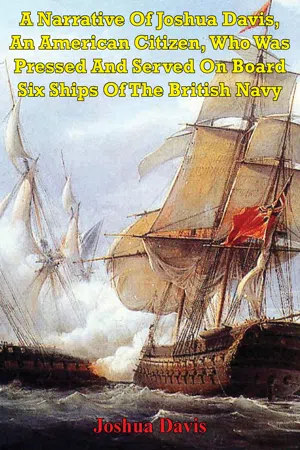
Joshua Davis was a native of Boston born in 1760, as his short memoir attests he was an experienced sailor and seasoned campaigner. In 1779 he boarded the 20 gun privateer, the Jason, on a mission to capture as many British ships as possible, he and his crewmates were successful in their search for targets along the eastern seaboard. However on a very calm day with no hope of escape, his ship was run down by the British frigate Surprise and captured. Pressed in British service, Davis did his best to make a nuisance of himself, often punished for his crimes, clapped in irons or confined. He was present at seven engagements on board British ships, and wounded once, before his eventual escape and return to America many years later.
A fascinating story of early American maritime adventure.
eBook - ePub
A Narrative Of Joshua Davis, An American Citizen, Who Was Pressed And Served On Board Six Ships Of The British Navy
- 46 pages
- English
- ePUB (mobile friendly)
- Available on iOS & Android
eBook - ePub
A Narrative Of Joshua Davis, An American Citizen, Who Was Pressed And Served On Board Six Ships Of The British Navy
About this book
Information
Subtopic
Military & Maritime HistoryIndex
HistoryNARRATIVE, &c.
I, JOSHUA DAVIS, was born in Boston, in the Commonwealth of Massachusetts, on the 30th of June 1760. On the 14th of June, 1779, I entered on board of the privateer Jason, of 20 guns, commanded by Commodore John Manly, bound on a cruise. About the 25th of the same month, we sailed from Boston to Portsmouth, in order to take on board Lieut. Frost, and a number of men. We arrived there the next day, and after taking the men on board, put to sea again. The morning following, the man at the masthead discovered two sail a head of us. Our Captain went up in the fore-top with a spy glass to see what they were. On his coming down, he told Lieut. Thayer he supposed the two vessels to be one of our privateers with a prize. Lieut. Thayer went forward with the glass, and after looking sometime, said one of them appeared to be a frigate and the other a brig. On running nearer them, we supposed them to be enemies, and Lieut. Thayer advised the Captain to heave the ship in stays, to see if they would follow us; to which the Captain consented, and we hove the ship about. When they saw this, they hove in stays, and gave us chase. We ran back for Portsmouth, and by the time we had got within half a league of the Isle of Shoals, the vessel got within two gun-shot of us. We perceived a squall coming on to the westward, very fast, and the Captain ordered every man to stand by, to take in sail. When the squall struck us, it hove us all aback—when we clued down. In ten seconds the wind shifted to our starboard beam, and shivered our sails. In a few seconds more the wind shifted on the starboard quarter, and struck us with such force that hove us on our beam ends, and carried away our three masts and bowsprit. She immediately righted and the squall went over. The vessels that were in chase of us saw our trouble—hove about—and went off with the squall; and we saw no more of them.
We went to work, to strip our masts, and to get the sails and rigging on board; when we found one of our men drowned under the fore-top-sail. We got up jury-masts, and run in between the Isle of Shoals and Portsmouth, where our Captain was determined to take our masts in. In a few days Capt. Manly went on shore to see to getting the masts on board. While he was gone, Patrick Cruckschanks, our boatswain, and John Graves, captain of the forecastle, went forward and set down on the stump of the bowsprit, and said they would not step the masts in such a wild rodestead, to endanger their lives; but if the ship was taken into the harbour, they would do it with pleasure. When the Captain came on board, he asked Mr. Thayer why the people were not at work; and was told they wished to get into the harbour first. The Captain answered. “I’ll harbor them,” and stepped up to the sentry at the cabin door, took his cutlass out of his hand, and ran forward, and said, “boatswain, why do you not go to work?” He began to tell him the impropriety of getting the masts in where the ship was; when Capt. Manly struck him with the cutlass on the cheek, with such force that his teeth were to be seen from the upper part of his jaw to the lower part of his chin. He next spoke to John Graves, and interrogated, and was answered in a similar manner, when the Captain struck him with the cutlass on the head, which cut him so bad that he was obliged to be sent to the hospital, with the boatswain. The Captain then called the other to come down, and go to work. Michael Wall came down to him; the Captain made a stroke at him, which missed, and while the Captain was lifting up the cutlass to strike him again, Wall gave him a push against the stump of the foremast, and ran aft; the Captain made after him—Wall ran to the main hatchway and jumped down between the decks, and hurt himself very much. The Captain then, with severe threats, ordered the people to go to work; they went to work, and stepped the masts, got the topmasts on end, lower yards athwart, top sail yards on the cap, top gallant masts on end, sails bent, running rigging rove, boats on the booms, &c. and all done in the space of 36 hours.
Next day a privateer brig, called the Hazard, from Boston, came down under our stern, and hailed us; we informed them it was the Jason, John Manly, commander. The Captain then said, “my orders from the General Court is, that all vessels of war that I meet with on my way to Penobscot, must repair there without fail.” To which the Captain consented.
As soon as the Hazard was out of sight, we tript our anchor and stood to sea. In a few days we were off Sandy Hook; we hove too, and drifted off and on with the tide for a few days. One day our sailing master went to the fore-top-mast-head, to look out for a sail; about 3 o’clock he cried out, “a sail on the weather bow;” in a few minutes after, another; we made sail, and stood for them. As soon as they perceived us, they bore away for [from] us. In about two hours we were within two gun shot of them. Our Captain ordered every man to his quarters. The enemy hove upon the wind, with his larboard tacks on board—run up his courses, hoisted his colours, and gave us a broad side. Our Captain ordered the sailing master to get the best bower anchor out, so that the bill of it should take into the fore shrouds of the enemy. It was quickly done. The Captain ordered the helm hard a-port, which brought us a long side. The anchor caught their fore rigging. Our Captain then said, “fire away, my boys.” We then gave them a broadside, which tore her off side very much, and killed and wounded some of them. The rest ran below, except their Captain, who stood on the deck like a man amazed.
Our Captain order Lieut. Frost to go out on the driver boom and get on board of her, and send the Captain on board of us, and keep the prisoners below. It was done; and as soon as the Captain came on board of us, our men on board of her cut away all her fore rigging, and pushed her ahead, to clear our anchor. When we got disentangled, we bore away for the other privateer, that began to run from us. We gave her a few shot from our bow chasers, and she hove too. Our Captain told them to take their boat and come on board. They answered, “our boat won’t swim.” Our Captain said, “then sink in her; you shall come on board or I will fire into you.” They then put out boat and came on board.
After we got all our prisoners in irons, and put all things to rights, we made sail for Boston, where we arrived in a few days.
In the action we had our sailing master wounded in the head, and was sent to the hospital, where he died of his wounds. He was the only man hurt in the engagement.—The two brigs taken were both privateers—one called the Hazard, of 18 guns, from Liverpool; the other called the Adventurer, of 18 guns, from Glasgow.
In a few days our commander came on board, and ordered the anchor up, as quick as possible, to run to sea. We crowded all sail upon her for all that night and next day. On the morning following, being on Nantucket Shoals, (and very foggy) a man on the forecastle cried out “sail ahead, within one cable’s length of us.”
We run under her stern; and Lieut. Thayer hailed them. They answered they were from Liverpool, bound to New York. Our captain came on deck and said to Mr. Thayer that he would give them a shot, and make them heave too. At that instant a man called out “a sail to windward” and a man in the foretop said “there is a fleet bearing down upon us.” We had to run to the northward of the fleet, until we judged ourselves clear of them. In about one hour after the fog cleared off so that we could discover about 40 sail; and a large ship astern of them all. She crowded all sail to get away from us. We came up with her very fast. Our captain said to Mr. Thayer, “that ship has got drags along side, and means to trap us; we will go about and try them.” No sooner had we hove in stays, than they in studding sails, hove about, and came on pretty briskly after us. When she got within two gunshot of us, the fog came on again, and we lost sight of her. We stood on to the eastward for some days, when a man in the mast head cried out “a sail to leeward of us;” we put away for her, and crowded all the canvas we could put on her. In two hours we run her hull down; when a man at the maintopmasthead cries out, “two sail bearing down on the ship we are chasing.” It was almost night, and our captain thought fit to give over the chase, and run under easy sail until next morning. In the morning we discovered two sail in chase of us, their hulls full in sight, and coming up with us very fast. We were ordered to man the guns on both sides of the ship. One of them came up under our starboard quarter. A man in our maintop insisted that it was the Dean frigate, and that he saw his old captain (Nickerson) on the quarter deck. Our captain, to prove the man’s words, took the spy-glass, and was satisfied that it was Capt. Nickerson.—We hailed each other, and afterwards our captain went on board of her. The other ship was the Boston frigate, of 36 guns, commanded by Capt. Tucker. We sailed in company ten or twelve days, when we parted, and gave them a salute of 13 guns, which they returned.
We then made sail, and run to the eastward. A few days after, the ship’s company had pork served out to them. Thirty two pieces were hung over the ship’s side to soak over night. The next morning a man went to his rope, and on pulling it up, found the rope bit, and the pork gone. Every man ran to his rope, and found them bitten in the same way. They went aft, and looked over the taffrel, and saw a shark under the stern. Our captain came upon deck, and ordered the boatswain to bring him a shark hook. He baited it with three pounds of pork. The shark took hold of the bait, and hooked himself. We made the chain fast to the main brace; and when we got him half way up, he slapt his tail, and stove in four panes of the cabin windows. We got a bite of rope round his tail, and pulled him on board; and when he found himself on deck, he drove the man from the helm, and broke two spokes of the wheel. The carpenter took an axe, and struck him on the neck, which cut his head nearly off; (the boatswain tickling the shark under the belly with a handspike to keep his eyes off the carpenter.) When he had nearly bled to death, the carpenter gave him another blow, which severed his head from the body. Our captain then ordered the steward to give the ship’s company two casks of butter, and the cook to prepare the shark for the people’s dinner. He was 11-1/2 feet long.
In about 8 days after, the man at the mast-head sung out “a sail ahead.” We gave chase to her, and in six hours came ...
Table of contents
- Title page
- TABLE OF CONTENTS
- NARRATIVE, &c.
- APPENDIX
- TO MY READERS AND OTHERS.
- THE CONCLUSION.
Trusted by 375,005 students
Access to over 1.5 million titles for a fair monthly price.
Study more efficiently using our study tools.
Frequently asked questions
Yes, you can cancel anytime from the Subscription tab in your account settings on the Perlego website. Your subscription will stay active until the end of your current billing period. Learn how to cancel your subscription
No, books cannot be downloaded as external files, such as PDFs, for use outside of Perlego. However, you can download books within the Perlego app for offline reading on mobile or tablet. Learn how to download books offline
Perlego offers two plans: Essential and Complete
- Essential is ideal for learners and professionals who enjoy exploring a wide range of subjects. Access the Essential Library with 800,000+ trusted titles and best-sellers across business, personal growth, and the humanities. Includes unlimited reading time and Standard Read Aloud voice.
- Complete: Perfect for advanced learners and researchers needing full, unrestricted access. Unlock 1.5M+ books across hundreds of subjects, including academic and specialized titles. The Complete Plan also includes advanced features like Premium Read Aloud and Research Assistant.
We are an online textbook subscription service, where you can get access to an entire online library for less than the price of a single book per month. With over 1.5 million books across 990+ topics, we’ve got you covered! Learn about our mission
Look out for the read-aloud symbol on your next book to see if you can listen to it. The read-aloud tool reads text aloud for you, highlighting the text as it is being read. You can pause it, speed it up and slow it down. Learn more about Read Aloud
Yes! You can use the Perlego app on both iOS and Android devices to read anytime, anywhere — even offline. Perfect for commutes or when you’re on the go.
Please note we cannot support devices running on iOS 13 and Android 7 or earlier. Learn more about using the app
Please note we cannot support devices running on iOS 13 and Android 7 or earlier. Learn more about using the app
Yes, you can access A Narrative Of Joshua Davis, An American Citizen, Who Was Pressed And Served On Board Six Ships Of The British Navy by Joshua Davis in PDF and/or ePUB format, as well as other popular books in History & Military & Maritime History. We have over 1.5 million books available in our catalogue for you to explore.