Helmuth von Moltke's alleged statement the U.S. Civil War was an affair in which two armed mobs chased each other around the country and from which no lessons could be learned underlines a grave misjudgment of this war in contemporary Germany. Today, however, the American Civil War is recognized as the first modem war. It produced a number of lessons across the strategic operational and tactical levels that shaped the face of war. But the German observers failed to draw significant conclusions at the time. A wide variety of reasons inhibited a thorough and unbiased analysis.
This study aims to analyze the German observations and to arrive at the causes that led to the underestimation and disregard of the lessons from the Civil War. The thesis provides a sketch of the Civil War and the situation of contemporary Germany. It then examines the German observers and their evaluations. Thereafter, the author reflects selected essential lessons of the war against the contemporary German military evolution. In a final step the conclusions of these sections will merge into an analysis of the causes, which prevented the German army from arriving at the lessons of the U.S. Civil War.
eBook - ePub
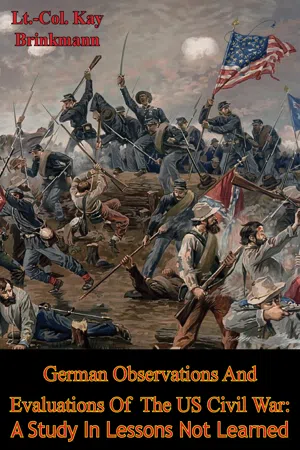
German Observations And Evaluations Of The US Civil War: A Study In Lessons Not Learned
- 121 pages
- English
- ePUB (mobile friendly)
- Available on iOS & Android
eBook - ePub
German Observations And Evaluations Of The US Civil War: A Study In Lessons Not Learned
About this book
Information
Subtopic
19th Century HistoryIndex
HistoryCHAPTER 1 — INTRODUCTION
Field Marshall Helmuth von Moltke is said to have stated that the U.S. Civil War was an affair in which two armed mobs chased each other around the country and from which no lessons could be learned.{1} The Prussian army, respective German army,{2} failed to draw significant conclusions from the American Civil War.{3} Today the Civil War is considered to have been the first modern war:{4} “The Civil War was the first of the world’s really modern wars. That is what gives it its terrible significance.”{5}
In view of this discrepancy, the purpose of this thesis is to seek an answer to the question what did the Germans observe from the war and what caused them to underestimate and disregard its lessons. The first step is to examine the situation of contemporary Germany in order to gain an understanding of the conditions that would influence the analysis of the American Civil War. Second, and most important, is the analysis of the German efforts at and results of observing and evaluating the war. This will require a reflection of the essential lessons of the American Civil War against the contemporary German military evolution. The conclusions from the previous steps will lead to the reasons that inhibited a thorough concern with the U.S. Civil War and the lessons it produced.
The German Armed Forces always have placed a significant interest on the study of war and military history. The most evident fact underlining this interest was the institution of a “Section/Division for History of War” in the German General Staff. The U.S. Civil War, unfortunately, never received any significant attention. Until today the study of the Civil War with few exceptions is left to be researched on an individual initiative.{6} It is one aim of this study to generate a greater interest of German military officers in the U.S. Civil War. As very little is known about the Civil War the thesis will have to provide for an understanding of its origins, its objectives and the course of the war in a broad outline. The approach to evaluate the Civil War from the perspective of the contemporary Germans and then to mirror that perspective against the lessons that were to evolve from the war are to direct interest to more detail of the Civil War.
The thesis provides a perspective of the military perception and judgment of the U.S. Civil War in the “Old World.” Little research has been devoted to this aspect so far. The thesis will attempt to provide an answer from the German, respective Prussian side. This may be the more interesting because of the short, but decisive wars between 1864 and 1871—hence, the time parallel and immediately following the U.S. Civil War—the German Army doctrine began to dominate the evolution of warfare of the time.
Another aspect of consideration is the extensive number of German-Americans who fought in the Civil War of whom many had prior military training and experience in the German militaries. The assumption lies near that these constituted a potentially valuable source of valuable feedback for the German Armies. The answer is short and clear: a transfer of information did not take place. Therefore, the focus is on the inhibitors that caused this source not to be tapped.
One may ask now where the relevance and importance lies in concerning oneself with another study of military history, especially one that has taken place far away from Europe, in a different environment and with a unique origin.
The paragraphs above may already answer the question of relevance and importance, but the thesis will show a number of still valid and valuable lessons. The assumption seems valid that the contemporary study of the Civil War could have had a decisive impact on the conduct of follow-on wars. Through the approach of focusing on the contemporary German observation and evaluation, the thesis intends to link the German interest to the study of the Civil War and underline its relevance to the study of military history.
The thesis covers an area that has been researched very little. It will try to put a little light into the perception of the Civil War in continental Europe, “the Old World.” The focus will be on the German states, primarily on Prussia. Compared to Great Britain and France that initially were considerably involved in the Civil War in pursuit of specific interests, other powers of Europe seem to have had little, if no interest. But precisely because of that, a study of their militaries’ evaluation to the Civil War may be an interesting track to pursue.
The three central questions to be answered by the thesis are the following:
How did the Germans observe and analyze the Civil War?
What conclusions were drawn from these observations and evaluations?
What were lessons to be learned from today’s view, as compared to the findings in the contemporary German states, and what may have obstructed a thorough, objective analysis at the time?
In addition, a number of supporting questions are considered:
1. Who were the opponents of the Civil War and under which strategic environment did the war commence?
2. What were the strategic objectives and how were they put into military campaigns?
3. What was the situation in contemporary Prussia, respective the German states?
4. Who observed and evaluated the Civil War from a German perspective?
5. Why were experiences from the German-Americans not regarded by the contemporary German military?
6. What were the valuable lessons of the Civil War and could they have been recognized at the time?
These research questions are founded upon the following assumptions:
1. By far not all of the addressed audience has an extensive knowledge of the Civil War.
2. The difficulty of grasping the Civil War as a whole, meaning going beyond the simple evaluation of individual tactical battles, lies in definition of the strategic and operational aims by the political and military leadership and in the ways they were translated into military campaigns.
Since the Civil War is not and was never of substantial importance of military history and the study of war in the German Armed Forces, the view and observations of the German observers must assume to have been biased or failed to be effective due to other reasons that prevented an input to German General Staff analysis. The flow of decisively influential information from the German-Americans to the German states was neglected, obstructed or even non-existent. Furthermore, the situation of the contemporary German states, specifically Prussia, decisively influenced a thorough and detailed interest in and analysis of the Civil War.
The methodology of the thesis is primarily based on the analysis of collected information and its transfer into logical conclusions.
Chapter 1, “Literature Overview,” focuses on describing briefly the most significant sources applied in each chapter. It also aims at providing the reader with an aid for individual research and at facilitating further interest in the subject.
Chapter 2 describes the Course of the Civil War. Its objective is to give an outline of the U.S. Civil War, to enable the reader to visualize the Civil War in its totality and to relate observations and conclusions that will be discussed in the later chapters. Two unequal adversaries would fight each other. Although by itself not a sufficient base to predispose the outcome of the war, economic base, infrastructure, and manpower decisively impacted the strategic situation. A second aspect concerns the strategies followed by both sides. The Confederacy, whose interest should have been to protect its resources and build on time as its primary ally to achieve its war objective—to gain recognition—followed an offensive strategy that strained not only its valuable manpower resources but failed to achieve success. Ultimately, it forced upon itself a defensive strategy with little freedom for initiative. The Union, on the other hand, not only unsuccessfully struggled for an effective military strategy, but also failed to achieve synchronicity among its forces toward a common center of gravity. It was Ulysses S. Grant, the first commander to win the unquestioned trust of President Lincoln, who incorporated economic, and political aspects into his military strategy and capably synchronized his forces toward a common objective, attrition of the enemy by defeating his forces and striking at his war-sustaining resources. Finally, the a broad outline of the war encompasses the blockade effort, the campaigns in the East up to the battle of Gettysburg, the campaigns in the West up to the battle of Vicksburg, and the campaigns from 1864. It relates the strategies to the events and marks the turning points of the war.
Chapter 3 provides an account of the situation in the contemporary German states. The description and assessment of the contemporary German situation provides the base upon which an understanding for the German perception of the U.S. Civil War can be founded. The German States were basically focused upon themselves. The timeframe between 1815 and 1871 was characterized by the struggle over the social and political direction within the German states as well as over the composition and leadership of a unified Germany. In 1848 the liberal revolution failed, causing many of the liberal leaders to emigrate to the United States. The conservative royal social order was firmly reestablished, but the mutual goal of all social factions remained the wish for a unified Germany. Austria and Prussia as the predominant German states quarreled over influence and leadership of the German states. Eventually it was a carefully balanced policy Count Otto von Bismarck that gave the edge. However, “blood and iron” decided the political issues of the time. The Prussian military had engaged in an extensive reform since the end of the 1850s, securing a conservative officer corps loyal to the monarch and raising the size of the standing army. It instituted a general staff system that faced up to the challenges of command and control, mobilization and rapid deployment, and to technological advances. In two quick wars (1864 and 1866) the Prussian military not only proved its effectiveness and set a standard for all other German armies, but foremost set the stage for the political leadership of Prussia in Germany and German unification. Unification required another war. Consequently, the military’s focus lay, besides instituting reforms, on evaluation of own lessons learned and operational planning against the future adversary, France.
Chapter 4 provides the German assessment. The Civil War never became a topic of study at the Prussian Kriegsakademie or of the general staff’s historical study. Only very few officers devoted attention to the issue. The first section describes who these officers were and from which perspective, background and interest they approached their studies. Primarily, Captain Justus Scheibert, who had been tasked to observe the Civil War by the Prussian army, would not only dominate the publications, but also cover the war in greatest breadth. Most of the other observers limited their interest only to certain specified aspects or issues. However, as is shown in the second part of the chapter, even though in summary the observers covered a wide spectrum of issues, very little was found to be of value to the Prussian army. Lessons taken from the Civil War concerned the military railroad organization, the effects of rifled artillery (the primary interest of the Prussian army with regard to the Civil War) and principles for a coastal defense. A comparative rather than evolutionary focus of attention mirrored observations of the war rather to Prussian doctrine and developments than to the effects of technological advances on warfare. Furthermore, the multitude of Scheibert’s publications (compared to the singular works of the others) as well as his bias in favor of the Confederacy contributed definitely to the dominance of his evaluations over those of others and to a distorted perception of the Civil War. Theoretically, accounts of the German-American soldiers could have offset this imbalance. But they had left Europe in the wake of a revolution that had left them economically and politically deprived. The Civil War shaped their identity as German-Americans; their interest lay in proving the loyalty and value of their ethnic group to their new home, but not in evaluating military lessons. Hence, the assessment and evaluation of the Civil War remained the issue of a few interested Germans.
Chapter 5 analyzes the essential lessons of the Civil War across the strategic, operational and tactical spectrum and relates them to the developments in contemporary Germany up to World War I. The strategic aspects focus on the political-military relations and the elements constituting total war, such as the consideration of total force potential, the end of the short war, and the buildup of the people’s army. On the operational level operational art began to play a greater role as with total war the era of the decisive battle came to an end. Maneuver, deep operations, jointness, logistics, and communications symbolized the military’s adaptation to new conditions. Little of these evolutions the Germans recognized, mainly because of the significantly different political conditions within a monarchy and a military perception of war as that of an act restricted solely to the encounter of the military forces and of military defeat as the mechanism to end war. This perception of war, as well as the underestimate of the effects technological evolutions had on the battlefield, caused the Germans to neglect the tactical developments of the Civil War: the utilization of field fortification as a combat multiplier, the evolution of infantry and cavalry tactics, and the adapted role of artillery.
Chapter 6 answers the question what caused and inhibited the Germans from coming to a clear and thorough analysis of the U.S. Civil War. Primarily, the reasons rest with the distinctly differing political, organizational and environmental circumstances that effected military thinking in general and doctrine in specific. Additionally, the contemporary perceptions and biases influenced the willingness and extent of critical analysis. Finally, the quality, experience, and focus of the observers did not suffice to portrait a consistent, overall view of the war and its developments, which could have facilitated a more detailed study.
Does a study like this of the U.S. Civil War still bear relevance today? Taking into consideration today’s world, the Civil War and its perception by the contemporary international community indeed carries a valuable lesson. The face of war or—to put it into a more general term-conflict is like a face covered with many masks. One may never know with what he his confronted until he can look beyond the mask. In today’s world one cannot risk neglecting the study of a major conflict-no matter of what kind it be or where it occurs, because one may eventually be confronted with its consequences ourselves. The Civil War was neglected in the military history studies in Germany, if not in all of Europe. The effects of this neglect extended at least up and into World War II.{7} The lessons of the Civil War would have to be learned the hard way—through war.
CHAPTER 2 — LITERATUR...
Table of contents
- Title page
- TABLE OF CONTENTS
- ABSTRACT
- CHAPTER 1 - INTRODUCTION
- CHAPTER 2 - LITERATURE REVIEW
- CHAPTER 3 - THE COURSE OF THE CIVIL WAR
- CHAPTER 4 - THE CONTEMPORARY GERMAN STATES
- CHAPTER 5 - ASSESSMENT OF THE CIVIL WAR FROM THE GERMAN POINT OF VIEW
- CHAPTER 6 - ESSENTIAL LESSONS FROM THE CIVIL WAR
- CHAPTER 7 - REASONS FOR THE INSUFFICIENT ANALYSIS OF THE CIVIL WAR
- CHAPTER 8 - CONCLUSION
- BIBLIOGRAPHY
Trusted by 375,005 students
Access to over 1.5 million titles for a fair monthly price.
Study more efficiently using our study tools.
Frequently asked questions
Yes, you can cancel anytime from the Subscription tab in your account settings on the Perlego website. Your subscription will stay active until the end of your current billing period. Learn how to cancel your subscription
No, books cannot be downloaded as external files, such as PDFs, for use outside of Perlego. However, you can download books within the Perlego app for offline reading on mobile or tablet. Learn how to download books offline
Perlego offers two plans: Essential and Complete
- Essential is ideal for learners and professionals who enjoy exploring a wide range of subjects. Access the Essential Library with 800,000+ trusted titles and best-sellers across business, personal growth, and the humanities. Includes unlimited reading time and Standard Read Aloud voice.
- Complete: Perfect for advanced learners and researchers needing full, unrestricted access. Unlock 1.5M+ books across hundreds of subjects, including academic and specialized titles. The Complete Plan also includes advanced features like Premium Read Aloud and Research Assistant.
We are an online textbook subscription service, where you can get access to an entire online library for less than the price of a single book per month. With over 1.5 million books across 990+ topics, we’ve got you covered! Learn about our mission
Look out for the read-aloud symbol on your next book to see if you can listen to it. The read-aloud tool reads text aloud for you, highlighting the text as it is being read. You can pause it, speed it up and slow it down. Learn more about Read Aloud
Yes! You can use the Perlego app on both iOS and Android devices to read anytime, anywhere — even offline. Perfect for commutes or when you’re on the go.
Please note we cannot support devices running on iOS 13 and Android 7 or earlier. Learn more about using the app
Please note we cannot support devices running on iOS 13 and Android 7 or earlier. Learn more about using the app
Yes, you can access German Observations And Evaluations Of The US Civil War: A Study In Lessons Not Learned by Lt.-Col. Kay Brinkmann in PDF and/or ePUB format, as well as other popular books in History & 19th Century History. We have over 1.5 million books available in our catalogue for you to explore.