The mechanism for the operation of our military forces beyond the shores of the U.S. is the modern coalition from the grand alliance of NATO to simple bilateral relationships. Understanding the dynamics of coalition warfare is important for a U.S. Military that often finds itself operating as the dominant member of any coalition it joins. One of the major considerations listed in the portion of joint doctrine which addresses multinational coalitions is the concept of unity of effort Current U.S. Army doctrine has long recognized the importance of unity of command. However, the latest drafts of the new Army keystone doctrine publication, FM 100-5, have upgraded the principle of unity of command to unity of effort. The efficacy of this change recognizes the realities of operations in a world of coalitions, trans-governmental agencies, and private organizations all which find themselves often in league with our military as we strive to reach common (not always strictly military) objectives.
This monograph will examine two historical case studies from the Napoleonic Wars (1792-1815) in order to explore the relationship between tactical and doctrinal differences between different members of the same coalition. The first case study examines the coalition army of Marshal Suvorov at the battles of the Trebbia and Novi in 1799. The second example will move forward in time to the Russo-Prussian army of the spring of 1813 and its performance at the battles of Lützen and Bautzen.
Although history does not provide us with exact recipes for implementing complex solutions in a complex world, it does provide a means to understand the dynamics of human behavior on a vast scale. The Napoleonic period represents a veritable laboratory of coalition warfare and provides a means of applying the lessons of a historical period to understanding the dynamics of coalitions.
eBook - ePub
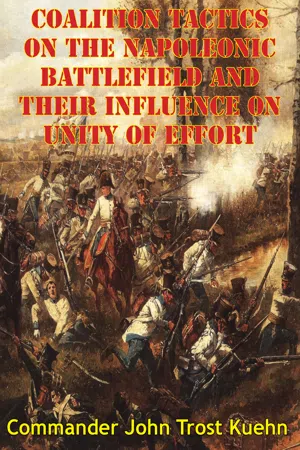
Coalition Tactics On The Napoleonic Battlefield And Their Influence On Unity Of Effort
- 72 pages
- English
- ePUB (mobile friendly)
- Available on iOS & Android
eBook - ePub
Coalition Tactics On The Napoleonic Battlefield And Their Influence On Unity Of Effort
About this book
Trusted by 375,005 students
Access to over 1.5 million titles for a fair monthly price.
Study more efficiently using our study tools.
Information
Subtopic
British HistoryIndex
HistoryTable of contents
- Title page
- TABLE OF CONTENTS
- ABSTRACT
- I. - INTRODUCTION
- II. - THE COALITION, TACTICS, AND SUCCESS IN 1799
- III. - TACTICS, THE COALITION, AND FAILURE IN 1813
- IV. - CONCLUSIONS
- APPENDIX A (SUVOROV’S OPERATIONS ORDER FOR THE ASSAULT ON PRAGUE)
- BIBLIOGRAPHY
- Appendix - Maps
Frequently asked questions
Yes, you can cancel anytime from the Subscription tab in your account settings on the Perlego website. Your subscription will stay active until the end of your current billing period. Learn how to cancel your subscription
No, books cannot be downloaded as external files, such as PDFs, for use outside of Perlego. However, you can download books within the Perlego app for offline reading on mobile or tablet. Learn how to download books offline
Perlego offers two plans: Essential and Complete
- Essential is ideal for learners and professionals who enjoy exploring a wide range of subjects. Access the Essential Library with 800,000+ trusted titles and best-sellers across business, personal growth, and the humanities. Includes unlimited reading time and Standard Read Aloud voice.
- Complete: Perfect for advanced learners and researchers needing full, unrestricted access. Unlock 1.5M+ books across hundreds of subjects, including academic and specialized titles. The Complete Plan also includes advanced features like Premium Read Aloud and Research Assistant.
We are an online textbook subscription service, where you can get access to an entire online library for less than the price of a single book per month. With over 1.5 million books across 990+ topics, we’ve got you covered! Learn about our mission
Look out for the read-aloud symbol on your next book to see if you can listen to it. The read-aloud tool reads text aloud for you, highlighting the text as it is being read. You can pause it, speed it up and slow it down. Learn more about Read Aloud
Yes! You can use the Perlego app on both iOS and Android devices to read anytime, anywhere — even offline. Perfect for commutes or when you’re on the go.
Please note we cannot support devices running on iOS 13 and Android 7 or earlier. Learn more about using the app
Please note we cannot support devices running on iOS 13 and Android 7 or earlier. Learn more about using the app
Yes, you can access Coalition Tactics On The Napoleonic Battlefield And Their Influence On Unity Of Effort by Commander John Trost Kuehn in PDF and/or ePUB format, as well as other popular books in History & British History. We have over 1.5 million books available in our catalogue for you to explore.