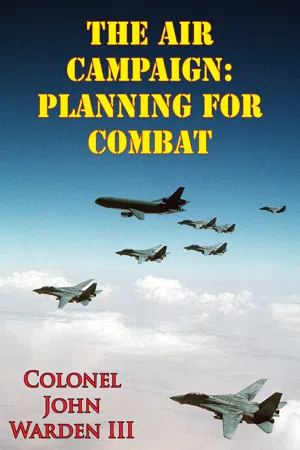
In the short history of air warfare, no nation with superior air forces has ever lost a war to the force of enemy arms. Air superiority by itself, however, no longer guarantees victory. This book, one of the first analyses of the pure art of planning the aerial dimension of war, explores the complicated connection between air superiority and victory in war.
In The Air Campaign, Colonel John A. Warden III focuses on the use of air forces at the operational level in a theater of war. The most compelling task for the theater commander, he argues, is translating national war objectives into tactical plans at operational levels. He presents his case by drawing on fascinating historical examples, stressing that the mastery of operational-level strategy can be the key to winning future wars. Colonel Warden shows us how to use air power more effectively-through rough mass, concentration, and economy of forces-because, he warns, the United States no longer holds an edge in manpower, production capacity, and technology.
Simply put, an air force inferior in numbers must fight better and smarter to win. This book offers planners greater understanding of how to use air power for future air campaigns against a wide variety of enemy capabilities in a wide variety of air operations. As the reader will see, the classic principles of war also apply to air combat. One of the author's important contributions is to demonstrate that perception to those whose grave responsibility one day may be to plan and carry through a victorious air campaign.
- 150 pages
- English
- ePUB (mobile friendly)
- Available on iOS & Android
eBook - ePub
The Air Campaign: Planning For Combat
About this book
Information
Subtopic
Military & Maritime HistoryIndex
History1. Air Superiority—The Concept
Air superiority is a necessity. Since the German attack on Poland in 1939, no country has won a war in the face of enemy air superiority, no major offensive has succeeded against an opponent who controlled the air, and no defense has sustained itself against an enemy who had air superiority. Conversely, no state has lost a war while it maintained air superiority, and attainment of air superiority consistently has been a prelude to military victory. It is vital that national and theater commanders, their air component commanders, and their surface component commanders be aware of these historical facts, and plan accordingly.{7}
To be superior in the air, to have air superiority, means having sufficient control of the air to make air attacks on the enemy without serious opposition and, on the other hand, to be free from the danger of serious enemy air incursions. Of course, variations exist within the category of air superiority.
Air Supremacy Allows Operations Anywhere
For example, air supremacy means the ability to operate air forces anywhere without opposition. Local air superiority gives basic air freedom of movement over a limited area for a finite period of time. Theater air superiority, or supremacy, means that friendly air can operate any place within the entire combat theater. Air neutrality suggests that neither side has won sufficient control of the air to operate without great danger. We also have a condition we might call defensive air superiority—in which enemy air cannot operate over some part of one's territory, and where one's own air force (if one exists) is equally unable to operate against the enemy.
This situation could arise if a state were able to create a sufficiently strong ground-based air defense system. To date, no ground system has given this degree of protection, but it is theoretically possible.
The contention that air superiority is a necessity to ensure victory or avoid defeat is based on theory and on an analysis of the last half century of warfare. Theory alone would suggest that surface warfare cannot possibly succeed if the surface forces and their support are under constant attack by enemy aircraft. And, indeed, the theory is supported by copious historical examples, a few of which should suffice to make the point.
Germany destroyed Poland's air force in the first days of the campaign. From then on, the Germans were able to use their air forces to interdict, to attack ground troops, and to soften positions for subsequent movement on the ground.{8}
Nine months later, Germany did the same thing in France, when the Luftwaffe won air superiority in two days.{9}
The attack on Russia in June 1941 was a classic example of seizing air superiority with massive, violent attacks. The Germans capitalized on their air superiority by moving ground forces unprecedented distances up to the late fall, when weather and failure to follow up on the initial air victories helped bring the great offensive to a halt.{10}
The attack on Russia had followed, and was a function of, Germany's failure to win the Battle of Britain and thereby establish the air superiority which was a prerequisite for invasion.{11} The invasion of Russia was the last instance when Germany was able to establish air superiority over an opponent. It was the last strategic offensive Germany was to make before her own homeland lay devastated and occupied.
On the other side in World War II, the Western Allies achieved air superiority before German Field Marshal Erwin Rommel's last offensive at Alam Halfa. Rommel observed that "anyone who has to fight, even with the most modern weapons, against an enemy in complete control of the air, fights like a savage against a modern European army."{12}
Rommel subsequently made a similar comment about the situation in Sicily and in Italy. "Strength on the ground was not unfavorable to us," Rommel said. "It's simply that their superiority in the air and in ammunition is overwhelming, the same as it was in Africa."{13}
The value of air superiority was even clearer in the Normandy invasion. Von Rundstedt, the German commander in France during the invasion, reported, "The Allied Air Force paralyzed all movement by day, and made it very difficult even by night."{14}
In the summer of 1944, the Allies gained control over the skies above Germany. By the end of the war, the situation was so bad, because of the incessant bombing permitted by having control of the air, that the Germans had no fuel for their airplanes and only enough gas to give a tank enough for it to make one attack.{15}
Lest it be argued that World War II is ancient history and thus no longer applicable, consider a few cases from wars since then.
In Korea, Lieutenant General Nam Il, the chief representative of the North Koreans at the armistice talks, remarked in a moment of candor, "It is owing to your strategic air effort of indiscriminate bombing of our area, rather than to your tactical air effort of direct support to the front lines, that your ground forces are able to maintain barely and temporarily their present position."{16}
The "indiscriminate bombing" to which General Nam Il referred was a direct consequence of air superiority all the way to the Yalu River.
The Israelis have well illustrated the power of air superiority.
In 1967, the Israelis destroyed the Egyptian and Syrian air forces on 5 June and then proceeded to lay waste the Egyptian army in the Sinai, where Israeli command of the air had made life intolerable for the Egyptian soldier.{17}
Six years later, the victors of 1967 paid a terrible price for not gaining air superiority in the first phase of the war. Only after recognizing the need to suppress enemy missile systems—their primary barrier to air superiority—were they able to turn the tide of battle and go on to win the war.{18}
Finally, the North Vietnamese were unable to conduct a successful conventional offensive as long as American air power was stationed in Indochina. Only after the Americans had left was the North able to mount a decisive ground offensive into South Vietnam. In this case, South Vietnamese air attempted little and was easily repulsed by North Vietnamese mobile ground-based air defense systems.{19}
As air played no significant role in the invasion for either side, the ensuing action was essentially as it would have been before the era of the aircraft.
Air Superiority Crucial to Success
In affairs such as war that are only roughly subject to scientific analysis, and where so much depends on the human element, a hypothesis is virtually impossible to prove. However, if one argues that air superiority is crucial to success (as the weight of historical evidence overwhelmingly suggests), then explaining how the operational commander goes about achieving it becomes necessary.
If air superiority is accepted as the first goal, then clearly all operations must be subordinated—to the extent required—to its attainment. This observation is not meant to suggest that no operation be undertaken until air superiority is won. It does, however, mean that no other operation should be commenced if it is going to jeopardize the primary mission, or is going to use forces that should be used to attain air superiority. As with most things, exceptions abound, although when it seems most obvious that the rule should be disobeyed, it is most likely that it should not be.
One may be in such dire straits, brought about perhaps by a surprise attack, that no choice is available but to throw everything into the breach in a desperate gamble to buy some time, or to save some strategically important entity.
The Israelis were faced with this kind of problem in 1973, when they were surprised by both the Syrian and Egyptian attacks.
The Egyptian attack was not immediately threatening, but the Israelis judged the Syrian attack as very dangerous. The Israeli high command committed aircraft against the Syrian ground forces, even though the enemy had de facto defensive air superiority over his own lines by virtue of his surface-to-air missile systems. As desperate as the ground situation was, the Israelis quickly realized that they could not continue to use their air force against the Syrian tanks in the absence of air superiority. Consequently, they made the missile fields the primary target, won back air superiority, and then brought the full brunt of their air force against all elements of the Syrian offensive.{20}
We will examine further the theory of the emergency situation in chapter 11, on planning an air campaign.
While exceptions may exist, they should not be made the basis of planning. In normal circumstances, air superiority is the first and most compelling task. One normally thinks of attaining air superiority through a combination of aircraft and surface-to-air missiles or guns. Indeed, these two elements normally will play a key role—but by no means the only role. Army ground forces and naval surface forces can and have made major contributions to the air superiority mission. Their contribution can be even greater if they are consciously integrated into the air superiority campaign. This subject will receive expanded treatment in chapter 10, on planning, but for now a few examples will help elucidate the idea.
Hitler, in his Directive #6 For the Conduct of the War, dated 6 October 1939, noted that the Luftwaffe could not attack England from Germany because of range and fuel costs. On the other hand, Hitler noted, if Germany [occupied] the Low Countries, "in no doubt, Great Britain could be struck a mortal blow [by the Luftwaffe]." He further saw destruction of the British and French ground forces as "the main objective, the attainment of which will offer suitable conditions for the later and successful employment of the Luftwaffe [against Great Britain]."
Thus, the seizure of territory to support (and deny) air bases became a ground objective and influenced the planning that went into the attack on France.{21}
On a much smaller scale, the British launched a commando raid on a small German bomber unit on the island of Crete that had destroyed an inordinate amount of shipping.{22}
Naval forces have reversed traditional roles on more than one occasion.
In the 1973 Arab-Israeli war, Israeli gunboats attacked Egyptian surface-to-air missile systems on the Egyptian left flank, to pave the way for Israeli air force movements through the opened corridor.{23}
Thinking that air superiority must be obtained by air means alone seriously limits commanders in their quest for victory. Attaining air superiority is not simple in either concept or execution.
To begin the process, one must necessarily know that...
Table of contents
- Title page
- TABLE OF CONTENTS
- Illustrations
- Foreword
- Preface
- Introduction
- Acknowledgments
- The Air Campaign in Prospect
- 1. Air Superiority-The Concept
- 3. Offensive Operations
- 4. Defensive Operations
- 5. Limited Options
- 6. Air Interdiction
- 7. Close Air Support
- 8. Reserves
- 9. The Orchestration of War
- 10. Planning the Air Campaign
- The Air Campaign In Retrospect
- Selected Bibliography
Trusted by 375,005 students
Access to over 1.5 million titles for a fair monthly price.
Study more efficiently using our study tools.
Frequently asked questions
Yes, you can cancel anytime from the Subscription tab in your account settings on the Perlego website. Your subscription will stay active until the end of your current billing period. Learn how to cancel your subscription
No, books cannot be downloaded as external files, such as PDFs, for use outside of Perlego. However, you can download books within the Perlego app for offline reading on mobile or tablet. Learn how to download books offline
We are an online textbook subscription service, where you can get access to an entire online library for less than the price of a single book per month. With over 1.5 million books across 990+ topics, we’ve got you covered! Learn about our mission
Look out for the read-aloud symbol on your next book to see if you can listen to it. The read-aloud tool reads text aloud for you, highlighting the text as it is being read. You can pause it, speed it up and slow it down. Learn more about Read Aloud
Yes! You can use the Perlego app on both iOS and Android devices to read anytime, anywhere — even offline. Perfect for commutes or when you’re on the go.
Please note we cannot support devices running on iOS 13 and Android 7 or earlier. Learn more about using the app
Please note we cannot support devices running on iOS 13 and Android 7 or earlier. Learn more about using the app
Yes, you can access The Air Campaign: Planning For Combat by John A. Warden III in PDF and/or ePUB format, as well as other popular books in History & Military & Maritime History. We have over 1.5 million books available in our catalogue for you to explore.