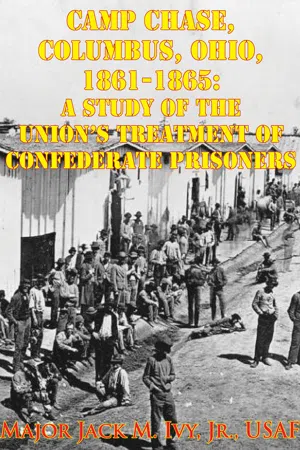
Camp Chase, four miles southeast of Columbus, Ohio, began in May 1861 as a mustering center for units entering Union service during the American Civil War. By June 1861 it picked up additional responsibilities of housing Confederate prisoners captured by Ohio units during the earliest military actions of the war. It eventually expanded to hold 9,423 prisoners in Jan. 1865, which made it one of the larger Union prison camps.
The earliest prisoners were afforded extraordinary leniency by state authorities until the Union government stepped in with rules and regulations. By Oct. 1862, an effective system was in place to secure and care for prisoners. Success continued despite fluxuations in prison population, disease and a constant influx of captured wounded, until Aug. 1864 when rations were reduced in retribution for Confederate treatment of Union captives.
Ration reduction caused prisoners hardships but did not markedly increase mortality. Quality medical care and sanitation kept mortality below Union Army deaths from disease.
As prison population soared during the last months of the war, increasing numbers of wounded, severely exposed and weakened captives joined Camp Chase. Reduced rations continued to pose hardships but ration reduction was offset by superb medical care and sanitation which continued to keep mortality below that experienced by the Union Army from disease.
...Prisoners were well treated up to the time rations were reduced in retaliation for alleged Confederate cruelities to Union prisoners. In spite of this, Camp Chase officials continued to stress sanitation and provide clothing late in the war even though they were not obligated to do so. This demonstrated that officials at Camp Chase were successful in managing a prisoner of war camp, even during the period of Union retaliation.
eBook - ePub
Camp Chase, Columbus, Ohio, 1861-1865: A Study Of The Union's Treatment Of Confederate Prisoners
- 71 pages
- English
- ePUB (mobile friendly)
- Available on iOS & Android
eBook - ePub
Camp Chase, Columbus, Ohio, 1861-1865: A Study Of The Union's Treatment Of Confederate Prisoners
About this book
Information
Subtopic
19th Century HistoryIndex
HistoryCHAPTER 1 — THESIS AND OUTLINE
The Civil War was and still is a controversial period in our nation’s history. Reasons for the war and policies of the opposing governments continue to stir interest and debate among scholars even today, 135 years after the issue was “resolved.”. During the war, newspapers carried headlines of atrocities, especially in the Union, after the exchange of prisoners halted and misery multiplied in Confederate prisons not equipped to handle increasing populations. Emotions and tempers flared, then resulted in retribution on both sides.
Treatment of prisoners evoked much emotion from veterans in the years following the conflict. Personal accounts and memoirs were written by former prisoners on both sides. These accounts survived in the form of autobiographies, and articles written for veteran’s magazines.
Though personal accounts abound, the victor demanded the most attention to the plight of its former prisoners. The Confederacy operated prison camps which are infamous to most Americans. The prisons at Andersonville and Libby stand out as examples of the horrors of prison life in a besieged country. Prisoners suffered because of overcrowding, poor sanitary conditions, and especially from the chronic Confederate shortage of such basic supplies as food, and clothing.
The Union also operated prisoner of war camps. The names Elmira, Johnson’s Island, and Camp Chase, however, are unfamiliar to most, even many historians. The purpose of this thesis is to examine one Union camp, Camp Chase, Ohio, to determine how successful officials at Camp Chase were in managing a prisoner of war facility.
How may success be measured? Camp Chase was successful as a detention facility with 38 escapes throughout the war. Its success in this area is unquestioned. That being the case, what other measures of success may be used? Care provided for humane treatment of prisoners, evaluating such factors as food, clothing, medical care, and sanitation is an effective measure. Success in this area may be measured by subjective evaluation of historical facts and an objective evaluation of prisoner mortality, comparing it with Union armies in the field and with other Union prisoner of war camps{1}.
The most balanced and credible study of prisoner of war camps during the American Civil War is William B. Hesseltine’s book, Civil War Prisons: A Study In War Psychology. His basic thesis is that:
“...prisoners [both North and South] were well treated by their captors in the early days of the war. But after the cessation of exchange... the prisons of the South became crowded, and the poverty of the Confederacy resulted in excessive suffering among those unfortunates who were confined in the stockades of Andersonville, Florence, Millen, Macon, and Columbia, or spent dreary days in the famed Libby prison or on Belle Isle. These conditions, being reported in the North created the belief that the prisoners were ill-treated through a deliberate purpose; the inevitable hatred engendered by the war made such a belief readily credible. The result of this psychosis was that prisoners in the Northern prisons were forced to suffer in retaliation for the alleged Southern cruelty.{2}”
This thesis is designed to test Hesseltine’s thesis by making a detailed examination of one prison camp, something Hesseltine was unable to do because he surveyed them all, both North and South.
This study is organized into five chapters:
This chapter defines purpose, limitations, and research methods used in the study and defines terms.
Chapter 2, background, contains background information essential to the reader. It briefly describes the development of prisoner of war procedures and customs prior to the Civil War. It summarizes prisoner exchange agreements between Union and Confederate officials and describes the founding and early history of Camp Chase.
Chapter 3 covers the first surge of prisoners between February 1862 to August 1862. As the prisoner population increased dramatically, control procedures and standards developed. From August 1862 to June 1863 Camp Chase was a temporary holding facility for prisoners awaiting exchange.
Chapter 4, the final surge of prisoners, from July 1863 to the end of the war, covers a period when the population soared because the prisoner exchange ended. During this period, standards and procedures developed early in the war had come to fruition, only to be marred by restrictions imposed in retaliation for Union prisoner of war sufferings in Southern camps.
Chapter 5 analyzes data, evaluates events, and draws conclusions.
The following definitions will assist the reader in understanding material presented in this study:
Prisoner: a Confederate prisoner of war.
Political prisoner: Private citizen placed in prison because of suspected disloyalty to the Union. Many were detained temporarily while investigations were completed, while some were detained throughout the war.
Parole: Prisoner released on oath of honor not to take up arms and fight against the releasing government. Paroled prisoners were not allowed to perform military or military related duties.
Parole arrangements: Captives were released on parole immediately after surrender; after serving some time in a prisoner of war facility; for a limited time to temporarily perform a duty outside the prison gate or for a limited time to visit friends, tend to business, etc.
Exchange: By custom and agreement, prisoners would be swapped according to a mutually agreeable formula. Paroles would often proceed exchange.
Mustering: The rallying into service of volunteers to form state or Union units.
Sutler: Private businessman authorized to sell goods within a garrison or prison camp. Goods were often sold at inflated prices.
Limitations of this study of Camp Chase as a Confederate prisoner of war detention facility, 1861-1865, include the following:
Security procedures, escapes, and escape attempts are not addressed unless they influence attitudes, care, or otherwise had a direct impact on prisoner well being. Camp Chase was a successful detention facility. The most escapes (19) took place in September, 1863, and had an impact on all prisoners. The largest escape attempt took place on July 4, 1863, and also had an impact on the treatment of prisoners. These two events are addressed in detail within this study.
Interesting stories occur throughout diaries, letters, and memoirs of prisoners. They tell of prison life, amusements, comradery, and despair. These stories have been avoided unless they illustrate results of policy or reinforce or dispute items contained in official reports.
Political prisoners who shared the prison with Confederates at Camp Chase are not directly addressed by this study except when their numbers are used to analyse prison death statistics. Also, a few political prisoners wrote accounts of prison conditions during 1861-1862 which were used to help illustrate points.
This study illustrates and analyzes how prison commanders at Camp Chase grappled with problems of establishing a management system, dealt with conflicting guidance, and provided care for prisoners. It provides an example of how a prison system and facility came into existence during the first great war in which Americans dealt with large numbers of captives. By studying examples taken from history, military leaders and field commanders may better understand and be better prepared to deal with problems they will face during future conflicts.
Literature and sources for information on Camp Chase may be found in the bibliography of this study.
Sources used in this study are as follows:
The War of the Rebellion: A Compilation of the Official Records of the Union and Confederate Forces forms the basis of this study, supplemented by other reliable primary accounts found in records of the Ohio State Adjutant General’s file, contemporary newspaper articles, prison diaries, letters, and post-war memoirs. Memoir accounts were used when they specified periods of time or referenced identifiable incidents which allowed them to be placed in chronological sequence. Secondary sources were used infrequently. When used, they were used for clarification, explanation, or for information from primary sources which were unavailable to this researcher because of time or distance.
CHAPTER 2 — BACKGROUND
As long as there has been battle, the dilemma of what to do with those captured existed. The ancient Greeks killed prisoners, while Romans made them slaves. Early Europeans held prisoners hostage for ransom{3}. Ransom ended by the American Revolution, as major European powers began following the practice of exchange. As a prelude to exchange many were paroled until the warring governments made an exchange. Imprisonment was less frequently used than parole or exchange.
By the War of 1812, the British administrator for prisoners of war was called the commissary general of prisoners. Americans adopted this office and placed it under the quartermaster general’s department.{4} This system worked well and was formalized into army regulation and military custom. It formed a basis for the Union to deal with the prisoner of war problem during the American Civil War.
By 1861, the ideals of parole and exchange were well established but these ideas succumbed to the opinion that the war would end quickly and Lincoln’s refusal to deal with the Confederacy, Lincoln was careful not to imply recognition of the Confederacy by negotiating with its officials. This included policies of exchanging prisoners of war.
In the earliest military operations in western Virginia Union militia units from Ohio captured prisoners. State authorities took charge of them and freed most on their oath not to fight again unless exchanged. All this took place despite the Lincoln administration’s stance early in the war not to parole or exchange.
After the loss at Bull Run, the Union became interested in negotiating the exchange of prisoners, and appointed Brigadier General John Ellis Wool to deal with the Confederates. On February 13, 1861, Wool invited authorities in Richmond to discuss prisoner exchange. The Confederate government appointed Brigadier General Howell Cobb as its spokesman. The two officers decided on a cartel by which prisoners taken by either side would be paroled within ten days of capture and delivered to their front lines. Both parties agreed to this, but could not agree on who would pay the expense of transporting prisoners for exchange. The Confederates insisted that the receiving army pay the costs while the Union insisted that the loosing army bear the expense.{5}
When Forts Henry and Donelson fell in February 1862, a large number of Confederate prisoners fell into Union hands. The Union broke off negotiations to gain time to handle this challenge. Prisoners captured in the Henry-Donelson campaign were incarcerated at such places as Camp Chase.{6} An agreement reached in July, 1862, between Major General John A. Dix and Confederate Major General D.H. Hill stipulated that:
“All prisoners of war [are] to be discharged on parole in ten days after their capture, and the prisoners now held and those hereafter taken [are] to be transported to the points mutually agreed upon, at the expense of the capturing party. The surplus prisoners, not exchanged, shall not be permitted to take up arms again, nor to serve as military police, or constabulary force in any fort, garrison, or field work, held by either of the respective parties, nor as guards of prisoners, deposit, or stories, nor to discharge any duty usually performed by soldiers, until exchanged under this cartel. The exchange is not to be considered complete until the officer or soldier exchanged for has been actually restored to the lines to which he belongs.{7}”
Until July 1863, the Confederates had the largest number of prisoners, most of whom were released on parole shortly after capture. In July, the Union declared paroles granted by the Confederacy void, because both sides disputed the number of paroles granted by the Confederacy. The Confederates claimed the number was larger tha...
Table of contents
- Title page
- TABLE OF CONTENTS
- ABSTRACT
- CHAPTER 1 - THESIS AND OUTLINE
- CHAPTER 2 - BACKGROUND
- CHAPTER 3 - THE FIRST SURGE OF PRISONERS
- CHAPTER 4 - THE FINAL SURGE OF PRISONERS
- CHAPTER 5 - CONCLUSIONS
- BIBLIOGRAPHY OF WORKS CITED
- BIBLIOGRAPHY OF WORKS REVIEWED BUT NOT CITED
Trusted by 375,005 students
Access to over 1.5 million titles for a fair monthly price.
Study more efficiently using our study tools.
Frequently asked questions
Yes, you can cancel anytime from the Subscription tab in your account settings on the Perlego website. Your subscription will stay active until the end of your current billing period. Learn how to cancel your subscription
No, books cannot be downloaded as external files, such as PDFs, for use outside of Perlego. However, you can download books within the Perlego app for offline reading on mobile or tablet. Learn how to download books offline
Perlego offers two plans: Essential and Complete
- Essential is ideal for learners and professionals who enjoy exploring a wide range of subjects. Access the Essential Library with 800,000+ trusted titles and best-sellers across business, personal growth, and the humanities. Includes unlimited reading time and Standard Read Aloud voice.
- Complete: Perfect for advanced learners and researchers needing full, unrestricted access. Unlock 1.5M+ books across hundreds of subjects, including academic and specialized titles. The Complete Plan also includes advanced features like Premium Read Aloud and Research Assistant.
We are an online textbook subscription service, where you can get access to an entire online library for less than the price of a single book per month. With over 1.5 million books across 990+ topics, we’ve got you covered! Learn about our mission
Look out for the read-aloud symbol on your next book to see if you can listen to it. The read-aloud tool reads text aloud for you, highlighting the text as it is being read. You can pause it, speed it up and slow it down. Learn more about Read Aloud
Yes! You can use the Perlego app on both iOS and Android devices to read anytime, anywhere — even offline. Perfect for commutes or when you’re on the go.
Please note we cannot support devices running on iOS 13 and Android 7 or earlier. Learn more about using the app
Please note we cannot support devices running on iOS 13 and Android 7 or earlier. Learn more about using the app
Yes, you can access Camp Chase, Columbus, Ohio, 1861-1865: A Study Of The Union's Treatment Of Confederate Prisoners by Major Jack Morris Ivy Jr. in PDF and/or ePUB format, as well as other popular books in History & 19th Century History. We have over 1.5 million books available in our catalogue for you to explore.