- 179 pages
- English
- ePUB (mobile friendly)
- Available on iOS & Android
eBook - ePub
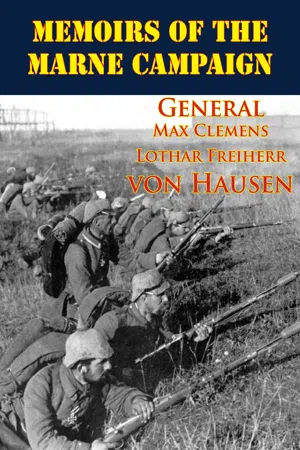
Memoirs Of The Marne Campaign
About this book
General Baron von Hausen, after a long and successful career in the Royal Saxon Army, was charged with the most important command of his career as the head of the German Third Army in 1914. The army participated in the Battle of the Frontiers, mainly in the battles of Dinant and Charleroi gained infamy for their responsibility for the destruction of Reims in September 1914. After the Second Army's was forced back after the First Battle of the Marne, Von Hausen saw his own flank exposed and ordered a retreat. Upon the stabilization of the front on the river Aisne, Von Hausen was made a scapegoat for the failure of the Schlieffen Plan and relieved of his command and replaced by General Karl von Einem. Affronted by the stain on his and his Saxon comrades, von Hausen considered it his duty to write his personal testimony concerning the Third Army under his command. Kircheisen comments that "According to the most authoritative sources, the Battle of the Marne can not be considered as a strategic defeat for the Germans. It should be regarded rather as a battle lost by us on account of tactical reasons".
Information
Subtopic
Military BiographiesIndex
HistoryCHAPTER I
MOBILIZATION—AUGUST 8TH-7TH
ON the afternoon of Saturday, August 1, 1914, several hours after the publication of the notice of the imminent danger of war, I received at Loschwitz, No. 2 Wunderlich Street, by telephone from the Ministry of War in Berlin, the following:
“ORDER OF MOBILIZATION.—August 2nd is the first day of mobilization.”
The following day, an order from His Majesty the Emperor informed me of my assignment, the same that had been designated for me since 1910. The imperial message addressed to me read as follows:
“I hereby name you, for the duration of active operations, Commander-in-Chief of the Third Army.
(Place of Mobilization, General Headquarters of the Army, Dresden)
“Berlin, August 1, 1914.
(signed) “WILLIAM.”
Immediately sending word in writing to the King of Saxony of my nomination, I then appropriately informed the (Saxon) Minister of War, after which I proceeded to Dresden, where I established myself at the Hotel Kronprinz.
During the following days the mobilization of the Headquarters of the Third Army was effected in conformity with the plan prepared by the General Staff of the XII Active Corps. Nothing of importance occurred during the mobilization, which was concluded by a review of the Headquarters on the afternoon of August 7th by the Minister of Finance, at the conclusion of which I proposed “Hochs” in honor of the Emperor of Germany and the King of Saxony.
During my sojourn in Dresden, the King of Saxony received me at his palace. As a mark of his confidence, he recommended that the (Saxon) Crown Prince serve on my Headquarters Staff, and expressed to me his desire that the Prince see active service. During the course of subsequent events, I remembered to comply with the royal wish, and I was always pleased to learn of the fidelity and calmness with which the young Prince discharged his duties, of the Intelligence he displayed in the service, and of how glad he was to be included in the circle of his comrades.
The becoming modesty and exquisite tact of the Prince, his serious and tranquil manner, his absence of pretension, and his affability made him esteemed by all.
The day before the last day of mobilization, I repaired with my wife to the rectory of Doctor Friedrich, Councillor of the Consistory and Court Preacher. We received communion. During the morning of August 7th, a day of penitence and of general prayers, we assisted at divine service, directed by the Reverend Dibélius, Doctor of Theology and Chief Court Preacher.
Immense throngs worshipped in all the churches of the country. Everyone was imbued with the gravity of the hour but full of hope and confidence. Like sentiments also prevailed when at 9:40 o’clock P.M. the same day the first echelon of my Headquarters entrained at the Dresden freight station for Prüm in the Eifel.{29} The second echelon followed several hours later.
At the moment of the entraining of the first echelon, the King, accompanied by all the members of the Royal Household, proceeded to the station, where I presented to His Majesty the members of my Headquarters Staff and made a short address to him, which was followed by a “Hoch.” The King in turn expressed his wish for our prompt and glorious return, and the train got under way.
Full of gratitude, I remember yet my dear wife, who accompanied me to the station on the evening of August 7th upon my departure from Dresden, and who assuaged the separation by her heroic attitude. Neither she nor I suspected under what circumstances we were to see each other again, nor what cruel ordeals we were destined to experience together.
CONCENTRATION—AUGUST 8TH-17TH
The Third Army, the composition of which is given in Annex No. 1, was—in accordance with the orders of Supreme Headquarters—to concentrate in the frontier region of the Eifel (Saint Vith, Waxweiler, Neuerburg, Prüm, and Wittlich), supported on the right by the Second Army and on the left by the Fourth, with
The XI Active Corps as the right wing,—In the Front Line
The XII Active Corps as the center, and—In the Front Line
The XIX Active Corps as the left wing.—In the Front Line
The XII Reserve Corps was in the second line in the rear of the XII and XIX Active Corps.
From the publication of the mobilization order, a brigade each from the XII Active Corps and the XIX Active Corps was sent to the frontier to cover that Concentration Zone.
These brigades shared with the cavalry of von Richthofen—whose I Cavalry Corps arrived in good time—the mission of covering the reassembling of troops arriving by train.
Leaving Dresden August 7th at 9:40 o’clock P.M., the first echelon of my Headquarters passed through Leipzig, Eisenach, Marburg, Coblenz, Cochem, Wengerohr, and arrived at Prüm August 9th at 9:30 o’clock in the evening. The second echelon followed on the morning of August 10th. Although ill from the fatigue of the long train trip, I retained an indelible impression of the order which prevailed in all the localities through which we travelled, and of the enthusiasm which filled all hearts. This enthusiasm found a ready echo among the troops during the journey. It was much more sincere than that of alcohol, even the slightest use of which had been forbidden.
At Prüm I was received by Captain Loof of my General Staff, who had preceded my Headquarters into the Concentration Zone, and also by representatives of the commander of the XI Active Corps, who had already arrived at Saint Vith: Captain von Plessen and Prince Joachim of Prussia. I put up at the house of Justice of the Peace Muller on Cock Street. With a splendid personality and with much vigor despite his fifty years, Muller was a most agreeable host to me—always sympathetic and attentive, and ably assisted by his wife, who was full of solicitude for me. Having resided in Prüm for sixteen years, Muller enjoyed the greatest consideration as justice of the peace there. He was very familiar with Belgian affairs, and gave me a great deal of good counsel regarding the organization of my Headquarters military police and intelligence service. Later he sent me communications respecting the agitations of the chauvinistic Belgian press, containing some valuable suggestions which were applied in two proclamations addressed by my Headquarters to the Belgians.
The Headquarters of the Third Army, the composition of which is given in Annex No. 2, regretted the absence on account of illness of the Dukes of Saxe-Meiningen and Saxe-Coburg-Gotha, who were to be attaches. My Headquarters found itself confronted by some important problems upon its arrival in the Concentration Zone. There were questions not only of organizing the interior service, of preparing a close liaison between the commands and the various services, of getting into direct personal relations with the subordinate army corps commanders and with the commands of the neighboring armies, but also the consideration in the field of the measures necessary to prepare for the forward movement of the Third Army, as well as those required in order to carry out the plans that had been made for the beginning of our hostile operations.
The Second Army made its debouchment in good time. However, the directives of Supreme Headquarters prescribed that the Third Army should first complete its concentration and not thereafter begin its march toward the Meuse in the direction of Namur and Givet until it had received the specific order to do so. In this forward movement, the Third Army was not to lose sight of the fact that very likely it would be called upon to take part in the investment of the front south of Namur.
Upon the expiration of the term fixed for the concentration period, I was able to approve the beginning of the forward movement on August 18th. In fact, according to the plan of transport, the arrival of the final combatant elements of the XII Reserve Corps had been scheduled for August 17th. Accordingly, the army corps were able—from August 12th to 17th—to take the necessary preparatory measures for the general attack that Supreme Headquarters judged was indispensable.
A glance at the map will show that the corps of the first line were arranged by the Great General Staff so that their Zones of Concentration were of great depth, as follows:
58 kilometers to the XI Active Corps, measured along the line: Gerolstein, Prüm, Eleialf, Saint Vith, and the frontier.
75 kilometers to the XII Active Corps, measured along the line: Oberkeil, Bitburg, Waxweiler, Burgreuland, and the frontier.
105 kilometers to the XIX Active Corps, measured along the line: Hetzerath, Quint, Speicher, Auw, Meckel, Wolsfeld, Bettingen, Neuerburg, Dasburg, and the frontier.
And only 30 kilometers to the XII Reserve Corps, the zone of which—unlike those of the others—was not long and narrow, but very large and limited along the line: Bengel, Wittlich, Eisenschmitt, and the frontier.
This extensive échelonnement of the XI, XII, and XIX Active Corps left the head of the XII Reserve Corps at a distance of two or three days marching in the rear and to the east of the other army corps in the first line. It was necessary, therefore, to shorten this distance immediately so as to bring the XII Reserve Corps closer to the front after the beginning of operations. Consequently, I decided to order the troops of that army corps on the march as soon as possible after their arrival, and to order the other corps to press more and more toward the west and to withdraw little by little from the eastern part of their Cantonment Zone so that the XII Reserve Corps in turn would be able to enter that section by August 13th.
Besides the possibility of participating in the siege of Namur, which was contemplated by Supreme Headquarters, I was also obliged to provide for the deployment of the right wing of the Third Army. Therefore, I decided to place the XII Reserve Corps up forward on a wide front, with its two divisions side by side, behind the XI and XII Active Corps. According to the calculations of my Headquarters—based on this change—we would be able to say that the XII Reserve Corps, naturally without taking a day of repose, would be west of the Our River on August 17th in the following order:
The 24th Reserve Division southeast of Saint Vith, in the rear of the XI Active Corps; and
The 23rd Reserve Division southeast of Burgreuland, in the rear of the XII Active Corps.
In this manner my Headquarters would have the XII Reserve Corps in hand in case Supreme Headquarters should give the Third Army the order to advance on August 18th.
The army cavalry—the 5th Cavalry Division and the Cavalry of the Guard—reinforced by the 11th, 13th, and 13th Battalions of Chasseurs and Tirailleurs of the Guards—was ordered by Supreme Headquarters to advance from the Concentration Zone via Bastogne in a westerly direction toward Dinant, with the mission of observing and exploring the line of the Meuse from Namur to Mezières. In the accomplishment of this mission, these troops at once encountered some detachments of French cavalry, weak at first but gradually growing stronger. Only in the Meuse sector, south of Namur, did they meet with a resistance, however, that could not be broken at the onset.
It thus appeared likely that the scene of combat would be at Aseesse and at Dinant, but meanwhile the cavalry was able to gather complete information concerning the enemy and his positions at Dinant. The success of the cavalry’s explorations strengthened the belief of my Headquarters in the possibility that the army would be able to execute its initial movements without striking a blow; but other news regarding the attitude of the Belgian civil population, which emanated from the cavalry corps and brigades charged with the surveillance of the frontier gave rise to anxiety for the future. These reports fully established the fact that while the inhabitants on the other side of the frontier would not be absolutely hostile in the presence of our troops, they would not fail, whenever occasion afforded, to ambush our men when their backs were turned, or when they appeared in isolated detachments. Judging from what occurred in many of the localities in the sections through which we passed, we were impressed with the fact that the population—excited by the chauvinistic press, by the clergy, and by the government—was acting under advance instructions. We could not—and consequently did not—hesitate a single instant to safeguard the situation with the most severe and rigorous measures. The incidents that bear witness to this hostility are too numerous to mention here. The discovery of depots for rifles, revolvers, munitions, and dynamite was not a rare thing—no more than the destruction of telegraph and telephone lines, and of bridges along the route; or, where there were railroads, the obstruction of the roadway for long stretches by trees felled from nearby forests, and so on and so forth.
Particularly characteristic was a circular issued by a Belgian postal authority which fell into the hands of the General Staff of the XI Active Corps. This circular counselled an attitude of apparent friendliness to the faces of the Germans, while striving by underhand means behind their backs to do them all the harm possible. A number of assassinations resulted from these hostile sentiments. Spurred on by urgent necessity, Supreme Headquarters did not hesitate to repress with the utmost vigor this hostile conduct on the part of t...
Table of contents
- Title page
- TABLE OF CONTENTS
- INTRODUCTORY NOTE BY ENGLISH TRANSLATOR
- PREFACE By General Mangin
- FOREWORD
- HISTORICAL STUDY
- AUTHOR’S FOREWORD By Baron von Hausen
- CHAPTER I
- CHAPTER II
- CHAPTER III
- CHAPTER IV
- CHAPTER V
- CHAPTER VI
- CHAPTER VII
- FINAL REMARKS
- APPENDIX TO HISTORICAL STUDY
- ANNEX NO. 1-Composition Of The Headquarters Of The Third Army
- ANNEX NO. 2-BATTLE ORDER OF THE THIRD ARMY
- EXPLANATORY NOTE
Trusted by 375,005 students
Access to over 1.5 million titles for a fair monthly price.
Study more efficiently using our study tools.
Frequently asked questions
Yes, you can cancel anytime from the Subscription tab in your account settings on the Perlego website. Your subscription will stay active until the end of your current billing period. Learn how to cancel your subscription
No, books cannot be downloaded as external files, such as PDFs, for use outside of Perlego. However, you can download books within the Perlego app for offline reading on mobile or tablet. Learn how to download books offline
Perlego offers two plans: Essential and Complete
- Essential is ideal for learners and professionals who enjoy exploring a wide range of subjects. Access the Essential Library with 800,000+ trusted titles and best-sellers across business, personal growth, and the humanities. Includes unlimited reading time and Standard Read Aloud voice.
- Complete: Perfect for advanced learners and researchers needing full, unrestricted access. Unlock 1.5M+ books across hundreds of subjects, including academic and specialized titles. The Complete Plan also includes advanced features like Premium Read Aloud and Research Assistant.
We are an online textbook subscription service, where you can get access to an entire online library for less than the price of a single book per month. With over 1.5 million books across 990+ topics, we’ve got you covered! Learn about our mission
Look out for the read-aloud symbol on your next book to see if you can listen to it. The read-aloud tool reads text aloud for you, highlighting the text as it is being read. You can pause it, speed it up and slow it down. Learn more about Read Aloud
Yes! You can use the Perlego app on both iOS and Android devices to read anytime, anywhere — even offline. Perfect for commutes or when you’re on the go.
Please note we cannot support devices running on iOS 13 and Android 7 or earlier. Learn more about using the app
Please note we cannot support devices running on iOS 13 and Android 7 or earlier. Learn more about using the app
Yes, you can access Memoirs Of The Marne Campaign by General Max Clemens Lothar Freiherr von Hausen in PDF and/or ePUB format, as well as other popular books in History & Military Biographies. We have over 1.5 million books available in our catalogue for you to explore.