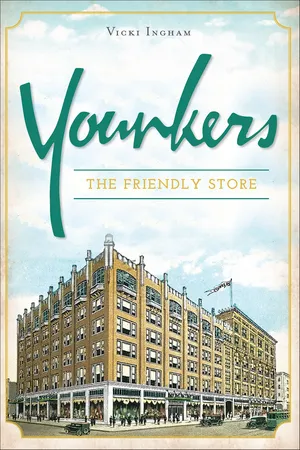
When shoppers went to Younkers, they experienced something magical. Celebrities signed autographs, chefs gave cooking demonstrations and Miss Universe discussed the latest styles in swimwear. The flagship store, a showplace in the heart of downtown Des Moines, boasted dazzling selling spaces equipped with the first escalator and air conditioner in the state. The Tea Room established a legendary reputation for its food, fashion shows and Theater Nights. A great place to work, it gave thousands of teens their first paychecks and afforded hundreds of associates a lifelong career. Join Vicki Ingham for Younkers' journey to become one of the most important department store chains in the Midwest.
- 160 pages
- English
- ePUB (mobile friendly)
- Available on iOS & Android
eBook - ePub
About this book
Information
Subtopic
Business BiographiesIndex
HistoryChapter 1
BAND OF BROTHERS
Like many department stores in the United States, Younkers started out as a dry goods store established by Jewish immigrants. In the mid-1800s, six Younker brothers, born in Lipno, Poland, made their way to the Midwest in search of opportunity. The two eldest, Benjamin and Lipman, arrived first and settled in Louisiana, Missouri, in 1851 or 1852 (sources disagree). Samuel (age seventeen) and Marcus (age fifteen) arrived in New York City in 1854. Younger brothers Manassa and Joseph and two half-brothers, Herman and Aaron, followed later.
They apparently arrived in America with little more than their wits and some knowledge of trade. Many years later, Marcus recalled, “I had a stock of stationery amounting to $2.50 to start my career in this country with.” As he was climbing onto a stage to Union Square, where he would sell the stationery either to passersby or door to door in office buildings, he dropped the stationery in the muddy gutter. “Kind-hearted bystanders had remorse upon me and helped me out with the sum of one dollar and that practically was my start in the United States,” he wrote.2 After a few unsuccessful years in the city, Samuel and Marcus traveled to Keokuk, Iowa, where Lipman had moved in 1855. The three brothers opened a dry goods store, Younker & Bros., in 1856, leasing the first floor of 82 Main Street.3
Nestled between the Des Moines and Mississippi Rivers and lying just south of impassable rapids on the Mississippi, Keokuk prospered as a terminal port for riverboats carrying goods and freight up from St. Louis. The Des Moines River, though unpredictable, remained an important way to move goods into the interior, and as the gateway to this region, Keokuk promised opportunities for growing numbers of entrepreneurs and merchants. Settlers moving west in large convoys of covered wagons passed through Keokuk and stopped for supplies. By 1856, the town was prosperous enough to install gas streetlights, and the Daily Gate City newspaper noted that citizens were busy organizing a Republican party, attending the occasional theatrical production and listening to Lyceum lectures.4
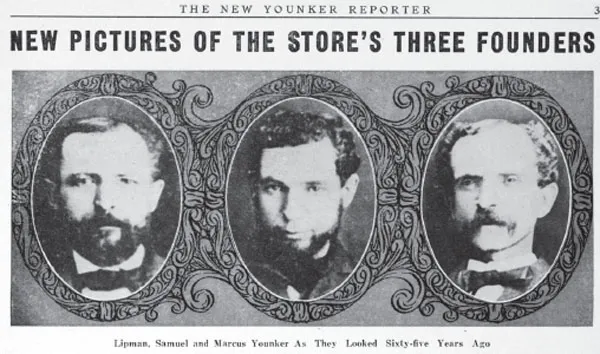
Lipman, Samuel and Marcus Younker, the company’s founders. SHSI.
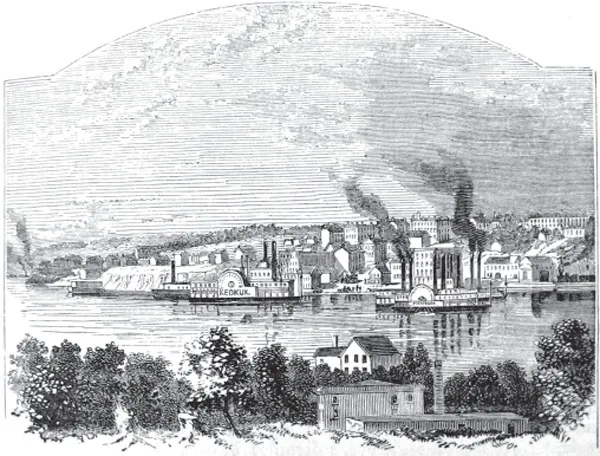
Keokuk, Iowa, gateway to the Midwest in the mid-1800s.
Keokuk also had the largest Jewish population in the young state. Most were merchants, either of dry goods or clothing; one was a physician. In 1855, they established a mutual aid society to help the sick and bury the dead. By 1863, there were enough faithful to form a congregation, which met above the Younker & Bros. store. In 1876, the first synagogue in Iowa was built in Keokuk with the help of the Younker brothers.5
The Younker & Bros. store, Marcus recalled, “carried a little bit of everything” and served settlers living as far west as Eddyville and Ottumwa. “They were hard days, but we had good patronage, and our greatest trouble was in establishing credit with eastern wholesale houses,” he wrote. Sometimes they had to take whatever the buyer sent them. “Once our buyer cleared out the remnant of a stock of bowie knives and shipped them west to us…When the knives came, we unpacked them and found ten or twelve dozen.” Faced with what seemed an absurdly large number of knives, they debated whether to send them back to New York but decided instead to display a few in the window. “One day the driver of a prairie schooner came to our store, noticed the knives in the windows, and asked their price. We told him $2.00 apiece. ‘Have you got many?’ he asked. We told him we had a good stock…A few minutes later, fifty or sixty men came over from the emigrant train and they bought every knife in the store.”6
In addition to selling from the store, the brothers used the shop as a base for going out into the countryside of Lee and Des Moines Counties as itinerant peddlers. According to company history, they stayed with farmers in the Des Moines River Valley and paid for their bed and board with merchandise. The packs were as large as steamer trunks, loaded with bolts of cloth, sewing notions and sundries, and each man carried one on his back.7
When the Civil War began in 1861, most of the Iowa regiments set off from Keokuk. In addition to a military camp, the town hosted six war hospitals, and eventually a national cemetery was established. Manassa’s son Isaac remembered his father saying that the store kept busy looking after the needs of the soldiers who passed through.8
Sometime during the first year of the war, Lipman, by now twenty-seven years old, returned to New York City to marry Gertrude Cohen, the daughter of a Polish rabbi. Two years later, in 1863, Samuel married Gertrude’s sister, Ernestina (Tina), and brought her back to Keokuk. Marcus married his cousin Anna Berkson in New Orleans in 1868.9
In 1864, Younker & Bros. took out its first newspaper ad in the Daily Gate City. The notice alerted the public to its selection of dry goods “for sale at the very lowest market prices,” including black and colored silks, “Merinos and Alpacas, Shawls and Cloaks, Blankets and Quilts, Yarns and Hosieries, Carpets and Oil Cloths, Which will be sold at prices to correspond with the late decline in gold.” The ad also stated that “special notice is given that our store will be closed on every Saturday,” allowing the brothers to keep the Sabbath.
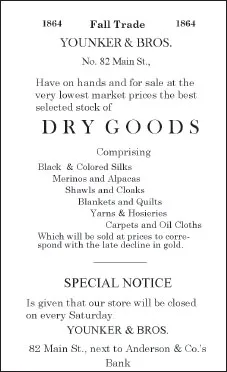
Re-creation of Younkers’ first newspaper ad in Keokuk, 1864.
On August 29, 1866, the first passenger train from Keokuk to Des Moines made its maiden run, and Samuel was among the forty residents of Keokuk making the seven-and-a-half-hour trip to the capital city. When the train pulled into the station at East Fifth and Market, the travelers were treated like celebrities, with speeches, a parade and a brass band. The passengers spent the night either at the Savery Hotel (then at Fourth and Walnut) or the Demoine House.10 Presumably, Samuel went to investigate expansion opportunities but must have returned unimpressed. The family didn’t stake a claim in the retail business there until 1874.
Although Lipman had arrived in Keokuk first, it was Samuel who took the lead in running the store. This may have created some tension between the equally entrepreneurial brothers. In addition to participating in the dry goods store, Lipman opened his own shop in 1868, L.M. Younker & Company, selling gentlemen’s clothes and furnishings. His youngest brother, Joseph, had arrived in Keokuk two years earlier to begin working at the main store, and then he joined Lipman as a clerk. In March 1870, Lipman officially dissolved the partnership with Samuel and Marcus and focused on his clothing store. Sometime before 1879, Lipman moved his store to Des Moines, setting up shop at 319 Walnut Street, and moved his family to New York.11
During the early 1870s, Younkers continued to promote fabrics, dress goods, table linens “and everything else pertaining to a First Class Dry Goods Store,” but now stylishness was mentioned along with rock-bottom prices. Samuel went to New York himself to buy merchandise, and for the 1874 Christmas sale, he brought back “all classes of dry goods suitable for Holiday Presents. We are receiving new goods every day, bought purposely for this special sale and bought for cash at such prices that we are enabled to offer everybody unprecedented bargains.” Furs; dress goods such as shawls, blankets and felt skirts; and “Domestic and Housekeeping Goods of every kind at Immense Bargains,” along with gloves, underwear, notions and “Fancy Goods of every kind in endless variety,” were all on offer at “prices to astonish.”12
In May 1879, just a week after a family reunion, Samuel became ill with severe diarrhea. He suffered for about ten days before dying of “congestion of the bowels and stomach.” Marcus was in New York about to embark on a trip to Europe when he received the news and returned immediately to Keokuk for the funeral. All of the brothers except Lipman attended the services, held at the synagogue that Samuel had helped build three years before. Samuel’s obituary in the Daily Gate City on May 22 noted that he had been vice-president of B’nai Israel, a member of the congregation’s school board and “an enthusiastic B’nai B’rith over which body, in this city, he was president…[A]n influential member of the Hebrew Congregation, [he] enjoyed the respect and confidence not only of his Hebrew fellow citizens, but of all who knew him, and was regarded as a man without an enemy.”13
Tina and Marcus kept the store operating for about six years after Samuel died. Then they closed shop and moved to Des Moines to join Marcus’s half-brother Herman. Manassa Younker and his children continued operating the M. Younker store in Keokuk until 1924. Joseph had opened a store in Bonaparte called Younker & Sonshine in about 1877 but moved his family to east Des Moines in 1884 and opened a dry goods store there in the center of the Jewish community.14 Thus, the Younker name stood for honest merchandise at low prices in several Iowa towns, but it would be Herman’s store that would become a community institution in the state and beyond.
Chapter 2
A BRANCH IN DES MOINES
When Samuel Younker visited Des Moines in 1866, he found twenty-two dry goods stores already in operation. Since Des Moines had about the same population as Keokuk at that time, Samuel apparently thought the town was too small, with too much competition, to risk opening a store there. Eight years later, however, the population in Des Moines was on its way to doubling, and the number of dry goods stores had dropped to seventeen.15
Samuel’s sixteen-year-old half-brother, Herman, had arrived in Keokuk from Poland in 1870. After four years in training with his older half-brothers, he was ready to go to Des Moines to open a branch store. Most of his competitors were clustered on Walnut Street, so Herman rented a one-story room twenty-two feet wide and sixty feet deep near the corner of Sixth and Walnut. His first ad, appearing in the October 3, 1874 Iowa State Register, consisted of three lines of text sandwiched between reports on a thief ’s arraignment and September arrests: “We have come to live here, and mean to do what is right. If you want honest goods at bottom prices, call at Younker Brothers. McCain’s Block, Cor. 6th and Walnut.”
According to family history, Herman’s nephew, Aaron, age ten, came with him to Des Moines, although the city directory doesn’t list Aaron until 1879.16 In 1876, Herman’s cousin Barney joined him as a clerk, and in 1877, the Younkers moved the store a block east to 423 Walnut while they enlarged and remodeled the original building to take in both 515 and 517 Walnut. They returned to that location in 1881 and remained there for eighteen years. Ads placed in the Des Moines Register during this period emphasized the store’s variety of stock and low prices with those alluring words, “Finest, Largest and Cheapest.”17
Meanwhile, by 1879, Lipman had opened the short-lived L.M. Younker & Company at 319 Walnut, selling men’s clothing and related goods.18 Because he was living in New York, he left the running of the store to thirty-one-year-old Morris Wilchinski and a nephew, Albert Younker. When he was a toddler, Wilchinski, along with his older sister, Anja, had accompanied Lipman and Benjamin to America. Anja married Benjamin, and Morris would later marry Agnes Berkson, a cousin of the Younker brothers. Their son Norman would become one of the most beloved presidents in the history of Younkers.19
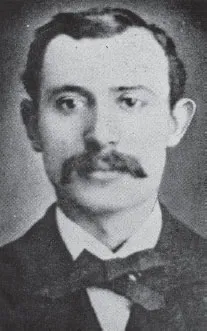
Herman Younker, founder of the Des Moines branch. SHSI.
In 1880, Herman Younker made news by hiring the first woman clerk in Des Moines. Mrs. Mary McCann, a thirty-year-old widow, had no work experience outside the home and was nervous about the job. Years later, she said that she stayed at the rear of the store at first, “feeling entirely strange and out of place in this business world dominated by men.” Soon, however, female customers began “seeking her out, because they liked the idea of being waited on by a woman. Her success was so decided that a good deal of jealousy was felt among the men.” They were less than helpful, but Mary remembered that Mr. Younker became “her friend and tutor and daily gave her valuable lessons in selling, especially introducing new merchandise.”20
In some cities in the late nineteenth century, female clerks were frowned upon as being of a lower class or of dubious character, but that wasn’t the case in Des Moines. After about a year, Mary McCann was joined by other women, including Margaret Cummins, the sister of Albert B. Cummins, future state senator, governor and U.S. senator. Not long after, applicants included former teachers and a former assistant in a dentist’s office.21
In the early 1880s, store personnel worked long hours, from 7:00 a.m. to 11:00 p.m. In the 1890s, opening was pushe...
Table of contents
- Front Cover
- Half Title
- Title Page
- Copyright
- Contents
- Preface
- Introduction
- 1. Band of Brothers
- 2. A Branch in Des Moines
- 3. The Largest Store in Iowa
- 4. “As Modern as Tomorrow”
- 5. Supporting the Troops
- 6. Midcentury Expansion
- 7. The Younkers Tea Room
- 8. Furnishing the Iowa Home
- 9. A Full-Service Store
- 10. Iowa’s Fashion Capital
- 11. Something Is Always Happening at Younkers
- 12. A Great Place to Work
- 13. Here to Do What Is Right
- 14. The End of Independence
- Notes
- Bibliography
- About the Author
Trusted by 375,005 students
Access to over 1.5 million titles for a fair monthly price.
Study more efficiently using our study tools.
Frequently asked questions
Yes, you can cancel anytime from the Subscription tab in your account settings on the Perlego website. Your subscription will stay active until the end of your current billing period. Learn how to cancel your subscription
No, books cannot be downloaded as external files, such as PDFs, for use outside of Perlego. However, you can download books within the Perlego app for offline reading on mobile or tablet. Learn how to download books offline
Perlego offers two plans: Essential and Complete
- Essential is ideal for learners and professionals who enjoy exploring a wide range of subjects. Access the Essential Library with 800,000+ trusted titles and best-sellers across business, personal growth, and the humanities. Includes unlimited reading time and Standard Read Aloud voice.
- Complete: Perfect for advanced learners and researchers needing full, unrestricted access. Unlock 1.5M+ books across hundreds of subjects, including academic and specialized titles. The Complete Plan also includes advanced features like Premium Read Aloud and Research Assistant.
We are an online textbook subscription service, where you can get access to an entire online library for less than the price of a single book per month. With over 1.5 million books across 990+ topics, we’ve got you covered! Learn about our mission
Look out for the read-aloud symbol on your next book to see if you can listen to it. The read-aloud tool reads text aloud for you, highlighting the text as it is being read. You can pause it, speed it up and slow it down. Learn more about Read Aloud
Yes! You can use the Perlego app on both iOS and Android devices to read anytime, anywhere — even offline. Perfect for commutes or when you’re on the go.
Please note we cannot support devices running on iOS 13 and Android 7 or earlier. Learn more about using the app
Please note we cannot support devices running on iOS 13 and Android 7 or earlier. Learn more about using the app
Yes, you can access Younkers by Vicki Ingham in PDF and/or ePUB format, as well as other popular books in History & Business Biographies. We have over 1.5 million books available in our catalogue for you to explore.