Illustrated with 6 portraits
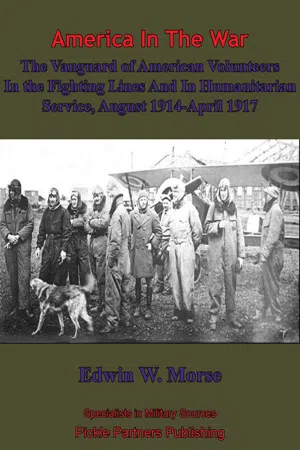
Even before the official entry of the United States of America into the First World War in April 1917, many of its citizens had already crossed over "The Pond" and already had lent their efforts to the Allied cause. The author Edwin Morse set himself a terribly difficult task to record even a handful of these gallant soldiers, doctors, surgeons and aviators; he selected as a sampling of 34 different stories which he set out to tell in brief. Those he selected contributed to the Allied cause in different and diverse ways - some joined the Foreign Legion, some the British Army, others supported the medical services or drove ambulances; still further more joined the French Army aviators and formed the famous Lafayette Escadrille.
eBook - ePub
The Vanguard Of American Volunteers In The Fighting Lines And In Humanitarian Service
August,1914-April, 1917 [Illustrated Edition]
- 173 pages
- English
- ePUB (mobile friendly)
- Available on iOS & Android
eBook - ePub
The Vanguard Of American Volunteers In The Fighting Lines And In Humanitarian Service
August,1914-April, 1917 [Illustrated Edition]
About this book
Information
Subtopic
Military BiographiesIndex
HistoryPART I: IN THE FOREIGN LEGION
II — WILLIAM THAW, LATE OF YALE
To the young Americans with French sympathies who, at the beginning of the war, were eager to get into the real fighting as quickly as possible, the Foreign Legion offered the readiest means. Every able-bodied man who was willing to fight for France was welcomed as a brother to its ranks, whatever his nationality and without regard to his record. For scores of years the Legion had been famous, even notorious, as the refuge of soldiers of fortune, criminals, scapegraces and adventurers of all types—of all the outcasts of, society in fact. This unenviable reputation was no obstacle, however, in the way of the young Americans who were anxious to get into the fighting-lines by the easiest and quickest means possible. They were willing to take their chances. Their experiences varied because the regiments differed greatly in the character of the men. To Farnsworth and Morlae they were picturesque and interesting. Chapman found himself among “the scum of the Paris streets,” and doubted if six months’ training would make them fit for active service. That some of the regiments failed to conform in character to the traditions of the Legion may easily have been the case, if Genet was correct in his statement of January, 1916, that there had been about 48,000 volunteers enrolled in that body since the war began, of whom there were then only about 5,000 left fit for service.
One of the first of the American youths to join this famous organization was William Thaw, of Pittsburgh, who had been a member of the class of 1915 at Yale. As was the case with several other Americans, Thaw was destined to win renown not in the Legion but in the flying corps. His experiences in the Legion, however, were described in his letters to his family, which were printed in the Yale Alumni Weekly, in such a racy, breezy manner and with such a genuinely American sense of boyish humor, that some selections from them are well worth quoting. Incidentally it may be noted that at the very beginning, when practically all the rest of the world was in a state of more or less bewildered amazement at what was taking place in Belgium, this Yale youth grasped the essential, fundamental fact that this was to be a world-conflict between civilization and barbarism.
Under date of August 30, 1914, Thaw wrote:
I am going to take a part, however small, in the greatest and probably last, war in history, which has apparently developed into a fight of civilization against barbarism. That last reason may sound a bit grand and dramatic, but you would quite agree if you could hear the tales of French, Belgian and English soldiers who have come back here from the front....
Talk about your college education, it isn’t in it with what a fellow can learn being thrown in with a bunch of men like this! There are about 1200 here (we sleep on straw on the floor of the Ecole Professionel pour Jeunes Filles) and in our section (we sleep and drill by sections) there is some mixture, including a Columbia Professor (called “Shorty”), an old tutor who has numerous Ph.D.s, M.A.s, etc., a preacher from Georgia, a pro. gambler from Missouri, a former light-weight second rater, two dusky gentlemen, one from Louisiana and the other from Ceylon, a couple of hard guys from the Gopher Gang of lower N. Y., a Swede, Norwegian, a number of Poles, Brazilians, Belgians, etc. So you see it’s some bunch! I sleep between the prize-fighter and a chap who used to work for the Curtiss Co. As for the daily routine it reminds me of Hill School, and then some; only instead of getting demerits for being naughty, you get short rations and prison.
Early in September the detachment was transferred to Toulouse, where it was joined by 500 veterans from the Legion in Africa. Nearly a month was spent in Toulouse in drilling and hardening the men for front-line work. Thaw was made a student-corporal. He wrote:
It is not a very exalted position, as you command only seven men. But it was a starter, and meant four cents a day instead of one, better shoes, and the power to put the guys you don’t like in prison for four days instead of having to lick them personally! But of course now that we’ll be with veterans there will have to be a lot of officers killed off before I get another chance. But it was a rare sight to see me drilling the awkward squad to which I was assigned. (A somewhat doubtful compliment to my abilities as a commander.) And that squad was some awkward. To add to my difficulties there were in it a chap from Flanders who spoke neither French nor English, a Russian who didn’t speak French, a Frenchman who didn’t speak English and some Americans and English with various linguistic accomplishments. It took me two hours to get them to obey about twenty simple commands with any sort of precision. But it was a lot of fun, even if I did lose half my voice and about 3 kilos.
Finally, early in October, Thaw’s company was moved north to Camp de Mailly, Chalons-sur-Marne. This paragraph from a letter dated October ~ indicates the nature of Thaw’s work as a scout:
Yesterday I got a new job, being one of the two scouts or éclaireurs de marche, for our squad of 17 men The other is a big Servian, who is beside me in ranks and who was wounded twice in the Balkan War. It’s some job; you have to beat it off through the country, when your company is on the march, walk about three kilometres over rough ground, and, as far as I can see, get shot at, which gallant deed proves that the enemy are near and warns your comrades. The sergeant (he’s always kidding us) consoled us by saying that he chose only men of great “sang froid“ and skill with the rifle, and only the best marchers, whereupon I offered him a cigarette.
The cross-country “military marches,” each man carrying the official equipment weighing 120 pounds, [Note: This weight was confirmed in a later letter from Thaw.] were severe tests of the endurance of the men:
I was agreeably surprised to find that I got less tired than most, and didn’t even mind carrying an extra gun the last five kilos. It’s just a matter of getting used to it; but, take it from me, in comparison a game of football is almost a joke, for you don’t get a rest every fifteen minutes, and a game doesn’t last seven hours.
By the middle of October Thaw’s battalion was in the front-line trenches. In the meantime his skill with the ride had won for him promotion to soldier of the first class, with a red stripe on his sleeve. He found the life monotonous and disappointing, however. Under date of November 27 he wrote:
War is wretched and quite uninteresting. Wish I were back dodging street cars on Broadway for excitement. Am that tired of being shot at! Got hit in the cap and bayonet—Do you mind? Have been in the trenches now nearly six weeks. Haven’t washed for twenty days. Expect to get a ten days’ rest after another two weeks.
A month later he summarized his experiences thus:
We didn’t make an attack and were attacked only once, and I doubt that, for I didn’t see any Germans. I didn’t even shoot when they gave the order “fire at will,” and when I told the excited, spluttering little sergeant that there was nothing to shoot at (it was very dark) he said, shoot anyway, which I did at the German trenches 800 metres away, for by that time they were replying, in astonishment, no doubt, to our fire, and their bullets were snipping through the trees at us—which is my idea of some battle.
The humorous side of one episode appealed strongly to this American youth:
Another very exciting experience, of which I’d nearly forgotten to tell you, was when one night we received ”sure dope” that there would be an attack, six of us, under the American corporal, Morlae, went out as an advance guard into an open trench 100 metres in front of the main line, the idea being that while the Germans were killing us off the others would be warned and have time to get ready. It was a peachy idea, but “les Boches” never showed up, and the “exciting experience” consisted in standing for thirteen hours in three inches of water and nearly dying of fright when a dozen cows came browsing across the meadows in perfect skirmish order. “C’est terrible, la guerre,” as we Frenchmen say.”
A month later Thaw was transferred at his request to the French aviation service.
III — MORLAE’S PICTURE OF THE LEGION
Two days after the war began E. Morlae, the American corporal referred to by Thaw, left Los Angeles, California, for Paris. Born in California, Morlae was of French parentage, his father having served in the French army in the War of 1870. On arriving in Paris he enlisted in the Foreign Legion, and his father’s record, with his general familiarity with military matters and his command of French, soon secured for him promotion to the rank of corporal. After serving in the Legion for more than a year he returned to the United States, wounded in the neck and knee.
Morlae contributed to the Atlantic Monthly for March, 1916, a description of the Legion’s share in the battle of Champagne, the last week in the previous September, which was remarkable for its vividness and its graphic power. The scene of that portion of the battle which Morlae described was from Souain to Navarin, where lay the immediate objective of the attack, the little fort of Navarin. This objective was attained, but at a heavy cost of lives. Of Morlae’s section of sixty men only twelve survived, several of those being severely wounded.
In the following paragraph from his Atlantic Monthly paper, Morlae described the honors that were paid to the Legion before and after this battle, and gave the reasons therefor:
One day during the latter part of August, 1915, my regiment, the 2me. Etranger (Foreign Legion), passed in review before the President of the French Republic and the Commander-in-chief of her armies, General Joffre. On that day after twelve months of fighting, the regiment was presented by President Poincaré with a battle-flag. The occasion marked the admission of the Légion Etrangère to equal footing with regiments of the line. Two months later —it was October 28—the remnants of this regiment were paraded through the streets of Paris, and, with all military honors, this same battleflag was taken across the Seine to the Hotel des Invalides. There it was decorated with the Cross of the Legion of Honor and, with reverent ceremony, was placed between the flag of the cuirassiers who died at Reichshofen and the equally famous standard which the Garibaldians bore in 1870-71. The flag lives on. The regiment has ceased to exist.
To the men of the Legion, which survived this blow as it had others, these honors, as Morlae points out, meant much. For they were no longer to be classed as pariahs and outcasts, as they had always been. Of the personnel of the Legion and of the reasons for the devotion of the Légionnaires to France, Morlae said:
Of the Legion I can tell you at first hand. It is a story of adventurers, of criminals, of fugitives from justice. Some of them are drunkards, some thieves; and some with the mark of Cain upon them find others to keep them company. They are men I knew the worst of. And yet I am proud of them—proud of having been one of them; very proud of having commanded some of them.
It is all natural enough. Most men who had come to know them as I have would feel as I do. You must reckon the good with the evil. You must remember their comradeship, their esprit de corps, their pathetic eagerness to serve France, the sole country which had offered them asylum, the country which had shown them confidence, mothered them and placed them on an equal footing with her own sons. These things mean something to a man who has led the life of an outcast, and the Légionnaires have proved their loyalty to France many times over...
In my own section there were men of all races and all nationalities. There were Russians and Turks, an Anamite and a Hindu. There were Frenchmen from God knows where. There was a German, God only knows why. There were Bulgars, Servians, Greeks, Negroes, an Italian and a Fiji Islander, fresh from an Oxford education,—a silent man of whom it was whispered that he had once been an archbishop,—- three Arabians and a handful of Americans who cared little for the quiet life.
Of this group of Americans Morlae wrote as follows:
But even the Americans were not all of one stripe. J. J. Carey had been a newspaper artist, and Bob Scanlon, a burly negro, an artist with his fist in the squared ring. Alan Seeger had something of the poet in him. Dennis Dowd was a lawyer; Edwin Boligny a lovable adventurer. There was D. W. King, the sprig of a well-known family. William Thaw, of Pittsburgh, started with us, though he joined the Flying Corps later on. Then there were James Bach, of New York, B. S. Hall, who hailed from Kentucky, Professor Ohlinger, of Columbia, Phelizot, who had shot enough big game in Africa to feed the regiment. There were Delpenche and Capdevielle, and little Trinkard, from New York. Bob Subiron came, I imagine, from the States in general, for he had been a professional automobile racer. The Rockville brothers, journalists, signed on from Georgia; and last, though far from least, was Friedrich Wilhelm Zinn, from Battle Creek, Michigan.
The King referred to by Morlae was David W. King, a Harvard undergraduate of the class of 1916, whom Victor Chapman found in July, 1915, in a village in Alsace “rolling in luxuries,” “smoking imported cigarettes and refusing to make a row even when the bill was three times what it should be.”
In a letter which was reprinted in the Harvard Alumni Bulletin, King described how Zinn, who had become his best friend, was wounded a few months later:
The night of the 8th [of October, 1915] we came up here. It’s the deuce of a place. We work on the front line all night, and they amuse themselves by dropping shrapnel and “marmites” into the working parties. During the day we are supposed to rest, but there are batteries all around us, and the consequence is that the Boches are always feeling around for them, and the guns themselves make such a fiendish racket we are almost deaf. To make things more cheerful, as we were going to work a shell burst near my best friend (F. W. Zinn) who was walking just ahead of me and he got a piece in the side. It did not penetrate, but it made a bad contusion just under his heart, and I am afraid it smashed some ribs. There were no Red Cross workers near by, so I had to take him back. He could hardly breathe when I got him to the “poste de secours.” Lucky devil! He will get a month’s rest, but I miss him like anything, as friends are pretty scarce around here.
IV — HENRY FARNSWORTH, LOVER OF BOOKS
One young American volunteer in the Foreign Legion was killed in the battle for the Fortin de Navarin at the end of September, 1915. He was Henry Weston Farnsworth, of Dedham, Massachusetts, a graduate of Groton and of Harvard, of the class of 1912. His tastes were bookish, musical and artistic. Burton, Dostoievski, Tolstoi, Gogol, Ibsen and Balzac were favorites with him, although his studies in literature covered a much wider field—the English classics as well as the modern continental writers. After he was graduated he spent the summer in Europe; visiting Vienna, Budapesth, Constantinople, Odessa, Moscow, and St. Petersburg, revelling in the historical associations, the art collections and the music of these cities, and making odd friends here and there, as was his wont, and studying the people. His curiosity was insatiable, particularly as regards the Oriental peoples and the Russians.
When the European War broke out Farnsworth was in the city of Mexico, whither he had gone when the United States Government s...
Table of contents
- Title page
- TABLE OF CONTENTS
- DEDICATION
- PART I: IN THE FOREIGN LEGION
- PART II: WITH FAMOUS BRITISH REGIMENTS
- PART III: THE AMERICAN RED CROSS IN SERVIA
- PART IV: AMERICAN AMBULANCES IN FRANCE
- PART V: RELIEF WORK IN BELGIUM AND IN NORTHERN FRANCE
- PART VI: AMERICAN VOLUNTEER AIRMEN
- INDEX
- REQUEST FROM THE PUBLISHER
Trusted by 375,005 students
Access to over 1.5 million titles for a fair monthly price.
Study more efficiently using our study tools.
Frequently asked questions
Yes, you can cancel anytime from the Subscription tab in your account settings on the Perlego website. Your subscription will stay active until the end of your current billing period. Learn how to cancel your subscription
No, books cannot be downloaded as external files, such as PDFs, for use outside of Perlego. However, you can download books within the Perlego app for offline reading on mobile or tablet. Learn how to download books offline
Perlego offers two plans: Essential and Complete
- Essential is ideal for learners and professionals who enjoy exploring a wide range of subjects. Access the Essential Library with 800,000+ trusted titles and best-sellers across business, personal growth, and the humanities. Includes unlimited reading time and Standard Read Aloud voice.
- Complete: Perfect for advanced learners and researchers needing full, unrestricted access. Unlock 1.5M+ books across hundreds of subjects, including academic and specialized titles. The Complete Plan also includes advanced features like Premium Read Aloud and Research Assistant.
We are an online textbook subscription service, where you can get access to an entire online library for less than the price of a single book per month. With over 1.5 million books across 990+ topics, we’ve got you covered! Learn about our mission
Look out for the read-aloud symbol on your next book to see if you can listen to it. The read-aloud tool reads text aloud for you, highlighting the text as it is being read. You can pause it, speed it up and slow it down. Learn more about Read Aloud
Yes! You can use the Perlego app on both iOS and Android devices to read anytime, anywhere — even offline. Perfect for commutes or when you’re on the go.
Please note we cannot support devices running on iOS 13 and Android 7 or earlier. Learn more about using the app
Please note we cannot support devices running on iOS 13 and Android 7 or earlier. Learn more about using the app
Yes, you can access The Vanguard Of American Volunteers In The Fighting Lines And In Humanitarian Service by Edwin Morse in PDF and/or ePUB format, as well as other popular books in History & Military Biographies. We have over 1.5 million books available in our catalogue for you to explore.