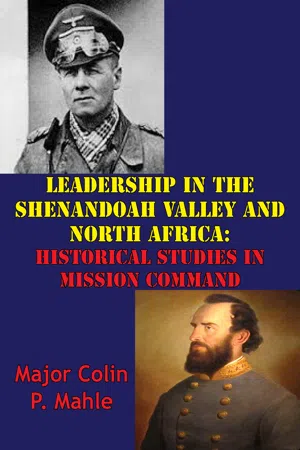
Mission command, as outlined in Army Doctrine Reference Publication (ADRP) 6-0, Mission Command, is the contemporary philosophy through which army commanders combine mission, intent, and subordinate initiative to win in unified land operations. Though not known to them as mission command, prominent leaders such as Field Marshal Erwin Rommel and Major General Thomas J. "Stonewall" Jackson used similar concepts.
This study specifically examines how these leaders employed three of the six principles outlined in current mission command doctrine. They are: (1) build cohesive teams through mutual trust, (2) exercise disciplined initiative, and (3) provide a clear commander's intent. Determining the methods that these commanders employed during their celebrated campaigns through the framework of mission command highlights characteristics that will benefit military leaders at all levels. The linkages between these historical campaigns and current mission command philosophy are the focus of this study.
eBook - ePub
Leadership In The Shenandoah Valley And North Africa: Historical Studies In Mission Command
- 111 pages
- English
- ePUB (mobile friendly)
- Available on iOS & Android
eBook - ePub
Leadership In The Shenandoah Valley And North Africa: Historical Studies In Mission Command
About this book
Information
Subtopic
19th Century HistoryIndex
HistoryCHAPTER 1 — INTRODUCTION
Mission command is the contemporary philosophy through which army commanders combine mission, intent, and subordinate initiative to win in unified land operations. It is the guiding doctrine that advocates a shared understanding of the commander’s intent while fostering trust in junior leaders to implement decentralized decision making during the execution of operations. The principles of mission command have been proven generally effective over more than a century of warfare. Though not known to them as mission command, prominent leaders such as Field Marshal Erwin Rommel and Major General Thomas J. “Stonewall” Jackson used similar concepts. Their integration of these techniques led to varying levels of success during their campaigns. Determining the methods that these commanders employed during their celebrated campaigns through the framework of mission command, will highlight characteristics that will benefit military leaders at all levels. The linkages between these historical campaigns and current mission command philosophy are the focus of this study.{1}
The Valley Campaign, 1862
Major General Thomas J. “Stonewall” Jackson was appointed commander of the Valley District, Department of Northern Virginia in October 1861. In this position he was directly subordinate to General Joseph E. Johnston, the overall Confederate field commander in Northern Virginia. Promoted from division command, Jackson had the task of securing the Shenandoah Valley against larger Federal armies and preventing them from reinforcing Union columns operating against Richmond. In March to June 1862, Jackson crisscrossed the valley, leading an outnumbered force, thwarting several Union operations. His exploits became one of the most famous and studied campaigns in American history. Jackson’s ability to use his force to achieve strategic victories through tactical actions makes his generalship worthy of study.{2}
The North Africa Campaign 1941-1943
In February 1941, following success as a division commander during the invasion of France, Field Marshal Erwin Rommel was selected to take command of German forces that would become the Afrika Korps (Deutsches Afrikakorps). Adolf Hitler personally selected him based of his abilities shown during World War I and reconfirmed during the invasion of France in 1940. His task was to reinforce Germany’s Italian allies, who had been severely beaten and driven out of Egypt by the British. Rommel used a coalition of German and Italian troops to conduct extended operations for nearly two years through Libya, Egypt, and Tunisia. Although successful in achieving regional objectives in the short term, Rommel was unable to link his tactical success to advance the greater German strategic objectives from 1941 to 1943. Ultimately, Rommel’s triumphs, like all other German operations, dissolved under the combination of resource limitations and pressure from Allied Forces.{3}
Review of Major Literature
The military history of the American Civil War has been extensively examined from nearly every angle, in works ranging from detailed battle descriptions to the study of important leaders. American and international historians remain fascinated with the struggle that ripped apart the nation from 1861 to 1865. The Valley Campaign of 1862 has been widely surveyed and scrutinized because of the remarkable exploits by a revered Confederate leader. Many details of the campaign can be obtained through reports in The War of the Rebellion: A Compilation of the Official Records of the Union and Confederate Armies, or Official Records, which contain combat reports and expansive correspondence. They remain the definitive primary source of material for any Civil War study, but are presented without analysis or commentary.{4} In addition, there are a number of published first hand staff officer accounts, such as Henry Kyd Douglas’ I Rode With Stonewall and Make Me a Map of the Valley by Jedediah Hotchkiss. Although these provide historical context, in some cases their dedication to the cause kept objectivity comparatively low.{5}
There have been a number of compilations of wartime letters that lend themselves to better understanding of individual perspectives. Such is the case with The Wartime Letters of Robert E. Lee, edited by Clifford Dowdey and Louis H. Manarin.{6} Although these letters provide interesting insights into Lee’s relationships with Confederate leaders and politicians, current army doctrine was unavailable as a framework to analyze these interactions. Recently, Donald C. Pfanz edited a previously unpublished group of letters entitled, The Letters of General Richard S. Ewell.{7} While Pfanz offers quality dialogue and historical notes in addition to the letters, he did not analyze how Ewell’s leadership qualities directly related to his military operations. In addition, the letters encompass his entire adult life and offer only a small glimpse into his relationship with Jackson during the Shenandoah Valley Campaign.
In recent decades, a number of complete biographies on Thomas J. Jackson have been written. The best of these is James I. Robertson, Jr.’s Stonewall Jackson: The Man, The Soldier, The Legend. Robertson’s exhaustive account describes Jackson’s hardships and lessons from West Point through his death at the Battle of Chancellorsville in 1863.{8} Additionally, examinations of the Valley Campaign exist, such as Peter Cozzens’s Shenandoah 1862: Stonewall Jackson’s Valley Campaign, which gives a balanced and detailed account of actions during the campaign. Although these works outline many specifics, they did not have the recently adopted mission command philosophy to evaluate Jackson’s leadership traits.{9}
Likewise, World War II has many published accounts depicting events that spanned the globe. Erwin Rommel, as one of the key German military leaders, has numerous works dedicated to his achievements throughout France and North Africa. The mystique of the German Afrika Korps has captured audiences almost continuously since 1945. The preeminent biography of Rommel’s life is David Fraser’s Knight’s Cross: A Life of Field Marshal Erwin Rommel. This study outlines Rommel’s life during both World Wars through his forced suicide in 1944.{10} The North Africa Campaign also has many respected works such as Desmond Young’s Rommel, The Desert Fox: The Classic Biography of the Legendary Leader of Germany’s Afrika Korps. Although insightful, the fact that it was written in 1950 does not allow enough time separation for proper reflection and analysis.{11} More recently published, The Foxes of The Desert, by Paul Carell offers a well-rounded discussion of both Axis and Allied perspectives in North Africa, but does not conduct analysis centered on military doctrinal framework.{12}
There also exist a number of primary accounts from leaders who were present for the North Africa Campaign. Field Marshal Albert Kesselring published his memoirs entitled: The Memoirs of Field Marshal Kesselring.{13} Likewise, Field Marshal Bernard Law Montgomery’s personal diaries and correspondence were published in, Montgomery and the Eighth Army.{14} These present intimate details of the campaigns, but both remain unable to describe personal leadership traits of Rommel and their effect on his operations. The book that comes closest to analyzing the principles of mission command and their effect on operational events is Dennis E. Showalter’s, Patton and Rommel: Men of War in the Twentieth Century. This study is a dual military biography that discusses leadership principles, but is largely focused around comparing the political and military differences present in the greater German and American systems.{15}
The most useful published primary source is Rommel’s own papers. They were written during the campaign in preparation for a book focused on operational lessons of World War II combat. These writings show Rommel’s intimate thoughts and the decision making methods he used in North Africa. The manuscripts were compiled by his son and now exist in The Rommel Papers, edited by B.H. Liddell Hart. Although these accounts highlight Rommel’s sentiments and relay many specifics during the campaign, they fail to outline specific leadership traits through the contemporary framework of mission command philosophy.{16}
Primary Research Questions
Research Question 1: What elements of mission command are evident in how Major General Thomas J. “Stonewall” Jackson and Field Marshal Erwin Rommel exercised command during their most celebrated campaigns: the Valley Campaign of 1862 and North Africa Campaign of 1941 to 1943?
Research Question 2: Did they achieve success or failure in these campaigns in part by using or not using these elements?
Limitations
There are two limitations to consider in this analysis. The first, and most obvious, is that this study uses a modern doctrinal structure to examine historical campaigns that had no links to the current mission command philosophy outlined in Army Doctrine Reference Publication (ADRP) 6-0, Mission Command. In both cases, there were significant differences between this philosophy and Confederate and German Army doctrine and techniques. The second is that the current philosophy of mission command contains six principles that are outlined in chapter 2. Due to constraints, this study analyzed the three most important principles: (1) build cohesive teams through mutual trust, (2) exercise disciplined initiative, and (3) provide a clear commander’s intent. By focusing on only three principles, there were other aspects of the mission command philosophy that were left unexamined.{17}
Structure
Chapter 2 will discuss the history of mission command philosophy from its roots in nineteenth century Prussia through its impact on current mission command doctrine as outlined in ADRP 6-0, Mission Command. The chapter highlights the forces that generated reformist thought and led to a preference for decentralized decision making and junior leader empowerment. Chapter 3 focuses on the Valley Campaign of 1862, and analyzes Jackson’s use of mission command principles. The chapter shows Jackson’s evolution as an independent military commander who was required to make decisions that affected Confederate strategic objectives. Chapter 4 focuses on the North Africa Campaign of 1941 to 1943, and likewise analyzes Rommel’s development throughout the campaign. Chapter 5 examines both campaigns to identify trends and offer perspectives about how mission command principles were used to achieve success and what these lessons mean for modern military leaders charged with executing operations.
Significance of the Study
Both of the campaigns examined in this study have been analyzed for decades from nearly every angle. The findings have informed the thinking of generations of military leaders about battlefield conduct at the tactical and operational levels of war. This study uses the philosophy of mission command to gain a better understanding of what individual leadership principles were evident during these campaigns and to evaluate their effectiveness to inform future military leaders.
CHAPTER 2 — THE EVOLUTION OF MISSION COMMA...
Table of contents
- Title page
- TABLE OF CONTENTS
- ABSTRACT
- CHAPTER 1 - INTRODUCTION
- CHAPTER 2 - THE EVOLUTION OF MISSION COMMAND
- CHAPTER 3 - THE VALLEY CAMPAIGN
- CHAPTER 4 - THE NORTH AFRICA CAMPAIGN
- CHAPTER 5 - CONCLUSION
- BIBLIOGRAPHY
Trusted by 375,005 students
Access to over 1.5 million titles for a fair monthly price.
Study more efficiently using our study tools.
Frequently asked questions
Yes, you can cancel anytime from the Subscription tab in your account settings on the Perlego website. Your subscription will stay active until the end of your current billing period. Learn how to cancel your subscription
No, books cannot be downloaded as external files, such as PDFs, for use outside of Perlego. However, you can download books within the Perlego app for offline reading on mobile or tablet. Learn how to download books offline
Perlego offers two plans: Essential and Complete
- Essential is ideal for learners and professionals who enjoy exploring a wide range of subjects. Access the Essential Library with 800,000+ trusted titles and best-sellers across business, personal growth, and the humanities. Includes unlimited reading time and Standard Read Aloud voice.
- Complete: Perfect for advanced learners and researchers needing full, unrestricted access. Unlock 1.5M+ books across hundreds of subjects, including academic and specialized titles. The Complete Plan also includes advanced features like Premium Read Aloud and Research Assistant.
We are an online textbook subscription service, where you can get access to an entire online library for less than the price of a single book per month. With over 1.5 million books across 990+ topics, we’ve got you covered! Learn about our mission
Look out for the read-aloud symbol on your next book to see if you can listen to it. The read-aloud tool reads text aloud for you, highlighting the text as it is being read. You can pause it, speed it up and slow it down. Learn more about Read Aloud
Yes! You can use the Perlego app on both iOS and Android devices to read anytime, anywhere — even offline. Perfect for commutes or when you’re on the go.
Please note we cannot support devices running on iOS 13 and Android 7 or earlier. Learn more about using the app
Please note we cannot support devices running on iOS 13 and Android 7 or earlier. Learn more about using the app
Yes, you can access Leadership In The Shenandoah Valley And North Africa: Historical Studies In Mission Command by Major Colin P. Mahle in PDF and/or ePUB format, as well as other popular books in History & 19th Century History. We have over 1.5 million books available in our catalogue for you to explore.