eBook - ePub
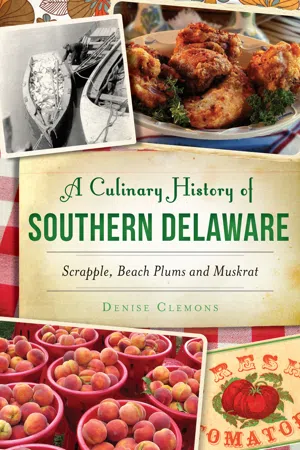
A Culinary History of Southern Delaware: Scrapple, Beach Plums and Muskrat
- 160 pages
- English
- ePUB (mobile friendly)
- Available on iOS & Android
eBook - ePub
A Culinary History of Southern Delaware: Scrapple, Beach Plums and Muskrat
About this book
Historic farms and waterways crisscross Southern Delaware, connecting its residents to a set of rich culinary traditions. The original Nanticoke inhabitants baked hearty johnnycakes and hunted wild game. Hungry for a taste of home, German settlers developed scrapple from local ingredients. Today's home cooks and chefs draw their bounty from the land and sea for a distinct, seasonal cuisine. Summer strawberries and peaches from local farms and orchards become delectable preserves thanks to treasured family recipes. Come springtime, succulent blue crab reigns supreme. With recipes for regional favorites like beach plum jelly and chicken with slippery dumplings, author Denise Clemons explores the history behind the ingredients and savors the story in every dish.
Trusted by 375,005 students
Access to over 1.5 million titles for a fair monthly price.
Study more efficiently using our study tools.
Information
Subtopic
North American HistoryIndex
HistoryChapter 1
SETTLING SOUTHERN DELAWARE
THE FIRST TOWN IN THE FIRST STATE
The Dutch were the first European settlers to arrive in Southern Delaware. They came in search of whaling trade opportunities in 1631 and called the area Zwaanendael, or “Valley of the Swans.” This small group of men built an enclosed fort in what became the town of Lewes on the tip of land between the Atlantic Ocean and the Delaware Bay. According to the evidence left behind, they did not develop friendly relations with the original inhabitants they encountered. Not only did they fail to find whales in the coastal waters, but their entire enterprise also came to an untimely end in a dispute stemming from a cultural misunderstanding with the local Native Americans. When Peter de Vries arrived a year later to check on the settlement, he found that his men had been killed and the buildings burned.
While their presence was short-lived, this timely arrival of the Dutch predated several other land grants and property claims. In the years leading up to the Revolutionary War, ownership was variously held by settlers from Sweden, England and Holland. The last was William Penn’s attempt to include the “lower counties” within the borders of Pennsylvania. The issue was finally resolved during negotiations prior to the start of the Continental Congress, and the three counties (New Castle, Kent and Sussex) became the independent state of Delaware.

The De Vries monument on Pilottown Road, Lewes, Delaware, marks the site of the state’s first settlement and Delaware’s sovereignty as a separate state. Jack Clemons photo.
Other early claims by the English, who wanted the region as part of the Virginia territory, left their mark in Delaware’s name, which comes from the title of the first Virginia governor, Thomas West, 3rd Baron de la Warr. As the first of the original thirteen colonies to ratify the constitution of the new country in 1787, Delaware earned its nickname of the “First State.” Lewes, in the heart of southern Delaware, has come to be known as the “First Town in the First State.”
Progress came slowly to Southern Delaware. As late as 1860, Kent and Sussex Counties remained isolated from the rest of the surrounding region to the north and west. Harold Hancock described this leisurely rural lifestyle in his book Delaware During the Civil War. He found that most people lived on their family farms or in small communities; roads were sandy, not paved; oxen pulled crude farm machinery; much of the harvest was sown and harvested by hand; fabric was loomed from handspun, vegetable-dyed flax; and foodstuffs were limited to what was grown on the farm, pulled from local waters and culled from nearby forests.
After the Civil War, the residents of Southern Delaware became more involved in commercial growing and distribution of fruit, vegetables and grain crops. Over time, the roads and railroads improved transportation, while modernization of machinery and techniques created opportunities for commercial sales and food processing for distant markets.
Throughout the centuries, the favorite foods of Southern Delaware have changed very little; the residents of small towns and expanding communities of today share a rich culinary history.
THE NANTICOKES
Long before any European explorers found their way to the North American continent, Southern Delaware was home to a thriving native population of Nanticoke Indians, descendants of whom still live here today. One of the earliest explorers in the region, Captain John Smith, the founder of Jamestown Colony, extensively traveled the waterways and made several observations about the Nanticokes, whose name translates as “the Tidewater People.” In his 1608 journey along the Nanticoke River, he observed the farming, fishing and hunting practices of the group. He described them as the “best merchants” of all the tribes he encountered, trading animal pelts and beads fashioned from clam and oyster shells.
Because of their proximity to the water, seafood was the primary protein in the Nanticoke diet. Using spears, specially designed woven baskets, nets or bow and arrows, they successfully caught crab, eel, shrimp and a variety of fin fish, especially shad, which were eaten roasted or boiled. They feasted on the abundant supplies of oysters and clams, both raw and cooked. The women butchered the deer, elk, muskrat, rabbit, turkey and ducks hunted by the men. Meat was spit roasted, smoked or added to stews and broths. According to tradition, some of the meat was dried, pounded into a powder and mixed with melted animal fat to make pemmican, a long-lasting, high-energy food that can be considered a precursor to our modern protein bar.
Although the marshy region was not well suited for agriculture, areas slightly inland were cultivated as farmland, where the “three sisters” were grown: corn, squash and beans. Cornstalks provided a trellis for the beans, and the spreading squash vines suppressed weeds at the base of the plants. Fruits, nuts and berries were staples of the Nanticoke diet, although they were rarely eaten fresh out of hand. Fruit and berry pulp was boiled into a dense mash that was then dried into well-preserved strips of “fruit leather.” Nuts were shelled and boiled so the fat that floated to the top could be skimmed and saved to prepare other dishes. The nut pulp was used for fried pancakes, and the reserved boiling liquid was used to cook corn grits.

Nanticoke man in tribal dress at a powwow, circa 1920. Courtesy of the Delaware Public Archives.
Everything we bring to the table in Southern Delaware stems from the traditions handed down from the first people who lived here. They shared what they knew about netting, snaring, shooting, trapping, planting and harvesting, giving early settlers insight into their successful techniques. And they knew how to recycle and reuse: discarded fish bones became fertilizer, and corn husks became livestock bedding.
There are no cookbooks describing how to make the corn and meat dishes favored by the Nanticokes—only traditions passed down through generations. With nothing written as a reference, children learned from their parents by observing and practicing. Into the late seventeenth and early eighteenth centuries, the traditional methods of cooking that had served the Nanticokes for generations evolved with the influx of European settlers. As the Nanticoke community sold off parts of their tribal lands to the newcomers, they were more limited in the available supply of fresh fish and game; many residents turned to farming and trapping to feed their families.
When asked today about their food traditions, the members of the Nanticoke tribe living in Southern Delaware will list three things: corn, muskrat and fry bread. If you were to attend a local powwow, their annual tribal reunion celebration, you would find tacos made with fresh rounds of fry bread and authentic pemmican from dried meat, fat and berries.
RECIPES
These are modern versions of two traditional Nanticoke foods.
Johnnycakes
Once cooked, these sturdy cornmeal disks could be packed to take along on a trip, which gave them the nickname “journey cakes.” Instead of the long-handled wooden tool used to hold these over the fire to brown, the modern cook can use a skillet or griddle to cook these on the stove. On today’s menu, these are a nice change from pancakes for breakfast and tasty when served with maple syrup or jam.
1 cup cornmeal
¾ teaspoon salt
1 cup water
½ cup milk
fat for cooking
Combine the cornmeal and salt in a bowl; set aside. Bring the water to a boil and pour slowly over the cornmeal while stirring constantly. Stir in the milk until mixture is smooth. Generously grease a skillet with bacon fat or lard and place over medium-high heat. When the pan is hot, spoon dollops of batter into the pan and flatten each round to about ¼-inch thick. Cook until golden brown and then flip to brown the other side.
Fry Bread
A byproduct of the forced relocation of Native Americans onto reservations during the 1800s. With limited (and sometimes spoiled) rations provided by the government, women made this high-calorie, puffed-dough circle from just a few ingredients. Their original version might have used dried milk powder, but buttermilk adds a lighter texture. Resist the temptation to substitute vegetable oil—you need to fry these in a traditional solid shortening such as Crisco.
1½ cups flour
1½ teaspoons baking powder
¼ teaspoon salt
½ cup buttermilk
¼ cup water (or more, as needed)
solid shortening for cooking
Sift together the flour, baking powder and salt in a large mixing bowl. Make a well in the center and add buttermilk, stirring to combine. Add just enough water for the dough to hold together, but do not overwork. Cover bowl with a dishtowel and set aside for 45 minutes. Melt enough shortening in a skillet to reach a depth of two inches. Break off a piece of dough about the size of a lime. Set it on a flat work surface and flatten, pushing outward from the center to a diameter of about five inches. Slide disk into the hot oil and cook until browned on the bottom, about 1 minute. Using a pair of tongs, flip the dough and cook until browned on the other side, about another minute. Remove to a paper towel to drain; continue until all the dough has been cooked. Serve topped with honey, cinnamon sugar or jam; alternatively, use as a soft taco shell and top with seasoned ground meat, salsa and cheese. Yield: 6 servings.
Chapter 2
FARMERS FIRST AND ALWAYS
The lands and waters of Southern Delaware attracted European immigrants who could readily earn their livelihoods and feed their families by farming and fishing, a lifestyle that continues through today.
EARLY DAYS
From the time of the first European settlers to the mid-twentieth century, most families who lived in Southern Delaware were farmers and fishermen. Their diets were limited to the crops they grew, the livestock they pastured, the game they hunted and the fish they caught. During the 1600s, families cultivated corn, peas, wheat and barley, all of which grew well in the region. They arrived from Europe or relocated from nearby Virginia and Maryland, bringing pigs, cattle, sheep and goats, which they raised for both meat and milk.
By the early 1700s, tobacco was still popular as a literal cash crop: harvests were used to settle debts, pay court fines or exchange for purchases. Beef cattle ranged freely across the marshes and in the woodlands, needing almost four years to grow large enough for slaughter. By comparison, according to the Delaware Department of Agriculture, today’s commercial beef producers grow their cattle to full size in less than one year.
In this period, many of the farms were small, producing just enough to feed the family, with some surplus to sell or trade for commodities and imported goods such as sugar and spices. Life revolved around the schedule of the growing season: preparing the ground after the spring thaw, planting crops, thinning and weeding the fields and, finally, harvesting.
A similar cycle dictated when hogs were fattened, butchered and cured with salt or smoke or both. In the winter months, hunting and trapping augmented the menu of smoked meats, preserved fruit and pickled vegetables. While most livestock and game became part of a meal according to the season, hens supplied eggs throughout the year.
The daily diet of the region was simple and spare. For most people who rose early to begin chores, breakfast was a hastily swallowed bowl of cornmeal mush or bread soaked in milk, typically washed down with cider or beer. The main meal of the day, called dinner, was served in the early afternoon. Meat or fish, roasted or stewed, was a common main course, served with boiled vegetables and bread. An evening meal was most likely leftovers from earlier in the day or the previous day.
Plates, known as trenchers, were made of wood or horn, and a small, shallow, one-handled cup known as a porringer served for eating pudding or drinking soup. Spoons were much flatter than the deep, bowl-shaped spoons of today, and the first forks (rarely used) were a...
Table of contents
- Front Cover
- Half Title
- Title Page
- Copyright
- Dedication
- Contents
- Acknowledgements
- Introduction
- 1. Settling Southern Delaware
- 2. Farmers First and Always
- 3. Fruits of the Orchards and Vines
- 4. Always Eat Your Vegetables
- 5. Grains and Gristmills
- 6. Meat on the Hoof and in the Streams
- 7. Poultry and Plucky Blue Hen Chickens
- 8. Swimmers and Shellfish
- 9. Potent Potables
- 10. The Road to the Future
- Appendix I. How Cookbooks Tell Our Stories
- Appendix II. Farms and Markets in Southern Delaware
- Bibliography
- About the Author
Frequently asked questions
Yes, you can cancel anytime from the Subscription tab in your account settings on the Perlego website. Your subscription will stay active until the end of your current billing period. Learn how to cancel your subscription
No, books cannot be downloaded as external files, such as PDFs, for use outside of Perlego. However, you can download books within the Perlego app for offline reading on mobile or tablet. Learn how to download books offline
Perlego offers two plans: Essential and Complete
- Essential is ideal for learners and professionals who enjoy exploring a wide range of subjects. Access the Essential Library with 800,000+ trusted titles and best-sellers across business, personal growth, and the humanities. Includes unlimited reading time and Standard Read Aloud voice.
- Complete: Perfect for advanced learners and researchers needing full, unrestricted access. Unlock 1.5M+ books across hundreds of subjects, including academic and specialized titles. The Complete Plan also includes advanced features like Premium Read Aloud and Research Assistant.
We are an online textbook subscription service, where you can get access to an entire online library for less than the price of a single book per month. With over 1.5 million books across 990+ topics, we’ve got you covered! Learn about our mission
Look out for the read-aloud symbol on your next book to see if you can listen to it. The read-aloud tool reads text aloud for you, highlighting the text as it is being read. You can pause it, speed it up and slow it down. Learn more about Read Aloud
Yes! You can use the Perlego app on both iOS and Android devices to read anytime, anywhere — even offline. Perfect for commutes or when you’re on the go.
Please note we cannot support devices running on iOS 13 and Android 7 or earlier. Learn more about using the app
Please note we cannot support devices running on iOS 13 and Android 7 or earlier. Learn more about using the app
Yes, you can access A Culinary History of Southern Delaware: Scrapple, Beach Plums and Muskrat by Denise Clemons in PDF and/or ePUB format, as well as other popular books in History & North American History. We have over 1.5 million books available in our catalogue for you to explore.