This study is an historical analysis of the operational methods of two men who commanded large military formations with great success during World War II: Colonel-General Heinz W. Guderian of the German Army; and General George S. Patton, Jr. of the American Army. The focus of the study is on each man's conduct of operational art, the connecting link between tactics and strategy. The study analyzes the writings and campaigns of Guderian and Patton and attempts to identify the tenets or principles by which each man guided his conduct of Operational art. The study then compares the tenets each man applied in his conduct of warfare to discover whether there were any principles common to their operational methods. Finally, the study suggests what implications common tenets at the operational level of war might have for Airland Battle Doctrine.
The study concludes that Guderian and Patton shared six common tenets in their conduct of operational art and suggests that the American Army's current organizations at the division and corps levels may not be suitable to conduct the sort of agile operations that will be required on a future battlefield. As well, we must ensure that doctrinal foundations for joint operations involving air and ground forces-as a minimum-are in place before war breaks out. It also suggests that we need to get together with our European Allies and adopt a common doctrinal approach to warfighting in Western Europe, one that supports a common theater strategy. Finally, the study concludes that the American Army should continue to study the history of warfare and learn its lessons.
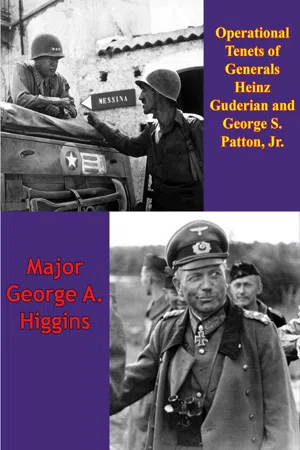
eBook - ePub
Operational Tenets Of Generals Heinz Guderian And George S. Patton, Jr
- 138 pages
- English
- ePUB (mobile friendly)
- Available on iOS & Android
eBook - ePub
Operational Tenets Of Generals Heinz Guderian And George S. Patton, Jr
About this book
Information
Subtopic
European HistoryIndex
HistoryCHAPTER 1: INTRODUCTION
The recent resurgence of interest in operational art in the American Army has spawned historical comparisons that suggest valid implications for the contemporary American Army's preparations for the conduct of operational art. Of particular interest in such comparisons are the operational styles of successful commanders such as Generals Heinz Guderian and George S. Patton, Jr. To many professional soldiers and students of military history alike, those names have special meaning. The reason for that probably lies in the fact that each man was an eminently successful commander in World War II. But that answer, of course, only begs the further and more meaningful question: Why was each of these men successful in commanding large formations of men in combat? It is not only a question worth asking, it is one worth taking the time to answer as well. This thesis represents an attempt to partially answer that question by answering the question “Were there any tenets common to the operational methods of Generals Heinz Guderian and George S. Patton, Jr. in World War II?” The answer to this question will provide, in part at least, an explanation for the success of these two men in commanding large military formations. If it turns out, for example, that each man adhered to a set of common tenets in his planning and conduct of operational art, then that would serve as some evidence that success in operational art derives, in part, from the correct application of certain tenets. Given the focus of this thesis, research into the operational methods of Guderian and Patton could not, of course, give a full account of the successes of those men because it fails to take into consideration other relevant factors such as personal leadership, mistakes of opposing commanders, and training status of enemy and friendly units, to mention just a few. But it would, nonetheless, help illuminate the principled basis for the employment of forces at the operational level of war, a subject of considerable interest today because doctrinally the American Army is committed to fighting in a fashion remarkably similar to the manner of combat in World War II, as will soon be pointed out.
At this point, however, one may well ask why Generals Guderian and Patton were selected for the purposes of this study. In part, the answer has already been given. Doctrinally, contemporary Airland Battle envisions the commitment of U.S. Army forces to combat on a battlefield of the future which is likely to be fluid, dynamic, lethal, and fast moving. Such a description of the modern battlefield goes a long way toward describing the World War II battlefields on which Guderian and Patton fought. Moreover, aside from temporary reverses suffered by both, each of these soldiers was immensely successful in commanding at the operational level of war: corps and echelons above corps level. Because success in battle is the final arbiter in war, there is not much else to be said about these men except that they serve, if any do, as paradigmatic examples of successful planners and executors of operational art.
A final point worth making about the selection of these men for the focus of this study is that the diversity of their cultural, social, and political heritages as well as the diverse natures of the theaters in which they fought adds a breadth to this investigation that would otherwise be absent. The value of this feature of the study is that if it should turn out that there is a shared principled basis for operational art between Patton and Guderian, then already we have evidence that such tenets are not culturally or geographically specific.
Another question which naturally suggests itself is “Why do a study such as this at all?” This question, too, has been answered partially already but demands fuller treatment. First, the U.S. Army's current doctrine as reflected in the 1932 version of FM 100-5, Operations, envisions the necessity for employing and sustaining operational-level forces—corps and echelons above corps—on a fluid, non-linear, lethal, integrated, and dynamic battlefield. Such a battlefield will be integrated in the sense that opposing forces will not only fight with light and heavy armored and mechanized combined arms forces in joint operations but also employ chemical and nuclear fires as a matter of course. And, the chemical and nuclear dimensions notwithstanding, the historical precedents which most closely approximate the conditions of such future combat are the highly fluid campaigns which occurred in World War II in virtually every theater.
Second, and equally important, the current doctrinal requirement is not merely to execute tactical operations but to plan, execute, and control the maneuver of large bodies of forces—corps, armies, and army groups. Here the rub is two—fold: (1) the American Army has had no occasion or requirement to plan and execute operational art since Korea;{1} and as a result, (2) it has neither an officer corps well-schooled in operational art nor a firm doctrinal grasp on the principled basis for how to fight large units. Taken together, these facts present a dilemma. Although current U.S. Army doctrine—Airland Battle—requires the American Army to fight corps and armies, it does not have the properly trained leadership to plan and conduct operational art. Moreover, there does not appear to be an abundance of contemporary literature forthcoming which addresses the principled basis for operational art. Consequently, the answer to the question “Why this study?” lies in a recognition of the large vacuum of experience and knowledge in the U.S. Army about the subject and the absence of any recent literature on the subject.
Having considered what this thesis focuses on and why, we need to establish some definitions and outline a methodology which serve as the logical framework for the arguments that are developed herein. First, for any discussion on a technical subject such as military art to be fruitful, indeed intelligible, a shared vocabulary is a prerequisite. So, before launching into a discussion of the operational tenets of Guderian and Patton, it would be wise to come to some agreement on what is meant by some key words and concepts used throughout this thesis.
For example, if this study proposes to identify and define operational tenets employed by the commanders under consideration, then one must have some idea of what an “operational tenet” is because it is not immediately clear how one might go about finding something without having some fairly clear idea about what is being sought. In short, “What is an operational tenet?” is a question that readily suggests itself. And the temptation here is to offer a synonym such as “rule” or “law,” but it should be evident that such a step not only complicates the problem but begs the question besides. Procedurally, we first need to make it clear what is meant by terms such as “operational art” and “the operational level of war,” and then tackle the problem of what is meant by “tenet.”
It is generally acknowledged by contemporary theorists that any comprehensive theory of war must include at least three levels of war: strategic, operational, and tactical.{2} As suggested earlier, most American Army officers probably have a firm understanding of current tactical doctrine and, to a significantly lesser degree, an understanding of theater and global military strategy. What is almost wholly absent in our officer corps is a firm understanding of the dimension of war fighting which connects tactical operations to theater and global military strategy—the operational level of war. Whereas tactical art focuses on the winning of tactical engagements and battles and strategic art success at the theater level, the operational level of war focuses on the planning and conduct of campaigns{3} Simply stated, operational art involves the maneuver of large units such brigades, divisions, and corps. It may sharpen the focus of the discussion to say that generally tactical art is planned and executed at division level and below while operational art falls to the corps and field armies. It would be foolish, however, to draw the line between these two levels of war too sharply or insist that it remain where initially drawn. A division, for example, may be given an operational mission in a particular case. The operational level of war, then, may be defined as (1) the connecting link between tactics and strategy which is (2) concerned with the maneuver of large units (3) for the purpose of winning campaigns in support of theater strategy. And, generally, the units which perform these sorts of function are corps, armies, and army groups. Disposal of the task of defining the operational level of war still leaves the more difficult and delicate task of offering an intelligible definition of “tenet.”
Earlier it was suggested that a facile way of defining “tenet” is simply to say that a tenet is merely a rule or law. A better way to grasp what is meant by “tenet” is to begin by adopting the meaning implicit in the phrase “principles of war.” Here “principle” means a generalization or general truth about the nature of war. The principle of Surprise, for example, enjoins military commanders to achieve surprise whenever they can because by doing so a commander can gain a crucial psychological and moral advantage over his enemy. But notice two important characteristics of this principle of war. First, the principle is universal in application and therefore applies at the strategic and operational as well as tactical. levels of war. Second, the principle does not address the question of how surprise at any level is to be achieved. The value in having universal principles, however, is in knowing how to apply them to achieve some desired outcome: in the case of military art, victory. So at some point abstract principles such as “Achieve surprise when possible” have to be translated into more concrete principles or tenets that suggest how surprise can be achieved at a particular level of war. Here conceptual clarity appears to demand that we make a distinction between principles that guide our decision making and tenets which specify how to accomplish whatever it is the “what” principles have suggested. Where to draw the line between the abstract and the specific, between objective and technique, may at times be impracticable. Indeed, it may even be true that operational tenets of the sort this thesis proposes to uncover may include some of the method as well as the objective. Because the business of warfighting is part science and part art, it should not surprise us to see tenets that tell us what is to be done melding with techniques which suggest how they should be done. At some point the abstract has got to be translated into the concrete, into a definitive technique, preferably one that has been validated by the experiences of history. This discussion, than, suggests that operational tenets are generalizations about the nature of operational art as derived from historical reality. In essence, operational tenets are inductive generalizations which can be seen to apply at the operational level of war. For convenience throughout the remainder of this thesis “principle” and “tenet” will be used interchangeably to refer to such generalizations.
It remains now to address the question of methodology. The question this thesis seeks to answer—What were the common operational tenets of Guderian and Patton—presupposes the answers to two prior questions. First, were the operations of each commander guided by recognizable tenets at all? If the answer to this question is no, then we must give up the project right from the beginning. But surely the rational approach is to assume at the beginning that the operations of Guderian and Patton were guided by principles or basic tenets of some sort. Then, if it turns out that historical research will not support the assumption, the answer to the proposed thesis question will have become evident. A further point worth bearing in mind, moreover, is that if one takes the conduct of war to be a rational enterprise at all, then he should not be surprised to find that principles or tenets of some sort served as guides for the conduct of war at the operational level for these two highly successful World War II commanders and other commanders as well.
Second, in order to answer a question directed at commonality of tenets between Guderian and Patton, one must first uncover the operational principles of each man. Here the obvious approach is to read primary and secondary sources about these men and their operations in World War II. This should be a two-pronged approach. Examination of sources may shed light on what a particular commander said about operational art, and that would be some good evidence for inferences about the tenets which lay behind his operations. More revealing, however, is the further step of checking the consistency between what a commander said and what he and his units actually did in combat. If research reveals that a particular commander said, “X is a tenet by which I operated,” and his operations consistently reflect the application of that tenet as well, a good case can then be made for the view that X is a tenet by which that commander planned and conducted operational art.
By now it should be evident that a general methodology for answering the question this thesis proposes to answer is suggested by the question itself. First, it must be assumed that Guderian and Patton operated by recognizable tenets or principles. Although it may prove false, a case has been offered for the truth of that assumption. Second, one must determine by what particular tenets each man operated. Here the task is to search historical primary and secondary sources for evidence of what these men said about the operational level of war and how they actually conducted their campaigns. In the case of Guderian the focus is on three campaigns: the Polish Campaign of 1939; Flanders (Ardennes) Campaign of 1$40; and the Russian (BARBAROSSA) Campaign of 1941. For Patton, the thesis examines his North African Campaign of 1942; Sicily, 1943; and Northwest Europe, 1944-45. So, in order, Chapters 2 and 3 seek to answer succinctly the question: What were the operational tenets of Guderian and Patton in World War II? Third, Chapter 4 pursues the next logical step by ascertaining what tenets, if any, were common to the operational methods of these two commanders. What should fall out in Chapter 4 is an answer to the primary question this thesis seeks to answer. In addition, however, Chapter 4 tries to answer the further relevant question for contemporary soldiers: What does it all mean? A set of common operational tenets for operational art suggests that such tenets apply to Airland Battle Doctrine on a future battlefield if historical experiences are any useful guide to future experiences. Chapter 4 attempts to sketch out some implications for operational art on a future battlefield. Even a stab in this direction may help future commanders and staff officers cope with the unknown and doctrine writers to develop new concepts for fighting a future war.
CHAPTER 2: GENERAL HEINZ GUDERIAN
PART I: THE MAN
Even when he was a young major, Heinz Guderian's soldiers affectionately called him “Hurrying Heinz.” The reason for this appellation and its appropriateness will become evident as this chapter on the operational tenets of General Heinz Guderian unfolds. The story behind the nickname, however, anticipates the heart of the argument concerning Guderian's principles of operational art, which are developed in this chapter by examining Guderian's operations through a Prism of analysis which focuses on the following five broad categories: (1) combined arms operations, (2) offensive action, (3) momentum, (4) command and control, and (5) risk. The general approach is to examine Guderian's writings and his conduct of operations in the 1939 Polish, 1940 Flanders, and 1941 Russian Campaigns, and derive some substantive conclusions about the basis for Guderian's conduct of operational art. The chapter concludes by summarizing the principles derived -from the analysis. But before launching into the substance of Guderian's operational methods, a brief character and background sketch of the man who was Germany's leading proponent and commander of armored forces in World War Il is in order.
Born at Kulm in 1888, Heinz Wilhelm Guderian was the son of a German Army officer who traced his ancestry back to a thoroughly Prussian, landed gentry. He attended both the Karlsruhe cadet school in Baden and the Gross-Lichterfelde school near Berlin, graduating from the latter in 1907. After attendance at the War School at Metz, he was commissioned a second lieutenant and assigned to an infantry battalion in Hannover.
By inter-war standards the progress of Guderian's career was ordinary until Hitler's rise to power, and then his rise was quick. But even if ordinary in its early promotion pace, Guderian’s career was unusual for its diversity of assignments. In 1912, for example, he served with the 3rd Telegraph Battalion where he became acquainted with the latest wireless radio technology and its tactical applications. During World War I he served successively as a signals staff officer, General Staff officer, battalion commander, quartermaster officer, and operations officer with a variety of units from company and battalion to division and corps. Between the world wars Guderian commanded a motor transport battalion, taught motor transport doctrine and tactics at the Berlin War Academy, and as a colonel commanded the 2nd Panzer Division in 1935. Thanks to Hitler, by 1938 Guderian was a General of Panzer Troops and had played a leading role in the occupation of Austria and the Sudetenland.
During World War II Guderian had the unique opportunity to carry out operations in accordance with doctrine he helped develop in the pre-war years. In effect, he turned theory into practice by participating in three major campaigns—in Poland, Flanders, and Russia—and served in those campaigns respectively as an army corps, panzer group, and panzer army commander. In spite of great successes in all three campaigns, Hitler relieved Guderian of command of his panzer army in December 1941 for failing to follow orders to hold forward positions outside of Moscow at all costs.{4} Brought back on active service in March 1943 as Inspector-General of Armored Forces, Guderian was appointed Chief of the Army General Staff the day after the attempted assassination of Hitler in July 1944. He served as Chief of the Army General Staff until March 1945 when Hitler again dismissed him. He was captured by American forces in May 1945, held in captivity until June 1948, and died in 1954.
As impressive as these few paragraphs make Guderian's career out to be, they hardly do justice to the m...
Table of contents
- Title page
- TABLE OF CONTENTS
- ABSTRACT
- CHAPTER 1: INTRODUCTION
- CHAPTER 2: GENERAL HEINZ GUDERIAN
- CHAPTER 3; GENERAL GEORGE S. PATTON, JR.
- CHAPTER 4: CONCLUSION
- REQUEST FROM THE PUBLISHER
- BIBLIOGRAPHY
Trusted by 375,005 students
Access to over 1.5 million titles for a fair monthly price.
Study more efficiently using our study tools.
Frequently asked questions
Yes, you can cancel anytime from the Subscription tab in your account settings on the Perlego website. Your subscription will stay active until the end of your current billing period. Learn how to cancel your subscription
No, books cannot be downloaded as external files, such as PDFs, for use outside of Perlego. However, you can download books within the Perlego app for offline reading on mobile or tablet. Learn how to download books offline
Perlego offers two plans: Essential and Complete
- Essential is ideal for learners and professionals who enjoy exploring a wide range of subjects. Access the Essential Library with 800,000+ trusted titles and best-sellers across business, personal growth, and the humanities. Includes unlimited reading time and Standard Read Aloud voice.
- Complete: Perfect for advanced learners and researchers needing full, unrestricted access. Unlock 1.5M+ books across hundreds of subjects, including academic and specialized titles. The Complete Plan also includes advanced features like Premium Read Aloud and Research Assistant.
We are an online textbook subscription service, where you can get access to an entire online library for less than the price of a single book per month. With over 1.5 million books across 990+ topics, we’ve got you covered! Learn about our mission
Look out for the read-aloud symbol on your next book to see if you can listen to it. The read-aloud tool reads text aloud for you, highlighting the text as it is being read. You can pause it, speed it up and slow it down. Learn more about Read Aloud
Yes! You can use the Perlego app on both iOS and Android devices to read anytime, anywhere — even offline. Perfect for commutes or when you’re on the go.
Please note we cannot support devices running on iOS 13 and Android 7 or earlier. Learn more about using the app
Please note we cannot support devices running on iOS 13 and Android 7 or earlier. Learn more about using the app
Yes, you can access Operational Tenets Of Generals Heinz Guderian And George S. Patton, Jr by Major George A. Higgins in PDF and/or ePUB format, as well as other popular books in History & European History. We have over 1.5 million books available in our catalogue for you to explore.