During World War II, certain air force generals demonstrated an uncommon ability to succeed on the battlefield in spite of considerable obstacles. Whether solving operational issues, developing technical innovations, or devising logistic solutions, these commanders transcended service-centric doctrine and loyalties in order to achieve their objectives. Are there common elements among their personal background, professional education, officer development, and operational experience that helps explain their success? This paper will examine two contemporary tactical airpower commanders, Lieutenant General Elwood "Pete" Quesada and Generalfeldmarschall Wolfram Freiherr Von Richthofen, in an attempt to answer this important question.
This study comprises an analysis of two contemporary tactical airpower commanders from World War II, Lieutenant General Elwood "Pete" Quesada and Generalfeldmarschall Wolfram Freiherr Von Richthofen. It attempts to determine how they succeeded where others failed. Whether solving operational issues, developing technical innovations, or devising logistic solutions, these commanders transcended service-centric doctrine and loyalties in order to achieve their objectives. The author searches for common elements among their personal background, professional education, officer development, and operational experience that help explain their uncommon triumphs. The analysis includes both external and internal factors to determine which is dominant. The final section includes five recommendations intended for those who conduct officer accession, professional development, and promotion boards. The ultimate objective is to provide timeless criteria that transcend technological advancements and the changing character of war.
eBook - ePub
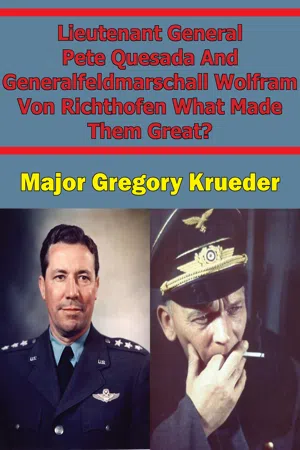
Lieutenant General Pete Quesada And Generalfeldmarschall Wolfram Von Richthofen What Made Them Great?
- 185 pages
- English
- ePUB (mobile friendly)
- Available on iOS & Android
eBook - ePub
Lieutenant General Pete Quesada And Generalfeldmarschall Wolfram Von Richthofen What Made Them Great?
About this book
Trusted by 375,005 students
Access to over 1.5 million titles for a fair monthly price.
Study more efficiently using our study tools.
Information
Subtopic
European HistoryIndex
HistoryChapter 1 — Introduction
History does not entrust the care of freedom to the weak or the timid. — General Dwight Eisenhower
During World War II, certain air force generals demonstrated an uncommon ability to succeed on the battlefield in spite of considerable obstacles. Whether solving operational issues, developing technical innovations, or devising logistic solutions, these commanders transcended service-centric doctrine and loyalties in order to achieve their objectives. Are there common elements among their personal background, professional education, officer development, and operational experience that helps explain their success? This paper will examine two contemporary tactical airpower commanders, Lieutenant General Elwood “Pete” Quesada and Generalfeldmarschall Wolfram Freiherr Von Richthofen, in an attempt to answer this important question.
Although this paper focuses on air force generals, any findings are relevant to all military services. In addition to the USAF, the US Army, Navy, and Marine Corps all strive to optimize recruitment, training, and professional development of their future leaders. They all use selection boards, officer development courses, and career planning pyramids to find, cultivate, and promote their officers. The US military today, as a volunteer force, enjoys the most professional and capable officer corps in history. To some extent, however, all branches still struggle with service-centric mindsets, adherence to parochial and obsolete doctrine, and resistance to new technologies that they see as a threat to either. Quesada and Von Richthofen not only successfully overcame these issues, but they did so under wartime conditions.
In researching these men, this study draws heavily on primary source documents stored at the Air Force Historical Research Agency (AFHRA). When available, it uses official messages, general orders, personal interviews, and unit histories. Immediately after World War II, former German commanders conducted several official air force historical studies regarding German operations during the war. These studies provide a rare insight into how the Luftwaffe viewed and conducted its Blitzkrieg operations. When necessary, this paper uses secondary and tertiary sources to fill in the gaps and provide a balanced perspective.
Using these sources, this paper will conduct a combination of qualitative and historical research. Looking at these generals in turn, it will explore their personal background, professional education, and operational experience. When possible, it focuses on their individual impact in an attempt to isolate personal characteristics or actions that seemed most effective. This paper will then comparatively analyze the two generals, focusing on external then internal factors, to determine if they share these key elements. Finally, while acknowledging the limited scope of this study, it will make an appropriate recommendation regarding any findings.
The ultimate goal is to provide those who conduct officer acquisition, training, and professional development with timeless criteria that will help them select and cultivate their future leaders. The human element in virtually any military operation remains both the most crucial and weakest link. Throughout history, some commanders have faced technologically and numerically superior forces, yet somehow emerged victorious. The US today is conducting overseas contingency operations in every corner of the world while tackling a financial crisis not seen since the Great Depression. Now more than ever, the nation demands military officers that have the ability, vision, and courage to lead the US through these tumultuous times.
Chapter 2 — Lieutenant General Elwood “Pete” Quesada
I have nothing to offer but blood, toil, tears and sweat....You ask, what is our policy? I say it is to wage war by land, sea, and air. War with all our might and with all the strength God has given us, and to wage war against a monstrous tyranny never surpassed in the dark and lamentable catalogue of human crime. That is our policy. You ask, what is our aim? I can answer in one word. It is victory. Victory at all costs—Victory in spite of all terrors-Victory, however long and hard the road may be, for without victory there is no survival. — -Sir Winston Churchill.
VICINITY OF ST. LO, FRANCE, 1 AUGUST 1944, 1015 HOURS. Allied forces rapidly advanced past St. Lo and IX Tactical Air Command (TAC) was struggling to keep up with the changing ground picture. Major General Elwood R. “Pete” Quesada, commander of IX TAC, grabbed Colonel Blair Garland, his signal officer, and headed to a forward unit for the latest intelligence. “Hop in the jeep, Garland,” Quesada said, “We are going up to the 70th Wing and see how things are going.” As soon as he arrived at the 70th Quesada walked up to the wing intelligence officer. Quesada inquired, “What’s the situation?” “Well, sir, at 9 o’clock...,” the Lieutenant Colonel began. “Goddammit, when I left the headquarters that was the situation,” Quesada barked. “What is it now?”{1}
Now furious, Quesada stormed up to the 70th Wing Commander, Brigadier General James McCauley, who greeted him with open arms. “Everything is going great,” McCauley said. Quesada repeated his question, “Well, what is the situation?” “At 9 o’clock.,” McCauley began. Quesada went straight up in the air, “Goddammit, I bet my headquarters knows more about this than you do!” Grabbing the telephone, Quesada barked at the hapless operator, “Give me my headquarters!” The operator, thoroughly unseated, promptly connected Quesada to the quartermaster by accident. Quesada slammed the phone down. “Nothing works in this goddamn command, nothing! It’s the worst communication system I ever saw!” With that Quesada grabbed Colonel Gilbert Meyers, a hapless bystander, jumped in the jeep and thundered off to the front to see for himself. Abandoned by his commander and pretty sure he had just been fired, Garland borrowed another jeep and drove fifty-five miles back to headquarters where he packed his bags. “Well, that’s the end of me,” he thought to himself.{2}
Meanwhile, Quesada and Meyers drove up to Major General Charlie Gerhardt, 29th Infantry Division Commander. Quesada announced that he was driving ahead to Villebaudon, where the Second Armored Division was spearheading the advance.{3} “Mighty fine,” Gerhardt replied, offering them a guide. “Hell, no,” Quesada retorted, “I’m used to moving among the enemy. I’m an airman. I can find my way.”{4} A few minutes later Quesada was weaving among the Sherman tanks at the front when they came upon a Tiger tank that had just punched in from the flanks.
“Say, that German tank there does not look like it’s been knocked out,” Quesada observed. He was right; just then an armor piercing shell slammed into Quesada’s jeep and went right under his seat, taking out the axle. The jeep, now useless, collapsed to the ground. Quesada and Meyers dove headlong into the adjacent hedges for cover. After the coast was clear they crawled along a ditch then scurried back behind friendly lines. Quesada eventually made his way back to IX TAC headquarters and ran into Garland two days later. “You know, I have been thinking about this,” Quesada said, apologizing in his own way. “You are the best goddamn signal officer I ever saw.” With that Garland unpacked his bags; he later reflected that Quesada would “occasionally blow his top, and he would always come back and say he was sorry.”{5} In a relentless quest to push IX TAC to the limit, Quesada’s aggressive nature would occasionally get the better of him. This was war, however, and Quesada was not afraid to step on toes in order to get the job done.
Personal Background
Elwood Richard Quesada was born on 13 April 1904 in Washington DC; his father was a Spanish banker and his mother an Irish-American from New York City. In his own words, Elwood was “basically an immigrant.”{6} Both of his parents were devout Catholics and raised Elwood accordingly. Unfortunately, they had a turbulent marriage as neither could agree on where to live. Although owning a residence in Washington as a part of his banking business, Elwood’s father argued that the family should live in Spain. His mother, on the other hand, was concerned about bringing up children in Spain, considering it a backward country with inferior medical care. His parents divorced over this issue when he was just a child.{7}
In accordance with contemporary customs, Elwood, his older sister, and two older brothers stayed with their mother in Washington DC. On several occasions Elwood traveled to Spain and visited his father, considering him “a decent, God-fearing man with an abundance of Spanish pride, which was to a young boy, attractive in those days.” Elwood’s moral and religious upbringing was a mainstay that he embraced throughout his career and life.{8}
In both high school and college, Quesada showed a clear preference for athletics over academics. Although a self-professed “fair” student in high school, Quesada compensated for his academic indifference as a capable quarterback for the football team. He was also a member of the baseball, basketball, tennis, and track teams. When Quesada attended the University of Maryland in 1923 he became moderately well-known as their quarterback.{9}
When school was out for the summer, Quesada sometimes worked as a lifeguard at the Tidal Basin Bathing Beach in Washington. One day, while Quesada was rowing the lifeboat in the basin, Millard “Tiny” Harmon, a lieutenant in the Air Service, swam up and hung on. Quesada, in his admittedly “arrogant way...told him to get off the boat.” Tiny had refereed some of Quesada’s games and noted his aggressive yet competent nature; he just smiled back and asked, “What are you going to next year?” Quesada, looking askance at him, replied he was going back to the University of Maryland. Tiny countered with an offer to take him on an airplane ride, “Come on, and go with me to Brooks Field.”{10} The offer intrigued Quesada and the next day he flew for the first of what would be many times at Bolling Field. It was love at first sight, thus marking a non-traditional beginning to an exemplary career.
When Quesada entered the military in the fall of 1924, he was an unlikely candidate to become a distinguished general. Quesada did not come from a military family nor did he attend a military academy. He did not share a sense of destiny and mission, which has driven so many other military leaders. In fact, it appears that timing and luck had more to do with his entry than anything else. Quesada entered the Air Service with few expectations and even fewer preconceptions. He held no preconceived notions of strategic airpower doctrine, nor was he concerned or likely even aware at the time of the Air Service’s ongoing struggle for independence from the Army. Free of these intellectual and moral burdens, Quesada could simply apply his natural talent to the task at hand without worrying about its future implications for the new air arm.
Early Military Career
Two days after his demonstration flight with Tiny Harmon, Quesada was on his way to Brooks Field in San Antonio for initial flight training. From the beginning, Quesada’s military career would prove truly unique. Soon after Quesada arrived at Brooks, he began playing as quarterback for the base football team. Unfortunately, one day Quesada broke his leg playing against the University of Texas and immediately fell behind in the training program.{11} As the holiday break approached, it did not seem Quesada would be in San Antonio long enough to greet the New Year. This is where First Lieutenant Nathan Twining, future Chairman of the Joint Chiefs of Staff, intervened to save what would have been a very short career. Twining sacrificed his holiday break and for the next two weeks flew with the barely-healed Quesada every day.{12} Quesada impressed Twining with his natural flying skill. When the holidays were over, Quesada had caught up with his classmates. Due to his broken leg, Quesada only flew eighty hours as opposed to the standard 100 training hours, but it was enough to graduate on time. Quesada and Twining remained friends as he, “was always grateful to Nate for keeping me in.” This was an auspicious start to Quesada’s career highlights his uncanny knack for forming important associates.{13}
Six months after graduating from primary flight school in February 1925, Quesada earned a slot in the pursuit training course, which he thoroughly enjoyed. Unfortunately, the air service soon released Quesada along with several other young pilots; this was common practice during the frugal interwar years. Quesada was mildly disappointed to leave the service in the fall of 1925, but he had gone to Texas mostly on a whim anyway. Over the next two years, Quesada flowed through a series of ...
Table of contents
- Title page
- TABLE OF CONTENTS
- ACKNOWLEDGEMENTS
- ABSTRACT
- Chapter 1 - Introduction
- Chapter 2 - Lieutenant General Elwood “Pete” Quesada
- Chapter 3 - Generalfeldmarschall Wolfram Von Richthofen
- Chapter 4 - Comparative Analysis and Recommendations
- Chapter 5 - Conclusion
- Bibliography
Frequently asked questions
Yes, you can cancel anytime from the Subscription tab in your account settings on the Perlego website. Your subscription will stay active until the end of your current billing period. Learn how to cancel your subscription
No, books cannot be downloaded as external files, such as PDFs, for use outside of Perlego. However, you can download books within the Perlego app for offline reading on mobile or tablet. Learn how to download books offline
Perlego offers two plans: Essential and Complete
- Essential is ideal for learners and professionals who enjoy exploring a wide range of subjects. Access the Essential Library with 800,000+ trusted titles and best-sellers across business, personal growth, and the humanities. Includes unlimited reading time and Standard Read Aloud voice.
- Complete: Perfect for advanced learners and researchers needing full, unrestricted access. Unlock 1.5M+ books across hundreds of subjects, including academic and specialized titles. The Complete Plan also includes advanced features like Premium Read Aloud and Research Assistant.
We are an online textbook subscription service, where you can get access to an entire online library for less than the price of a single book per month. With over 1.5 million books across 990+ topics, we’ve got you covered! Learn about our mission
Look out for the read-aloud symbol on your next book to see if you can listen to it. The read-aloud tool reads text aloud for you, highlighting the text as it is being read. You can pause it, speed it up and slow it down. Learn more about Read Aloud
Yes! You can use the Perlego app on both iOS and Android devices to read anytime, anywhere — even offline. Perfect for commutes or when you’re on the go.
Please note we cannot support devices running on iOS 13 and Android 7 or earlier. Learn more about using the app
Please note we cannot support devices running on iOS 13 and Android 7 or earlier. Learn more about using the app
Yes, you can access Lieutenant General Pete Quesada And Generalfeldmarschall Wolfram Von Richthofen What Made Them Great? by Major Jeremy Kreuder in PDF and/or ePUB format, as well as other popular books in History & European History. We have over 1.5 million books available in our catalogue for you to explore.