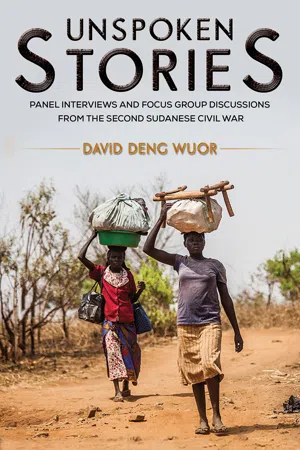
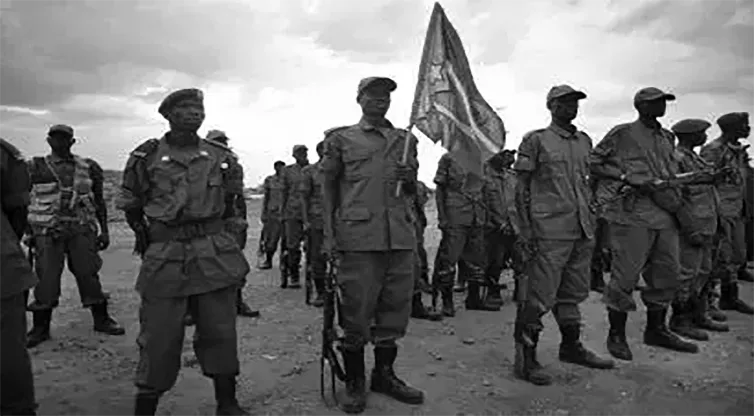
Source: AP / Jason Patinkin / Juba, South Sudan in April 07, 2016.
Just right after 1890-1953 British colonial powers, they let the so-called Old Sudan regime go for independence in 1956, for self-governance, and/or self-determination. In 1956, Sudan started to monopolize powers independently from overseas 1890-1953 colonial British’s Boma-like stockade Administrations.
"In the 1890s, British forces invaded the Mahdi’s Sudan,
bringing it under control, imposing their policies, and
filling the top administrative posts with British officials
(Zirulnick, 1-7, 2011)."
Without legitimate working governmental structures put in place in the areas of South Sudan residences. Sudan, as a whole, was becoming “safe haven” for “Mahdi-gahdeen” terrorist groups, and/or splintering groups. And South Sudan regional people probably were not explicitly entitled to anything then. And they were also not part of colonial independent, power monopoly, proper wealth sharing, border demarcations, religious freedoms, and/or River Nile authority arrangements. Of course, the 2005-2011 Comprehensive Peace Agreement (CPA) mandate was still not brokered by the Intergovernmental Development Authority (IGAD).
Few angry and dissatisfied folks from South Sudan’s regional entities: Upper Nile region, equatorial region, and/or Bhar-el-Ghazal regions organized themselves for open military training leadership in the Torit town in the equatorial region. For potential uprising campaigns against the Old Sudan, they recently brokered independence from the 1890-1953 British colonial powers with series of twin causations. There was not any proper power monopoly in the Old Sudan government, and/or implicit wealth and resource-sharing mandate. And lack of religious freedoms was pivotal regardless of heritages whether from the Middle East Arabian (ics) descents, and/or from the “pariah” of African heritage descents. The Old Sudan as they brokered independence from 1890-1953 British colonial powers, they were arrogantly possessed, and/or obsessed with the sensation of “Sudanism” regardless of, where your heritages stemmed and entailed. But Old Sudan had political and social intentions to foster campaigns against the so-called “marginalized of marginalized,” later they stipulated people of “pariah of Sudan” down in the utopian and/or political ideology of “New Sudan” visions. They began to advance “democratic changes” from the bottom-up of piecemeal approach by “taking village/towns, social infrastructure, and/or political services to people in the neglected localities in the Old Sudan’s political playing books. Instead of, they took those”marginalized people" “Grubhub” services delivery to people, village, towns without teaching given ethnic groups, and/or indigenous folks on how to fish for themselves. They started to upgrade their old Survival modes, and social mobility strategies from “hunting, and/or gatherers Society. There were not any clear-cutting edges”forward" thinking to fix their political and social tangible issues such as encouraging local economies to compete in the global markets. And they encouraged other physical structures, and/or issues in upgrading their farming lands. With hidden visions in place, they started to drain out River Nile through building of “Jonglei Canal” across the heartlands of Upper Nile legalized regions. And of course, their “end-goals” were meant to leave them without proper drinking water and with possibility herd to residential livestock pasture. Everything was “dry-up” in the long-term.
Transferring of River Nile water monitoring authority to Egyptian brokering authorities in the concert, and they started to cluster their move with Old Khartoum in Sudan. River Nile Water monitoring was a major issue that factored into “in, and/or out” Anya-Anya I troops attack campaigns against the Old Sudan. They solely monopolized power entity, and resources freeze to the expenses of the North Sudan of “Mahdhist” Arabic descent people. And they disregarded local ethnic groups’ participations in wealth sharing dividends in the three regionally areas: Upper Nile region, equatorial regions, and Bhar-el-Ghazal regions.
These potential South Sudan “Anya-Anya I” led military, and political campaigns against the old Sudan independence was brokered between Sudan itself, and the British colonial oversees boma-like powers without recognitions of South Sudan in the colonial independent package dividends. Sudan’s Civil War continued from 1956, the one side “memorial” independent period until South Sudan’s political organizations famously referred to as “Anya-Nya I.” They started to advance their political and/or social change agendas. South Sudan in the Conceptual frameworks was not a legally recognized country. However, they silently decided on their own to form their governing leaderships in the Torit town in the sky-overhang, and/or of mountainous Main-lands of equatorial regions. And they selected their “Anya-Anya I” political uprising known in local Arabic language as “intifadas” leader by Joseph Lagu from the equatorial region to lead throughout the foreseeable struggles and/or tribulations. This 1956-1972 Anya-Anya I’s “Intifadas” later occurred by encountered with Sudan’s military Armed Forces (SAF). They subsequently left aside a lawyer by training from Anya-Anya I leadership, Abel Alier Kwai from the Upper Nile region present-day Jonglei State in Bor South County in South Sudan.
Anya-Anya I, the potential political, and/or social organizations stayed in the Bush. And they always, or frequently were on the verge of run throughout those years from the Old Sudan in Khartoum rogue regime. After independent’s dividends under the sole leadership of Joseph Lagu, and the contesting lawyer by training figure in North Sudan, they “decisively liberated” South Sudan from within by staging “Protests,” political, and/or social dissatisfactions as 2000-2008 US President George W. Bush had paraphrased it. A lawyer by training, Abel Alier Kwai stayed foot in Khartoum in North Sudan until when the 1972 Addis-Ababa Agreement was due to be brokered in Ethiopia’s headquarter of Addis-Abbas in Africa.
Both sides of contesting political entities were internationally, and/or regionally summoned to sign peace agreement dividends. There were a lot of contesting political, and social issues that occurred right after Old Sudan brokered independence’s package mandate with 1890-1953 British colonial powers. Without proper power monopoly, resource-sharings, and border demarcations laid out clearly in the independence from British colonial entity. Joseph Lagu, the Nya-Nya I movement’s rebel leader, he led political and social change movements. He convincingly sat down with Old Sudan leaderships in Addis-Ababa in Ethiopia with cutting-edge supervisions from regional organizations, the African Union (AU), and international communities. Power-sharing brokers were intensively agreed for “unified” Sudan government. They decided to bring “the so-called”lasting" peace dividends in the most devastating wealth-rich country to the “pariah” people of South Sudan.
After signing of the 1972 Addis-Abbas’s protocols agreement over potential stipulated agendas in the “political playbook manuscripts,” the Anya-Anya I political organizations, especially the previous campaign entity, and/or the Old Sudan combined stopped. And they came up with plans to select South Sudanese leadership figures to be incorporated into the unified Sudan governments, where they will participate fully in the rogue government of Khartoum. And the former Anya-Anya I’s rebel movement leader, Joseph Lagu over those lasting years 1956-1972, he did not become the deputy prime minister in the unified power-sharing governments. They decided to run, and/or formed transitional governments, where they will manage Old Sudan. After all those years of “tribulations, pretrials, and/or hardships” incurred since 1956, they finally got their independence from British overseas Boma-like Administrations until the 1972 Addis-Abbas agreement. A lawyer by training, Abel Alier Kwai became a deputy prime minister in the unified Sudan government. And he started his “Unified Sudan Governments” as the prime minister of three regional areas of Upper Nile regions, equatorial regions, and Bhar-el-Ghazal regions. These three regional areas: Upper Nile regions, equatorial regions, and Bhar-el-Ghazal regions became known, and/or referred to as the vast country of South Sudan today.
South Sudanese political and social leaders were not totally satisfied with the “new” unified Khartoum governments. And this was fostered by low dissatisfactions stipulated in the 1972 Anya-Anya I Agreement over improper representations, and imbalance of power monopoly from the Old North Sudan. This outrageous political behaviors over improper wealth-sharings, River Nile authority arrangements, and/or Jonglei canal drillings across the heartland of Upper Nile regions became “platforms” to accomplish them. They started to drain out water from the Nile River for foreseeable dry up, and boundary demarcations between regionally recognized South Sudan famously referred to as “Junub” in local Arabic language jargon. These “unified” Khartoum governmental entities were forged without potential six-year terms protocols for general referendum elections for secession. They also agreed for “regime change,” and to install new leadership. Regional South Sudan’s governments led by Abel Alier Kwai, and North Sudan were “heads, and necks.” This pinching of one another to the corner was done without implementation accomplishments to attain “proper, and sound” implementations. There were a lot of certain protocols signed in 1972 Addis Abbas Agreement. However, both contesting sides of administering entities were probably planning the long-term attack tactics, which entailed in the previous campaigns for either unified, and/or independent two countries of South Sudan, and North Sudan. They were expecting to achieve full implementations stipulated in the 1972 Addis-Abbas agreements.
This fighting within the unified government led to disengagement from the Old Sudan. And this is now referred to as 1983 Civil War according to the South Sudanese history narrative. It was a war fueled and triggered by disengagement from Old Sudan over some impending issues stipulated in 1972 Addis-Abbas agreements for latest 2005 CPA Agreement, which comprised, or consisted of "power monopoly, improper wealth sharing, border demarcations, River Nile authority arrangement, Abyei territory ownership, Blue Nile Authority, and/or Nuba Mountain areas’ Administrations.
After a robust diagnostics, and critiques, the Anya-Anya I’s political organizations was dismantled, and/or replaced with the South Sudanese Liberation Party (SPLM). However, the Anya-Anya I movements’ political agendas stipulated in the 1972 Addis-Abbas Agreement, were passed on to the new feisty political organizations. After extensive meetings, and compromises among South Sudanese leadership councils, they started to form the transitional governments from within the Old Sudan and in the regional South Sudan. Joseph Lagu felt relieved from the onslaught Treatments to which he was exiled, and/or demoted from the “unified” Old Sudan Administrations and regional South Sudan highest position in the face of the earth. Everything was brokered and issued to the lawyer by training Abel Alier Kwai. It was the first disappointing to the Anya-Anya I movement, and/or rebel leader, Joseph Lagu until his agendas, and/or platforms were consolidated them. And by then everything was taken into account by the “new” leadership of 1983 Civil war organizers.
Easier said than done, 1983 Civil War took two decades in the Bush fighting against the Old Sudan to which 1956 Anya-Anya I political organizations had tried for years. Until quasi-compromises in the 1972 Addis-Abbas agreements for the unified government was accomplished. Hurdles like “Manpower,” and logistics were deteriorating in the frontline, and at home. More people were dying and it was hard to scrutinize them. And they generated more people to join the SPLM rebellious political organization to continue disengagement fighting against the Old Sudan.
Getting messages to the grass-root of silent majority people at South Sudan regional homes was tough. There were problems of odd impediments since tens of thousands of people, who were enlisted in the South Sudan Liberation organizations (SPLM), they were not “single-mind” oriented. They did not come back to their respective regions, and/or localities. So SPLM political organization crippled for those years in the Bush without quick accomplishments for liberations as it was first envisioned and said to achieve “New Sudan visions” with arm struggles.
Famine, pandemics diseases, and starvation strike kicked-in at the home front and in the frontline since there were not enough “resources” to support liberation armies and/or leadership. This was also the “Cold War” period, where “Arms and Ammunition” were easier trapped in the hands of freedom fighters, and/or to SPLA/SPLM Liberation’s regimes changes by freedom fighters. And this must have had been what have happened in the South Sudan, where they generated their fighting ammunitions. They started to continue fighting with little resources to afford buying. South Sudan liberations organization eventually experienced “Cold War” Containment in the 1990s in Ethiopia when leader anticipated coup d’état from Eritrea. Of course, Ethiopian government before it has experienced and encountered disbandment from its “Sphere of power influence in the region. Eritrea was very helpful and supportive to ongoing disengagement of South Sudan SPLA/SPLM liberation political organizations against the Old Sudan to which Ethiopia hosted and brokered in the 1972 Addis-Abbas agreement. This was the beginning of”regime Change" in Ethiopia since its “sphere of influence” in the region. Eritrea broke away from its Administrations and benignant hegemony. And they were so weakened by South Sudan’s (SPLM) Liberation political organizations. South Sudanese (SPLM) liberation leadership later conferred after long escapes from involvement in the Ethiopian domestics calamities, which resulted in the “regime change,” and “new” administrations. This was not friendly and foreign to the South Sudanese (SPLM) liberation political organizations.
Tens of thousands of South Sudanese, who fled fighting in the country, left Ethiopia in disarray to find “Refugees Resettlement” in the bordering East Africa countries like Kenya. They trekked for tens of thousand miles with their bare-foot (s) after long bloody fighting and calamity in Ethiopia. There were poor shelters, and food security in the way to Kenya and to equatorial region in South Sudan. Tons of South Sudanese people unlike Ethiopian people have had perished, and/or decomposed in the way. This was because they did not have something to eat, Sheltering place to sleep, and clean “water” to drink. And hence, they dehydrated and literally collapsed in the way without US Federal Emergency Management Agency (FEMA) organizations to collect, and take them for Loki Town in Kenya. They have had stationed Non-for-profit organizations like the United Nations High Commissioners for Refugees (UNHCR)—the refugee agency, the World Food Programs (WFP), the Lutheran World Food Federations (LWF), the CARE International, and the American Red Cross for Emergency medical dispensing organizations.
As civilians of South Sudanese people arrived in Loki Town, Kenya, they waited for short-term or long-term refugee resettlements like United Nations-led organizations. And they embraced them with “life-saving” food security, shelters, and/or medical treatments. UNHCR, the refugee agency later scheduled them for displacement. They started to uplift them by train-like convoy vehicles for UNHCR—Kakuma Refugee Camps in the Turkana district area in Kenya. People, by and large, began to experience “warm-welcomed” by the United Nations-led organizations. They gave them the so-called “second” chance’s lives in their Protection of Civilians (POC) sites, but literally, hope was “sowed, and disseminated” in their hearts and/or minds of these civilians, who ran away from rogue regime in Old Sudan in Africa. After long “tribulations, and/or calamities” within their country, they began to relocate to the regional country like Uganda, Somalia, Djibouti, Ethiopia, and Kenya.
South Sudanese liberation leadership, and its SPLM political organization, on the other hand, felt so relieved since its civilians had gotten their “Protections,” and/or “warm-welcomed” in the regional country in Kenya by the United Nations-led not-for-profit International organizations. They became energized and highly supported since its civilians found “bravery hope” inseminated and sowed in its people’s lives. After a long trek from their home country to-be and as well as from regional country in Ethiopia, South Sudanese (SPLM/SPLA) liberations in meantime resumed its military operations and disengagement in the South Sudanese areas. They started to curb back Old Sudan Army Forces (SAF) from taking hold in the key village/towns, and cities in South Sudan.
South Sudanese (SPLM/SPLA) Liberation organizations and its political bureau leadership decided to discuss some of the foreseeable problems. And of course, 1991 Nuer defections started to withdraw from the mainstream SPLM Party. After days of contemplations within, the South Sudanese (SPLM/SPLA) liberations factions, and leaderships held a cutting-edge conference in 1994 Chukudum Town in equatorial region to resettle issues and political spat that split them apart with the so-called “Nasir defection” also known as “1991 massacre.” Since they possessed the sophisticated manpower, courageous with “mono-ethnic” ambitions for expansion that they began what would have had been a great surge for disengagement against the Khartoum regime. Out of the 1994 Chukudum meeting, a lot of issues that had weakened and mitigated South Sudanese (SPLM/SPLA) liberations Army struggles. They thoroughly discussed agendas to resolve military operations. And while they first stopped the “Nasir defection,” they realized that Nasir defections had basis and stronghold in Panyagor Town in Twic East County, Jonglei State in South Sudan. There was also the rumor that Khartoum affiliates will unlikely back them up. And since there was not any strong, and/or viable pieces of evidence for connections, they started to ignore a rumor that “Nasir defections” had a terrorist web-connections with Khartoum affiliates.
In 1993, a portion of South Sudanese (SPLA) liberation troops were heavily equipped, and sent to Panyagor Town, in Twic East County, Jonglei State in South Sudan. They were sent for intention to fight against the Nuer ethnic groups’ “Nasir insurgency” in the area while the rest of SPLA troops remained in the equatorial regions, and other parts of South Sudan. They had to continue fighting with Khartoum led mercenary militias, and its main armies. Right in the dawn in January 1993, South Sudanese (SPLA) liberations troops arrived, and ignited “Counter-insurgency” fights against Nasir Insurgency in Panyagor Town, Twic East County, Jonglei State in South Sudan. It was heavy fighting and was fought for two days interval to curb them out of the areas. As Nasir insurgency was defeated, they were chased up to their horizons of homestead areas like Ayod County and beyond. The mainstream South Sudanese (SPLA) liberation troops sent a successful telegraphic message back to the SPLM leadership. And this telegraphic message contained “rhetoric decisions” to defeat counter-insurgency fighting against Nasir sectarian fighters. They said that they ways to get rid of them, was to make Panyagor Town a headquarter for South Sudanese (SPLA) troops. And they started to also sow “cluster bombs” landmines surrounding Panyagor Town in Twic East County in South Sudan. SPLA Army were there to circumvent fighting against the Nasir insurgent-back attacks. SPLA combatant plans were implemented. And “cluster bombs” were sowed in the lands to strike them as they put their feet again in the Twic East County soils in South Sudan. Unless, Nuer ethnic groups’ Nasir defectors come for other compromises like peace dividends, and solidarity messages for re-unifications as “one” solitaire “marginalized of marginalized people.” And they were located in the pariah of South Sudan from the known Khartoum regime, and its Administrations.
Of course, Nuer-Nasir insurgency eventually raised two attacks against South Sudanese (SPLA) liberation troops based in Panyagor Town, Twic East County in South Sudan. These insurgent attacks were known as “one-eyed-man led” insurgency in 1994, meaning “Nuer e Nyin-tok” in Dinka language. And the other Nuer ethnic groups’ attempt was “landmine-fought” attack. They were defeated again consecutively with those two “insurgency attacks” they raised against South Sudanese (SPLA) troops in Panyagor Town in Twic East County in South Sudan. Other two counties of Bor South County were partially o...