- 33 pages
- English
- ePUB (mobile friendly)
- Available on iOS & Android
eBook - ePub
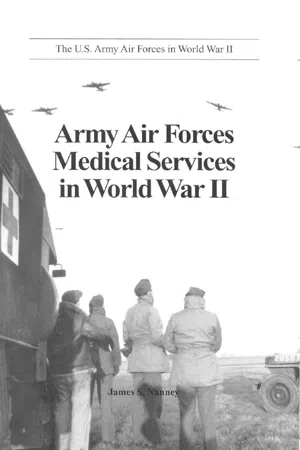
Army Air Forces Medical Services In World War II
About this book
This history summarizes the Army Air Forces (AAF) medical achievements that led to the creation of the Air Force Medical Service in July 1949. When the United States entered World War II, our nation's small aviation force belonged to the U.S. Army and relied on the Army medical system for support. The rapid expansion of the AAF and the medical challenges of improved aircraft performance soon placed great strain on the ground-oriented Army medical system. By the end of the war, the AAF had successfully acquired its own medical system oriented to the special needs of air warfare. This accomplishment reflected the determined leadership of AAF medical leaders and the dedication of thousands of medical practitioners who volunteered for aviation medical responsibilities that were often undefined or unfamiliar to them. In the face of new challenges, many American medics responded with hard work and intelligence that contributed greatly to Allied air superiority.
Information
Subtopic
European HistoryIndex
HistoryINTRODUCTION
The Army Air Forces (AAF) relied on many types of medical support in World War II. One of the greatest medical contributions was research and development of personal survival gear and equipment for fighter and bomber crews. AAF doctors, for example, helped design the first flying suits that countered the physiological effects of the excess gravity forces (g-forces) in high-speed maneuvers. Aided by the U.S. Navy and organizations in Allied countries, the AAF Aeromedical Laboratory at Wright Field, Ohio, developed the first clothing designed successfully to counteract the negative effects of g-forces. Early in 1944, U.S. crewmen began to use the G-suits in Europe. G-suits were tactically valuable because they helped fighter pilots maintain consciousness under high gravitational forces. One P-51 pilot, who was credited with shooting down five enemy planes on one sortie, wrote:
I found myself all alone in the middle of a bunch of Jerrys. Having no one to keep Jerry off my tail I had to keep full throttle and keep my air speed sufficient so that I could break away from anyone coming up on my tail. This maneuver would normally black me out but my G-suit kept me fully conscious of what was going on. I followed Jerry down to the deck, picking up an air speed of 600 mph. The Jerry went straight in without pulling out, and I would have, too, if I had not been wearing my G-suit.


Because of the special needs of such pilots and crewmen, the AAF during World War II often required and obtained its own support services, separate from those of the ground forces of the U.S. Army. Early in the war, the commander of the AAF, Gen. Henry
. “Hap” Arnold, decided to try to obtain his own system of AAF medical support. By war’s end, AAF Air Surgeon Maj. Gen. David N. W. Grant had forged a medical service that was largely autonomous, although still subject to the authority of the Army Medical Department.
Two other notable AAF medical leaders were Malcolm Grow and Harry Armstrong, who directed the AAF medical program that helped air-crews cope with many new challenges in Europe. Grant, Grow, and Arm-strong were the best of a highly educated group of AAF medical professionals, many of whom volunteered to leave private practice to cope with new aeromedical challenges in distant theaters of war. On the home front, the AAF also administered a large network of hospitals and convalescent centers, and its programs in medical research, development, and training prevented many deaths, wounds, and illnesses in combat theaters. By the end of the war, the AAF had laid a foundation for the independent Air Force Medical Service created in July 1949.
AAF Medical Independence
Throughout the war, Air Surgeon Grant disagreed with the Army Surgeon General over the amount of independence the AAF medical system needed to fulfill its mission. Grant agreed with AAF leaders that the special matériel features of air warfare required a separate air force supply and logistics system, and he urged his military superiors to recognize the special needs of aerial combat and to give the AAF medical service the same degree of independence from the Army that most other portions of the AAF already had been given.
General Grant had developed his ideas on medical independence before World War II. In 1938, he graduated from the Air Corps Tactical School, the home of air power theory, which held that air power was a separate arm deserving a separate commander and support structure. The Tactical School produced many leaders who promoted an independent Air Force during World War II. Grant was the first and only medical corps officer to graduate from the school before Pearl Harbor. He was influenced by air power theory and by his readings on Dr. Theodore C. Lyster, the air surgeon in World War I who achieved a small measure of independence. After graduation from the Tactical School, Grant was assigned to England as an AAF medical observer—an assignment that allowed him to study the aeromedical problems of the Royal Air Force (RAF) in the Battle of Britain. In October 1941, Grant became Chief Air Surgeon of the Army Air Corps.
At the start of World War II, military airplanes were flying much faster and higher than ever before, creating new medical problems for aircrews. This technological revolution in aviation was yet another argument for a medical service specialized in aeromedical support. In fact, the AAF achieved some medical independence in March 1942 when a reorganization made the AAF equal with the Army Ground Forces (AGF) and Services of Supply (SOS). General Arnold, the AAF commander, was granted authority over some medical facilities, their patients, and the medical staff who cared for them. Air bases soon received surgeons and a medical reporting system was established. But official control of major logistical functions, including medical support, was delegated to the SOS, which evolved into the Army Service Forces command. The Army Surgeon General, who was subordinate to the SOS command, continued to claim ultimate jurisdiction over AAF medical services, a claim that crossed organizational boundaries. This boundary crossing caused problems. First, it prevented the highly mobile AAF, which sometimes created bases far from Army bases, from setting its own sanitary standards and procedures to prevent infection. Second, in combat theaters the AAF lacked its own station and general hospitals. Without them, it had to transfer many patients to Army theater hospitals where those patients often became administratively lost to the AAF. Because patients* medical reports were routed through long administrative channels, the AAF theater commander found it difficult or impossible to get reliable information on the health of the command.
Grant argued that there were other problems. Early in the war, there were not enough Army specialists trained in aviation medicine to adequately staff both combat units and Army hospitals abroad and in the

United States. To AAF leaders, it seemed that the theater SOS handled the medical logistics and facilities of AGF units much more rapidly and effectively than it handled those of AAF units, thereby forcing AAF medics to devise their own makeshift supply lines and facilities. In sum, the Air Surgeon thought that the Army Medical Department was not committed to giving the AAF fair and adequate medical support.
Although Grant failed to win medical independence abroad during World War II and was denied permission to set up AAF general hospitals in the United States, he obtained a considerable level of independence in 1943 for AAF station hospitals in the United States. He issued to the station hospitals equipment normally found only in general hospitals, and he used those hospitals to receive AAF patients directly from abroad.
The Army Surgeon General opposed Grant’s independent actions. In November 1943, citing a shortage of surgical specialists, the Army Surgeon General proposed a virtual prohibition on elective surgery in AAF hospitals in the United States—an action that would effectively reduce them to dispensaries. In February 1944, Grant and Arnold countered with a request for a separate, integrated AAF hospital system, both at home and abroad, to furnish continuous care for AAF patients in venues from combat theaters to highly specialized stateside AAF treatment centers. Grant noted that the AAF had already created their own repair and maintenance depots in Great Britain, separate from the Army theater SOS. But the Army Surgeon General was convinced that the AAF did not need its own hospital system.
To deal with this crisis and with complaints about the medical care given AAF combat crews in Great Britain, President Franklin D. Roosevelt sent a special team to Europe in March 1944. The team chief, Dr. Edward A. Strecker, then consultant in psychiatry to the secretary of war, was accompanied by Grant and Army Surgeon General Maj. Gen. Norman T. Kirk. St...
Table of contents
- Title page
- TABLE OF CONTENTS
- Army Air Forces Medical Services in World War II
- INTRODUCTION
- SUGGESTED READING
Trusted by 375,005 students
Access to over 1.5 million titles for a fair monthly price.
Study more efficiently using our study tools.
Frequently asked questions
Yes, you can cancel anytime from the Subscription tab in your account settings on the Perlego website. Your subscription will stay active until the end of your current billing period. Learn how to cancel your subscription
No, books cannot be downloaded as external files, such as PDFs, for use outside of Perlego. However, you can download books within the Perlego app for offline reading on mobile or tablet. Learn how to download books offline
Perlego offers two plans: Essential and Complete
- Essential is ideal for learners and professionals who enjoy exploring a wide range of subjects. Access the Essential Library with 800,000+ trusted titles and best-sellers across business, personal growth, and the humanities. Includes unlimited reading time and Standard Read Aloud voice.
- Complete: Perfect for advanced learners and researchers needing full, unrestricted access. Unlock 1.5M+ books across hundreds of subjects, including academic and specialized titles. The Complete Plan also includes advanced features like Premium Read Aloud and Research Assistant.
We are an online textbook subscription service, where you can get access to an entire online library for less than the price of a single book per month. With over 1.5 million books across 990+ topics, we’ve got you covered! Learn about our mission
Look out for the read-aloud symbol on your next book to see if you can listen to it. The read-aloud tool reads text aloud for you, highlighting the text as it is being read. You can pause it, speed it up and slow it down. Learn more about Read Aloud
Yes! You can use the Perlego app on both iOS and Android devices to read anytime, anywhere — even offline. Perfect for commutes or when you’re on the go.
Please note we cannot support devices running on iOS 13 and Android 7 or earlier. Learn more about using the app
Please note we cannot support devices running on iOS 13 and Android 7 or earlier. Learn more about using the app
Yes, you can access Army Air Forces Medical Services In World War II by James S. Naney in PDF and/or ePUB format, as well as other popular books in History & European History. We have over 1.5 million books available in our catalogue for you to explore.