General Maximilien Foy was a renowned and experienced French general with a long and distinguished career. An artilleryman like his master Napoleon, he fulfilled his duty to France despite disagreeing with Napoleon, and fought across Europe from Switzerland, Germany, Portugal and Spain. He spent a major part of his career fighting in the Peninsular armies at Busaco and with Masséna in Portugal. His military career came to an end after heroic fighting at Waterloo in 1815, after which he became involved in politics and writing.
Foy set about writing a history of the Peninsular War, which had been covered in great detail by British and Spanish writers but not so well by those of France. Although his untimely death in 1825 cut short his endeavour to two books, they are a valuable addition to the literature on the period, filling the gap of a French perspective on the bloody "Spanish Ulcer".Author — Général de Division Comte Maximilien Foy, 1775-1825.
Editor —Élisabeth Augustine (née Daniels) Foy
Translator — Anon
Text taken, whole and complete, from the edition published in1827, London, by Treuttel and Würtz
Original Page Count – xii and 608 pages.
Illustrations — 1 Facsimile.
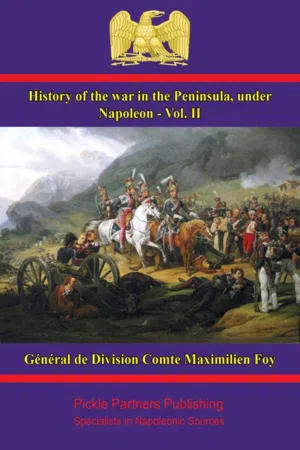
eBook - ePub
History of the War in the Peninsula, under Napoleon - Vol. II
to which is prefixed a view of the political and military state of the four belligerent powers
- 316 pages
- English
- ePUB (mobile friendly)
- Available on iOS & Android
eBook - ePub
History of the War in the Peninsula, under Napoleon - Vol. II
to which is prefixed a view of the political and military state of the four belligerent powers
About this book
Trusted by 375,005 students
Access to over 1.5 million titles for a fair monthly price.
Study more efficiently using our study tools.
Information
Subtopic
British HistoryIndex
HistoryBOOK THE THIRD.
No. XVIII.—See Page 130.
LETTER OF FERDINAND, PRINCE OF ASTURIAS, TO THE EMPEROR NAPOLEON.
SIRE—The fear of incommoding your Imperial and Royal Majesty in the midst of your exploits and the great affairs which continually surround you, has hitherto prevented me from satisfying directly what has been my most ardent wish; namely, that of expressing, at least by writing, the sentiments of respect, esteem, and attachment, which I have vowed for a hero who eclipses all who have preceded him, and who has been sent by providence to save Europe from the total subversion which threatened her, to settle her tottering thrones, and to restore peace and happiness to nations.
The virtues of your Imperial Majesty, your moderation and goodness, even towards your most unjust and implacable enemies, have all led me to hope, that the expression of my sentiments would be received as the overflowing of a heart filled with admiration and the most sincere friendship.
The situation in which I have been placed for a long time, and which cannot have escaped the piercing eye of your Imperial Majesty, has also, hitherto, been a second obstacle to prevent my ready pen from expressing my wishes to your Imperial Majesty; but full of the hope of finding the most powerful protection in your magnanimous generosity, I have come to the determination, not only of testifying my heartfelt sentiments for your august person, but also of pouring them into your bosom, as into that of the most tender father.
It is a great misfortune for me, that circumstances compel me to conceal, as a crime, an action so just and praiseworthy; but such are the fatal consequences of the extreme goodness of the best of kings.
Filled with respect and filial love for the author of my being, who possesses a heart the most generous and upright, I would never dare to repeat to any but your Imperial Majesty what you know better than myself—that these very qualities which are so estimable, but too often serve as instruments in the hands of the designing and the wicked, for concealing the truth from sovereigns, although a quality so consonant to a character like that of my respectable father.
If the men who, unfortunately, are found here, would allow him to know the character of your Imperial Majesty as I know it, with what ardour would he not wish to strengthen the ties that should unite our two houses! and what means are more proper for that, than my seeking the honour of allying myself to a princess of your august family? This is the unanimous wish of all my father’s subjects, and would be also his own, I doubt not, in spite of the efforts of a few malevolent men, as soon as he knew the intentions of your Imperial Majesty, which is all that my heart desires: but this is not the interest of the perfidious and selfish men who surround him, and they may, in an unguarded moment, take him by surprise. Such is the motive of my fears.
Nothing but respect for your Imperial Majesty can overturn their designs, open the eyes of my good and beloved parents, render them happy, and at the same time bestow happiness on my nation and myself.
The whole world will more and more admire the goodness of your Imperial Majesty, who will always find in me a son the most devoted and grateful.
I implore therefore, with the greatest confidence, the paternal protection of your Majesty, in order, not only to confer on me the honour of an alliance with your family, but to smooth all the difficulties, and remove all the obstacles which may be opposed to this object of my wishes.
This gracious effort on the part of your Imperial Majesty is so much the more necessary, as I, on my part, am totally unable to make any attempt of this nature; since it would be, perhaps represented as an insult offered to paternal authority; and since I have only one means left me, that of refusing with invincible constancy, to form an alliance with any one whatever, without the positive approbation and consent of your Imperial Majesty, from whom alone I wait the choice of a spouse.
This is a happiness which I expect from the goodness of your Imperial Majesty, praying God to preserve your valuable life for many years.
Written and signed, with my own hand and seal, at the Escurial, October 11th, 1807, by your Imperial and Royal Majesty’s affectionate servant and brother,
FERDINAND.
No. XIX.—See Page 131.
DECREE OF KING CHARLES IV.
God, who watches over all his creatures, prevents the consummation of atrocious deeds directed against innocent victims. It is by his omnipotent aid that I have been delivered from the most frightful catastrophe. My attendants, my subjects, all the world, know my religious habits, and the regularity of my conduct; all are attached to me, and show me those marks of veneration equally demanded by the respect due to a father, and the love required of his children. I was living tranquilly in the bosom of my family, in the confidence of this happiness, when an unknown hand placed before me and informed me of a plan, the most enormous and unexpected, carried on in my own
palace against ray person. My life, which has been so often in danger, appeared too long to my successor, who, infatuated and blinded, and abjuring all those principles of religion which were imposed on him by the solicitude of paternal affection, had entered into a plan for dethroning me. I wished to satisfy myself of the truth of this fact. Having surprised him in my apartment, and found in his possession the cypher of his correspondence, and of the instructions he had received from the vile conspirators, I summoned to the examination the governor of the council, with other ministers, that they might prosecute the inquiry with the greatest diligence. All is finished, and the result is the detection of several individuals, whom I have ordered to be imprisoned.
My son will be confined to his apartments. This affliction adds to the weight of those which already oppress me; but as it is the most sensibly felt, so is it of most importance that it should be cleared up. I have therefore ordained that the result be published. I do not wish to conceal from my subjects the real nature of a sorrow which will be alleviated by their loyalty. I inform you of my intentions that you may promulgate them in the proper form.
San Lorenzo, October 30, 1807.
I, THE KING.
“To the Governor, par interim, of the Royal Council of Castile.”
No. XX.—See Page 136.
THE avowal of the growing uneasiness of Godoy, in his letters to Don Eugenio Izquierdo, his agent at Paris, must not be passed over. This correspondence forms part of the useful collection of Llorente, entitled “Memoirs relative to the History of the Revolution in Spain,” published under the anagram of Don Juan Nellerto.
The 3rd of November, 1807, five days after the discovery of the conspiracy of the Escurial, the Prince of the Peace write “Madrid is full of rumour and expectation. It occurs to me that Beauharnais said that the French troops would establish their head-quarters at Madrid. I have much to do against so many enemies, but the cannon will keep them in order.”
The 18th of the same month, his apprehensions were still greater:—”Matters assume a terrible aspect. Be secret and attentive to what passes.”
On the 24th, he expresses his fears in a manner still more decided:—
“The commotion at Madrid, excited by the reports issued from the French ambassadors, is not entirely appeased. Everything is shaken, and I know not if my constancy can surmount so many evils. A thousand times I have meditated on giving up my official situations, and I shall carry my ideas into execution, only reserving the War-office Department, since that has been agreed on between our King and the Emperor. I intend putting the Infant Don Francisco at the head of the Admiralty. Being educated for this department, he may yet, in his parent’s absence, be able to maintain himself against the attacks meditated on this establishment. Speak to the Grand-duke of Berg about this, in the spirit of my letter, for his opinion is of great importance to me. You know how fickle a nation’s attachment is, and that its praise or blame shifts with equal facility. You perceive with what disasters I am threatened; in short, I am not at all easy.”
At the date of December the 18th, he endeavours to persuade himself that should Napoleon come into Spain, it would be with pacific intentions, and he endeavours to compose his fears. “Be tranquil,” he says to Izquierdo, “I am above everything; the villany of traitors has shown their character, and furnished me with proofs which I could not otherwise have obtained.”
This pretended calm was of short duration; the French troops entered Spain at all points, and spread over the provinces of the interior. On February 9th, 1808, the Prince of the Peace writes to his confidant:—” I receive no letter from you. The treaty that you have signed is no longer in existence. The kingdom is overrun with French troops; they are about to occupy the passes which lead into Portugal, and Junot commands the whole. Our remaining squadrons have been demanded, and orders are given for them to march, united with those of the Emperor. Everything is in a state of uncertainty, intrigue, and apprehension; public opinion is divided, the heir of the throne is implicated in a charge of high treason. The allied troops are living at our expense. We continue to pay the subsidy, while no consideration frees us from this charge. The Dutch loan has been made according to our advice, but we draw no benefit from it. You suspected at Paris! the ambassador a mere shadow! What the d—l does all this mean? How will it end? I summoned you to come and render an account, but you have not come. If you know anything, tell me; if not, make no mystery of it.”
It was after this letter, and for the purpose of dispelling the fears of the Prince of the Peace, that Don Izquierdo solicited and obtained permission from the Emperor Napoleon to set out for Madrid.
No. XXI.—See Page 144.
LETTER OF CHARLES IV. TO THE EMPEROR NAPOLEON.
SIR, my Brother;—For a long time past, the Prince of the Peace has frequently solicited permission to give up his offices of Generalissimo and Admiral.
I have agreed to his wishes in these respects; but as I cannot forget his services, and particularly his co-operation in my constant and invariable wish to maintain the alliance and intimate friendship which subsists between myself and your Imperial and Royal Majesty, this Prince will continue to possess my esteem.
Perfectly persuaded that nothing will be more agreeable to my subjects, nor better adapted for accomplishing the d...
Table of contents
- Title page
- TABLE OF CONTENTS
- ADVERTISEMENT.
- BOOK I.-THE INVASION OF PORTUGAL
- BOOK II.-THE INVASION OF PORTUGAL
- BOOK IV.-THE INVASION OF SPAIN
- BOOK V.-THE INVASION OF SPAIN.
- BOOK VI.-THE INVASION OF SPAIN.
- BOOK VII.-THE INVASION OF SPAIN
- BOOK VIII.-THE INVASION OF PORTUGAL.
- BOOK IX.-THE INVASION OF PORTUGAL.
- NOTES AND ILLUSTRATIONS.
- BOOK THE SECOND.
- BOOK THE THIRD.
Frequently asked questions
Yes, you can cancel anytime from the Subscription tab in your account settings on the Perlego website. Your subscription will stay active until the end of your current billing period. Learn how to cancel your subscription
No, books cannot be downloaded as external files, such as PDFs, for use outside of Perlego. However, you can download books within the Perlego app for offline reading on mobile or tablet. Learn how to download books offline
Perlego offers two plans: Essential and Complete
- Essential is ideal for learners and professionals who enjoy exploring a wide range of subjects. Access the Essential Library with 800,000+ trusted titles and best-sellers across business, personal growth, and the humanities. Includes unlimited reading time and Standard Read Aloud voice.
- Complete: Perfect for advanced learners and researchers needing full, unrestricted access. Unlock 1.5M+ books across hundreds of subjects, including academic and specialized titles. The Complete Plan also includes advanced features like Premium Read Aloud and Research Assistant.
We are an online textbook subscription service, where you can get access to an entire online library for less than the price of a single book per month. With over 1.5 million books across 990+ topics, we’ve got you covered! Learn about our mission
Look out for the read-aloud symbol on your next book to see if you can listen to it. The read-aloud tool reads text aloud for you, highlighting the text as it is being read. You can pause it, speed it up and slow it down. Learn more about Read Aloud
Yes! You can use the Perlego app on both iOS and Android devices to read anytime, anywhere — even offline. Perfect for commutes or when you’re on the go.
Please note we cannot support devices running on iOS 13 and Android 7 or earlier. Learn more about using the app
Please note we cannot support devices running on iOS 13 and Android 7 or earlier. Learn more about using the app
Yes, you can access History of the War in the Peninsula, under Napoleon - Vol. II by Général de Division Comte Maximilien Foy, Comtesse Élisabeth Augustine Foy in PDF and/or ePUB format, as well as other popular books in History & British History. We have over 1.5 million books available in our catalogue for you to explore.