- 160 pages
- English
- ePUB (mobile friendly)
- Available on iOS & Android
eBook - ePub
About this book
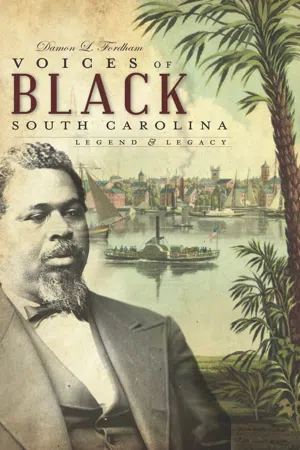
Discover the contributions notable Black South Carolinians gave to bring encouragement and inspiration to their communities.
Did you know that eighty-eight years before Rosa Parks's historic protest, a courageous black woman in Charleston kept her seat on a segregated streetcar? What about Robert Smalls, who steered a Confederate warship into Union waters, freeing himself and some of his family, and later served in the South Carolina state legislature? In this inspiring collection, historian Damon L. Fordham relates story after story of notable black South Carolinians, many of whose contributions to the state's history have not been brought to light until now. From the letters of black soldiers during the Civil War to the impassioned pleas by students of "Munro's School" for their right to an education, these are the voices of protest and dissent, the voices of hope and encouragement and the voices of progress.
Information
RICHARD CARROLL—CONTROVERSIAL LEADER
In the late 1800s and early 1900s, during the early days of segregation and widespread lynching, a number of black leaders felt that the best way to improve conditions for their brethren was not to fight aggressively against their heavy odds. Some leaders felt that they did the best they could under the limits of their situations. This usually meant speaking softly, if at all, against racism, while stressing the need for education and self-improvement among blacks and gaining favor with the more progressive white leadership of the time.
The best-known leader of this type was Booker T. Washington. Born into slavery in what is now West Virginia around 1856, he walked all the way to Hampton Institute in Hampton, Virginia, to obtain an education. Six years after his graduation in 1875, he was hired to help establish the Tuskegee Institute in Tuskegee, Alabama (which would later become Tuskegee University). His emphasis on self-help and hard work gained him a following among blacks and whites, and this school became one of the best-known black schools in America. He gained international fame in 1895, when he spoke at the Atlanta Exposition, where he stressed the need for hard work, self-improvement and maintaining friendly relations with whites over emphasizing integration and civil rights for the time being. He was hailed as a hero by whites and some blacks. A number of black teachers who studied under Washington established similar schools around the South, and white leaders such as President Theodore Roosevelt and millionaire Andrew Carnegie befriended and financially supported him. Some educated blacks criticized this approach, but it was not widely known at the time that Washington occasionally spoke out against lynching and segregation and quietly supported early civil rights efforts.
A number of other black leaders in the southern states tried Booker T. Washington’s approach with varying degrees of success. South Carolina’s most prominent example was the Reverend Richard Carroll, who was often referred to as “the Booker T. Washington of South Carolina.” He was also the most controversial black leader of South Carolina during his lifetime.
According to Idus A. Newby’s book Black Carolinians, Carroll was born into slavery in Barnwell, South Carolina, in 1859 on the plantation of W.D. Rice. Carroll’s mother died young, and he never knew the identity of his father, although his light complexion led some to suggest that his father may have been white. Apparently, he grew up in dire poverty because a white minister named Reverend A.W. Lamar recalled meeting a teenaged Carroll around 1876 wearing ragged clothes and no shoes. Reverend Lamar invited young Richard to his sermon, but the young boy refused to go to “the white folks’ church,” as he called it. Reverend Lamar smiled and replied that “the Lord will be glad to see you there,” so Carroll agreed to attend. This changed Carroll’s life, as he was so inspired by the sermon that it led to his membership in the Baptist Church.
Eventually, Carroll attended Benedict College in Columbia, where he studied theology and worked in the school’s dairy, “milk[ing] his way through college,” and completed his studies at Shaw University in Raleigh, North Carolina. The writing and oratory skills he gained at these schools would serve Carroll well in life, as his frequent articles and letters to newspapers would make him one of the better-known preachers of the region and preserve much of his story and messages. According to Dr. Bobby Donaldson’s article on Reverend Carroll in the South Carolina Encyclopedia, he married Mary Madgeline Sims in 1883 and spent the decade preaching in various Baptist churches throughout South Carolina and touring the country as a traveling evangelist through a number of Baptist organizations.
An early indication of things to come for Reverend Carroll took place in 1890. In that year, Benjamin Tillman ran for governor of South Carolina and the state’s blacks were horrified. While Tillman promised reform for farmers and advocated establishing Winthrop and Clemson Colleges, he was also outspoken in his racism against blacks and bragged of killing African Americans during the Hamburg Riot of 1876. South Carolina’s black leaders, organized as the “Colored Reform Conference,” held a meeting in Columbia on October 15, 1890, to discuss the problem. Most agreed that Tillman’s election was dangerous for the state’s blacks, and they supported his opponent, Alexander C. Haskell.
Reverend Carroll begged to differ. He knew that Haskell had also boasted of his role in oppressing blacks in the past and felt that Tillman was going to win the election regardless, so he suggested that “Tillman ought to be governor” to the boos and cries of “No! Never!” from the other blacks. Reverend Carroll then hotly debated Representative George Washington Murray, the Sumter County inventor who served as the last black congressman from South Carolina during this era. Reverend Carroll stated that most of South Carolina’s white politicians bragged about their roles in repressing black votes. Murray spoke for the others present when he noted, “In all cases where Negroes have been lynched, in all cases where they have been assassinated, it has been by the poor whites led on by men like Tillman.” The Charleston News and Courier of October 17, 1890, noted that this statement was met with thunderous applause from the gathering.
History proved that though Reverend Carroll was correct about the poor chances almost anyone had of defeating Benjamin Tillman for the governorship of South Carolina that year, the other members of the Colored Reform Conference were correct in their concerns about what life under Tillman’s rule would mean for the state’s African Americans. According to Francis Simkins’s book Pitchfork Ben Tillman: South Carolinian, within five years Tillman would surrender a black man named John Peterson over to a lynch mob, endorse a bill for segregated railroad cars in South Carolina and sponsor a convention to strip the state’s blacks of their right to vote.
Reverend Carroll apparently saw what he felt was the futility of fighting for African Americans’ civil rights during this difficult time, so he decided to use a delicate balance of operating within the current system and telling powerful whites what they wanted to hear, while at the same time trying to improve conditions for blacks. In 1897, he displayed this difficult balance in a November 8, 1897 interview with the New York Times:
In nine cases in ten, the men who commit the crime for which lynching is the penalty are loafers or bad characters, without position, means or friends. In the sections of the South, especially on the coast, where the Negroes outnumber the whites from ten to fifty to one, that crime is almost unknown because the few whites there are of such a high class that they do not come in contact with any Negroes but their servants and are well protected.
After adding that lynching usually occurred where the percentage of blacks and whites in an area were roughly equal, Reverend Carroll noted, “The better class of Negroes believe as strongly as the whites do in prompt infliction of the death penalty for the crime alluded to, but the guilty man should be killed at least under a form of law.”
The New York Times referred to Reverend Carroll as having “unusual views on the subject of lynching.”
Reverend Carroll’s speeches were to continue along this line. He was the featured speaker at the Emancipation Day ceremonies in Sumter County in 1898. At that time, many black South Carolinians celebrated January 1 as “Emancipation Day” in honor of President Abraham Lincoln signing the Emancipation Proclamation, which ended slavery in rebelling states on January 1, 1863. While acknowledging this fact, the following were some of Reverend Carroll’s remarks to a mostly black audience about the Reconstruction era before the state’s blacks lost their political power:
We went into politics when we should have gone back to the fields. We went into office when we should have gone to school. We went to gambling when we should have gone to church. We went to making and administrating law when we should have been studying law. We emigrated when we should have remained where we were. We went to fighting Southern white people when we should have made friends with them. Gentlemen, the [black] race was badly led, for they were led against their best interests.
In this speech, and many others afterward, Reverend Carroll offered several ideas about how black South Carolinians might become successful. He advised them to “stay on the farm,” rent or own land and raise their own food instead of going to cities where “temptation” awaited them. As was the case with Booker T. Washington, he felt that blacks who were qualified for professional educations should receive them but that the masses should not “build their homes from the top” and should learn such skills as cooking, cleaning and building. As for blacks who wished to enter politics after they were stripped of their political rights in many states, he said that he saw “no good” coming from blacks getting involved with politics, and those who waited for government positions were often “approaching starvation doors.” He added that it was not because of their color that blacks were denied the vote but because “we are poor and ignorant.” To solve the problem of lynching, Reverend Carroll advised:
Be good citizens. Help to fight sin and crime. Do not harbor thieves, robbers, or rapists. Help to catch any man who would commit the unnameable crime [rape]. Have no sympathy for such. Do your part as good citizens and there will be no more lynchings in the South.
Predictably, most white South Carolinians were fond of such speeches. Benjamin Tillman included Reverend Carroll among the few blacks of whom he spoke well, and he would later encourage President Woodrow Wilson to appoint Reverend Carroll as minister to Liberia (Carroll declined). The Charleston News and Courier of January 4, 1898, headlined the above speech as “A Negro’s Words of Wisdom.” This newspaper would later describe Carroll as a “remarkable colored man” who was “so full of meaning, of eloquence and sense in all that he had to say.” Many African Americans at the time begged to differ.
John Hammond Moore, in his book Columbia and Richland County—A South Carolina Community 1740–1990, recalled that some blacks referred to Reverend Carroll as “the white man’s pimp.” According to the Booker T. Washington Papers (University of Illinois Press, 1981), in 1906 Reverend Carroll went to hear the famed educator Booker T. Washington speak at the National Negro Conference in New York City. A black man named Granville Martin accused Richard Carroll of being “an endorser of lynching” and proceeded to denounce the South Carolinian minister with profane language. Only the interference of a black newspaper editor from Philadelphia prevented a fistfight between the two men. Interestingly, while Carroll was often called “the Booker T. Washington of South Carolina” and the two leaders were well acquainted, Washington himself had mixed feelings about Reverend Carroll. On August 9, 1910, Washington wrote the following in a letter to Oswald Garrison Villard (grandson of white abolitionist William Lloyd Garrison): “Richard Carroll is a man who has many qualities that neither you or I would admire, but at the same time there is no discounting the fact that he has tremendous influence with the white people of South Carolina.”
At the Baptist Educational and Missionary Convention in Union, South Carolina, in 1905, Reverend Carroll incurred the wrath of his fellow ministers when he publicly accused his fellow pastors of theft. “I was at a meeting when a collection was lifted for Africa and every cent of the money was divided among those present!” said Carroll, according to the Charleston News and Courier of May 6, 1905. The convention responded in outrage, and Reverend G.W. Ralford led a resolution dismissing these charges as “unwarranted.” Carroll replied, “I am prepared to prove all that I have said! I was inspired by God to write and say what I have said. I know you men! I am honest in dealing with you!” The Courier described what followed as a “circus-like uproar,” but peace was eventually restored and the convention continued constructively.
A few months earlier, Reverend John Adams, a black Columbian Congregationalist minister, had this to say about another speech by Carroll:
Nothing is more qualified to damage the race than the public babblings of some half-witted Negro, concerning the Negro’s ambition to lead. It keeps prejudice afloat, it is the maker of unjust treatment and it antagonizes the relation between both races.
Judging from these events, many modern readers might be inclined to dismiss Reverend Richard Carroll as an “Uncle Tom” or a “traitor to the black race,” as did many blacks of his time. However, as I.A. Newby pointed out in Black Carolinians, Reverend Carroll was far too complex to be so simply condemned. The record shows that it would be unfair to condemn him without learning of his other activities.
During the Spanish-American War, Carroll served as a chaplain to the Tenth Calvary, one of the African American units known as the famed “Buffalo Soldiers.” This unit assisted future president Theodore Roosevelt in the legendary capture of San Juan Hill. After his return to Columbia in 1899, Carroll established a school and orphanage known as the Industrial Home for Girls and Boys. Unfortunately, as I.A. Newby noted, the strict regimen at this orphanage caused many youths to run away, and unlike Booker T. Washington’s more successful Tuskegee Institute, Carroll’s school did not survive its founder. However, a “Colored State Fair” and Negro Employment Agency that he helped to begin found greater success. Carroll was also fond of mentoring promising black youngsters as future leaders, such as I.S. Leevy, whose funeral home in Columbia survived a century later, and the more outspoken lawyer and newspaper publisher Nathaniel Frederick. There were also a number of occasions on which he took stands that most people would consider to be progressive in later years.
In 1905, a North Carolina writer named Reverend Thomas Dixon Jr. became a controversial celebrity through his books and plays. He wrote The Clansman, a novel of revised history portraying slavery as an institution of kindness, the African Americans who held office during Reconstruction as rapists and savages and the Ku Klux Klan as heroes who saved the southern states. The play version of this book caused controversy, outrage, protests and, in some cases, violence where it appeared.
In October 1905, the play ran at the Columbia Opera House, which was then across from the statehouse building. The Winnsboro, South Carolina–born educator Kelly Miller eloquently denounced Reverend Dixon and The Clansman, as well as some influential whites. William Gonzales, editor of the Columbia State, dismissed the play and book as “commended by those who have engaged in lynchings or who are ready to lead a lynching party.” The Women’s Christian Temperance Union of South Carolina condemned The Clansman as “being designed to arouse race hatred.” Since Thomas Dixon had known Richard Carroll from his days as a traveling evangelist, he arranged for Reverend Carroll to have a front-row seat at this performance. Since Carroll was concerned about the white audience’s reaction at this play, he decided that it was safer to stand near the exit door. Reverend Carroll recorded his impressions of what he saw in an interesting article in the Columbia State of October 17, 1905.
Carroll was horrified as some members of the audience booed the black characters (played by white actors in blackface makeup), who were shown holding drunken parties during legislative sessions at the statehouse during Reconstruction and abusing their positions to molest white women. Carroll noted:
From the beginning to the end, the Negro was represented as a brute, a beast, and a demon from hell! No play that has ever come to the South or has been exhibited in this country is calculated to do more harm than “The Clansman.”
At one point in the play, Reverend Carroll noticed Reverend Dixon step outside of the theatre, and Carroll followed him to talk. As Dixon began to fondly recall their last meeting, Carroll interjected with his fury against the play, calling it “an outrage and calculated to injure both races in the South.” Dixon smiled and replied, “You stay until this play is over and you will endorse it.” Dixon went on to claim that “prominent Negroes” (whom he did not name) had seen the play and spoke well of the production. When Reverend Carroll challenged this statement by his fellow minister, Dixon gave a telling reply:
There is no chance for the Negro to get justice in this country. The United States government will have to set aside some permanent territory for the Negroes and let them govern themselves partly in this country and partly in Africa.
Reverend Carroll saw this remark as a statement of Reverend Dixon’s true feelings, so he returned to the theatre to watch the rest of The Clansman. The second act included scenes of Ku Klux Klansmen lynching a black man for raping a white woman and forcing African Americans out of their votes and power and concluded with the Klansmen being celebrated in a parade for their supposed “victory.” Carroll left the theatre in disgust and in a hurry, fearing that whites agitated by the play would “put a bullet through me.” However, he was pleased to hear a white female audience member express her disapproval of Dixon’s play.
As he exited the opera house, Carroll encountered Dixon again. Reverend Carroll bluntly and angrily ...
Table of contents
- Front Cover
- Half Title
- Title Page
- Copyright
- Contents
- Acknowledgements
- Introduction
- Passing It On
- Ernest Everett Just and the Spirit of Youth
- Spoken Like a True Role Model
- Letters from Black Civil War Troops
- Eighty-eight Years Before Rosa Parks
- The Beginning of a New Order
- A Woman’s Testimony
- The First Integrated School in the South
- The Hamburg and Cainhoy Massacres
- The End of Reconstruction
- The Fight to Save Their Rights
- Richard Carroll—Controversial Leader
- “I’ve Been to Munro’s School”
- Elizabeth Wright and Voorhees College
- Benjamin Mays and the Phoenix Riot
- Septima Clark—Sacrificing Teacher
- The Mystery of Uncle Johnny
- An Early Protest
- A Student Speaks Out
- A South Carolinian in Vietnam
- Epilogue
- About the Author
Trusted by 375,005 students
Access to over 1.5 million titles for a fair monthly price.
Study more efficiently using our study tools.
Frequently asked questions
Yes, you can cancel anytime from the Subscription tab in your account settings on the Perlego website. Your subscription will stay active until the end of your current billing period. Learn how to cancel your subscription
No, books cannot be downloaded as external files, such as PDFs, for use outside of Perlego. However, you can download books within the Perlego app for offline reading on mobile or tablet. Learn how to download books offline
Perlego offers two plans: Essential and Complete
- Essential is ideal for learners and professionals who enjoy exploring a wide range of subjects. Access the Essential Library with 800,000+ trusted titles and best-sellers across business, personal growth, and the humanities. Includes unlimited reading time and Standard Read Aloud voice.
- Complete: Perfect for advanced learners and researchers needing full, unrestricted access. Unlock 1.5M+ books across hundreds of subjects, including academic and specialized titles. The Complete Plan also includes advanced features like Premium Read Aloud and Research Assistant.
We are an online textbook subscription service, where you can get access to an entire online library for less than the price of a single book per month. With over 1.5 million books across 990+ topics, we’ve got you covered! Learn about our mission
Look out for the read-aloud symbol on your next book to see if you can listen to it. The read-aloud tool reads text aloud for you, highlighting the text as it is being read. You can pause it, speed it up and slow it down. Learn more about Read Aloud
Yes! You can use the Perlego app on both iOS and Android devices to read anytime, anywhere — even offline. Perfect for commutes or when you’re on the go.
Please note we cannot support devices running on iOS 13 and Android 7 or earlier. Learn more about using the app
Please note we cannot support devices running on iOS 13 and Android 7 or earlier. Learn more about using the app
Yes, you can access Voices of Black South Carolina by Damon L. Fordham in PDF and/or ePUB format, as well as other popular books in History & African American History. We have over 1.5 million books available in our catalogue for you to explore.