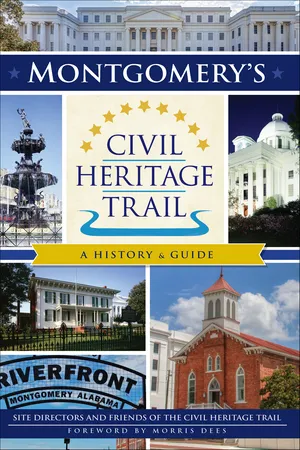
Montgomery's cultural heritage reflects two of America's most transformative struggles: the Civil War and the civil rights movement. On February 18, 1861, Jefferson Davis was inaugurated as president of the Confederate States of America on the Alabama Capitol steps. Those same steps marked the final destination of the Selma-Montgomery voting rights march on March 25, 1965. The telegram to fire on Fort Sumter originated from the Winter Building on Court Square on April 11, 1861. Just down the street, and a century later, Mrs. Rosa L. Parks refused to give up her seat, sparking the Montgomery Bus Boycott. Discover these compelling stories and more surrounding the historical landmarks along Montgomery's Civil Heritage Trail.
eBook - ePub
Montgomery's Civil Heritage Trail
A History & Guide
- 128 pages
- English
- ePUB (mobile friendly)
- Available on iOS & Android
eBook - ePub
Montgomery's Civil Heritage Trail
A History & Guide
About this book
Trusted by 375,005 students
Access to over 1.5 million titles for a fair monthly price.
Study more efficiently using our study tools.
Information
Subtopic
North American HistoryIndex
History1
UNION STATION
MARY ANN NEELEY
On May 6, 1891, the citizens of Montgomery, Alabama, turned out en masse for the long-awaited opening of Union Station and its companion train shed. Parading through town were flower-bedecked carriages and dandies with their young ladies equally adorned. Over forty passenger trains entering and leaving Montgomery daily attested to the exceptional role trains played in people’s lives and the monetary power passengers wielded. Their goodwill was a necessity to the railroads, and Union Station epitomized the determination the railroad lines were displaying for earning and keeping the relationship amiable.
The story begins before then. During the Civil War, the city served as a major railhead for the shipping of soldiers and materials to the battlefields. Following the war, railroad building began again in earnest, and with the acquisition of the South and North Railroad by the Louisville and Nashville (L&N) Railroad, connections between south Alabama and the northern region were completed. As the economy recovered from the war and Reconstruction, Montgomery assumed a role as the wholesale center for many businesses. Six railroads come through Montgomery: the L&N, Western of Alabama, Central of Georgia, Seaboard Airline, Mobile and Ohio and the Atlantic Coast line.
As railroad passengers increased, they became more vocal with their discontent with conditions. This was true all over the state as well as in other parts of the country. During the mid-1880s, a small Italianate station on Water Street served Montgomery, but there was no shed to protect passengers from the elements. Complaints grew louder, and finally in 1888, a small shed was built that temporarily quieted the clamor. However, the L&N and other railroad lines realized the dire need for an adequate station and arranged for the construction of a station to begin.

The renovated Union Station with the train shed in the back has always served Montgomery with beauty and grace. Landmarks Foundation.
Benjamin Boswell Smith designed the new, monumental station, and the Louisville and Nashville Engineering Department produced the working drawings. Incorporating a variety of materials, the building design was much like the eclectic look of the late Victorian style. Undergirded with a rusticated limestone base, the brick structure incorporated both Romanesque and Chateauesque characteristics. Stained-glass windows, a copper marquee, elegant Romanesque rounded windows and front doorway and terra-cotta details bespoke the railroad’s intention of providing its passengers with beauty and grand fashion.
In 1896, the Supreme Court of the United States had ruled in a specific railroad case that segregation was legal; the political climate in the South in that day and time was exemplified in the design of the new train facility. The “White Only” waiting room and dining room had companion pieces in “Colored Only” features of the same.

Union Station serves as the Convention and Visitors Bureau Welcome Center, a commercial lease space, meeting areas and a restaurant. Landmarks Foundation.
At the rear of the station is the National Historic Landmark Train Shed. It is one of very few of its kind still standing. Constructed of iron and timbers, its phoenix trusses reflect the influence of late nineteenth-century technology that is also found in the Eiffel Tower and the Brooklyn Bridge. The six-hundred- by seventy-eight-foot shed sheltered four of the six tracks that brought passenger trains in and out of the city.
An active, bustling place, Union Station opened at the same time that the United States declared war on Spain. Therefore, much of its early use was for the movement of troops. Again, during World Wars I and II and the Korean War, the depot witnessed mass movements of men coming for training and departing for war. The famous, infamous and ordinary have traveled through Union Station. Some of the more distinguished include President Theodore Roosevelt, President-elect Franklin D. Roosevelt, the Wright brothers, and F. Scott and Zelda Fitzgerald.

A full view of Union Station shows the historic train shed. Events such as music, food and art festivals are held in the shed. Landmarks Foundation.

A front view of Union Station shows the wings, the copper canopy and the imposing nature of the building that welcomes visitors to Montgomery. Montgomery Convention and Visitors Bureau.
By the late 1970s, passenger trains had given way to automobiles, buses and planes, so Union Station was no longer the exciting and bustling place it once was. Many depots were demolished by the railroad lines, but then mayor Earl James insisted that the City of Montgomery become the guardian of the facility.
In 1982–83, developer Jim Wilson purchased and restored the building for his corporate offices. In 1999, the City of Montgomery acquired it with plans to jointly use it with the Montgomery Area Chamber of Commerce Convention and Visitors Bureau and as a part of the riverfront development projects.

The restoration of Union Station included stripping many years of paint and repairing extensive damage in order to bring it back to its original grandeur. Landmarks Foundation.

The restoration of the historic interior of Union Station included many original elements; the interior acts as the Montgomery Visitor Center. Montgomery Convention and Visitors Bureau.
Today, it serves as the Montgomery Area Visitor Center and the Stop, the Union Station gift shop, along with other business offices. The train shed is often the scene of parties, wedding receptions, concerts and a variety of other events.
2
RIVERFRONT PARK AND HARRIOTT II RIVERBOAT
KEN REYNOLDS
As civilization has developed through time, the recurring need to have settlements near water has been a constant motif. And so it was when, prior to colonization by European settlers, the Alibamu and Coushatta Indian tribes settled on opposite sides of the river at the sweeping bend of what is now called the Alabama River, at the location of present-day Montgomery, Alabama. This location features the high red bluff visible today in downtown Montgomery.
The Coosa, Alabama and Mobile Rivers are essentially a single river whose name changes at the confluences of major tributaries. The Alabama River is formed by the joining of the Tallapoosa and Coosa Rivers six miles north of present-day Montgomery. The Alabama River flows west to Selma and then turns southwest until it merges with the Tombigbee River forty-five miles north of Mobile to form the Mobile and Tensaw Rivers, which ultimately discharge into Mobile Bay and, farther south, into the Gulf of Mexico.
The earliest known Europeans to travel through the region were Hernando De Soto and the members of his expedition, who, in 1540, camped for a brief period in the Indian village of Towassa, located atop the red bluff. Also called Hostile Bluff or Thirteen Mile Bluff, this spot became a key strategic point in colonial days.
Later settlers from the Carolinas traveled down the Alabama River in 1679. However, the first permanent settler, James McQueen, did not arrive in the area until 1716, and the first commercial venture in or around present-day Montgomery, a trading post, was established in 1785.
The defeat of local and regional Indian tribes at the Battle of Horseshoe Bend by forces led by General Andrew Jackson effectively ended the Creek Indian War and subsequently the Indian threat in the territory. Treaties with the Indians opened up vast areas for European/American exploration and settlement.
The first significant group of settlers to arrive along the banks of the Alabama River at what is now Montgomery was headed by General John Scott. The group founded Alabama Town approximately two miles downstream from the current downtown location. In the area located in what is now the eastern section of downtown Montgomery, Andrew Dexter Jr. founded New Philadelphia. General John Scott later established East Alabama Town on land adjacent to New Philadelphia. As the population grew along the banks of the Alabama River and the two towns prospered, rivalries were set aside, and on December 3, 1819, they merged to form the town of Montgomery.
It is interesting to note that each of Alabama’s capitals—St. Stephens, Huntsville, Cahawba, Tuscaloosa and Montgomery—are or were river towns.
Just as the Alabama River played a key role in the location and founding of Montgomery, it was to also play a major role in the new town’s development and growth.
The rich soil of what was to become known as the Black Belt led to the establishment of an agrarian society in which cotton was king. In 1821, the first riverboat, Harriott, arrived in Montgomery, ushering in a new age of growth and prosperity as the Alabama River became a major upriver conduit for goods received from Mobile, New Orleans, the East Coast and Europe. Millions of bales of cotton were shipped downriver from Montgomery’s wharf to the textile mills of England in return for manufactured goods and letters of credit that sustained a growing merchant class and landed aristocracy. The ability to promote and extend traffic both upstream and downstream made Montgomery prosperous as a hub for commerce, as well as the center for the state and later Confederate governments.
By the 1840s, the demand for cotton was also driving a booming slave trade in Montgomery and throughout the South. Steamboats carried slaves upriver from Mobile and New Orleans. At its peak, the slave market in Montgomery received hundreds of slaves daily, turning Montgomery into a principal slave-trading center in Alabama.

This historic view shows the Alabama riverboat being loaded with cotton and other cargo. After being loaded, it went on its way to the port of Mobile. Montgomery County Historical Society.
Cotton slides were used to move bales of cotton from the higher elevation of Montgomery down the bluff to the riverboats for loading and transport. In 1879, the tunnel at the end on Commerce Street was constructed to permit horse-drawn wagons to deliver bales of cotton to the riverfront without having to cross over the railroad tracks.
During and after the Civil War, railroads began to compete with steamboats for passengers and cargo, and though the boats held their own for the rest of the nineteenth century, the railroads won the battle. Travel by rail was faster and more dependable. Steamboats continued to carry large amounts of cotton, but when the boll weevil arrived and began to destroy the cotton crop, the days of river commerce were...
Table of contents
- Front Cover
- Title Page
- Copyright
- Contents
- Foreword, Morris Dees
- Preface, Anne Tidmore
- Acknowledgements
- Introduction
- 1. Union Station
- 2. Riverfront Park and Harriott II Riverboat
- 3. Court Square and Fountain
- 4. Rosa L. Parks Library, Museum and Children’s Wing
- 5. Freedom Rides Museum at the Greyhound Bus Station
- 6. Dexter Avenue King Memorial Baptist Church
- 7. The Alabama State Capitol
- 8. Alabama Department of Archives and History and Museum of Alabama
- 9. First White House of the Confederacy
- 10. Civil Rights Memorial and Center
- 11. Old Alabama Town
- 12. St. John’s Episcopal Church
- Appendix
- Notes
- Bibliography
- About the Authors
Frequently asked questions
Yes, you can cancel anytime from the Subscription tab in your account settings on the Perlego website. Your subscription will stay active until the end of your current billing period. Learn how to cancel your subscription
No, books cannot be downloaded as external files, such as PDFs, for use outside of Perlego. However, you can download books within the Perlego app for offline reading on mobile or tablet. Learn how to download books offline
Perlego offers two plans: Essential and Complete
- Essential is ideal for learners and professionals who enjoy exploring a wide range of subjects. Access the Essential Library with 800,000+ trusted titles and best-sellers across business, personal growth, and the humanities. Includes unlimited reading time and Standard Read Aloud voice.
- Complete: Perfect for advanced learners and researchers needing full, unrestricted access. Unlock 1.5M+ books across hundreds of subjects, including academic and specialized titles. The Complete Plan also includes advanced features like Premium Read Aloud and Research Assistant.
We are an online textbook subscription service, where you can get access to an entire online library for less than the price of a single book per month. With over 1.5 million books across 990+ topics, we’ve got you covered! Learn about our mission
Look out for the read-aloud symbol on your next book to see if you can listen to it. The read-aloud tool reads text aloud for you, highlighting the text as it is being read. You can pause it, speed it up and slow it down. Learn more about Read Aloud
Yes! You can use the Perlego app on both iOS and Android devices to read anytime, anywhere — even offline. Perfect for commutes or when you’re on the go.
Please note we cannot support devices running on iOS 13 and Android 7 or earlier. Learn more about using the app
Please note we cannot support devices running on iOS 13 and Android 7 or earlier. Learn more about using the app
Yes, you can access Montgomery's Civil Heritage Trail by Site Directors,Friends of the Civil Heritage Trail in PDF and/or ePUB format, as well as other popular books in History & North American History. We have over 1.5 million books available in our catalogue for you to explore.