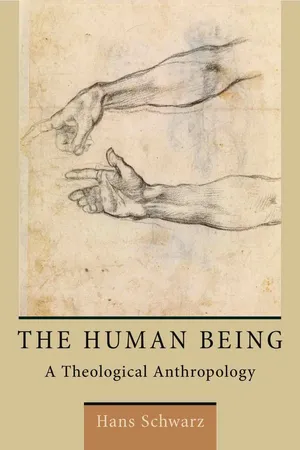
This overview of Christian anthropology by Hans Schwarz uniquely emphasizes three things: (1) the biblical testimony, (2) the historical unfolding of Christian anthropology through the centuries, and (3) the present affirmation of Christian anthropology in view of rival options and current scientific evidence.
Schwarz begins by elucidating the special place occupied by human beings in the world, then ponders the complex issue of human freedom, and concludes by investigating humanity as a community of men and women in this world and in the world beyond. While maintaining a strong biblical orientation, Schwarz draws on a wide range of resources, including philosophy and the natural sciences, in order to map out what it means to be human.
Schwarz's
Human Being will interest anyone who is concerned with how in the face of fascinating scientific insights we can intelligently talk today about human sinfulness, human freedom, and human beings as children of the God who created us.
- 416 pages
- English
- ePUB (mobile friendly)
- Available on iOS & Android
eBook - ePub
About this book
Information
Topic
Theologie & ReligionSubtopic
Christliche TheologieI.
A Special Place in the World
In the last century it became more and more evident that human beings occupy a special place in this world. Through their unprecedented population growth they are crowding out more and more living species. If they continue to consume nonrenewable natural resources at such prevailing rates, they will also in the long run crowd themselves out, or at the least make the present standard of living in “developed” countries a thing of the past. When we look at the biblical account, we also find there an ambivalent assessment of human existence.
1.
The Biblical Perspective
In Psalm 8:4 the psalmist raises the all-important question “What are human beings that you are mindful of them, mortals that you care for them?” With the creation narrative in Genesis 1 we could answer that the reason God cares for humans is that God created them. Whereas the God relationship is expressed there, this does not tell us anything about the constitution of humans.
1. The Old Testament View
There are three or perhaps even four Hebrew terms that describe a human being: nefesh, basar, ruah, and perhaps leb. These terms point to the essentials of a human being and are translated roughly as soul, flesh, spirit, and heart.
a. Humans as Living Beings
The term nefesh occurs at least 750 times in the Old Testament and is translated 680 times as “psyche” in the Septuagint, the Greek version of the Old Testament.1 Yet each of these renderings remains wanting. We notice this at once when we read in Genesis 2:7, “The Lord God formed man from the dust of the ground, and breathed into his nostrils the breath of life; and the man became a living being.” The original Hebrew nefesh hayah, translated as “living being,” certainly does not mean a living soul or a living psyche. A human being does not have a nefesh (soul or psyche), but is one and lives as one. As we see in 1 Kings 17:17ff., when the breath leaves the child (v. 17) and only returns after the prophet Elijah uses mouth-to-mouth resuscitation, the nefesh is what makes a person a living being. Since a human being breathes, nefesh is also the breath and it can be strong (Exod. 15:10) or laborious (Isa. 42:14). As soon as the breath stops, life ends. This means the nefesh has no existence outside the body, but is always tied to a bodily existence. Therefore nefesh can simply be equated with “life.”2 The throat, the visible organ for breathing, can also be called the nefesh (Ps. 69:2[1]). But the Old Testament is not very discerning, anatomically speaking. Therefore the throat can also be said to experience hunger (Deut. 23:25[24]), thirst (Prov. 25:25), and appetite (Mic. 7:1). As the agent of life, nefesh can also be identified with the blood (Deut. 12:23). Since nefesh is so closely tied to life, it can also denote the power to live. When Rachel’s nefesh departed, she died (Gen. 35:18). At the same time, nefesh can also mean one’s own self. For example, Isaac said to Jacob that he should bring some of the wild game so that “I [my nefesh] may bless you” (Gen. 27:25).
When we read the command “You shall love the Lord your God with all your heart [leb], and with all your soul [nefesh], and with all your might” (Deut. 6:5), we notice not just a close relation of leb and nefesh, but also a summons to the innermost core of a human being. The same goes for Psalm 103:1, where the psalmist says, “Bless the Lord, O my soul [nefesh], and all that is within me, bless his holy name.” The whole human existence is denoted by nefesh. It comes as no surprise that even human feelings and passions, such as hatred (2 Sam. 5:8), longing (Ps. 42:2), and affection toward other people (Gen. 34:3, 8), are expressed with this term.
“Basar can sometimes denote the whole man as well as nefesh.”3 So we read in Deuteronomy 12:23, “For the blood is the life [nefesh],” connecting leb (blood) and nefesh. In Leviticus 17:11 we then read, “For the life [nefesh] of the flesh [basar] is in the blood [leb],” whereby the blood as spreading through the whole human being contains the life of the body. Yet nefesh is not an indestructible core of personal existence that could stand in contrast to the body and exist independently of the body. Therefore the translation of nefesh with “soul” is misleading. “Though much is said about nefesh as the life, any cult of life or death is lacking, and with it also every speculation about the fate of the ‘soul’ beyond the borders of death.”4 The psalmist, however, prays to God: “For you do not give me [my nefesh] up to Sheol, or let your faithful ones see their Pit” (Ps. 16:10). Human life is under the protective care of God and no other powers have any claim on it. When the “I” becomes synonymous with nefesh, it shows that humans do not have a nefesh but as living beings they are a nefesh. So nefesh can denote an individual person (Lev. 22:3) or even in the plural a whole group of people (Gen. 9:5).
b. Humans as Bodily Beings
When we consider the term “flesh” (basar), we notice that it is exclusively used for living beings. “Whereas nefesh is applied to God in at least three percent of its occurrences in the Old Testament, there is not a single instance in the case of basar.”5 Basar stands for living beings and their bodily existence. As Hans Walter Wolff (1911-93) has shown, out of the 273 occurrences of basar in the Old Testament, 104 are references to animals. The term largely connects humans with animals. With reference to the latter, basar can simply mean the flesh or meat of animals, such as the roasted meat that is eaten (Isa. 44:16) or the flesh of animals that are still alive (Job 41:23). When one reads in Leviticus of animal offerings, reference is made quite often to the flesh of animals (Lev. 4:11). Yet in the same book one can also read of the curse that falls on Israel on account of its disobedience to God. Then “you shall eat the flesh of your sons, and you shall eat the flesh of your daughters” (Lev. 26:29). Human flesh can also be contrasted to bones, as can be seen in the creation story. In creating Eve God took one of Adam’s ribs “and closed up its place with flesh” (Gen. 2:21).
Basar not only denotes the distinction between flesh and bones, but it is also used “euphemistically” of the sexual organs, as is seen in the injunction on cultic uncleanness: “When any man has a discharge from his member [basar], his discharge makes him ceremonially unclean” (Lev. 15:2).6 Similarly, we hear “when a woman has a discharge of blood, that is a regular discharge from her body [basar], she shall be in her impurity for seven days” (Lev. 15:19). While the New Testament can distinguish between skin and flesh, often basar simply means the whole body, including the skin. The Israelites are admonished, for instance, not to make any gashes in their flesh (Lev. 19:28), a custom that is still observed today by some tribes who inflict on themselves such gashes or wounds as ornamentation. “Basar is probably the most comprehensive, most important, and most frequently used anthropological term for the external, fleshly aspect” of human nature.7
Nefesh basar (a bodily living being) can also represent a person, as we read in Psalm 119:120: “My flesh [basar] trembles for fear of you, and I am afraid of your judgments.” Besides being used for an individual, basar can also denote a human togetherness, for instance, when the first man said concerning the first woman, “This at last is bone of my bones and flesh of my flesh” (Gen. 2:23). Moreover, it can be used for a certain relationship, as is expressed by the brothers of Joseph when they say about him, “He is our brother, our own flesh” (Gen. 37:27). When Yahweh promises Israel that he “will remove from your body the heart of stone and give you a heart of flesh” (Ezek. 36:26), we notice that, like nefesh, flesh denotes here something living. Yet in the same vein it is also something that is limited in duration, as can be seen in Job 34:14f.: if Yahweh “should take back his spirit to himself, and gather to himself his breath, all flesh would perish together, and all mortals return to dust.” The fact that the flesh is alive is not to be taken for granted, but ultimately rests on God’s ruah, on God’s spirit. One need not even be afraid of such a mighty king as Sennacherib of Assyria, as Hezekiah of Judah states, “With him is an arm of flesh; but with us is the Lord our God, to help us and to fight our battles” (2 Chron. 32:8). Human flesh is always limited in its duration and power, and life is not an innate human faculty. Therefore we hear God in Ezekiel’s vision of the valley of dry bones saying, “I will cause breath to enter you, and you shall live. I will lay sinews on you, and will cause flesh to come upon you, and cover you with skin, and put breath in you, and you shall live” (Ezek. 37:5f.). This breath (ruah) that comes from God and makes the difference between life and death is not just nefesh as in Genesis 2:7, but is more fittingly translated “spirit.”
c. Humans as Theomorphic
Ruah can be used in two ways. First, almost one-third of its usage in the Old Testament denotes a natural power, namely, the wind.8 Second, it is used almost equally often to signify the ruah of God and to a somewhat lesser extent of humans, animals, and idols. When ruah is compared with nefesh, nefesh is only rarely used with reference to God, but basar is never found in this context. We agree with Hans Walter Wolff who calls ruah “a theo-anthropological term.”9
Ruah is used to denote the wind as a natural power. For instance, we hear that “the trees of the forest shake before the wind” (Isa. 7:2). In the story of the crossing of the Red Sea, we hear that “the Lord drove the sea back by a strong east wind all night, and turned the sea into dry land” (Exod. 14:21). When the wind is called a “natural” power in this context, it should be noted that the wind is God’s tool to rescue the Israelites. The modern bifurcation between the natural and the supernatural spheres is unknown to the Old Testament. The wind is a mighty power that is at the disposal of Yahweh, as we read in Ezekiel 13:13: “Therefore thus says the Lord God: In my wrath I will make a stormy wind break out, and in my anger there shall be a deluge of rain, and hailstones in my wrath to destroy it.”
In its theo-anthropological meaning, however, ruah is first of all the human breath, so to speak the human wind that endows a human being with life. Again, this breath is nothing natural to be taken for granted as we read in Isaiah 42:5: “Thus says God, the Lord, who created the heavens and stretched them out, who spread out the earth and who comes from it, who gives breath to the people upon it and spirit [ruah] to those who walk in it.” This is the difference between God’s creatures and the idols made by human beings. Whether they are made of stone or wood, whether they are gold- or silver-plated, “there is no breath [ruah] in [them] at all” (Hab. 2:19). Only Yahweh alone can endow things with ruah. On the one hand, this ruah is the spirit or breath of life that belongs to humans because “when their breath departs, they return to the earth” (Ps. 146:4). But it is also God’s life-giving breath, or Spirit, as we see in Job 34:14f.: “If he should take back his Spirit to himself, and gather to himself his breath, all flesh would perish together, and all mortals return to dust.” The Israelites knew that as long as someone breathes, this breath, spirit, or wind is inhaled and exhaled and there is life in that person. In this way they can talk about ruah in a very mundane way. We read, for instance, in Job 19:17: “My breath is repulsive to my wife; I am loathsome to my own family.” Here ruah is equated with bad breath.
Yet the Israelites knew that this spirit of life is nothing natural, as being derived from nature. It is God’s creative power and makes the difference between life and death. We read in Genesis 6:3: “The Lord said, ‘My Spirit shall not abide in mortals forever, for they are flesh.’” In the last analysis ruah is God’s life-giving Spirit that determines how long a person will live. If this Spirit is given in abundance, humans enjoy exceptional qualities. Therefore the Egyptian Pharaoh looked for a person “in whom is the Spirit of God” (Gen. 41:38), so that this person would have sufficient wisdom to take appropriate measures to avoid the threatening famine. Like the ruah Yahweh endows a person with artistic abilities (Exod. 31:3). This would mean that b...
Table of contents
- Title Page
- Copyright Page
- Contents
- Preface
- Abbreviations
- Introduction
- Part I: A Special Place in the World
- Part II: Human Freedom
- Part III: Humanity as a Community of Men and Women
- In Conclusion
- Index of Names
- Index of Subjects
- Index of Biblical References and Other Ancient Texts
Trusted by 375,005 students
Access to over 1.5 million titles for a fair monthly price.
Study more efficiently using our study tools.
Frequently asked questions
Yes, you can cancel anytime from the Subscription tab in your account settings on the Perlego website. Your subscription will stay active until the end of your current billing period. Learn how to cancel your subscription
No, books cannot be downloaded as external files, such as PDFs, for use outside of Perlego. However, you can download books within the Perlego app for offline reading on mobile or tablet. Learn how to download books offline
Perlego offers two plans: Essential and Complete
- Essential is ideal for learners and professionals who enjoy exploring a wide range of subjects. Access the Essential Library with 800,000+ trusted titles and best-sellers across business, personal growth, and the humanities. Includes unlimited reading time and Standard Read Aloud voice.
- Complete: Perfect for advanced learners and researchers needing full, unrestricted access. Unlock 1.5M+ books across hundreds of subjects, including academic and specialized titles. The Complete Plan also includes advanced features like Premium Read Aloud and Research Assistant.
We are an online textbook subscription service, where you can get access to an entire online library for less than the price of a single book per month. With over 1.5 million books across 990+ topics, we’ve got you covered! Learn about our mission
Look out for the read-aloud symbol on your next book to see if you can listen to it. The read-aloud tool reads text aloud for you, highlighting the text as it is being read. You can pause it, speed it up and slow it down. Learn more about Read Aloud
Yes! You can use the Perlego app on both iOS and Android devices to read anytime, anywhere — even offline. Perfect for commutes or when you’re on the go.
Please note we cannot support devices running on iOS 13 and Android 7 or earlier. Learn more about using the app
Please note we cannot support devices running on iOS 13 and Android 7 or earlier. Learn more about using the app
Yes, you can access The Human Being by Hans Schwarz in PDF and/or ePUB format, as well as other popular books in Theologie & Religion & Christliche Theologie. We have over 1.5 million books available in our catalogue for you to explore.