- 176 pages
- English
- ePUB (mobile friendly)
- Available on iOS & Android
eBook - ePub
Stories of the Humboldt Wagon Road
About this book
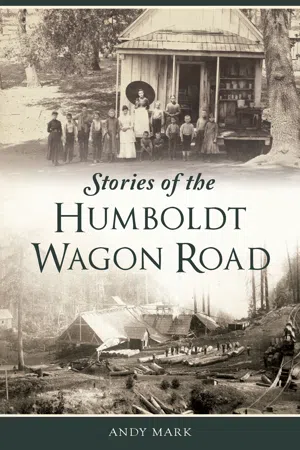
Before the completion of the transcontinental railroad, there was the Chico and Humboldt Wagon Road, meant to connect California with the burgeoning mining industries of Nevada and Idaho. The ambitious plan to make Chico a major Northern California transportation hub was spearheaded by John Bidwell and began in earnest in 1864. The road opened new areas to mining and logging and provided opportunities for less scrupulous characters. Stagecoach robberies, murders and shootouts were just some of the misfortunes that occurred on the road, along with the dangers nature provided--snowstorms, perilous terrain and grizzly bears. Author Andy Mark offers a glimpse of what it was like for nineteenth-century travelers and settlers on the route of the Humboldt Wagon Road.
Information
Subtopic
North American HistoryIndex
History1
1860S
The Road to the Mines
OVERVIEW
History tells us that, from early adulthood, John Bidwell was an adventurous person who was willing to take some risks. At twenty-one years old, in the spring of 1841, he became a member of the first group of American settlers traveling overland to a region that was eventually named the state of California. (At that time, it was still Mexican territory.) The expedition was later known as the Bidwell-Bartleson Party because John Bidwell played a major role in organizing the journey and John Bartleson was elected captain.
The inexperienced California-bound travelers faced many hardships along the way on a trail that was not yet established. They had to cross an unforgiving, barren desert and were forced to negotiate steep, narrow and winding canyons to climb up and over high mountain passes. When they reached northeastern Nevada, they abandoned their wagons and had to pack their goods on oxen. Loss of livestock and shortage of food was commonplace. By the time the exhausted travelers arrived at their destination near San Francisco Bay on November 4, they had journeyed almost six months and covered about two thousand miles.
In late 1841, Bidwell landed a job with John Sutter, who was developing a settlement called New Helvetia near the confluence of the American and Sacramento Rivers. The fort that Sutter soon built there was to become the gateway for overland explorers arriving in California from 1843 to the end of the decade. Sutter immediately recognized Bidwell’s strong character and many talents and soon made him his right-hand man, creating assignments for the young employee that ranged from bookkeeping to managing various enterprises that required Bidwell to travel all over Northern California. For the next eight years, Bidwell acquired some important experiences under the direction of Sutter, something that he would find useful in his own future enterprises.
In 1843, some horses were stolen from Bidwell not far from Sutter’s Fort. To retrieve his lost livestock, Bidwell followed the guilty party up through Northern California. Along the way, he passed through a most beautiful and fertile region some ninety miles north of Sutter’s, of which he quickly became enamored. This was the site of the future Rancho Chico in Butte County, the place that would eventually put Bidwell on the map.
In 1845, Bidwell purchased some land on the Farwell grant, which provided him a foothold in the area he had fallen in love with earlier. Bidwell built a small cabin on this land along Little Butte Creek and began to occupy the dwelling in 1847.
It was during the following year that possibly the most momentous event in California’s recorded history occurred—the discovery of gold at Sutter’s Mill in Coloma. Bidwell even had a hand in this. He was the one who drew up the contract between Sutter and James Marshall for the construction of the lumber mill. So, it seems appropriate that Bidwell would eventually strike it rich on the Middle Fork of the Feather River during the years 1848 and 1849. Not only was he successful at prospecting, but his business mind also went to work. He opened a store at the location, which made a healthy profit of its own. (Ironically, the subsequent widespread environmental destruction created by corporate-owned mines caused massive soil erosion to fill waterways all the way to the valley and prompted Bidwell to later become one of the mining industry’s biggest critics.)
With his newfound wealth, John Bidwell purchased more land and, by 1851, was sole owner of Rancho Chico, a vast spread of ground 22,214 acres in size situated just north of the Farwell grant. Over the next decade, Bidwell developed a large agricultural operation on his rancho. During much of this time, he was still holding the land under a Mexican land grant, but he was eventually awarded a U.S. patent in 1860. That same year, he laid out and founded the town of Chico south of the agricultural area as a place for his employees to live and buy goods. He would eventually sell or give away almost all his properties on the Farwell grant while keeping most of Rancho Chico.

John Bidwell struck it rich at a place that was eventually named after him, Bidwell Bar. From Coy’s 1925 book, Pictorial History of California.

Plat of Rancho Arroyo Chico, surveyed in 1859. Courtesy of CSU, Chico, Meriam Library, Special Collections.

Portrait of John Bidwell, taken in 1860. Courtesy of CSU, Chico, Meriam Library, Special Collections.
Bidwell soon recognized the importance of creating conditions to secure Chico’s future, and when news got out about rich silver strikes along the Humboldt Range, Nevada Territory in 1861, he thought it might be a good idea to get in on the action. Shortly afterward, Bidwell proposed a trans-Sierra wagon road, with Chico as the valley terminal, to connect Nevada’s burgeoning mining industry with California. Not only would this operation put Chico in the enviable position of becoming a principal connection in a supply line between northwestern Nevada mines and San Francisco and beyond, but it would also give Bidwell a greater opportunity to ship products from his expanding field crop, orchard and livestock business.
In 1862, another mining boom was reported in southwestern Idaho, giving even more impetus to the establishment of a major transportation line from the valley to the Nevada and Idaho mining regions. Roadwork began that year. In September, it was reported that Bidwell managed to punch a sixty-five-mile road from Chico over the Sierras to deliver freight to the Humboldt mines,1 suggesting the portion to Prattville was open.
In April 1863, John Bidwell and four others (J.C. Mandeville, R.M. Cochran, E.B. Pond and John Guill) received a twenty-year franchise from the state legislature to build and operate a toll road between Chico and Susanville in the Honey Lake Valley of northeastern California, where it would connect to a federal wagon road that went eastward to the Big Bend of Nevada’s Humboldt River and beyond. Later that spring, it was advertised that pack trains, droves of cattle and wagons were crossing the road on a daily basis.2 One paper reported that over six thousand head of cattle were on their way to the Humboldt mines.3
In 1864, the Chico and Humboldt Wagon Road Company was incorporated, and the name reflected the original intent of the enterprise. Bidwell was the wealthiest person in the Chico area and was the chief stockholder of the corporation. By the end of 1864, stagecoaches were also moving over the mountains from Chico to Susanville.
It should be noted that in September 1863, during the Civil War, Governor Leland Stanford appointed John Bidwell to the position of brigadier general in the state militia. The new commander’s primary responsibility was to suppress any threat of a Confederate uprising in California. Thereafter, Chico’s founder was referred to as “General” Bidwell.
In the winter of 1864 and into 1865, three Idaho businessmen, J.B. Francis, E.D. Pierce and G.C. Robbins, formed the Idaho Stage Company and were looking for a connection into California from the southwestern corner of their state. Naturally, Bidwell thought it would be a great opportunity if the Idaho road connected with his own to make Chico the western terminal. Competing with Red Bluff and its more northern route to the Sacramento Valley was not easy because the way to Tehama County clearly had its advantages. But Bidwell may have swayed the decision by doing just about anything within reason to have his way. As it turned out, he gave the Idaho group substantial financial aid in the way of livestock, hay, harnesses and stagecoaches.
On April 3, 1865, the first saddle train traveled the road from Chico to Ruby City, Idaho,4 taking twenty-seven days. After some problem areas were worked out (including changing sections of the route), the travel time was reduced considerably, with one party in June reportedly cutting it in half. Through traffic commenced sometime later that year, but there were troubles from the start, including periodic American Indian raids and lack of road maintenance. Well-known roadbuilder Captain John Mullan, who joined the operation in July, managed to get more military protection against natives, but they still caused trouble for travelers. Finally, the whole line was discontinued in the fall of that year. It was not prepared for winter travel anyway.
Early the next year, news of another mineral strike in the Black Rock Desert in northwestern Nevada fueled more enthusiasm for reopening the road. When the ambitious General Bidwell, by then a member of the U.S. House of Representatives, used some of his political clout to obtain a federal mail contract between Idaho and Susanville while switching the western terminus of the Susanville contract from Oroville to Chico, things began to look really rosy for his new road.
By April 1866, news began to emerge of freight and passenger travel out of Chico for destinations in Nevada, Idaho and Montana. It was reported that the way northward was being opened by none other than the well-known Indian fighter Hi Good and his train of five wagons and fifty pack animals.5 One thing was for sure—Hi Good wasn’t going to be intimidated by any hostile Nevada Indians. The tall, muscular man, who was considered by many at the time to be a regional hero, had already made quite a name for himself by killing many American Indians in California’s Butte and Tehama Counties. Good was eventually killed by an orphaned Indian boy who he was raising at the time.6 (Evidence suggests the boy likely had accomplices.)
After catching a good deal of heat from the press for failing to immediately come up with a magical solution to the Susanville-Idaho road problems of 1865, Captain John Mullan7 was back in action the following spring. He was described by Chico’s local press as “a small steam engine, and things move when he hitches to them.”8 On July 1, the new mail contract went into effect, and the first regular coach left Chico for Ruby City. The news later reported that the trip took three days and five hours.9 It wasn’t long before stages were leaving Chico for Idaho every other day.10
Earlier that spring, the Chico newspaper reported that the distance between Chico and Ruby City was 401 miles and published distances between the stations along the way.11 One might wonder how they calculated mileage in those days. Well, it wasn’t much different than today—with odometers attached to the wheels of a vehicle, such as a coach.12
In light of the competition with other local roads, it’s interesting to note that if you believed everything the Chico newspaper had to say, its road couldn’t be beat. Of course, newspapers from other towns would have the same glowing reports of their thoroughfares. Although Red Bluff ’s Tehama County Wagon Road and Oroville’s Humbug Road were the nearest competitors for the westernmost section of the highway to Idaho,13 they all shared a rivalry with the dominant Oregon Steam Navigation Company, which moved merchandise north from San Francisco, over the ocean, up the Columbia River, across the Blue Mountains and into the Idaho Basin. Chico’s Courant newspaper never passed up a chance to report criticism of the steam company’s path, commonly referred to as the “Webfoot” route, in which cargo had to be loaded and unloaded several times, risking damage to the goods.14
Despite continued Indian attacks, traffic was substantial on Bidwell’s road for the rest of the year, until the first heavy snows of November. In March 1867, it was reported that the mail contract was cancelled.15 When this was combined with the completion of the western portion of the Central Pacific Railroad track up to the big bend of the Humboldt River, allowing the distance by stage to be essentially cut in half, the demise of the Chico to Idaho stage route became obvious. The inevitable completion of the transcontinental railway in 1869 was the final nail in the coffin.

This Chico Courant ad, dated December 28, 1866, ran from the summer of 1866 to soon after the mail contract was discontinued early the following year.
While Bidwell’s dream of Chico being part of a major supply route from California to Nevada and Idaho came to an end, the road was still useful in other ways. Regular stage traffic to points from Chico to Susanville continued, and the road opened the foothills and mountains to stands of virgin timber to supply an expanding logging industry. The resort business thrived as people used the road to remove themselves from the stifling summer heat of the valley and fine hunting and fishing opportunities became available.
Small settlements and hotels were developed along the way to furnish resting and eating stops for the travelers. Hog Springs, located about six miles from the Junction, in Chico, was the first water stop out of town. R.H. O’Ferrall, Butte County auctioneer, had it for sale in 1867, claiming it was “one of the best and most desirable stands on the road.”16
Paul and Ellen Lucas settled on a small piece of land in Big Chico Creek Canyon, about fourteen miles from Chico (located in today’s Big Chico Creek Ecological Reserve). The couple soon started raising children there, while creating a stock and butchering business.
Someone had to pay for repair and maintenance of the new wagon road. Who better than the people who actually used it? A tollgate, sometimes referred to as Cement Springs, was located some fourteen miles from Chico,17 just up the road from the Lucas house.
Elias Findley’s place, about sixteen miles away, had a garden that provided cold watermelon. Just two miles above Findley’s was Saunders’s place. McDonald’s place was two miles beyond Saunders’s. In 1867, it was reported that a fine two-story hotel was kept there by J.C. Wertsbaugher. The water was taken from a well sixty f...
Table of contents
- Front Cover
- Title Page
- Copyright
- Contents
- Preface
- Acknowledgements
- Introduction: A Description of the Road
- 1. 1860s: The Road to the Mines
- 2. 1870s: A Postal Route Established
- 3. 1880s: The Road Charter Expires
- 4. 1890s: Clashing Over Road Maintenance
- Epilogue
- Appendix 1: Truth or Fiction
- Appendix 2: Grand Views from the Humboldt Road
- Notes
- Bibliography
- About the Author
Trusted by 375,005 students
Access to over 1.5 million titles for a fair monthly price.
Study more efficiently using our study tools.
Frequently asked questions
Yes, you can cancel anytime from the Subscription tab in your account settings on the Perlego website. Your subscription will stay active until the end of your current billing period. Learn how to cancel your subscription
No, books cannot be downloaded as external files, such as PDFs, for use outside of Perlego. However, you can download books within the Perlego app for offline reading on mobile or tablet. Learn how to download books offline
Perlego offers two plans: Essential and Complete
- Essential is ideal for learners and professionals who enjoy exploring a wide range of subjects. Access the Essential Library with 800,000+ trusted titles and best-sellers across business, personal growth, and the humanities. Includes unlimited reading time and Standard Read Aloud voice.
- Complete: Perfect for advanced learners and researchers needing full, unrestricted access. Unlock 1.5M+ books across hundreds of subjects, including academic and specialized titles. The Complete Plan also includes advanced features like Premium Read Aloud and Research Assistant.
We are an online textbook subscription service, where you can get access to an entire online library for less than the price of a single book per month. With over 1.5 million books across 990+ topics, we’ve got you covered! Learn about our mission
Look out for the read-aloud symbol on your next book to see if you can listen to it. The read-aloud tool reads text aloud for you, highlighting the text as it is being read. You can pause it, speed it up and slow it down. Learn more about Read Aloud
Yes! You can use the Perlego app on both iOS and Android devices to read anytime, anywhere — even offline. Perfect for commutes or when you’re on the go.
Please note we cannot support devices running on iOS 13 and Android 7 or earlier. Learn more about using the app
Please note we cannot support devices running on iOS 13 and Android 7 or earlier. Learn more about using the app
Yes, you can access Stories of the Humboldt Wagon Road by Andy Mark in PDF and/or ePUB format, as well as other popular books in History & North American History. We have over 1.5 million books available in our catalogue for you to explore.