The belief that airpower is inherently offensive is a recurrent theme throughout airpower theory and doctrine. Before World War I, dogmatic belief in the dominance of the offense in land warfare affected the military decisions which resulted in the disaster of the trenches. Termed the "cult of the offensive" by scholars, faith in offense became so unshakable in pre-1914 Europe that military organizations dismissed as irrelevant the numerous indications of the waning power of the offense as technological developments strengthened the defense. With airpower's professed inclination for offense, could a cult of the offensive perniciously trap airpower doctrine and lead to similarly disastrous consequences?
The study begins by establishing the theoretical background necessary for case study analysis. Airpower defense is defined as those operations conducted to deny another force's air operations in a designated airspace. Airpower offenses are those operations in the airspace defended by another, or operations conducted outside of one's actively defended airspace. The relationship between offense and defense is dissected to discover that airpower defense enjoys neither an advantage of position nor of time, so traditional Clausewitzian views relative to the power of the defense do not apply to airpower. Next, the study describes those factors which may inject, or reinforce, a preferential bias for offense into airpower strategy and doctrine. A cult of the offensive is defined as an organizational belief in the power of offense so compelling that the military organization no longer evaluates its offensive doctrine objectively. This leads to an examination of the ramifications postulated to result from offensive ideology.
- 111 pages
- English
- ePUB (mobile friendly)
- Available on iOS & Android
eBook - ePub
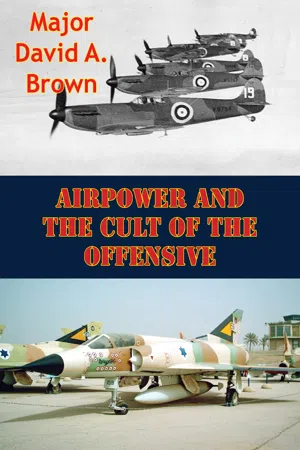
Airpower And The Cult Of The Offensive
About this book
Information
Subtopic
Military & Maritime HistoryIndex
HistoryCHAPTER 1—INTRODUCTION
“I am tempted indeed to declare dogmatically that whatever doctrine the Armed Forces are working on now, they have got it wrong. . . . Still it is the task of military science in an age of peace to prevent the doctrines from being too badly wrong.”—Michael Howard, Chesney Memorial Gold Medal Lecture, 3 October 1973
Since a complete understanding of the conditions of future conflict lies beyond the horizon of any strategist, those called upon in the future to execute doctrine formulated today will likely find it lacking. The degree to which doctrine fails to anticipate the actual conditions of combat may spell the difference between victory and defeat. That military organizations entrusted with the preservation of national security will strive to develop usable doctrine appears self-evident, as does the assertion that future conflict will hold some surprises despite the best efforts of planners, especially if a nation enters an unexpected conflict. What is surprising, however, is that doctrine sometimes turns out to be thoroughly inappropriate for even an anticipated, foreseen conflict. Obviously no organization sets out to develop a flawed doctrine, but despite the best of intentions, some doctrines lead to tragedy for the armed forces employing them. To help avert such future tragedies, this paper offers insights about how to avoid one possible cause of “badly wrong” doctrine.
The military doctrines of the European powers in 1914 erred terribly by underestimating the power of the defense. Several authors, notably Stephen Van Evera and Jack Snyder, have examined the antebellum characteristics of the major European powers’ World War I military organizations and label the myriad causes and effects of their extreme faith in offense over defense in spite of contrary evidence “the cult (or ideology) of the offensive.”{1} The experience of World War I appears to demonstrate that one way to get doctrine badly wrong is to overestimate the power of the offense.
The relationship between offense and defense has long intrigued military theorists. Jomini and Clausewitz both addressed the relative strengths and weaknesses of offense and defense in their major works. {2} One of the first airpower theorists, Giulio Douhet, claimed that no defense against aircraft was possible. {3} While acknowledging the possibility of defense, both AFM 1-2, the U.S. Air Force’s (USAF) first doctrine publication, and AFM 1-1, its current version of its basic doctrine, assert that airpower is inherently offensive. {4} Considering airpower doctrine’s predilection to offense, along with the observation that, in the case of World War I, overestimating the power of the offense led to truly bad doctrine, prompts the following question: can the cult of the offensive perniciously trap airpower doctrine, and, if so, what are the identifiable symptoms that an offensive bias may have skewed one’s airpower doctrine?
To answer this question, this thesis provides a theoretical background and examines three cases to test the hypothesis that the ideology of the offensive can trap airpower doctrine. After examining the nature of offense and defense as they apply to airpower in Chapter 2, Chapter 3 offers some of the reasons military organizations may prefer offensive doctrines and identifies the elements and implications of the cult of the offensive. Chapters 4, 5, and 6 each investigate a historical case to determine if the airpower doctrine under study was trapped by the cult of the offensive. Inferred from the case study data are the symptoms which strategists may use as indicators that their doctrine properly, or improperly, estimates the effectiveness of the offense. Chapter 7 reviews the empirical findings and discusses the implications of this study.
The use of evocative words like “trap” and “cult” requires some additional explanation, lest the reader be misled by the choice of terminology. Chapter 3 discusses some of the implications of organizational theory for military organizations, in particular the influence organizational forces can exert on the formulation of military doctrine. For comprehensible, logically justifiable reasons military organizations usually prefer offensive doctrines, and such natural attraction of offense is not what is meant by a cult of the offensive. Where exactly one draws the line between the customary, militarily useful appeal of the offense and a cult of the offensive is necessarily vague.
However, the difference is important. The use of the word “cult” is meant to describe, not indict. When doctrine depends on immediate offense for success either without regard to observable improvements which have significantly strengthened the defense, or when known political limitations prevent the use of the offense, one perceives a critical discontinuity between offensive doctrine and reality. It is this discontinuity which occurs when offensive preference continues, or even strengthens, in the face of known limitations or obstacles to offensive action, that is investigated as being possibly attributable to a cult of the offensive. A cultic belief in the success of the chosen offense, despite readily available evidence to the contrary, characterizes such instances.
Similarly, the use of the word “trap” indicates that preference for offense could make one’s doctrine susceptible to a cult of the offensive. As demonstrated in 1914, belief in the efficacy of offense can become so compelling that defensive improvements are ignored as irrelevant and the ability and requirement to conduct a successful offensive are no longer questioned. This dynamic becomes self-reinforcing: once acting, a powerful offensive preference begets more offense. It is in this sense that a cult of the offensive can trap doctrine. Robert Jervis asserts that it is possible to ameliorate the effects of the security dilemma by first recognizing that it exists. {5} This thesis likewise asserts that one may avoid the potential trap of a cult of the offensive by acknowledging the spiraling tendency of offensive doctrines, then remaining alert for symptoms which indicate that such a spiral may be occurring.
The proper use of evidence is critical to drawing any useful conclusions. One should not fault planners for underestimating the power of the defense when defensive improvements occur secretly, or result from an unanticipated technological improvement. For example, Luftwaffe planners did not fully comprehend how the Royal Air Force’s fighter direction net incorporated radar to increase the power of the defense in the Battle of Britain. While their intelligence methods may merit criticism, the Germans did not ignore the influence of new technology for the defense; they simply did not have adequate information to judge its importance. {6}
It also becomes much easier to find signs which accurately predicted the nature of a conflict in hindsight. The historical record may preserve the prognostications of those who correctly anticipated how a conflict would unfold, while not preserving other guesses which, though just as powerful at the time, turned out to be as wrong as the preferred doctrine. This phenomenon could lead one to conclude, erroneously, that strategists made a clear choice to reject the “correct” doctrine for the “incorrect” one. To demonstrate both the power and the danger of the ideology of the offensive, the evidence must show that the potential deficiencies of the offensive doctrine were apparent, that the organization under study had the opportunity to consider the data portending the ineffectiveness of their planned offense, and that the military organization nevertheless rejected doctrinal reform in favor of continued emphasis on the offense.
The case studies considered here, the doctrines of the British Royal Air Force in the interwar period through 1938, of the Israeli Air Force from 1967 to 1973, and of the United States Air Force from 1953 to 1965, are specifically bounded to test the hypothesis. Changing the boundaries could lead to different conclusions. For instance, the Israeli case begins after the remarkable success of 1967, the British case does not include World War II, and the U.S. case examines only the period before extensive bombing began in Vietnam. The cases do, however, have important similarities which drove their selection for this study. In each case, the airpower doctrine under study was offensive. During the time periods under study airpower employment conditions changed, which leads one to the question of the appropriateness of the offensive doctrine by the end of the period. Each case considers a relatively large, well-funded military organization which had sufficient flexibility to alter its doctrine, if leaders had decided that doctrinal reform was necessary. Finally, the lessons gleaned from these cases appear to have applicability to today’s airpower doctrinal development.
CHAPTER 2—THE NATURE OF OFFENSE AND DEFENSE FOR AIRPOWER
“In summary, the speed, range and flexibility of air power grant it ubiquity, and this in turn imbues it with an offensive capability. Because success in war is generally attained while on the offensive, the adage, “the best defense is a good offense,” is almost always true in air war.” —Colonel Phillip S. Meilinger, “10 Propositions Regarding Air Power”
To analyze the potential influence of offensive ideologies on the development of airpower doctrines, it is first necessary to clarify the definitions of offense and defense as they apply to airpower. Once the definitions are established, an accurate description of the relationship between offense and defense for airpower is possible.
Traditional Definitions of Offense and Defense
Interest in the relationship between offense and defense has increased with the growing importance of offense-defense theory in international security studies. {7} Because some elements of this theory are useful for explaining the relationship of offense and defense in airpower, portions of the theory merit a brief review in this study. Offense-defense theory defines offense and defense traditionally in terms of the ability to take or protect territory. {8} The offensive-defensive balance is expressed as the relative cost of offense and defense. While several variations of the definition of balance are in use, the key idea is that the offense has an advantage when it consumes fewer resources to take territory than to defend it. The theory expresses offense-defense balance as the ratio of the investment required in offense to offset an opponent’s investment in defense. {9} For example, if it requires a $3 investment in offense to offset a $1 investment in defense, then the offense-defense balance is expressed as 3:1. The larger this ratio, the greater the balance favors the defense. Defense has more of an advantage in a system, like the one cited above as an example, with a balance ratio of 3:1 than in another system where a $1 investment in defense can be offset by a $2 investment in offense, giving a balance ratio of 2:1. Still, in both of these systems, the defense has an advantage. The idea of “defense-dominance” or “offense-dominance” used to describe ratios other than 1:1 should be more accurately expressed as “advantage.” The ability to compare two systems with different balance ratios and identify movement of the ratio along a continuum provides more utility than making an absolute binary determination. {10} This definition of offense-defense balance avoids the contentious classification of weapons as inherently offensive or defensive by their characteristics, instead focusing on the net effect new technologies have on the overall security system.
Offense-defense theory has demonstrated plausible explanatory power for understanding the causes of wars, the potential for arms races, and the nature of the security dilemma at the strategic level. While the theory incorporates the strategic effects of airpower, it sheds little light on the nature of the offense-defense relationship for operational airpower forces. Even a definition of tactical offensive advantage still refers to the ability to seize or protect territory. {11} Limiting one’s definition of offense to the ability to seize or secure territory implies that airpower acts only as a supporting arm for forces which can take and occupy territory. While supporting ground forces in the conquest of territory is one significant role for airpower, it is not the only way airpower influences national security. Further analysis requires a more refined definition of offense and defense as they apply to airpower.
Airpower Perspective
The first problem in defining offense and defense concerns the matter of perspective. To illustrate, imagine that a fighter aircraft engages an attack aircraft flying to a target. Initially, one likely would call the initiator, the fighter, offensive and the reactor, the attack aircraft, defensive. Suppose that the attack aircraft negates the fighter’s initial weapons delivery attempts and turns to engage the fighter. Depending on each aircraft’s flying characteristics, each one’s air-to-air weapons capabilities, and the spatial relationship of the aircraft, the roles reverse if the attack aircraft attempts to shoot down the fighter, which must now defend. As the engagement continues the roles of offense and defense may cycle back and forth with each transitory advantage of altitude or position. Obviously the nature of the engagement does not change based on whether the fight occurs over friendly or enemy territory. While one may dismiss this dilemma as pertinent only to the most tactical level of war, it illustrates how the perspective of air warfare can differ from that of ground warfare. {12}
To resolve the assignment of offensive and defensive roles, several possibilities exist. One can define engagement roles by assigning each opponent the first role held. Thus, the fighter aircraft which initiated the attack bears the offensive role for the entire engagement, even though the roles may switch later. Yet another common convention acknowledges the exchange of roles by labeling the defender’s attempt to shoot the attacker as a counteroffensive. A third method characterizes tactical engagements by the nature of the higher operational-level strategy they support. In this case, roles at the operational level of war derive from the overall position of forces on the map; one considers the pre-battle status quo to categorize tactical moves as offensive or defensive. All of these conventions, however, stem from a ground combat perspective in which roles do not change as quickly with respect to time as they often do in air combat.
Adopting a territorial approach to offense and defense increases the definitional difficulties for operational airpower. If one flies close air support (CAS) sorties in support of an entrenched force attempting to repel an enemy advance, are the CAS operations defensive or offensive? From one point of view they are defensive, just as one considers the supporting artillery fires defensive. On the other hand, they appear offensive, since they must penetrate enemy airspace and attack enemy positions. Suppose one resolves this perplexity by categorizing air support like artillery support, in terms of the operations of the supported ground force. If the ground force is defensive then the air operations are defensive, and similarly, air support of offensive ground force operations would be offensive. This seems like a reasonable solution at first, but the problem compounds as one considers air missions other than CAS. Using this methodology, the sorties expended to establish air superiority over the battlefield so the defensive CAS can proceed themselves become defensive. Defense now also may include interdiction sorties flown against bridges or against supply convoys hundreds of miles from the ground fighting. Perhaps most absurdly, using this convention forces one to label strategic attack missions flown against an aggressor’s national-level command and control systems, perhaps in the enemy’s capital itself, as defensive.
To overcome this logical incongruence, the definitions of offense and defense for air combat must allow the categorization of air operations given the characteristics of airpower, and require the definitions to remain somewhat intuitive given the common, traditional usage of the terms. First, one should categorize air operations independently of ground operations to avoid the absurdities discussed above. Thus, a theater commander may choose to conduct offensive air operations while ground forces remain in defensive positions, as General Schwarzkopf employed coalition airpower during most of the 1991 Gulf War. Second, the definitions must recognize the key characteristic of airpower: its ability to strike targets throughout the depth of...
Table of contents
- Title page
- TABLE OF CONTENTS
- ABOUT THE AUTHOR
- ACKNOWLEDGMENTS
- ABSTRACT
- CHAPTER 1-INTRODUCTION
- CHAPTER 2-THE NATURE OF OFFENSE AND DEFENSE FOR AIRPOWER
- CHAPTER 3-AIRPOWER AND THE IDEOLOGY OF THE OFFENSIVE
- CHAPTER 4-CASE STUDY: THE ROYAL AIR FORCE, 1918 TO 1938
- CHAPTER 5-CASE STUDY: THE ISRAELI AIR FORCE, 1967 TO 1973
- CHAPTER 6-CASE STUDY: THE UNITED STATES AIR FORCE, 1953 TO 1965
- CHAPTER 7-IMPLICATIONS
- BIBLIOGRAPHY
Trusted by 375,005 students
Access to over 1.5 million titles for a fair monthly price.
Study more efficiently using our study tools.
Frequently asked questions
Yes, you can cancel anytime from the Subscription tab in your account settings on the Perlego website. Your subscription will stay active until the end of your current billing period. Learn how to cancel your subscription
No, books cannot be downloaded as external files, such as PDFs, for use outside of Perlego. However, you can download books within the Perlego app for offline reading on mobile or tablet. Learn how to download books offline
Perlego offers two plans: Essential and Complete
- Essential is ideal for learners and professionals who enjoy exploring a wide range of subjects. Access the Essential Library with 800,000+ trusted titles and best-sellers across business, personal growth, and the humanities. Includes unlimited reading time and Standard Read Aloud voice.
- Complete: Perfect for advanced learners and researchers needing full, unrestricted access. Unlock 1.5M+ books across hundreds of subjects, including academic and specialized titles. The Complete Plan also includes advanced features like Premium Read Aloud and Research Assistant.
We are an online textbook subscription service, where you can get access to an entire online library for less than the price of a single book per month. With over 1.5 million books across 990+ topics, we’ve got you covered! Learn about our mission
Look out for the read-aloud symbol on your next book to see if you can listen to it. The read-aloud tool reads text aloud for you, highlighting the text as it is being read. You can pause it, speed it up and slow it down. Learn more about Read Aloud
Yes! You can use the Perlego app on both iOS and Android devices to read anytime, anywhere — even offline. Perfect for commutes or when you’re on the go.
Please note we cannot support devices running on iOS 13 and Android 7 or earlier. Learn more about using the app
Please note we cannot support devices running on iOS 13 and Android 7 or earlier. Learn more about using the app
Yes, you can access Airpower And The Cult Of The Offensive by Major John R. Carter in PDF and/or ePUB format, as well as other popular books in History & Military & Maritime History. We have over 1.5 million books available in our catalogue for you to explore.