The urgent requirement for US Army preparedness in conducting urban operations (UO) is very real. As global urbanization continues to increase, the contemporary threat environment makes operations in cities impossible to avoid. The past decade has demonstrated through the American experiences in Mogadishu and Russian experiences in Grozny, less capable forces will attempt to use urban terrain asymmetrically to even the balance of power against technologically superior military forces.
While we have always had a serious requirement to conduct urban operations, the very nature of the cold war, which was successful by its deterrence, prevented us from ever having to face the reality of fighting such urban engagements. In the post-cold war era, the U.S. Army is forced to face the realities of fighting in the urban environment. It is not enough to speak of preparing for "future urban operations"; the future is here today and the Army must be prepared to engage in urban operations even as it moves towards the objective force. Being prepared means having solid doctrine, realistic training programs and facilities, and appropriate equipment to ensure success on the urban battlefield when the time comes to fight there.
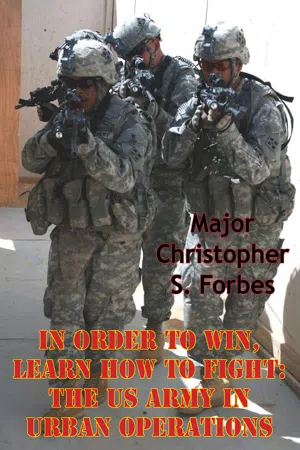
eBook - ePub
In Order To Win, Learn How To Fight: The US Army In Urban Operations
- 87 pages
- English
- ePUB (mobile friendly)
- Available on iOS & Android
eBook - ePub
In Order To Win, Learn How To Fight: The US Army In Urban Operations
About this book
Information
Subtopic
Military & Maritime HistoryIndex
HistoryCHAPTER 1—INTRODUCTION
Statement of the Problem, Background and Significance
Recent UN forecasts predict that 85 percent of the world’s population will reside in urban areas by the year 2025. {1} As the world trend towards urbanization increases, the military significance of cities is likely to increase proportionally. Urbanized areas, themselves, may become significant sources of future conflict. This dramatic shift of the world’s population will only serve to increase the need to create military capabilities adequate to successfully execute urban operations across the full spectrum.
While the cold war doctrine emphasized “city avoidance”, the contemporary and future threat environment may make operations in cities impossible to avoid. Learning from the demonstration of America’s technological superiority on the open field of battle during Operation Desert Storm, contemporary and future enemies hope to use the complexity of urban terrain as a means to counter US advantages. American experiences in Mogadishu and Russian experiences in Grozny serve as an example of less capable forces using urban terrain asymmetrically to even the balance of power against technologically superior military forces.
Since the Cold War, the US Army has focused much of its urban training efforts to deal with urban operations at the lower end of the threat spectrum. The success of this investment has been demonstrated in such operations as those conducted in Haiti, Bosnia, and Kosovo. But has the US Army successfully adjusted to prepare for the increasingly likely, higher end of the spectrum of urban conflict? Or has it maintained a focus on fighting in the less-likely symmetrical warfare of the open field?
Research Questions
The primary research question is as follows: Is the US Army adequately preparing for contemporary and future urban operations?
The secondary and tertiary questions are as follows:
1. What is the urban threat and how likely is urban combat in the future?
2. What is the state of our UO doctrine?
a. Is our UO doctrine joint, combined arms, and does it cover the full-spectrum of operations?
3. What is the state of our urban warfare training?
a. Does our UO training include joint forces, is it combined arms in nature, and does it cover the full spectrum of operations?
b. How often and at what level are units conducting UO training?
i. Home station?
ii. Combat Training Centers?
iii. Simulations?
c. Does UO receive adequate emphasis within Army commands?
4. Are units resourced with adequate UO training facilities and UO equipment?
Scope
The scope of this monograph will include an examination of the urban environment, current status of UO doctrine, training, and resourcing of the Army. It will not however, examine organization and force structure issues within the Army with regards to the execution of urban operations. While these are extremely important issues, they are beyond the scope and purpose of this monograph. The scope of this monograph will also be limited to examining primarily the Army branch of service and will not extend its research to cover the performance, needs and capabilities in UO by other branches of service.
Definition of Key Terms
The literature uses the terms “urban combat” and “fighting in cities” and “urban operations” (UO) interchangeably. The doctrinal term, urban operations, is a new doctrinal term that replaces the term Military Operations in Urban Terrain or MOUT. According to the new FM 3-06, UO are operations across the full spectrum of conflict that occur in an urban environment. The environment consists of complex terrain, a concentration of population, and an infrastructure of systems that form an operational environment in which the Army will operate. {2} This is a significant change from previous doctrine, which viewed urban centers as simply unique terrain. The new term addresses not only the unique urban terrain, but expands its definition to encompass the unique environment of urban centers.
Methodology
This monograph uses primary and secondary sources gathered from historical records, books, pamphlets, periodicals, master’s theses and monographs in order to answer the research question. Additionally it uses sources of information from the Department of the Army, Training and Doctrine Command, and the Combined Arms Command. In conjunction with personal interviews by the author, the monograph uses a series of surveys sent to various units ranging from brigade through company level throughout the Army to gather information concerning training and resourcing for urban warfare. The contents of these surveys are used to provide empirical data to further determine the level of proficiency to which our Army is training for UO, thus moving beyond mere speculation as to how prepared the Army is for urban warfare.
The monograph will review the urban threat and make a determination of what the Army must be prepared to face. Particularly it will examine lessons from both U.S. experience in Mogadishu and Russian experiences in Grozny.
Next it will review the current state of our UO doctrine in an attempt to determine if it is joint and combined arms in nature as well as determine if it covers the full spectrum of possible urban operations.
The monograph will examine the Army’s UO training to determine whether or not the Army is preparing sufficiently for contemporary and future urban threats. Specifically, it will attempt to ascertain how often units are conducting UO training, to what intensity, and does this training include joint forces, combined arms, as well as cover the entire spectrum of operations. It will address the level of emphasis UO receives in units based on the content of quarterly training guidance, unit mission essential task lists, and time dedicated to UO training.
Following the examination of training readiness, it will analyze the Army’s resourcing of units in preparation for urban offensive operations to determine if units are appropriately resourced for urban combat. The analysis will cover the adequacy of UO training facilities in the Army, and the level of UO specific equipment provided to units enabling them to conduct UO training.
Finally the monograph will outline the findings and conclusions on whether or not our Army is adequately preparing for contemporary and future urban warfare, and provide recommendations to fix any problems identified in UO doctrine, training and resourcing.
CHAPTER 2—THE CONTEMPORARY AND FUTURE URBAN ENVIRONMENT
“Cities always have been centers of gravity, but they are now more magnetic than ever before... They concentrate people and power, communications and control, knowledge and capability, rendering all else peripheral. They are also the post-modern equivalent of jungles and mountains—citadels of the dispossessed and irreconcilable. A military unprepared for urban operations across the broad spectrum is unprepared for tomorrow.”
—Ralph Peters, Fighting for the Future
“If you’re fighting me, and you have this great Air Force and this great Navy with these precision weapons, I’m going to find a way for you not to use them. I’m going to fight you in the city so you’re going to have to kill the city or kill me. Or I’m going to take refugees. I’m going to let you kill civilians and see how that flies on CNN. Doing that gives you a big problem.”
—LTG (RET) Jay M. Garner, USA
Background
During the Cold War, U.S. Army doctrine stressed city avoidance in favor of fighting with large maneuver forces on the open plains of Europe. Cities slowed maneuver tempo and were to be bypassed; entered only as a last result. The Cold War is now over. In 1989, with the collapse of the Berlin Wall, we entered into a new era; one that we have been slow to fully understand and reticent to adapt to. Today our armed forces must be prepared to fight in what is called the contemporary operating environment (COE) across the full spectrum of conflict. This new environment will more likely involve our armed forces operating within urban complexes.
Urban Trends
It is difficult to read any book or article written in the past ten years on the topic of Urban Operations (formerly known as MOUT or military operations, urban terrain), without discovering a repeat of a common mantra; U.S. military involvement in urban operations is increasingly likely. What has changed in the world to create this increased likeliness of U.S. military involvement in urban operations?
Some point to the myriad of statistics that document the world’s increased urbanization as a reason for the likeliness of involvement in urban operations. In the Government Accounting Office’s (GAO) report titled Focused Attention Needed to Prepare U.S. Forces for Combat in Urban Areas, it states that half of the world’s populations live in urban areas today. By 2015, that figure is expected to reach 75 percent, and by the year 2025, 85 percent of the world’s population is expected to reside in an urban setting. {3}

Table 1. Global Urban Population Trends {4}
An increased urban population is not the only cause for the growing likeliness of military involvement in cities, rather it is the dynamics this population influx into cities has created, particularly in developing countries. Driven by economic necessity, huge numbers of people are quitting the rural lifestyle of their ancestors and moving to cities worldwide. The number of cities with a current population of over one million in the de...
Table of contents
- Title page
- TABLE OF CONTENTS
- ABSTRACT
- LIST OF TABLES
- LIST OF FIGURES
- ACRONYMS
- CHAPTER 1-INTRODUCTION
- CHAPTER 2-THE CONTEMPORARY AND FUTURE URBAN ENVIRONMENT
- CHAPTER 3-CONTEMPORARY URBAN LESSONS: MOGADISHU AND GROZNY I
- CHAPTER 4-URBAN OPERATIONS DOCTRINE
- CHAPTER 5-URBAN OPERATIONS TRAINING
- CHAPTER 6-RESOURCING THE FORCE FOR URBAN OPERATIONS
- CHAPTER 7-CONCLUSIONS AND RECOMMENDATIONS
- APPENDIX A-CAMTF URBAN TRAINING FACILITIES
- APPENDIX B-FUTURE URBAN OPERATIONS TRAINING VENUES
- APPENDIX C-PLATOON URBAN OPERATIONS KIT
- BIBLIOGRAPHY
Trusted by 375,005 students
Access to over 1.5 million titles for a fair monthly price.
Study more efficiently using our study tools.
Frequently asked questions
Yes, you can cancel anytime from the Subscription tab in your account settings on the Perlego website. Your subscription will stay active until the end of your current billing period. Learn how to cancel your subscription
No, books cannot be downloaded as external files, such as PDFs, for use outside of Perlego. However, you can download books within the Perlego app for offline reading on mobile or tablet. Learn how to download books offline
Perlego offers two plans: Essential and Complete
- Essential is ideal for learners and professionals who enjoy exploring a wide range of subjects. Access the Essential Library with 800,000+ trusted titles and best-sellers across business, personal growth, and the humanities. Includes unlimited reading time and Standard Read Aloud voice.
- Complete: Perfect for advanced learners and researchers needing full, unrestricted access. Unlock 1.5M+ books across hundreds of subjects, including academic and specialized titles. The Complete Plan also includes advanced features like Premium Read Aloud and Research Assistant.
We are an online textbook subscription service, where you can get access to an entire online library for less than the price of a single book per month. With over 1.5 million books across 990+ topics, we’ve got you covered! Learn about our mission
Look out for the read-aloud symbol on your next book to see if you can listen to it. The read-aloud tool reads text aloud for you, highlighting the text as it is being read. You can pause it, speed it up and slow it down. Learn more about Read Aloud
Yes! You can use the Perlego app on both iOS and Android devices to read anytime, anywhere — even offline. Perfect for commutes or when you’re on the go.
Please note we cannot support devices running on iOS 13 and Android 7 or earlier. Learn more about using the app
Please note we cannot support devices running on iOS 13 and Android 7 or earlier. Learn more about using the app
Yes, you can access In Order To Win, Learn How To Fight: The US Army In Urban Operations by Major Christopher S. Forbes in PDF and/or ePUB format, as well as other popular books in History & Military & Maritime History. We have over 1.5 million books available in our catalogue for you to explore.