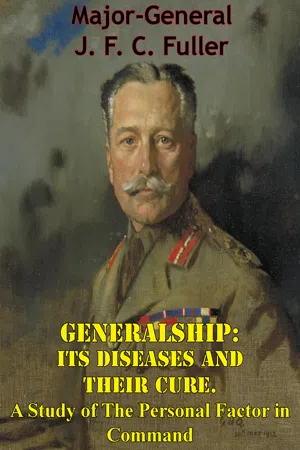
The seminal treatise on Generalship, by Major-General Fuller, reputed to have been the most formative book in General Patton's military training which he kept with him at all times.
"IN the summer of 1921 I was lunching at the Restaurant la Rue with the Deputy Chief of the French General staff when he told me the following story:
At the battle of Waterloo, Colonel Clement, an infantry commander, fought with the most conspicuous bravery; but unfortunately was shot through the head. Napoleon, hearing of his gallantry and misfortune, gave instructions for him to be carried into a farm where Larrey the surgeon-general was operating.
One glance convinced Larrey that his case was desperate, so taking up a saw he removed the top of his skull and placed his brains on the table.
Just as he had finished, in rushed an aide-de-camp, shouting: 'Is General Clement here?'
Clement, hearing him, sat up and exclaimed: 'No! but Colonel Clement is.'
'Oh, mon général,' cried the aide-de-camp, embracing him, 'the Emperor was overwhelmed when we heard of your gallantry, and has promoted you on the field of battle to the rank of General,'
Clement rubbed his eyes, got off the table, clapped the top of his skull on his head and was about to leave the farm, when Larrey shouted after him: 'Mon général—your brains!' To which the gallant Frenchman, increasing his speed, shouted back: 'Now that I am a general I shall no longer require them!'
In this modest study, my object is to prove that, though Clement was wrong about brains, without his courage there can be no true generalship."-Foreword.
eBook - ePub
Generalship: Its Diseases and Their Cure. A Study of The Personal Factor in Command
- 63 pages
- English
- ePUB (mobile friendly)
- Available on iOS & Android
eBook - ePub
Generalship: Its Diseases and Their Cure. A Study of The Personal Factor in Command
About this book
Information
Subtopic
Military & Maritime HistoryIndex
HistoryAPPENDIX — THE AGES OF 100 GENERALS
THE following list is unprejudiced by any idea of proving youth to be in itself a military virtue, The names and events mentioned in it were jotted down from memory, the ages and dates being afterwards looked up. In several cases I had to change my original selection as the date of birth was unknown. I have not included names of generals after 1866, because from that date onwards generalship becomes senile. The interesting points to note are: that according to this list the average age? or zenith, of generalship is 40.36 years; that 74 per cent of the generals mentioned are forty-five years old or under, and that 4 per cent only are sixty or over.
If we now make a graph of the above showing the number of generals according to their ages (see Graph No. 1), we find that the ,period of most efficient generalship lies between the years thirty and forty-nine, and that the peak is reached between the years thirty-five and forty-five. Compare these figures with Graph No. 2, which shows the average age, year by year, between January 1914 and January 1932, of all Field-Marshals, holding appointments, Generals and Lieutenant-Generals in the British Army (excluding India and ‘Ghosts’) on the active list. From this second graph the average age throughout this period works out at 59.9 years; that is approximately ten years outside the period of ‘most efficient generalship’. As far as generalship is concerned this shows clearly the reason why throughout history great generals have been few in number—peace conditions do not fit war requirements. Finally, Graph No. 3 is a composite diagram of the period 1919-1932 taken as a whole, showing the numbers of Generals according to age. From this graph it will be seen that the period of ‘greatest employment’, ranges between the years fifty-five and sixty-five and that the peak is reached between the years fifty-eight and sixty-two, which, I think, compares favourably with most foreign armies except the Russian, in which, I am told, the higher commanders average between forty and forty-five years of age. As to these figures I have no proof.
Concerning the influence of youth on generalship, the following letter written by Bonaparte on January 20th, 1797, and addressed to the Directory is of interest:
‘...As to generals of divisions, unless they are officers of distinction, I beg you not to send any to me; for our way of waging war is so different from others that I do, not wish to entrust a division to a general until I have tested him out in two or three operations.... It is essential for the Army and the Republic to send to me here young people (des jeunes gens) who are learning how to carry out a war of movement and manœuvres; it is wars o...
Table of contents
- Title page
- TABLE OF CONTENTS
- GENERALSHIP
- PREFACE
- GENERALSHIP IN THE WORLD WAR
- THE ESSENTIALS IN GENERALSHIP
- EXAMPLES OF THE PERSONAL FACTOR
- THE DISEASES DIAGNOSED
- THE REMEDIES SUGGESTED
- CONCLUSION
- APPENDIX - THE AGES OF 100 GENERALS
Trusted by 375,005 students
Access to over 1.5 million titles for a fair monthly price.
Study more efficiently using our study tools.
Frequently asked questions
Yes, you can cancel anytime from the Subscription tab in your account settings on the Perlego website. Your subscription will stay active until the end of your current billing period. Learn how to cancel your subscription
No, books cannot be downloaded as external files, such as PDFs, for use outside of Perlego. However, you can download books within the Perlego app for offline reading on mobile or tablet. Learn how to download books offline
Perlego offers two plans: Essential and Complete
- Essential is ideal for learners and professionals who enjoy exploring a wide range of subjects. Access the Essential Library with 800,000+ trusted titles and best-sellers across business, personal growth, and the humanities. Includes unlimited reading time and Standard Read Aloud voice.
- Complete: Perfect for advanced learners and researchers needing full, unrestricted access. Unlock 1.5M+ books across hundreds of subjects, including academic and specialized titles. The Complete Plan also includes advanced features like Premium Read Aloud and Research Assistant.
We are an online textbook subscription service, where you can get access to an entire online library for less than the price of a single book per month. With over 1.5 million books across 990+ topics, we’ve got you covered! Learn about our mission
Look out for the read-aloud symbol on your next book to see if you can listen to it. The read-aloud tool reads text aloud for you, highlighting the text as it is being read. You can pause it, speed it up and slow it down. Learn more about Read Aloud
Yes! You can use the Perlego app on both iOS and Android devices to read anytime, anywhere — even offline. Perfect for commutes or when you’re on the go.
Please note we cannot support devices running on iOS 13 and Android 7 or earlier. Learn more about using the app
Please note we cannot support devices running on iOS 13 and Android 7 or earlier. Learn more about using the app
Yes, you can access Generalship: Its Diseases and Their Cure. A Study of The Personal Factor in Command by Major-General J. F. C. Fuller in PDF and/or ePUB format, as well as other popular books in History & Military & Maritime History. We have over 1.5 million books available in our catalogue for you to explore.