From its beginning in the American Revolution to its current conflicts in Afghanistan and Iraq, the United States (U.S.) Army has had to deal with tribal societies. In order to succeed in tribal societies it is essential that the U.S. Army understand tribal structures and the fractures in tribal societies that present opportunities and possible solutions.
Tribal structures create an environment in which conflict over resources and status creates traditional enemies between the tribes. It further weakens internal tribal loyalty as loyalty resides at the lowest level within the tribe that can provide resources, increase the group's status and security. These characteristics create fractures within tribal societies that create an atmosphere in which it is possible to use tribal auxiliaries to resolve conflicts or issues within complex tribal environments.
The Indian Wars on the northern Great Plains from 1865 to 1890 provide some of the best examples in which tribal fractures created the opportunity to use tribal auxiliaries. By closely examining specific events during the Indian Wars, it is possible to identify the characteristics of tribal structures and societies that create the opportunity for using tribal auxiliaries as well as the fact that they provide a unique method for resolving conflict and issues within tribal societies. This study specifically focuses on events that occurred on the northern Great Plains as the U.S. Army sought to subdue and bring into compliance the Sioux and Cheyenne tribes. By examining tribes that assisted the U.S. Army, it is possible to identify tribal fractures and motivations behind why tribes such as the Crow and Pawnee faithfully served as allies to the U.S. Army. It is also possible to identify what led to the collapse of the Sioux and Cheyenne alliance, which resulted in Sioux and Cheyenne bands turning on one another by supporting the U.S. Army against others that refused to comply.
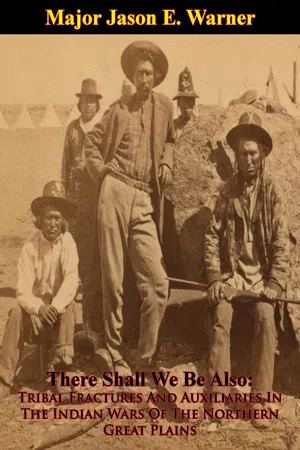
eBook - ePub
There Shall We Be Also: Tribal Fractures And Auxiliaries In The Indian Wars Of The Northern Great Plains
- 64 pages
- English
- ePUB (mobile friendly)
- Available on iOS & Android
eBook - ePub
There Shall We Be Also: Tribal Fractures And Auxiliaries In The Indian Wars Of The Northern Great Plains
About this book
Information
Subtopic
Social Science BiographiesIndex
Social SciencesTable of contents
- Title page
- TABLE OF CONTENTS
- ABSTRACT
- INTRODUCTION
- HISTORICAL CONTEXT OF THE INDIAN WARS
- HISTORICAL EXAMPLES
- CONCLUSION
- BIBLIOGRAPHY
Trusted by 375,005 students
Access to over 1.5 million titles for a fair monthly price.
Study more efficiently using our study tools.
Frequently asked questions
Yes, you can cancel anytime from the Subscription tab in your account settings on the Perlego website. Your subscription will stay active until the end of your current billing period. Learn how to cancel your subscription
No, books cannot be downloaded as external files, such as PDFs, for use outside of Perlego. However, you can download books within the Perlego app for offline reading on mobile or tablet. Learn how to download books offline
Perlego offers two plans: Essential and Complete
- Essential is ideal for learners and professionals who enjoy exploring a wide range of subjects. Access the Essential Library with 800,000+ trusted titles and best-sellers across business, personal growth, and the humanities. Includes unlimited reading time and Standard Read Aloud voice.
- Complete: Perfect for advanced learners and researchers needing full, unrestricted access. Unlock 1.5M+ books across hundreds of subjects, including academic and specialized titles. The Complete Plan also includes advanced features like Premium Read Aloud and Research Assistant.
We are an online textbook subscription service, where you can get access to an entire online library for less than the price of a single book per month. With over 1.5 million books across 990+ topics, we’ve got you covered! Learn about our mission
Look out for the read-aloud symbol on your next book to see if you can listen to it. The read-aloud tool reads text aloud for you, highlighting the text as it is being read. You can pause it, speed it up and slow it down. Learn more about Read Aloud
Yes! You can use the Perlego app on both iOS and Android devices to read anytime, anywhere — even offline. Perfect for commutes or when you’re on the go.
Please note we cannot support devices running on iOS 13 and Android 7 or earlier. Learn more about using the app
Please note we cannot support devices running on iOS 13 and Android 7 or earlier. Learn more about using the app
Yes, you can access There Shall We Be Also: Tribal Fractures And Auxiliaries In The Indian Wars Of The Northern Great Plains by Major Jason E. Warner in PDF and/or ePUB format, as well as other popular books in Social Sciences & Social Science Biographies. We have over 1.5 million books available in our catalogue for you to explore.