By 1807, Napoleon's victories over his European adversaries were legendary. His Grand Army had defeated the greatest European armies of the period. Each army, in succession, from the Hapsburg Empire to Russia, had been soundly beaten and had not been able to come to grips with how to deal with his lightning style of warfare. Yet, over a six-year period from 1807 to 1813, in the backwater Iberian Peninsula, Napoleon lost both his prestige and more troops than he lost in the infamous wintry campaign in Russia. How did an army of bandits, priests, and commoners along with a small expeditionary force achieve victory over the most powerful armies on the continent? The answer lies in that Napoleon did not only fight a band of insurgents and a small British led coalition army, but he also suffered from a combination of poor morale, weak leadership and a refusal to fully recognize the enemy situation. His overextended lines of communications covered an area that was bleak and poor in resources and he could no longer rely on foraging to feed and supply his troops, many of them suffering from starvation.
The Iberian Campaign cost Napoleon over 250,000 troops and drained the French of manpower and resources that could have been used elsewhere. The campaign bankrupt Napoleon's image of invincibility and sapped his armies' leadership and experience. Therefore, Napoleon would have to rely on more conscripts and an ever-increasing number of foreign troops to fill his depleted ranks. Napoleon's generals were entangled in a politico-military quagmire for which they were never prepared and for which they received little guidance. The Peninsular Campaign sucked the lifeblood of Napoleon's armies and they were never able to fully recover from it.
eBook - ePub
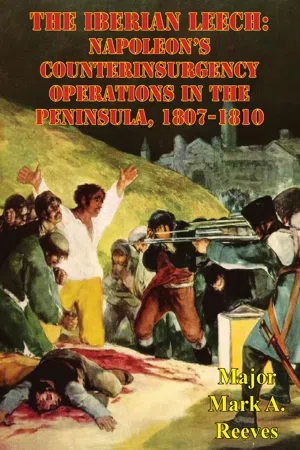
The Iberian Leech: Napoleon's Counterinsurgency Operations In The Peninsula, 1807-1810
- 85 pages
- English
- ePUB (mobile friendly)
- Available on iOS & Android
eBook - ePub
The Iberian Leech: Napoleon's Counterinsurgency Operations In The Peninsula, 1807-1810
About this book
Information
Subtopic
British HistoryIndex
HistoryCHAPTER 1 — LOS BUITRES CARNIVOROS
“Spaniards, your nation is perishing after a long agony; I have seen your ills, I am about to bring you the remedy for them.”{1} — Napoleon, 1807
A “whiff of grapeshot” fired into a mob. Through the smoke, noise and confusion, bodies lay motionless in the street, and people run in panic to find cover. The horrific picture, seemingly stolen from a scene of Paris during the Reign of Terror, was Madrid, on the second of May 1808. The invincibility of Napoleon’s Grand Army was about to be tested in Spain. By 1809, the victorious French legions that had crushed the greatest armies in Europe were facing an increasingly ferocious insurgency. The Madrid incident was just the spark that would quickly set the whole of the Iberian Peninsula aflame with the passions of a full out insurrection. In a very short time, it seemed as though the whole populace of Spain was in revolt. Suddenly, the French Army found itself surrounded by an enemy that did not wage war in the old familiar manner. Instead, this enemy blended in with local populace and could dissolve into the masses or the terrain as quickly as it had appeared. This adversary struck at times and places where he was not expected and, at times, in a much more dreadful way.
Insurgent warfare was nothing new to Napoleon and his troops. There had been revolts in Bavaria as early as 1806. A year before entering Spain, French troops had fought a bloody insurrection in Naples.{2} Some of the very same officers who had served in these earlier counterinsurgencies would find themselves once again caught up in the midst of a cruel and frustrating war. However, this insurgency was characteristically different in two ways.
First, the culture of the Spanish people was significantly different from the rest of Europe. The Spanish were unique within Western civilization and so different from other European countries. Spain had been the crossover point from Africa to Europe since the time of the Phoenicians. The Roman, Vandal, and Visigoth conquests came and went, but this common background persisted for several centuries in much of central and northern Europe. What really made the difference was the arrival in Spain of the Moors early in the 8th century. From that moment on, Spain’s development took on a distinctive character.
“Spain...for all practical purposes, is an island. The country’s insularity is proverbial. She belongs neither to Europe nor to Africa, but is a way station in between with qualities of each. Spain has ceased to be European by virtue of her Moorish blood. “Africa begins at the Pyrenees,” is more than an apt phrase. It expresses succinctly the exotic, half-oriental quality which gives to the people and to the culture of Spain their most distinctive features. One must be careful to specify that the Africa here referred to is not the lower part of the Dark Continent peopled by black men. It is northern Africa, the ancient homeland of the Iberians, of the Carthaginians, a Semitic race, of the Jews themselves, and of the Moors, composed of many Arabic-speaking groups. All of these ethnic and cultural groups have poured their blood and energy into the dead-end funnel that is Spain. The towering Pyrenees have sealed that funnel off from the rest of Europe more effectively than the Alps have ever sealed off Italy.”{3}
Also significant was the power that the Catholic Church exerted over the nation and how it impacted the culture of the people. More of how this affected and shaped the war will be discussed in later chapters.
The second significant difference in this insurgent war, as opposed to others, was the fact that this insurgency was reinforced and supported by a conventional force under the leadership of Great Britain. In 1808, responding to Napoleon’s naked aggression against Portugal, the British landed an expeditionary force of 30,000 troops on the peninsula to expel the French. Over time this force grew to approximately 60,000 British and 25,000 Portuguese troops.{4} Thus, the beginnings of the oscillating campaigns between the Allied forces of Britain and Portugal and Napoleon’s forces across the width and breadth of the Iberian Peninsula. Both of these aspects of the war had profound effects on French leadership and the tactics they attempted to counter this type of warfare.
The Peninsular War drained Napoleon’s Empire of troops, energy, and materiel. The loss of these precious commodities had long term consequences not only in the ongoing operations in Spain, but throughout the Empire until its dissolution. Between 1808 and 1813, 200,000 to 300,000 Imperial troops were operating in Spain at any one time. Some 250,000 of those troops perished there along with hundreds of thousands of Spanish and Portuguese.{5} Cost to the Empire was not only in human terms, but monetarily as well. The war cost the French close to 800 million francs in the first year of occupation and continued to grow substantially every year thereafter.{6} The war also tarnished the Imperial Army’s reputation of invincibility, something that would have implications when they would once again face their old familiar foes, Russia, Austria, and Prussia. The study of the early years of the Peninsular War, 1808-1810, is significant as it offers insight into the problems faced by the French armies in Spain, and their inability to deal with this asymmetrical threat. How Napoleon, his commanders, and his armies fought this threat, in the early period of the war, would shape the rest of the war and its outcome. Why did the greatest army in Europe, arguably the greatest army since the Roman Legions, suffer defeat in Spain? How did a collection of rebels and militants, poorly equipped, and for the most part poorly led, continue to cause problems for the French? Were Napoleon’s armies already beginning to see cracks in their invincibility in 1808? What made this particular conflict so different? How did the French armies and their commanders try to cope with this new threat?
Growing internal problems within the Imperial armies, stemming from continuous campaigning and overextension, and the inability to understand their enemies and quickly adapt new tactics to deal with fortified compound warfare, ultimately, led to the demise of the French in Spain. Many scholars claim that Napoleon had never been defeated until 1809, when the Austrians beat him at Aspern-Essling. Technically, this may be correct if one is considering the linear battles fought by Napoleon against the Allied forces in Central Europe. However, one could argue that the Empire had been losing a war, of a different kind, on the Iberian Peninsula since 1808.
The Peninsular War has been the subject for many Napoleonic historians. British authors have handed down the bulk of this scholarship. There were a number of well-educated British officers and men who served in the Peninsular War and kept diaries and journals as they campaigned and published them after the war. However, most of the history, written by British authors, focused on Sir Arthur Wellesley’s brilliant victories and not on the contributions of the insurgents. Another source of information is derived from French accounts. Most of this information comes from memoirs of French officers who had participated in the war and written long after its conclusion. Early French historians tend to ignore the guerrilla warfare aspect of the campaign. When the subject is discussed, there is little mentioned that would lead one to believe that the guerrillas had much of an effect on the French Army. Napoleon, himself, can be blamed for the some of the biased history and inaccuracies written by early French authors. He worked laboriously to cover up the flaws of the Peninsular War. Napoleon’s propaganda machine spread the message to the French people and the rest of the world that things were going smoothly in Spain. Unfortunately, the portrayals of the war by both sides gloss over the effects of the guerrilla warfare that raged throughout the country.
This paper will attempt to analyze why Napoleon’s armies were unable to control the Peninsula and defeat the Spanish insurgency. In the past, three aspects led to Napoleon’s successes on the battlefield: his soldiers and organization, his subordinate leaders, and the tactics he employed. First, the soldiers and organization of the armies sent into the Peninsula will be considered. Secondly, the leadership that directed the campaign will be explored. Lastly, the tactics and techniques that the French armies and their leaders attempted to use to deal with the guerrilla threat will be analyzed.
Before analyzing the varying aspects of the French Imperial armies, the environment in which Napoleon’s troops operated must be understood. The Spanish Insurrection, beginning in 1808, was the first time that guerrilla warfare had been waged on a national scale. In fact, the very word, guerrilla, came into our lexicon from this war. The atrocities associated with the insurgency and the French counterinsurgency were some of the most shocking ever in the history of Western Europe. The nineteenth century Spanish court painter, Francisco Goya, gives only a glimpse into the horrors and brutality, committed by both sides during the years of incessant guerrilla warfare, in his famous etchings, The Disasters of War.
The situation that the French commanders found themselves in was quite complex and began in early 1807. Napoleon had defeated the major powers on the continent of Europe and had consolidated his gains in Germany, Austria, and Italy. After a difficult campaign to defeat the Russian army at the Battles of Eylau and Friedland, Napoleon had signed the Treaty of Tilsit, in June 1807, with Tsar Alexander I and had persuaded him to join the Continental System. This system was aimed at the heart of the British economy in an attempt to deny its trade with the continent of Europe.
The British were being stretched to the limits during this time period. The Continental System of Europe was taxing the British economy; and the army, perennially too small, was burdened in the scale of employment. Economically, the country was starting to feel the effects of the embargoes and France’s commerce raiders. The British had also incurred huge debts due to the American Revolution. Prices on raw materials were skyrocketing and her exports were being severely constricted. In short, England was suffering, perhaps, near to making peace with Napoleon, on his terms.{7}
The impatient Emperor, seeking another way to tighten the noose around England’s neck, turned his eye on Portugal. Portugal was the only nation left in Europe that was not a participant in the Continental System, continued to trade with the British, and allowed the Royal Navy to refit in her harbors. As an added bonus, Portugal remained a wealthy nation with prize colonies that could aid in furthering Napoleon’s conquests and paying for his armies. The Portuguese Army was small and Napoleon believed that the Portuguese could be defeated effortlessly. The French emperor saw Portugal as an easy target and another way to further strangle Great Britain’s economy.{8}
The Emperor’s only problem seemed to be in getting there. The French Navy, after its defeat at Trafalgar, was in no manner prepared to conduct an expedition into Portuguese waters against the Royal Navy. The only plausible route was to march his armies through Spain. This dilemma lent itself to Napoleon’s overall objective of controlling the whole of the Iberian Peninsula. In July 1807, Napoleon began to prepare the diplomatic and political battlefield. He issued instructions to the rulers of Portugal to close their ports to British shipping, place British subjects under arrest, and declare war. At the same time, he began to gather forces in France to march on Portugal.{9}
Napoleon only required an excuse for entering Spain. Fortunately, for Napoleon, he had help in the Spanish government itself. This came in the form of the court favorite of King Charles IV, a man named Manuel Godoy. Godoy had charmed his way into favor with the Spanish royal family and had become chief minister. He felt certain that Great Britain posed more of a threat to the interests of Spain than France and he began to court the Emperor into an alliance. Although Napoleon did not trust Godoy, he felt that he could manipulate him into furthering the Empire’s interests in the region. After Napoleon’s brilliant military successes against the Prussians at Jena and Auerstädt in 1806 and feeling pressure from the now, very powerful, French Empire, Godoy brought Spain into alignment with the rest of Europe in the denial of trade with Great Britain. Later that year, Spain let it be known that they would support the French invasion of Portugal. On October 18, 1807, an army of 25,000 French troops under General Andoche Junot, crossed into Spain on its way to Portugal.{10}
Prior to these events there were many problems within the Spanish monarchy that also aided Napoleon in his endeavors. The Spanish ruling family was splintering into various factions, each one vying for power. Godoy had wrested any real power from Charles IV through his various intrigues. Charles’ wife Maria Luisa tried to maintain power and for a short time was able to cause Godoy to lose favor in the court. This was a short respite, however, and Godoy found himself once again at the reins of power, proclaiming attachment to Napoleon. Prince Ferdinand, heir to the throne, detested Godoy and was gaining popularity with the people who believed that he might be the savior of Spain. In order to gain support from the French in his bid for power, the prince made accusations against his own father. He claimed that Charles was being misled by Godoy and others and asked for the hand of a princess from the Bonaparte family to bind the two countries. The circumstances could not have been better for Napoleon. He had each of these persons trying to take power or retain power and all of them looked to him for help in their endeavors. Each of them would play into his hands.{11}
The Emperor kept Godoy believing that he could gain some personal profit if he kept an alliance with France. At the same time, Napoleon demanded that Spain give up 14,000 of its best troops to join the Imperial forces.{12} This would weaken the Spanish Army in case the Spaniards decided to turn against him. Napoleon also began massing troops on the Franco-Spanish border while secretly negotiating with Godoy’s intermediaries. The Treaty of Fontainebleau was the result of these negotiations. The treaty dealt with the parceling of Portugal that would take place after the French invasion. A principality would go to Godoy, while Charles IV would be guaranteed his European possessions and given title of “Emperor of the Two Americas.” The most significant article of this treaty was that it allowed for French troops to cross Spain in route to Portugal and that the Spanish would also provide an army for the invasion. This lent legitimacy to Napoleon’s incursion into the Peninsula.{13}
Initially, the campaign to subdue Portugal went well. The Spanish welcomed Napoleon’s troops as they marched through the nation on their way to Lisbon. As the campaign for Portugal progressed, Napoleon began to become more involved in the power plays and intrigues of the Spanish government. Most Spaniards welcomed Napoleon’s endeavors in the region and believed that the French would restore the monarchy under Prince Ferdinand, who they believed would restore Spain to its old glory. However, Napoleon had other plans in mind. He saw this as an opportunity to set up a puppet government that he could control. Once he had troops in the kingdom, there was not much that Spain could do. He began to deploy more troops into the region until he had more than 40,000 soldiers in country. By this time, the Spanish government was growing concerned and Godoy recalled the Spanish Army, fighting alongside Junot’s corps, from Portugal. Napoleon used this as an excuse to accuse Spain of not abiding by the Treaty of Fontainebleau. He considered the treaty no longer valid and declared that Spa...
Table of contents
- Title page
- TABLE OF CONTENTS
- ABSTRACT
- CHAPTER 1 - LOS BUITRES CARNIVOROS
- CHAPTER 2 - SOLDATS
- CHAPTER 3 - LES GROS BONNETS
- CHAPTER 4 - TACTICS
- CHAPTER 5 - CONCLUSION
- BIBLIOGRAPHY
Trusted by 375,005 students
Access to over 1.5 million titles for a fair monthly price.
Study more efficiently using our study tools.
Frequently asked questions
Yes, you can cancel anytime from the Subscription tab in your account settings on the Perlego website. Your subscription will stay active until the end of your current billing period. Learn how to cancel your subscription
No, books cannot be downloaded as external files, such as PDFs, for use outside of Perlego. However, you can download books within the Perlego app for offline reading on mobile or tablet. Learn how to download books offline
Perlego offers two plans: Essential and Complete
- Essential is ideal for learners and professionals who enjoy exploring a wide range of subjects. Access the Essential Library with 800,000+ trusted titles and best-sellers across business, personal growth, and the humanities. Includes unlimited reading time and Standard Read Aloud voice.
- Complete: Perfect for advanced learners and researchers needing full, unrestricted access. Unlock 1.5M+ books across hundreds of subjects, including academic and specialized titles. The Complete Plan also includes advanced features like Premium Read Aloud and Research Assistant.
We are an online textbook subscription service, where you can get access to an entire online library for less than the price of a single book per month. With over 1.5 million books across 990+ topics, we’ve got you covered! Learn about our mission
Look out for the read-aloud symbol on your next book to see if you can listen to it. The read-aloud tool reads text aloud for you, highlighting the text as it is being read. You can pause it, speed it up and slow it down. Learn more about Read Aloud
Yes! You can use the Perlego app on both iOS and Android devices to read anytime, anywhere — even offline. Perfect for commutes or when you’re on the go.
Please note we cannot support devices running on iOS 13 and Android 7 or earlier. Learn more about using the app
Please note we cannot support devices running on iOS 13 and Android 7 or earlier. Learn more about using the app
Yes, you can access The Iberian Leech: Napoleon's Counterinsurgency Operations In The Peninsula, 1807-1810 by Major Mark A. Reeves in PDF and/or ePUB format, as well as other popular books in History & British History. We have over 1.5 million books available in our catalogue for you to explore.