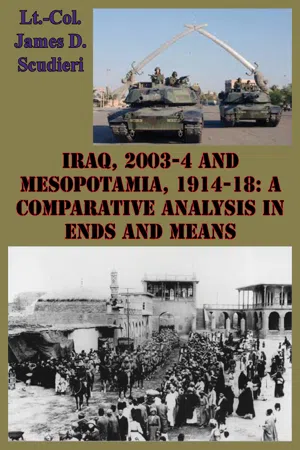
This paper is a comparative analysis of the British campaign in Mesopotamia during the First World War, 1914-18 and the current campaign in Iraq, 2003-4. The study focuses on an examination of Phase III decisive operations and Phase IV reconstruction operations, including strategic imperatives, operational planning, and the impact of changes during operations. The British had no campaign plan for Mesopotamia upon the outbreak of war in 1914. Deployment to this theater began as a peripheral operation. Overriding politico-strategic requirements spurred further exploitation to reach Baghdad. Failure to match ends and means resulted in the disastrous surrender of a division at Kut on 29 April 1916. Sweeping reorganization and large-scale reinforcements resumed the advance; Baghdad fell on 11 March 1917. The British conducted ad-hoc reconstruction operations throughout this period, beginning in the Basra vilayet and expanding their scope with the capture of Baghdad. The British established viable civil institutions, to include police forces, a functioning legal system, Revenue and Customs Departments, a banking system, and even domestic mail.
Conversely, the recent U.S. strategy of pre-emption in Iraq was a policy decision based upon the wider strategic perspective and benefited from exhaustive operational planning. However, the rolling start campaign utilized minimal forces. They had the capability to win the decisive operations phase rapidly, but this same troop level was woefully inadequate to conduct incompletely-planned, sorely under-estimated, post-conflict operations.
Both campaigns suffered from a serious mismatch of ends and means at certain stages, especially for post-war reconstruction operations. They achieved significant success due to herculean efforts in theater. The study concludes with recommendations for strategic leaders related to planning and force structure.
eBook - ePub
Iraq, 2003-4 And Mesopotamia, 1914-18: A Comparative Analysis In Ends And Means
- 43 pages
- English
- ePUB (mobile friendly)
- Available on iOS & Android
eBook - ePub
Iraq, 2003-4 And Mesopotamia, 1914-18: A Comparative Analysis In Ends And Means
About this book
Information
Subtopic
Military & Maritime HistoryIndex
HistoryBIBLIOGRAPHY
Mesopotamia
Barker, A. J. The Bastard War: The Mesopotamian Campaign of 1914-1918. New York: Dial Press, 1967.
Bell, Gertrude. The Arab War: Confidential Information for General Headquarters from Gertrude Bell, Being Dispatches Reprinted from the Secret “Arab Bulletin.” With an Introduction by Sir Kenahan Cornwallis, K.C.M.G., C.B.E., D.S.O. N.p.: Golden Cockerel Press, [1940].
________. The Letters of Gertrude Bell. 2 vols. New York: Boni & Liveright, [1927].
Braddon, Russell. The Siege. New York: Viking Press, 1970.
Burne, Lt. Col. A. H., D.S.O. Mesopotamia: The Last Phase. London: Gale & Polden, 1936.
Candler, Edmund. The Long Road to Baghdad, 2 vols. Boston: Houghton Mifflin Co., 1919.
Davis, Paul K. Ends and Means: The British Mesopotamian Campaign and Commission. London: Associated University Presses, 1994.
Egan, Eleanor Franklin. The War in the Cradle of the World. New York: Harper & Row, 1918.
Evans, Maj. R. A Brief Outline of the Campaign in Mesopotamia. London: Gifton Praed & Co., 1926.
Great Britain. Parliament. Commissions. Mesopotamia Commission: Report of the Commission Appointed by Act of Parliament to Enquire into the Operations of War in Mesopotamia Together with a Separate Report by Cdr. J. Wedgwood, D.S.O., M.P. and Appendices. London: His Majesty’s Stationery Office, 1917.
Heathcote, T. A. The Indian Army: the Garrison of British Imperial India, 1822-1922. Historic Armies and Navies Series. Hippocrene Books, 1974.
Lawley, Hon. Sir Arthur, G.C.S.I., G.C.I.E., A Message from Mesopotamia. London: Hodder & Stoughton, 1917.
Mason, Philip. A Matter of Honour: An Account of the Indian Army, Its Officers, & Men. New York: Holt, Rinehart, & Winston, 1974.
________. The Men Who Ruled India. New York: W. W. Norton & Co., 1985.
Moberly, Brig. Gen. F. J. Official History of the Great War. The Campaign in Mesopotamia , 4 vols. London: His Majesty’s Stationery Office, 1923-27.
Perry, F. W. The Commonwealth Armies: Manpower and Organization in Two World Wars. Manchester, England: Manchester University Press, 1988.
Swayne, Martin. In Mesopotamia. London: Hodder & Stoughton, 1918.
Townshend, Maj. Gen. Charles Vére Ferrers, K.C.B., D.S.C. My Campaign. 2 vols. New York: James A. McCann Co., 1927.
Trench, Charles Chenevix. The Indian Army and the King’s Enemies, 1900-1947. New York: Thames & Hudson, 1988.
Wilson, Lt. Col. Sir Arnold T. Loyalties: Mesopotamia, 1914-1917: A Personal and Historical Record. London: Oxford University Press, 1930. Reprint ed., New York: Greenwood Press, 1969.
Iraq, 2003-4
Ayers, Cynthia E. “Iraqi Resistance to Freedom: A Frommian Perspective.” Parameters 33 (Autumn 2003): 68-84.
Barone, Michael. “Iraq in Historical Perspective.” U.S. News & World Report, 22 September 2003, 30.
Barton, Frederick and Crocker, Bathsheba. A Wiser Peace: An Action Strategy for a Post- Conflict Iraq. N.p.: Center for Strategic and International Studies, 2003.
“Beyond Iraq.” The Stratfor Weekly Online 21 January 2004. Journal on-line. Available from <http://www.stratfor.com>. Internet. Accessed 23 January 2004.
“Bin Laden Tape: Honesty and Gloom.” The Stratfor Weekly Online 7 January 2004. Journal on line. Available from <http://www.stratfor.com>. Internet. Accessed 14 January 2004.
Brooks, David. “Building Democracy Out of What.” Atlantic Monthly, June 2003, 28-29.
Crane, Conrad. “Lessons of Germany.” Interview by Tom Moran. Newark Star Ledger, 31 August 2003, 1, 6.
Crane, Conrad and Terrill, W. Andrew. Reconstructing Iraq: Insights, Challenges, and Missions for Military Forces in a Post-Conflict Scenario. Carlisle, PA: U.S. Army War College Strategic Studies Institute (SSI), 2003.
Dowd, Alan W. “Thirteen Years: The Causes and Consequences of the War in Iraq.” Parameters 33 (Autumn 2003): 46-60.
Elliot, Michael. “Facing Reality.” Time, 22 September 2003, 26-32.
________. “3 Flawed Assumptions.” Time, 22 September 2003, 30-33.
Fallows, James. “Blind into Baghdad.” The Atlantic Monthly, January/February 2004, 52-74.
Fang, Bay. “Help Wanted.” U.S. News & World Report, 15 September 2003, 14-17.
________. “In Iraq, Some New Faces.” U.S. News & World Report, 22 September 2003, 23-24.
________. “Terror in a Holy Place.” U.S. News & World Report. 8 September 2003, 20-22.
Flavin, William. “Planning for Conflict Termination and Post-Conflict Success.” Parameters 33 (Autumn 2003): 95-112.
Friedman, Tom, writer and commentator. Television interview by Tim Russert, 20 September 2003.
Gibbs, Nancy. “After 9/11: Where Do We Go from Here?” Time, 15 September 2003, 36-37.
Gilmore, Gerry J. “Military’s Logistics System Found Wanting in Iraq War.” American Forces Press Ser...
Table of contents
- Title page
- TABLE OF CONTENTS
- ABSTRACT
- PREFACE
- IRAQ, 2003-4 AND MESOPOTAMIA, 1914-18: A COMPARATIVE ANALYSIS IN ENDS AND MEANS
- REQUEST FROM THE PUBLISHER
- BIBLIOGRAPHY
Trusted by 375,005 students
Access to over 1.5 million titles for a fair monthly price.
Study more efficiently using our study tools.
Frequently asked questions
Yes, you can cancel anytime from the Subscription tab in your account settings on the Perlego website. Your subscription will stay active until the end of your current billing period. Learn how to cancel your subscription
No, books cannot be downloaded as external files, such as PDFs, for use outside of Perlego. However, you can download books within the Perlego app for offline reading on mobile or tablet. Learn how to download books offline
Perlego offers two plans: Essential and Complete
- Essential is ideal for learners and professionals who enjoy exploring a wide range of subjects. Access the Essential Library with 800,000+ trusted titles and best-sellers across business, personal growth, and the humanities. Includes unlimited reading time and Standard Read Aloud voice.
- Complete: Perfect for advanced learners and researchers needing full, unrestricted access. Unlock 1.5M+ books across hundreds of subjects, including academic and specialized titles. The Complete Plan also includes advanced features like Premium Read Aloud and Research Assistant.
We are an online textbook subscription service, where you can get access to an entire online library for less than the price of a single book per month. With over 1.5 million books across 990+ topics, we’ve got you covered! Learn about our mission
Look out for the read-aloud symbol on your next book to see if you can listen to it. The read-aloud tool reads text aloud for you, highlighting the text as it is being read. You can pause it, speed it up and slow it down. Learn more about Read Aloud
Yes! You can use the Perlego app on both iOS and Android devices to read anytime, anywhere — even offline. Perfect for commutes or when you’re on the go.
Please note we cannot support devices running on iOS 13 and Android 7 or earlier. Learn more about using the app
Please note we cannot support devices running on iOS 13 and Android 7 or earlier. Learn more about using the app
Yes, you can access Iraq, 2003-4 And Mesopotamia, 1914-18: A Comparative Analysis In Ends And Means by Lieutenant Colonel James D. Scudieri in PDF and/or ePUB format, as well as other popular books in History & Military & Maritime History. We have over 1.5 million books available in our catalogue for you to explore.