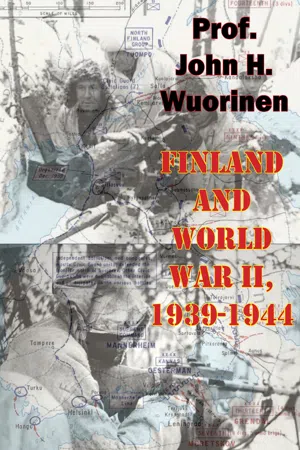
Finland gained its independence from Russia in 1917 during the turmoil of the Russian Civil War, and ever since the communist leaders cast envious eyes toward their former domain; only waiting for a chance to invade. With the rise of Hitler's Germany the face of Europe changed, agreements were reached between the Soviets and the Nazis in brutally dividing up a nigh-defenceless and the detente culminated in the Non-Aggression Pact of 1939. This gave Stalin and his cohorts a chance to expand their borders, whilst Hitler looked west at France and Britain, by launching an attack directed to recapture their former Grand Duchy. Thus started Finland's participation in the Second World War. This book eloquently recounts the stubborn resistance of the Finns against the Soviet attack during the Winter War, the horrific siege of Leningrad and the Finns brave bid to retain its independence from Soviet dominance. The manuscript for the book was smuggled out of Soviet controlled Finland in late 1945, it was passed to Professor Wuorinen who skilfully edited and annotated the work into its present form.
A fascinating sidelight on a little known corner of the brutal Second World War.
- 221 pages
- English
- ePUB (mobile friendly)
- Available on iOS & Android
eBook - ePub
Finland And World War II, 1939-1944
About this book
Information
Subtopic
European HistoryIndex
HistoryCHAPTER 1 – FINNISH FOREIGN POLICY BETWEEN THE TWO WORLD WARS
1. FINLAND’S LEGACY AS A GRAND DUCHY OF RUSSIA
The no years that Finland existed as an autonomous part of Imperial Russia were, with the exception of the final period of that union, a time of friendly relations between the small nation and the great Power. The Russian government honored Finland’s special position and her laws, and Finland was able to continue her development along the path of western European civilization so freely that the traces of Russian influence in Finland remained infinitesimally small. The period of Nicholas II (1894-1917), however, brought a change which altered the Finns’ attitude toward Russia and the Russians. When the Russian government started its Russifying policy in Finland in 1899, breaking the Finnish constitution and violating the Tsar’s solemn declaration to honor the law of the land, the Russians came to be looked upon as enemies of Finland.
In the constitutional struggle which ensued, the Finns looked for help outside their borders. Some sought and found generous help in Western Europe; others established contacts with Russian revolutionary circles which have continued to the present day. The ties with the West were the stronger. The moral support from the West gave the nation courage in its fight against Russia and at the same time retarded the tempo of Russian oppressive measures. In connection with the latter, it is worth mentioning that when the Russian government, just prior to the first World War, was considering the incorporation of the Karelian Isthmus border parishes of Uusikirkko, Kuolemanjärvi and Kivennapa into Imperial Russia, the plan fell through primarily because of the unfavorable publicity the idea aroused in Western Europe. Later, Finland’s war of independence in 1918 was fought on the one hand against the rebellious Finnish Left, born under Russia’s influence, and against Russian garrisons who had remained in the country in spite of the fact that the newly created Soviet government had already recognized the independence of Finland. Finland thus had to purchase her independence with a bitter war, and did not, as later Russian propaganda continued to argue, receive it as a gift. The war of independence was followed by an interim period of more than a year which closely resembled war. The one-sided Soviet attitude dates from this period, as does its one-sided information regarding Finland, and its deep-rooted suspicion of Finland, regardless of what Finland did or left undone.
2. RELATIONS WITH GERMANY AND WESTERN EUROPE
Since Finland had received military aid from Germany in her war of independence, it was quite natural that during the first phases of independence German influence was quite strong. However, as early as May, 1918, the Government of J. K. Paasikivi (the Foreign Minister was Otto Stenroth), tried to maintain Finnish neutrality in the World War, in such a way that friendly relations with Germany would not be broken. The German collapse in November, 1918, was followed by the end of the pro-German orientation in Finland. From this time on, the new groups responsible for Finnish policy rejected the ideals of imperial Germany and sought models from France and England, and oriented themselves politically in that direction. However, since the interest of the western Powers in Finland was not strong enough for Finland to receive all the support she needed, Finland had to seek out countries closer to home with whom mutual interests would guarantee common effort.
3. ORIENTATION TOWARD THE BALTIC STATES, 1919-1922
The immediate alternatives in foreign policy which could be considered after 1918 concerned the relationship with the new Soviet government and the Soviet system.
Cooperation with the White Russian forces opposing the Soviet Union was one possibility. This question became especially pressing when Yudenitch was approaching the gates of Petrograd in the fall of 1919. Finland did not take part in the proposed joint operation, however, because she considered it foolish to interfere in the internal affairs of her big neighbor. This decision actually marked the beginning of Finland’s new policy: neutrality. On October 14, 1920, Finland signed a peace treaty with the Soviet Union at Dorpat. Her old borders were recognized. In addition, the Petsamo region, which had already been granted to Finland in principle in 1864 as compensation for Finnish territory on the Karelian Isthmus incorporated at that time into Russia, was obtained. Thereafter, at least as far as Finland was concerned, every prerequisite for normal relations with the Soviet Union existed.
A second alternative was to join the “cordon sanitaire” sponsored by France, whose object was to block Russia off from the rest of Europe. The agreements drawn up in Warsaw in 1922 had in mind a bloc of border-states for achieving this end. The Finnish Foreign Minister was present at the drawing up of these proposals, but the Finnish Parliament shelved the question of ratification and never in fact did ratify. The debate of the question in the Finnish Parliament specifically emphasized that neutrality was the only proper policy for the country in foreign affairs. This quiet burial of the Warsaw agreement was the definite end of Finland’s “border states” policy.
While they lasted, Finland’s relations with Russia had been anything but good. The worst stumbling block had been the Eastern Karelia question. The Soviet Union had issued a declaration in connection with the Dorpat Treaty, whereby it bound itself to grant national autonomy to the Karelians. This pledge was not kept. The result was a Karelian rebellion in which Finnish volunteers took part. When both the Karelians and the Finns made an international issue of the question, the Soviets argued that, regardless of their Dorpat declaration, the Karelian question was completely an internal Russian affair which they had the right to solve as they saw fit, without the interference of outsiders. Although Finland had no territorial ambitions in Eastern Karelia, Finnish participation in the Karelian question sufficed to rouse the ire of Russia. The Soviet Union, on the other hand, interfered continually in Finnish internal affairs through the Comintern, and aroused Finnish bitterness toward the Soviet system. It was felt that the aim of the Comintern was to carry out the conquest of Finland from within.
A third alternative was also seen at the time. It meant drawing closer to Scandinavia. Foreign Minister Rudolph Holsti visited Stockholm in 1920 for this purpose. No concrete results came of the visit, because the question of the ownership of the Aland Islands, which was then under debate, made a rapprochement difficult.
4. LEAGUE OF NATIONS PERIOD, 1922-1935
Having become a member of the League of Nations in 1920, Finland thought that the support she needed had been found, and participated in the activities of the League. Finnish participation evidently was considered to be of some value, for Finland was represented on the League Council from 1927 to 1930. Finland tried, in fact, to have the League become an organization which would really guarantee peace and add to the security of small nations. That is why Finland in 1924 signed the Geneva Protocol, the purpose of which was to introduce peaceful arbitration of international disputes, a mutual aid pact and disarmament. With the failure of this effort, Finland in 1929 joined in the attempt to turn the Permanent Court of International Justice into a court of appeal for nationally appointed courts of arbitration. Toward the same end, Finland accepted other agreements and proposals of the League, Especially important was Finland’s own proposal of financial aid to countries attacked without provocation. Finland accepted the Covenant of the League, the Kellogg Pact, the agreement defining aggression, and participated in the disarmament conference.
As a direct consequence of her membership in the League, Finland adhered more closely than ever to her line of neutrality—in other words, she avoided joining any group or bloc of major Powers.
5. SCANDINAVIAN ORIENTATION, 1935-1938
About 1935, the international situation became particularly perturbed. In, that year Germany declared she was no longer bound by the military limitations contained in the Versailles Treaty; England concluded a naval treaty with Germany; and Italy attacked Abyssinia. In the following year, Germany re-militarized the Rhineland, signed the anti-Comintern pact with Japan, and began to approach Italy. Civil war broke out in Spain and developed into an international issue.
In this storm the League of Nations proved itself completely powerless. When sanctions should have been declared against Italy, only economic penalties were applied, without effect; the Powers lacked the courage to resort to military measures. This case revealed that sanctions could lead small nations into distressing complications but would be of no benefit to them. As a result a general attempt to be rid of sanctions obligations appeared. At the same time, however, all possibilities for the League to work effectively to prevent war were destroyed.
With their hopes in the League betrayed, the small nations generally began to seek help from the great Powers or by joining one another. True to her earlier stand, Finland adhered to the line of neutrality and sought contacts with her small neighbors that embraced the same stand. Finland had already joined the so-called Oslo group in 1932. At the end of 1935 the Scandinavian neutrality bloc was formed. The President of Finland went to Stockholm in the interests of the matter, and in a speech in Parliament on December 5, Premier Kivimäki outlined the form and purposes of this northern orientation so clearly that one would have expected it to arouse interest in Moscow.
“The Finns believe that of their neighbors, Scandinavia, Sweden in particular, is least likely to become involved in war or other dangerous international complications. Scandinavia has, therefore, the best possibilities for retaining its neutrality. Since Finland’s interests also demand, above all, the maintaining of neutrality, it is natural that Finland should align herself with Scandinavia, to which our country is more closely tied than elsewhere not only by bonds of history, but by economics and culture and by the consequent oneness of outlook as well. Finland sees as her responsibility the maintaining of an army for her defense (contemplated even in the Covenant of the League) in order to protect her neutrality and independence from danger no matter from what direction it may come, and in order thereby to aid the maintaining of the joint neutrality of all the Northern countries.”
Spokesmen for all the various political parties supported this declaration of the Government in Parliament. An immediate consequence of this new orientation was first of all a new policy toward the League, Declining to assume responsibility involved in sanctions, the possibilities of becoming involved in conflicts between the major Powers were to be avoided. Instead, cooperation with other nations that were free from any alliance commitments was to be sought. A second consequence of this Scandinavian orientation was an attempt toward a new policy toward Russia. Its purpose was to remove the tension which had prevailed until then. The forms and extent of Scandinavian cooperation were never precisely defined.
6. RELATIONS WITH THE SOVIET UNION
In spite of Finland’s policy of neutrality, it was impossible to establish good relations with the Soviet Union because of Russia’s suspicions and her two-faced policies. The discussions for a nonaggression pact in 1927, begun on Russia’s own initiative, were fruitless because Russia did not approve Finland’s proposals for arbitration procedure in settling disputes. In Finland, on the other hand, it was repeatedly ascertained that Russia continued to interfere in Finland’s internal affairs through the Comintern. When communism began to show itself in what non-communists thought were too challenging ways, the so-called Lapua Movement arose as a powerful counter movement, resulting in the dissolution of the Communist Party and the banning of communist activity in 1930. The Lapua Movement itself was later dissolved by the Supreme Court because of the lawless actions of which it had become guilty.
This period gave birth to the IKL (Isänmaallinen Kansanliike—Patriotic People’s Movement) which considered its chief platform to be opposition to communism. It was born wholly on home soil; it was not an imported form of Nazism. In its beliefs and program it remained confused to the end, but in any case its opposition to communism and the strengthening of the security of the nation were its basic tenets, and were responsible for whatever success it had in elections. The votes it received were so insignificant from the very beginning that it had in fact no important influence in parliamentary life, and its support among the voters progressively declined. At its peak, early in the 1930’s, it had fourteen out of the 200 representatives in the Parliament but at the outbreak of World War II its number of seats had dropped to eight. In foreign policy, it had no importance whatever. In Soviet Russia, however, the outlawing of communism in Finland was taken seriously: Albrechts, serving at that time in a highly responsible position in the Soviet, wrote that when the Lapua Movement carried out its big demonstrations in Helsinki in the summer of 1930, the Soviet Union prepared for war against Finland, but fortunately nothing came of it.
A second issue which had continued to irritate the Soviets was the Eastern Karelia question. This question was born of the fact, on the one hand, that the East Karelians were Finns, and on the other, from the Russian failure to carry out the promise to grant self-government to the East Karelians, These factors furnished enough material, in Finland, for nationalist-romanticist aspirations whose spokesmen became the Academic Karelia Society composed of university students. Later this Society made the Finnization of the Helsinki University the main point of its program, and brought upon its head the wrath of the Swedish-speaking intelligentsia. The Society had no influence in Finnish foreign affairs. But by its declarations about a “Greater Finland” the Society gave fuel to propaganda harmful to Finland. In any case, Finland’s official foreign policy was completely free of plans to enlarge Finland’s territory. A large majority in Parliament was always a guaranty that Finnish foreign policy would continue to center on complete neutrality, and all of Finland’s Foreign Ministers before and during the war of 1939 were free of the nationalist-romanticist taint of the Academic Karelia Society. The Soviet Union must have known this quite well enough.
If Russia had previously been suspicious of all foreigners, from the beginning of the 1930’s it may be said to have hermetically sealed itself. A deliberate and large-scale preparation for the coming war was then begun. The many-sided contacts and ties which other European states had at the time among themselves generally, were out of the question with Russia. For example, economic relations between the Soviet Union and Finland remained absolutely insignificant, although natural prerequisites for trade were abundant, and Finland made several attempts to extend commerce with Russia.
Finland did all she could to establish good relations with the only neighbor capable of threatening her security. In 1932 Finland signed the non-aggression pact proposed by Russia, and renewed it in 1934 for ten years. When Russia was admitted into the League of Nations in 1934, her admission took place without any investigation or reservations, in spite of the fact that Finland at least would have had more than sufficient reason for making them. At this time Russia already felt herself strong enough to use procedures in her foreign relations that would have been out of the question in the 1920’s. Her foreign policy began to develop a clearly imperialistic aspect. In this connection, a statement by Commissar for Foreign Affairs Litvinov early in 1933 is especially revealing. He declared that it was of advantage to Russia to maintain the complete independence and neutrality of the Baltic countries and Finland, but that Russia also was concerned with the development of those internal policies which might prove to be a threat to the independence of these countries. In this connection Litvinov mentioned for the first time those guaranties of the Baltic States’ independence and security which later proved so fateful. The Commissar of Leningrad, A. A. Zhdanov, spoke a still clearer language in a speech on November 2, 1936:
“We people of Leningrad sit at our windows, looking out at the world. Right around us lie small countries who dream of great adventures or permit great adventurers to scheme within their borders. We are not afraid of these small nations. But if they are not satisfied to mind only their own business, we may feel forced to open our windows a bit wider, and they will find it disagreeable if we have to call upon our Red Army to defend our country.”
After 1939 it was easy to understand just what was contained in that statement.
It is evident that Finland did not realize how great ...
Table of contents
- Title page
- TABLE OF CONTENTS
- FOREWORD
- INTRODUCTION
- CHAPTER 1 - FINNISH FOREIGN POLICY BETWEEN THE TWO WORLD WARS
- CHAPTER 2 - FINLAND’S FOREIGN POLICY, 1938-1939
- CHAPTER 3 - FINNISH FOREIGN POLICY ON THE EVE OF THE WAR, 1939
- CHAPTER 4 - THE WINTER WAR AND THE PEACE OF MARCH 12, 1940
- CHAPTER 5 - FINLAND UNDER THE MOSCOW PEACE
- CHAPTER 6 - FINLAND AND THE WAR, 1941-1942
- CHAPTER 7 - PEACE FEELERS AND THE PROPAGANDA WAR, 1943-1944
- CHAPTER 8 - THE ARMISTICE AND THE MOSCOW PRELIMINARY PEACE
- CHAPTER 9 - CONCLUSION
- APPENDIX A - ARMISTICE AGREEMENT
- APPENDIX B - TREATY OF PEACE WITH FINLAND
Trusted by 375,005 students
Access to over 1.5 million titles for a fair monthly price.
Study more efficiently using our study tools.
Frequently asked questions
Yes, you can cancel anytime from the Subscription tab in your account settings on the Perlego website. Your subscription will stay active until the end of your current billing period. Learn how to cancel your subscription
No, books cannot be downloaded as external files, such as PDFs, for use outside of Perlego. However, you can download books within the Perlego app for offline reading on mobile or tablet. Learn how to download books offline
Perlego offers two plans: Essential and Complete
- Essential is ideal for learners and professionals who enjoy exploring a wide range of subjects. Access the Essential Library with 800,000+ trusted titles and best-sellers across business, personal growth, and the humanities. Includes unlimited reading time and Standard Read Aloud voice.
- Complete: Perfect for advanced learners and researchers needing full, unrestricted access. Unlock 1.5M+ books across hundreds of subjects, including academic and specialized titles. The Complete Plan also includes advanced features like Premium Read Aloud and Research Assistant.
We are an online textbook subscription service, where you can get access to an entire online library for less than the price of a single book per month. With over 1.5 million books across 990+ topics, we’ve got you covered! Learn about our mission
Look out for the read-aloud symbol on your next book to see if you can listen to it. The read-aloud tool reads text aloud for you, highlighting the text as it is being read. You can pause it, speed it up and slow it down. Learn more about Read Aloud
Yes! You can use the Perlego app on both iOS and Android devices to read anytime, anywhere — even offline. Perfect for commutes or when you’re on the go.
Please note we cannot support devices running on iOS 13 and Android 7 or earlier. Learn more about using the app
Please note we cannot support devices running on iOS 13 and Android 7 or earlier. Learn more about using the app
Yes, you can access Finland And World War II, 1939-1944 by Prof. John H. Wuorinen in PDF and/or ePUB format, as well as other popular books in History & European History. We have over 1.5 million books available in our catalogue for you to explore.