- 160 pages
- English
- ePUB (mobile friendly)
- Available on iOS & Android
eBook - ePub
About this book
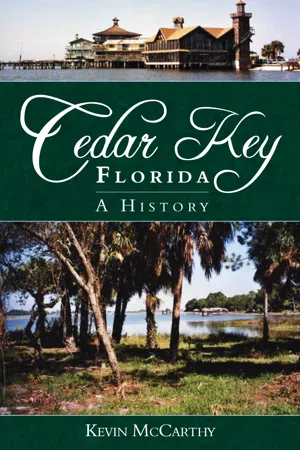
Visit "the island where time stands still" and explore the romantic, almost forgotten history of old Florida in this visual history.
Rich in small town atmosphere and old Florida history, Cedar Key is a quiet island community nestled among many tiny keys on the Gulf Coast of Florida. Refuge for birds and wildlife, Florida's oldest port, and home to artists and writers, the island has long been admired for its tranquility and natural beauty.
Trusted by 375,005 students
Access to over 1 million titles for a fair monthly price.
Study more efficiently using our study tools.
Information
Chapter One
Before 1800
TOPOGRAPHY
At the western edge of Levy County are a dozen islands that make up the Cedar Keys National Wildlife Refuge, encompassing about eight hundred acres of wetlands, forests and islands in the Gulf of Mexico. They began as huge sand dunes when the glaciers receded across North America thousands of years ago, and eventually became rich breeding grounds for thousands of birds. Their thick foliage and many trees have enabled the islands to act as buffers for Cedar Key and the mainland during the many storms that have pounded the west coast of Florida. The tallest island is Seahorse Key, rising fifty-two feet above sea level, the highest point on the Gulf Coast.
The Lower Suwannee National Wildlife Refuge, off State Road 347 to the north of Cedar Key and veering off from State Road 24, is one of the state’s largest protected habitats and nesting areas for American eagles, bald eagles, falcons, migratory birds, swallow-tailed kites and wading birds. Bird-watchers can see over two hundred species of birds there, as well as alligators, deer, hogs, wild turkeys and other wildlife. Workers built a bat house in the refuge in 2002 for more than 150,000 bats to roost before their nightly foray seeking out insects to eat. That has kept the annoying mosquito in some control, but visitors to the scrub and to the offshore islands should take along insect repellant. The Cedar Key Scrub State Reserve has trails through habitat areas reserved for the rare and endangered Florida scrub jay.
NATIVE AMERICANS
Archaeologists who have studied the early peoples of Florida tell us that Native Americans lived on the Florida peninsula for more than twelve thousand years, as evidenced by spear points and arrow tips found throughout the state, including Levy County. At that time, Cedar Key was probably eighty miles inland from the Gulf of Mexico, and Florida was twice as large as it is today, but rising sea levels shrank the coast dramatically.
At first, the Native Americans lived near water, whether freshwater streams and springs or saltwater bays along the Gulf of Mexico and the Atlantic Ocean. They adapted well to their environment, relying on fishing, hunting and farming to obtain food and raise their families. Their villages were probably small at first, a factor which would enable them to feed and clothe their families with the limited fish they could catch, crops they could grow and animals they could hunt. Little by little, they would trade with other tribes to obtain goods and products not available in their local areas.
The piles of trash that the Native Americans accumulated from decades of living in a place are called middens. When the Native Americans threw away the shells after eating shellfish, they threw them into piles—rather than spreading them around—in order to keep their living space free of shells. Although many of those middens have been destroyed by developers and road builders, enough middens remain to give clues as to how and where the Native Americans lived. The Shell Mound Archaeological Site on County Road 326, about nine miles north of Cedar Key, is a protected site that has long been a popular place for visitors to marvel at the height and size of such mounds. There is also a Native American mound at the Lions Club on the northwest corner of Sixth and F Streets in Cedar Key.
The Cedar Key State Museum on Museum Drive and the Cedar Key Historical Society Museum have more information about the Native Americans who lived in the area. The earliest Cedar Key inhabitants, those who lived there twelve thousand years ago, did not build Shell Mound. Instead, more recent peoples built it up some time between 500 BC and AD 1000. The five-acre mound, which is mostly covered with thick underbrush today, is made of discarded oyster shells and may have been deliberately built up in order to give the Native Americans a platform from which they could see the surrounding area and maybe act as a windbreak from storms.
The only archaeological digging at the site, done in 1959, went down just ten feet and found artifacts dating back to 500 BC. The twenty-eight-foot-tall mound probably holds many more artifacts, but archaeologists say that the mound was not a burial site or a temple mound. Some think that Hog Island, which can be seen from Shell Mound, may have been the burial site for the Native Americans in the area, but much of Hog Island is now marshland and belongs to the Lower Suwannee Wildlife Refuge.
Although archaeologists have not yet found any evidence of large towns in the area, the many artifacts found through the years, as well as the presence of several large Native American mounds, give tantalizing clues to a culture that may have flourished there for a long time. The people may have been part of what archaeologists call the Deptford Period (500 BC to AD 200) or the Weeden Island Period (AD 200 to AD 1000).
The tribe that probably lived in the area of the Cedar Keys was the Timucua, one of the largest groups of Native Americans in Florida at the time of the Spanish arrival in the sixteenth century. Although the estimated 150,000 Timucua in Florida in the sixteenth century fought battles with each other, they had a similar language and set of beliefs. The Native Americans were eventually killed by European diseases, slavery and deportation, and they have left behind few memorials, but the mounds, or middens, are testament to their having been in Florida for hundreds of years. The huge mound at the Crystal River State Archaeological Site in Citrus County, south of Cedar Key, is one of the most impressive in the state.

Seahorse Key is the highest island in the vicinity and has a lighthouse on top of it. Image courtesy of Kevin M. McCarthy.

An old Native American mound near the Lions Club testifies to the presence of Native Americans hundreds—and even thousands—of years ago. Image courtesy of Lindon Lindsey.

The Seminole who remained in Florida have prospered. Image courtesy of Florida State Archives.
When a tourist accidentally discovered a human skeleton on Atsena Otie Key around 1999, scientists determined that the human remains were of a male buried over two thousand years ago on the island. Sensitive to the feelings of Native Americans, who are very protective of such finds and do not want them displayed for the public to gawk at, authorities reburied the skeleton at a secure site.
THE EUROPEANS ARRIVE
In the sixteenth century, Spanish explorers, including Hernando de Soto, led large forces of soldiers through the land to the east of Cedar Key, capturing and killing the Native Americans—for example, the Timucua, who had a large village at Long Pond, south of present-day Chiefland. There is no record that the Spanish made it to the Cedar Keys area on their trek north to the Tallahassee area, but their ships passed offshore and their troops marched inland.
Catholic missionaries established missions from St. Augustine over toward Tallahassee, but there is no evidence of such places in the Levy County area. Such missionaries were part of the colonization efforts by the Spanish, who established St. Augustine in 1565, a year after the French had tried—but failed—to establish a foothold on the St. Johns River. The Spanish controlled the territory of Florida for the next 250 years, except for a 20-year rule by the British between 1763 and 1783.
SEMINOLES AND EX-SLAVES
By the end of the eighteenth century, diseases, battles and deportations had taken a heavy toll on the Native Americans, who had been living in the Florida peninsula for thousands of years. Archaeologists estimate that the number of Florida Native Americans decreased from several hundred thousand to just several thousand by that time. Because there were relatively few Native Americans in Florida in the last part of the eighteenth century, Native Americans from Georgia and Alabama began migrating south to raise their families, grow crops and establish new villages. The Spanish encouraged that migration because they needed more Native Americans there to work the fields, build Spanish towns and join with them as allies against their enemies like the British and French.
The new settlers in Florida became known as Seminoles, from the Spanish word cimarrone, meaning “wild ones” or “runaways.” Black slaves joined them after escaping from the harsh life on plantations north of Florida. In many cases, the Seminoles welcomed the runaway slaves, realizing that the ex-slaves could help them communicate with the whites, whose language the slaves had learned. The blacks also knew the latest farming methods, which they had learned on the plantations.
Chapter Two
1800-1849
ARRIVAL OF WHITE SETTLERS
The lack of control by Spain over her Florida land led to much disorder, including that fomented by the British, who were secretly supplying the Native Americans with guns with which to fight the Spanish and Americans. In 1814, General Andrew Jackson—leading a force of Tennessee militia, Cherokee warriors and U.S. regulars—fought a large band of Creeks in Alabama, killing eight hundred of one thousand Native Americans. Jackson pursued the surviving Creeks to a site near present-day Montgomery, Alabama, where they surrendered. In the First Seminole War, President James Monroe ordered Jackson in 1817 to lead a campaign in Georgia against the Seminole and Creeks, as well as to prevent Spanish Florida from becoming a refuge for runaway slaves.
Jackson probably exceeded his orders in his Florida campaign, but he knew that many, if not most, Americans wanted control of the Florida peninsula. The troops burned down Seminole villages and their crops, captured Pensacola from the Spanish, caught and executed two British subjects (Robert Ambrister and Alexander Arbuthnot) who had been in cahoots with the Native Americans, and effectively took control of Florida. In 1819, by terms of the Adams-Onís Treaty, Spain ceded Florida to the United States in exchange for the American renunciation of any claims on Texas. Jackson became the first territorial governor of Florida and later president of the United States. During his presidency (1829–1837), thousands of Native Americans were removed from the South, including Florida, to reservations in the West.
With many Native Americans gone from North Florida, more and more white settlers, some with their slaves, migrated to the area to fish, homestead, raise crops and raise their families. The opportunities were there for hard workers, who prospered in the temperate climate and little by little attracted more settlers.

The City of Hawkinsville was a steamboat that ran from Cedar Key up and down the Suwannee River. Image courtesy of Florida State Archives.
STEAMBOATS
Before railroads and roads were built in Florida, steamboats were a main means of transportation, especially as a way to reach coastal ports and those towns and settlements on the inland waterways. Merchants used steamboats to take goods to and from many places in Florida, and travelers used them to go from place to place. The fact that three of the major rivers of the peninsula—St. Johns, the Apalachicola and the Suwannee—ran north-south enabled steamboats to cover much of the territory.
Beginning in 1834, steamboats began navigating the Suwannee just north of Cedar Key, at first sticking to the lower river below Branford, but later venturing as far north as Columbus, now a ghost town in Suwannee River State Park. One particularly bold pilot, Captain James Tucker, once used the swollen Suwannee to take his steamboat, Madison, up as far as White Springs, thus making the river navigable at certain times of the year from its mouth at the gulf to White Springs. During the Second Seminole War (1835–1842), the river had some forts and camps that steamboats serviced. Also, the sawmills and turpentine camps that sprang up along the river’s banks needed groceries, hardware and clothing from Cedar Key.
As markets grew upriver, especially cotton, pilots would take their steamboats up from Cedar Key, where they would unload cargo from ocean-going vessels for the trip on the Suwannee. The river could be very tricky to navigate, especially around the rocky shoals upstream, and the wrecks along the way testify to those pilots who were careless.

The action of Osceola, an influential Seminole leader, putting a knife through a treaty, signaled the start of hostilities. Image courtesy of Florida State Archives.
SEMINOLE WARS
The Native Americans who were still in Florida in the first half of the nineteenth century deeply resented the intruders, especially those who claimed as their own land that which the Native Americans had been living on for centuries. When the Native Americans resisted the newcomers with force, the federal government sent troops to quell the revolt, suppress the Native Americans, kill or capture as many as possible and ship the live ones to Indian Territory in the West. Three major wars were fought with the Native Americans: the First Seminole War (1817–1818), the Second Seminole War (1835–1842) and the Third Seminole War (1855–1858).
After General Zachary Taylor became commander of federal forces in Florida fighting the Seminoles in 1838, he established over fifty forts and camps and built or improved over eight hundred miles of roads, including bridges and causeways. In order to distribute his troops as evenly as possible, he divided North Florida into twenty-square-mile sections, with each section to be guarded by a fort numbered according to the map showing all the forts. Fort Number Four in the Cedar Keys was manned by troops from 1839 through 1841. Later the term “Number Four” was used for a boat channel there, a railroad station, railway trestle, highway bridge and voting precinct.
Federal officials built a hospital and base on Depot Key (later called Atsena Otie Key) south of Way Key (where Cedar Key would later be located) and used it as a military depot (thus its name of Depot Key) and hospital between 1839 and 1842. It was on Depot Key that Colonel William J. Worth declared an end to the Second Seminole War in 1842, an action that allowed federal troops to leave the territory and go home. The staging area for both troops and Native American prisoners was on Seahorse Key.
Toward the end of the Second Seminole War, Seahorse Key had a temporary encampment, Cantonment Morgan, which consisted of a series of temporary buildings for receiving and deploying troops, caring for sick troops and Native Americans and housing captured Native Americans before they were shipped to the West. The location of Seahorse Key was advantageous from a health point of view, as the sea breezes alleviated the effects of the summer heat. While the cantonment was used in the early 1840s, a tornado or hurricane in October 1842 destroyed the buildings, although no one was seriously injured or killed. Among the soldiers stationed in the Cedar Keys in the 1840s was Lieutenant John Har...
Table of contents
- Front Cover
- Half Title
- Title Page
- Copyright
- Contents
- Preface
- Chapter One. Before 1800
- Chapter Two. 1800–1849
- Chapter Three. 1850–1859
- Chapter Four. 1860–1869
- Chapter Five. 1870–1879
- Chapter Six. 1880–1889
- Chapter Seven. 1890–1899
- Chapter Eight. 1900–1909
- Chapter Nine. 1910–1919
- Chapter Ten. 1920–1929
- Chapter Eleven. 1930–1939
- Chapter Twelve. 1940–1949
- Chapter Thirteen. 1950–1959
- Chapter Fourteen. 1960–1969
- Chapter Fifteen. 1970–1979
- Chapter Sixteen. 1980–1989
- Chapter Seventeen. 1990–1999
- Chapter Eighteen. 2000–2007
- Conclusion
- Further Reading
- About Kevin M. McCarthy
- About Lindon Lindsey
Frequently asked questions
Yes, you can cancel anytime from the Subscription tab in your account settings on the Perlego website. Your subscription will stay active until the end of your current billing period. Learn how to cancel your subscription
No, books cannot be downloaded as external files, such as PDFs, for use outside of Perlego. However, you can download books within the Perlego app for offline reading on mobile or tablet. Learn how to download books offline
Perlego offers two plans: Essential and Complete
- Essential is ideal for learners and professionals who enjoy exploring a wide range of subjects. Access the Essential Library with 800,000+ trusted titles and best-sellers across business, personal growth, and the humanities. Includes unlimited reading time and Standard Read Aloud voice.
- Complete: Perfect for advanced learners and researchers needing full, unrestricted access. Unlock 1.4M+ books across hundreds of subjects, including academic and specialized titles. The Complete Plan also includes advanced features like Premium Read Aloud and Research Assistant.
We are an online textbook subscription service, where you can get access to an entire online library for less than the price of a single book per month. With over 1 million books across 990+ topics, we’ve got you covered! Learn about our mission
Look out for the read-aloud symbol on your next book to see if you can listen to it. The read-aloud tool reads text aloud for you, highlighting the text as it is being read. You can pause it, speed it up and slow it down. Learn more about Read Aloud
Yes! You can use the Perlego app on both iOS and Android devices to read anytime, anywhere — even offline. Perfect for commutes or when you’re on the go.
Please note we cannot support devices running on iOS 13 and Android 7 or earlier. Learn more about using the app
Please note we cannot support devices running on iOS 13 and Android 7 or earlier. Learn more about using the app
Yes, you can access Cedar Key, Florida by Kevin McCarthy in PDF and/or ePUB format, as well as other popular books in History & North American History. We have over one million books available in our catalogue for you to explore.