Following the fall of the Taliban government in Afghanistan in late 2001, members of the former regime and Al-Qaeda found refuge in Waziristan. Waziristan is a tribal area in Pakistan located along the border with Afghanistan whose majority ethnic Pashtun population has menaced every occupying power since Alexander the Great. The formidable terrain coupled with the fierce independent character of the Pashtun tribes has made Waziristan a difficult area for outsiders to subdue. Taliban and Al-Qaeda elements use this tribal area as a sanctuary and staging area for attacks against international and government forces in Afghanistan. Waziristan is especially important to the U.S. due to the belief that sympathetic tribesmen may be sheltering Osama bin Ladin and his key lieutenants.
Due to the fact that Waziristan is part of a sovereign country that has forbidden the permanent presence of U.S. troops, the U.S. cannot directly influence this area with overt, uniformed military forces. Despite this challenge, the U.S. is not the first country to try to influence events in Waziristan. When developing the best course of action to accomplish its goals in Waziristan, the U.S. can look to the British colonial experience to help guide its actions. The British dealt extensively with Waziristan from 1849-1947. Despite the passage of time, the most important factors (i.e., political, military, geographical, and ethnographical, etc.) that influenced the British colonial experience have not changed significantly and are still relevant today.
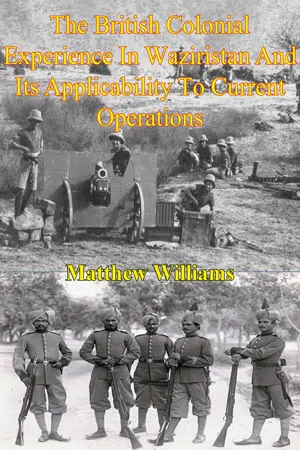
eBook - ePub
The British Colonial Experience In Waziristan And Its Applicability To Current Operations
- 86 pages
- English
- ePUB (mobile friendly)
- Available on iOS & Android
eBook - ePub
The British Colonial Experience In Waziristan And Its Applicability To Current Operations
About this book
CHAPTER 1 — Introduction
Following the fall of the Taliban regime in Afghanistan in late 2001, members of the former regime and Al-Qaeda found refuge in Waziristan. Waziristan is a tribal area in Pakistan located along the border with Afghanistan whose majority ethnic Pashtun population has menaced every occupying power since Alexander the Great. The formidable terrain, coupled with the fierce independent character of the Pashtun tribes, has made Waziristan a difficult area for outsiders to subdue. Taliban and Al-Qaeda elements use this tribal area as a sanctuary and staging area for attacks against international and government forces in Afghanistan. Waziristan is especially important to the U.S. due to the belief that sympathetic tribesmen may be sheltering Osama bin Ladin and his key lieutenants.
Although Pakistani President Pervez Musharraf allowed U.S. forces to use multiple Pakistani air bases to support its post-9/11 military operations in Afghanistan, he has forbidden nearly all operations by uniformed U.S. forces in Waziristan. Even Pakistani military forces did not operate in Waziristan until late 2001, historically leaving security of the area to local forces. The introduction of Pakistani military forces in this area represented a significant policy change that took place after the U.S. requested the Pakistani government deny sanctuary to Taliban and Al-Qaeda elements fleeing from Afghanistan. The Pakistani Army initially carried out limited offensive operations in the tribal areas accompanied by infrastructure development activities. The Army, however, did not launch a large-scale offensive in Waziristan until spring 2004 after suspected Islamic extremists tried to unsuccessfully assassinate Musharraf in December 2003. Despite the fact that Pakistani forces have conducted counter-insurgency operations in Waziristan, Al-Qaeda and Taliban elements continue to wage cross-border attacks against international and government forces in Afghanistan.
Even though this area of the world is relatively unknown to the U.S., the British dealt extensively with these tribal areas from 1846-1947. The British first made contacts in Waziristan in 1846-9 after it defeated the Sikhs in the first Sikh War. During this time period, revenue collection was the primary British activity. Some officers also proselytized the tribesmen. The British did not take full responsibility for Waziristan until 1849 after completely subduing the Sikh kingdom and annexing the Punjab. The British governed its new Punjabi possession from Lahore and initially made it a subordinate administrative entity to its colonial government in India.
In the nineteenth century, Britain viewed India as the “jewel in the crown” of its colonial possessions and took an aggressive stance toward any perceived threat toward the sub-continent. Fear of Russian imperial encroachment made the tribal areas between Afghanistan and India key territory in the eyes of the British. Although the so-called “Great Game” between Britain and Russian led to the First Anglo-Afghan war (1839-42), tensions subsequently eased to allow the British to manage Waziristan indirectly.
Yet the British government did not have the financial resources or forces needed to control the tribal areas located in the difficult terrain bordering Afghanistan. Therefore, after annexation of the Punjab, the British chose to follow a “Close Border” policy that decentralized control over these border areas. The principal goal of the British was to discourage tribal raiding into territory directly controlled by the provincial government in Lahore. As a consequence of this policy, the British launched punitive expeditions in Waziristan in 1852 and 1860 to punish Pashtun tribes for raiding into British territory.
Following Russian overtures to Kabul in the late 1870s, Britain launched another expedition into Afghanistan resulting in the Second Anglo-Afghan War (1878-80). The British installed a permanent political administration in Waziristan after punitive expeditions against recalcitrant tribes in 1894-5. The formal delineation of the Afghan/Indian border by the Durand commission in 1895 led to further conflict in the border areas. This new boundary, viewed unacceptable by most Pashtuns due to the perceived infringement of their independent status and the separation from their ethnic brethren in Afghanistan, resulted in a significant revolt against the British along the entire Afghan/Indian border in 1897. As a result, the British did not completely restore order until 1901.
The British subsequently conducted several more punitive expeditions in Waziristan up until Indian independence in 1947. The formidable terrain and militant character of the Pashtun tribes gave the British colonial administration significant challenges throughout its experience from 1849-1947. One religious firebrand in particular, the Faqir of Ipi, menaced British forces in Waziristan for many years during the 1930s. The British never captured or killed him despite their numerical and technological advantages. Overall, the British experienced and met many of the challenges that the U.S. and its allies currently face in Waziristan and its experiences may be applicable to current operations. Therefore, the research question for this monograph is: What lessons, if any, can the U.S. draw from the British colonial experience in Waziristan?
To determine if the U.S. can use lessons from the British experience the author collected primary and secondary sources from the time period (1849-1947). Primary sources consist of various critiques of the British campaigns in Waziristan. Other primary sources include commentaries from Pakistani government officials who served as political officers in Waziristan. Current newspaper and journal reports cover ongoing U.S. and Pakistani governmental operations in Waziristan.
To ascertain whether this evidence is valid for contemporary application, the author compared the political, military, geographical, and ethnographical realities in Waziristan during the British colonial experience and present-day Pakistan. Despite the passage of time, the British colonial period is a legitimate basis of study because these important variables remain mostly unchanged today. Historical material from the British colonial experience in Waziristan and current press on the tribal areas in general and Waziristan in particular provide enough evidence to answer the research question.
The first chapter of this monograph is the introduction. It provides the research question and the strategic setting of British colonial India. The first chapter also outlines the British experience in Waziristan from 1849-1947. The chapter provides the foundation that ensures the evidence presented in subsequent chapters is viewed in its proper context. The second chapter discusses the ethnic groups, population size, geography, and political boundaries of Waziristan. This chapter provides a description of the important characteristics which define Waziristan. Its ethnographic and geographical characteristics, in particular, make this tribal area a challenge for any central authority to manage.
The third chapter examines British policies in Waziristan from 1849-1947. It outlines the political and military actions the British took and the positive and negative inducements they used to influence tribal behavior. It also examines the effectiveness of various punitive expeditions. The fourth chapter discusses Waziristan in the post-9/11 world. It concentrates on Musharraf s policies and Pakistani military actions in the tribal area. In addition, it examines U.S. government actions in Waziristan since 9/11.
The concluding chapter summarizes the collected evidence and states the lessons the U.S. can draw from the British experience in Waziristan. Further, it also comments on U.S. policy and makes recommendations on future U.S. actions in Waziristan.
CHAPTER 2 — General description of Waziristan and its peoples
Waziristan is a complex, little known part of the world. To truly appreciate the British colonial experience in Waziristan, it is critical to first understand the characteristics that make this area so unique. This chapter examines the geographic, administration, meteorological and sociological factors as well as the tribes, transportation network, and populace of this area. Waziristan, located on Pakistan’s northwestern border with Afghanistan, is part of the Federally Administered Tribal Area (FATA), an area only nominally controlled by the Pakistani government. Waziristan is administratively divided into two agencies and encompasses 11,326 square kilometers. North Waziristan has a total of 4,707 square kilometers, while South Waziristan has a total area of 6,619 square kilometers.
Approximately ninety-six kilometers at its widest point, Waziristan is a rough parallelogram, which extends 144 kilometers from the Gumal and Sawa rivers in the south to the Kaitu (or Ketu) and Kurram rivers in the north. Bordered by Afghanistan to the west and the Bannu basin and the Derajat on the east, the terrain is mountainous in the south; the hills rise gradually from east to west, reaching heights of more than 3,000 meters. Preghal is the highest mountain peak at 3,513 meters. The northern part of Waziristan is more open and contains valleys separated by high hills. The rugged terrain not only made Waziristan difficult for outside armies to occupy but it also inhibited economic development by the indigenous population.
Waziristan did not, however, contain the critical passes the British used to transit to Afghanistan from India. The British primarily used the Bolan and Khojak Passes near Quetta and the Khyber Pass near Peshawar. Despite its lack of strategic passes, the British expended scare resources on Waziristan for its trading, revenue collection, and missionary potential. As its presence along the border endured, the British remained in the area to protect its territory from raiding by predatory tribes based in Waziristan.
Miranshah is the administrative center of North Waziristan and Wana is the agency headquarters for South Waziristan in the summer. The city of Tank (in the Tank district located directly east of Waziristan) serves as the winter headquarters for South Waziristan. Each agency is further organized into sub-divisions and tehsils or sub-units. The Pakistani government oversees each agency through a political agent. An assistant political officer/assistant political agent governs each sub-division and political tehsildars oversee each tehsil. The malik system provides another layer of traditional governance between the central administration and the individual tribe member. A malik is a hereditary intermediary between the tribe and the agency administration. The Lungi system or Sufaid Resh is a lower form of malik.{1}
All criminal and civil cases in Waziristan are guided by customary law called Rewaj, which is outlined by the Frontier Criminal Rules in 1901. This code governs the procedures for both criminal and civil cases. Political disputes are resolved by decisions derived by jirgas or councils of local elders. Waziristan’s current political administration is similar to the British system prior to 1947. The Pakistani government left the traditional structure in place to help ensure the loyalty of the tribes. Pakistan also adopted a “Close Border” policy and limited interference in tribal affairs. The nascent Pakistani government used a political agent to maintain relations with the tribes.
North Waziristan is divided into three sub-divisions and a total of nine tehsils. The Miranshah sub-division comprises the Miranshah, Ghulam Khan, and Datta Khel tehsils. The Mirali sub-division contains the Mirali, Spinwam, and Shewa tehsils. The Razmak sub-division consists of the Razmak, Dossali, and Garyum tehsils. South Waziristan has three sub-divisions (Sarwakai, Ladha, and Wana) and eight tehsils: Sararogha, Makin, Ladha, Sarwekai, Tiarza, Birmal, Wana, and Toi Khullah.
The political agent of each agency has a security force consisting of Khassadara (local police) and Scouts. Local tribes contribute men to the Khassadars who protect roads and bridges, escort government officials, and help maliks carry out government orders. Scouts provide general security for the entire agency. South Waziristan has 3,689 Khassadars and each tribe contributes the following number of personnel: 2,495 (Mahsud), 1,014 (Wazir), and 180 (Miscellaneous tribes). The number of Scouts who serve in South Waziristan is unknown.
North Waziristan has 3,269 Khassadars organized i...
Table of contents
- Title page
- TABLE OF CONTENTS
- ABSTRACT
- CHAPTER 1 - Introduction
- CHAPTER 2 - General description of Waziristan and its peoples
- CHAPTER 3 - British colonial experience in Waziristan
- CHAPTER 4 - Current political realities in Pakistan
- CHAPTER 5 - Analysis, Lessons Learned, and Recommendations
- BIBLIOGRAPHY
Trusted by 375,005 students
Access to over 1.5 million titles for a fair monthly price.
Study more efficiently using our study tools.
Information
Publisher
Tannenberg PublishingYear
2015Topic
HistorySubtopic
Military & Maritime HistoryeBook ISBN
9781782899938
Index
HistoryFrequently asked questions
Yes, you can cancel anytime from the Subscription tab in your account settings on the Perlego website. Your subscription will stay active until the end of your current billing period. Learn how to cancel your subscription
No, books cannot be downloaded as external files, such as PDFs, for use outside of Perlego. However, you can download books within the Perlego app for offline reading on mobile or tablet. Learn how to download books offline
Perlego offers two plans: Essential and Complete
- Essential is ideal for learners and professionals who enjoy exploring a wide range of subjects. Access the Essential Library with 800,000+ trusted titles and best-sellers across business, personal growth, and the humanities. Includes unlimited reading time and Standard Read Aloud voice.
- Complete: Perfect for advanced learners and researchers needing full, unrestricted access. Unlock 1.5M+ books across hundreds of subjects, including academic and specialized titles. The Complete Plan also includes advanced features like Premium Read Aloud and Research Assistant.
We are an online textbook subscription service, where you can get access to an entire online library for less than the price of a single book per month. With over 1.5 million books across 990+ topics, we’ve got you covered! Learn about our mission
Look out for the read-aloud symbol on your next book to see if you can listen to it. The read-aloud tool reads text aloud for you, highlighting the text as it is being read. You can pause it, speed it up and slow it down. Learn more about Read Aloud
Yes! You can use the Perlego app on both iOS and Android devices to read anytime, anywhere — even offline. Perfect for commutes or when you’re on the go.
Please note we cannot support devices running on iOS 13 and Android 7 or earlier. Learn more about using the app
Please note we cannot support devices running on iOS 13 and Android 7 or earlier. Learn more about using the app
Yes, you can access The British Colonial Experience In Waziristan And Its Applicability To Current Operations by Matthew Williams in PDF and/or ePUB format, as well as other popular books in History & Military & Maritime History. We have over 1.5 million books available in our catalogue for you to explore.