The process of urbanization throughout the world is making urban warfare a major aspect of future military conflicts. Past experience in such combat indicates that wall breaching is an important capability in facilitating the movement of ground units. Maneuver in strongly defended built-up areas is sometimes possible only if units move through buildings.
This study attempts to determine if there is a need for a wall-breaching capability in infantry units today. The investigation is focused on an analysis of historical experience, contemporary urban areas, and the capabilities of U.S. Army weapons.
Investigation reveals that a distinct need for a wall-breaching capability in infantry units does exist, and that current weapons and equipment readily available to the infantry rifle company are inadequate for this purpose. Further examination reveals that the means of satisfying the requirement are within the capability of current technology.
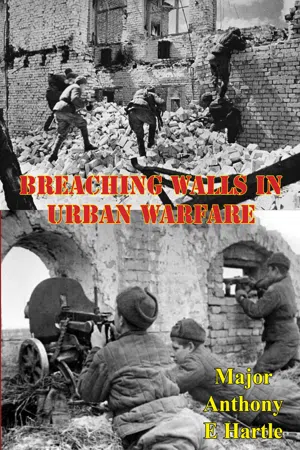
- 71 pages
- English
- ePUB (mobile friendly)
- Available on iOS & Android
eBook - ePub
Breaching Walls In Urban Warfare
About this book
Information
Subtopic
Military & Maritime HistoryIndex
HistoryCHAPTER I — PRESENTATION OF THE PROBLEM
“The worst policy is to attack cities. Attack cities only when there is no alternative.” —Sun Tzu: The Art of War
This study is an analysis of the capability of the infantry rifle company to breach walls in urban combat, primarily for the purpose of facilitating maneuver. At first glance such a subject appears relatively inconsequential, but combat in built-up areas is a subject of mounting concern to ground combat forces because of the continually increasing likelihood of urban warfare. This concern is clear in the Quadripartite discussions of the American, British, Canadian, and Australian armies in 1972:
We cannot escape from the basic fact . . . that sooner or later . . . open space will become more and more at a premium. Whether we or the Warsaw Pact countries like it or not, we will eventually be forced by the spread of urbanization to take it more into account and to organize ourselves with forces more suited to urban warfare, namely, more infantry and less armour.{1}
The Soviet Army joins this consensus in some of its authoritative publications: “In a modern war, should the imperialists unleash one, combat action in a city will be inevitable.”{2}
As the world population increases geometrically, a larger and larger proportion of that population lives in expanding metropolitan areas. A recent study of built-up area conflict recognized the significance of such development for the military: “The current urbanization of Europe and the projected growth rate indicate that the [U.S.] Army must be prepared to fight in built-up areas.”{3}
Urban areas in the underdeveloped countries are growing even faster than those in the rest of the world.{4} In 1920, Great Britain was the only nation in the world with a predominantly urban population. Today, about one third of the people on earth live in cities, and, if present trends continue, by the year 2000 over half of the expected world population of seven billion will live in vast metropolitan complexes.{5}
These facts, when related to historical data concerning city combat, present the U.S. Army with a broad array of problems. As subsequent discussion will show, current U.S. Army doctrine concerning combat in built-up areas is limited or inadequate in various respects. A recent study prepared at the U.S. Army Infantry School concerning combat in cities states, “Almost without exception, the development of weapons and materiel since World War II has proceeded with little regard to the applicability ... to urban fighting.”{6} Another special study report observed, “It has also been implicitly assumed that the organization and equipment used for operations in open country will be just as effective for operations in cities.”{7} These facts are particularly significant when one turns to wall breaching, a seldom discussed but nonetheless significant military capability. This study presents the importance of wall breaching in planning for future operations and future weapons development.
In any built-up area, movement of military forces is restricted. During combat, readily available avenues of approach are limited and largely predetermined by the pattern of construction, enabling a defending force to place extremely effective fire on all such avenues. This fact presents a problem for assaulting elements. The restriction affects defenders as well in that aggressive patrolling and the limited counterattacks necessary for a viable defense will also be constrained. Past experience in urban warfare has developed various means of preserving maneuver capability in cities. Forces may move underground, in tunnels and sewer systems; they can move across rooftops and thus avoid the streets; or they can go through the outer and the interior walls of buildings. The last possibility is the one that can he employed most consistently. There may be no accessible tunnels. If there are, information about the tunnels may not be available or the tunnels may be difficult to follow, a circumstance which would result: in confusion. Rooftops may not provide an avenue if buildings are separated or if building heights vary widely. Thus the capability to breach walls solely for the purpose of enhancing mobility is, in itself, a significant consideration in urban warfare.
The focus of this study is threefold: first, to analyze the need for a wall-breaching capability in units committed to urban combat; second, to examine the wall-breaching capability of weapons now available to infantry units; and, third, to recommend a solution to remedy any shortcomings identified.
Statement of the Problem
Does the infantry rifle company in urban combat need a wall-breaching capability to facilitate movement and maneuver? The remainder of this study is devoted to answering this question, primarily through analysis of combat experience during and since World War II in relation to the capabilities of current infantry weapons.
The study of the problems encountered in urban warfare has intensified in the U.S. Army in recent years. Our experience in Hue and Saigon during the Tet Offensive of 1968 focused attention on tactics and weapons in city fighting. The Advanced Research Projects Agency of the Department of Defense in the last six years has supported various studies of military operations in built-up areas. One of these, by Ketron, Incorporated, included the following conclusions:
The Army currently has no weapon system especially designed for wall breaching.{8}
Current weapons systems are not adequate for wall breaching. . . .{9}
S. L. A. Marshall reports that at a recent Army symposium on the problems of urban warfare, commanders “accented the need for a projectile that from one or several hits would blast a hole in a stone wall, quite a few inches of concrete or a reinforced house of brick so that men may move through the hole and neutralize defense within the structure.”{10} Interestingly, Marshall himself rejects this conclusion, saying, “Blowing down walls when buildings are designed so that they might be entered and used is going at it the hard way.”{11} This observation by the usually astute historian is rather surprising, for it appears he is overlooking the historically (and logically) supported fact that those entrances and the approaches to them are covered by boobytraps or intense fire.
The problem of wall breaching has been exacerbated by recently approved changes in tables of organization and equipment. The 106-mm recoilless rifle (M40A1) and the 90-mm recoilless rifle (M67) have been deleted from the standard inventory and replaced by the tube-launched, optically-guided, wire-command link (TOW) guided missile and the DRAGON missile (M47). The characteristics of these weapons, which will be discussed in Chapter V, make them largely unsuitable for close combat in cities. Experience with the recoilless rifles and data concerning the performance of these weapons show them to be useful for wall breaching, though they have serious limitations because of backblast characteristics. Their absence leaves a definite gap in the range of weapons effects available to the infantry, a gap that becomes acutely significant in urban warfare.
History of Wall Breaching
If an enemy force conducts a stubborn defense in a city complex today, the time required to reduce strongpoints and the casualties suffered will be major factors in determining whether the assaulting force succeeds or fails. The capability to breach walls quickly and efficiently is thus revealed as an important consideration in the development of forces which will conduct operations in built-up areas. When other avenues of approach are too difficult or simply unavailable, “mouse-holing” (tunneling through walls) may often prove to be a critical capability. A large number of breaching requirements will consume excessive time, a factor of great importance to commanders, if the assault units are not properly equipped. The pressure applied by General MacArthur's Far East Command for a speedy conclusion to the fight to seize Seoul in 1950 is a particular case in point. There the political considerations demanding speed overrode the tactical considerations counseling caution. Often in the history of warfare, combat in cities has been conducted under urgent time constraints.
In our modern environment, the search for a rapid means to enter a structure by other than the expected route or to move through “interior obstacles” in a building is intriguingly analogous to the ancient problem of wall breaching. As Phillip H. Stevens notes in his study of the history of artillery,
Wasting either time or good troops does not fit into the plan of any would-be conqueror. To be a successful military leader, one must overcome obstacles in the minimum possible time and with the least possible loss of manpower. Siege warfare, the art of quickly reducing a fortified town, gave the major impetus to the development of what we call artillery.
Early artillery devices were known as siege engines and their almost exclusive purpose was to knock things down—walls, gates, anything that stood between the attacker and his objective.{12}
Consider the campaign to unify Greece conducted by Phillip of Macedon, father of Alexander the Great. According to W. A. Windas, “He saw at once that without artillery, the task bordered on the impossible, for each of the independent city states was surrounded by strong walls. Therefore, his first thought was to develop efficient siege engines.”{13} The artillery referred to here undoubtedly consisted of catapults which hurled stones or similar projectiles, and their function was primarily to cause destruction and casualties inside the walls, but this reference illustrates the problem that walls have presented throughout history.
The Middle Ages also reveal the same preoccupation with the problem of overcoming walls. The eminent medieval war scholar, C. W. C. Oman, emphasized the significance of this problem:
In the whole history of the medieval period the most striking features are undoubtedly the importance of fortified places and the ascendance assumed by the defensive in poliorcetics .... A Norman keep, solid and tall, with no woodwork to be set on fire and no openings near the ground to be battered in, had an almost endless capacity for passive resistance.{14}
Because the problem of overcoming walled defenses was so vital, human ingenuity was intensively applied to a solution. The wide variety of siege engines of the Roman Empire and the later medieval period reveal this. The Roman Legions used huge battering rams to gain access to walled cities, but the casualties incurred in working directly under the walls were heavy. The catapult and the ballista, along with a host of related inventions, were designed to achieve a stand-off capability, but something more efficient was needed. A satisfactory solution to the problem was achieved in Europe only with the advent of gunpowder and cannon during the Hundred Years War between France and England, 1339 to 1453.
The Battle of Crecy between the French and the English in 1346 is often cited as the beginning of a new era in Western civilization. A. V. B. Norman, a specialist in arms and armor, grants that Edward III had guns at the time of Crecy and that Italian writers of the time excused the failure of the Genoese contingent during the battle by saying they were dismayed by the English guns, but he finds no clear evidence that guns were actually used.{15} Another scholar points out that Edward III actually used the “crakys of war,” essentially a vase-shaped pot propelling a heavy lance or battering projectile, as early as 1327, but that it “was good for lim...
Table of contents
- Title page
- TABLE OF CONTENTS
- ABSTRACT
- CHAPTER I - PRESENTATION OF THE PROBLEM
- CHAPTER II - REVIEW OF RELATED LITERATURE
- CHAPTER III - METHODOLOGY
- CHAPTER IV - HISTORICAL ANALYSIS
- CHAPTER V - PARAMETERS OF THE PROBLEM
- CHAPTER VI - FINDINGS AND CONCLUSIONS
- REQUEST FROM THE PUBLISHER
- BIBLIOGRAPHY
Trusted by 375,005 students
Access to over 1.5 million titles for a fair monthly price.
Study more efficiently using our study tools.
Frequently asked questions
Yes, you can cancel anytime from the Subscription tab in your account settings on the Perlego website. Your subscription will stay active until the end of your current billing period. Learn how to cancel your subscription
No, books cannot be downloaded as external files, such as PDFs, for use outside of Perlego. However, you can download books within the Perlego app for offline reading on mobile or tablet. Learn how to download books offline
Perlego offers two plans: Essential and Complete
- Essential is ideal for learners and professionals who enjoy exploring a wide range of subjects. Access the Essential Library with 800,000+ trusted titles and best-sellers across business, personal growth, and the humanities. Includes unlimited reading time and Standard Read Aloud voice.
- Complete: Perfect for advanced learners and researchers needing full, unrestricted access. Unlock 1.5M+ books across hundreds of subjects, including academic and specialized titles. The Complete Plan also includes advanced features like Premium Read Aloud and Research Assistant.
We are an online textbook subscription service, where you can get access to an entire online library for less than the price of a single book per month. With over 1.5 million books across 990+ topics, we’ve got you covered! Learn about our mission
Look out for the read-aloud symbol on your next book to see if you can listen to it. The read-aloud tool reads text aloud for you, highlighting the text as it is being read. You can pause it, speed it up and slow it down. Learn more about Read Aloud
Yes! You can use the Perlego app on both iOS and Android devices to read anytime, anywhere — even offline. Perfect for commutes or when you’re on the go.
Please note we cannot support devices running on iOS 13 and Android 7 or earlier. Learn more about using the app
Please note we cannot support devices running on iOS 13 and Android 7 or earlier. Learn more about using the app
Yes, you can access Breaching Walls In Urban Warfare by Major Anthony E. Hartle in PDF and/or ePUB format, as well as other popular books in History & Military & Maritime History. We have over 1.5 million books available in our catalogue for you to explore.