The River Severn is Britain's longest natural waterway. It rises in mid-Wales, where it is known as the Hafren. Both these names stem from that of a river goddess, known since prehistoric times as Sabrina. To stop anywhere along Sabrina's course, or on either side of her beautiful estuary, is to risk becoming absorbed and transfixed by her ever-moving, yet timelessly repetitive progress. Throw a net across Sabrina, from side to side, and you might catch a fish, but the body of her stream will pass straight through the mesh. Can words possibly convey the elusive majesty of her current, or adequately describe its multi-stranded sacred story? In Spirits of Severn, artist and mythographer Michael Dames - whose acclaimed work includes The Silbury Treasure, The Avebury Cycle and Mythic Ireland - brings the river's illusive legacy to the surface, while tracing her progress from her pair of sources to the furthest tips of her Mor Hafren estuary.
Trusted by 375,005 students
Access to over 1.5 million titles for a fair monthly price.
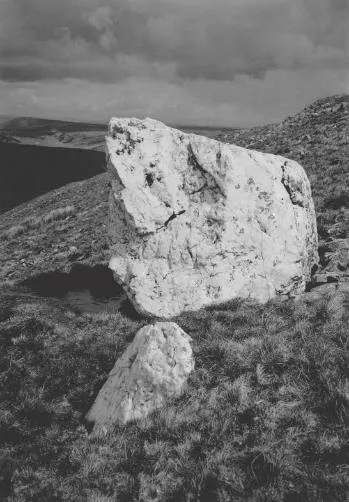
Britain’s longest river, the 220-mile Severn, rises at 2,000 feet above the sea, from beneath a ridge, named in Welsh Fuwch-wen-a-llo, ‘the white cow and calf’, after a pair of quartz-rich white rocks, deposited here by an ice sheet, 14,000 years ago. They were recognised as the primordial ‘white cow and her calf’. (In Welsh, wen, ‘white’, also means ‘holy’.) Thanks to a deep fissure in her head, the white cow-boulder seems to smile perpetually at her calf.1 No wonder that ‘eloquent poets’ have descanted upon this pair’, as Thomas Harper affirmed in the 17th century. The ridge on which they are sited stands in the Pumlumon mountainous region of mid-Wales.
On this Welsh outpost of widespread Indo-European languages and beliefs, the cow was regarded as a holy milk-giving epitome of nourishing motherhood.2 The Severn’s ‘cow rocks’ that overlook the Severn’s main source offer a distant echo of Hindu Indian beliefs, in which the white cow provides a home for all the gods. Along with Brahma, the father of the entire Hindu pantheon, they all nestle inside her. Consequently the white cow was seen as the source of prosperity across two continents.3 Accordingly, the mighty River Severn, engendered by the white cow, emerges from beneath the ridge named in its honour, to become home to the goddess Sabrina, whose name is said to have derived from the Sanskrit word sab,
‘milk’, according to E. Eckwall, a place-name expert.4 After spurting from
the White Cow, the sab in Sabrina’s name secures the sanctity of all her water downstream.5 Thus imbued with life-giving divinity, thanks to her internationally valid passport, our river was given a good start. Her spirit and substance were combined from the outset.
Yr Fuwch Wen a’r Llo, ‘the White Cow and Calf’ stones. This pair of glacially deposited quartz boulders describe a smiling cow over 6 feet
(1.8m) tall, gazing at her calf. She is ‘Ceridwen’, the ‘dear white one’, an Otherworld creature, adored in Celtic myth. Together, as omens of supernatural prosperity, they stand on, and give their names to the ridge from which the Severn emerges.
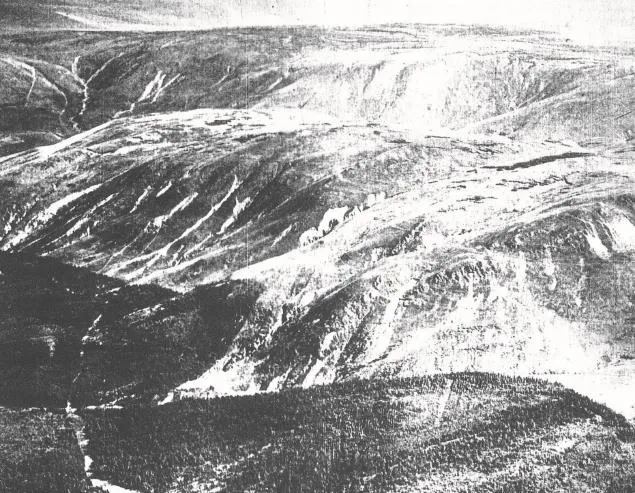
Despite receiving heavy rainfall, the Pumlumon district of mid-Wales was often termed ‘The Welsh Desert’ by travellers, due to its lack of
permanent inhabitants and dwellings. Today, a Forestry Commission
plantation covers some of the lower slopes, as seen in the foreground of this photograph.
In Ireland, Boand, the cow deity who gave birth to the river Boyne was originally named Bou-vinda, the ‘Cow-white goddess’.6 In ancient Sanskrit, the magic cow was sometimes known as Sabana, ‘the spotted cow of plenty’, alias Kamadhenu, who was often depicted as having a woman’s head and breasts, combined with her cow’s teat-rich body.7
The boundary between Sabrina and her mythic cow is as fluid as milk. She can become it, and it may double as her, since mythic and practical truths tend to merge. Until the mid-19th century AD, large herds of white cattle were annually driven on foot from Pembrokeshire and other parts of Wales, to feed along the pastures of the Severn Valley, before their arrival in the London market.8
Following Celtic nomenclature, Sabrina, as a river deity, was acknowledged by the Classical writers Tacitus and Ptolemy.9 In doing so, they were following the chief feature of Roman religion, the belief that all important processes in the world were divinely activated, with different gods being in charge of particular functions and spheres of activity. Roman religion was concerned with procuring health and happiness by winning the cooperation of the gods. This pax deorum, ‘peace of the gods’, was also sought through the religious founding of the cities established along Sabrina’s course, as vividly described in A. E. Truman’s Geology and Scenery of England and Wales.10
Even in modern times, Sabrina reappears in several sculpted images, and in the names of bridges thrown across her river.11 Thus the supernatural spirit of our longest natural waterway is widely recalled, while her fruitful estuary, and the Bristol Channel remains Mor Hafren, in Welsh where Hafren is derived from Welsh haf, ‘summer’, the season of abundance, and its sea laps onto both the Welsh and the English shores.
In Welsh, as in Irish folklore, the white cow functioned as the Bos Primigenius, the supernatural maternal beast.12 She took care of her people and symbolised the divine bounty of more than one river valley. In Wales, her connection with water is emphasised by the legend of Llyn Barfog, close to Aberdovey, in Gwynedd. There, often at dusk, some green-clad elfin women would appear with a herd of milk-white cattle. A farmer captured one of these animals. It yielded him amazing quantities of butter and cheese. However, when he fattened the beast prior to its slaughter, and a butcher was about to deliver the fatal blow, the women called the cow back into its lake, while the farmer’s remaining cattle turned jet black, which is now the colour of most Welsh cows.13
One traditional Irish verse declares that ‘There is a white cow on the mountain. A fair white cow; she goes east and she goes west, and my senses have gone for the love of her. She goes with the sun and he forgets to burn. And the moon turns her face with love to her’.14 In Ireland the white cow’s range ran from the underworld of the fairy hills, up towards the stars. Domesticated cattle arrived in Britain along with agriculture, c. 5,000 BC. In much later Saxon and Norse myth, the original cow was called Audhumla, meaning ‘Nourisher’. She was believed to have fed Ymir, the very first man, with her milk. Her supply was so copious that it also helped to create the world’s first rivers.15 Audhumla supplied the English with another version of the Indo-European faith in holy streams.
The Severn continues to offer her primitive legacy. She has survived an attempt made in the 12th century to reduce her into a purely historical context. Geoffrey of Monmouth16 had claimed that the river was named as the outcome of a domestic quarrel. In his fictional account, he described how Locrinus, his imagined first king of England, had fallen in love with a German princess who had been brought to this country by a continental warrior during his invasion of the river Humber.
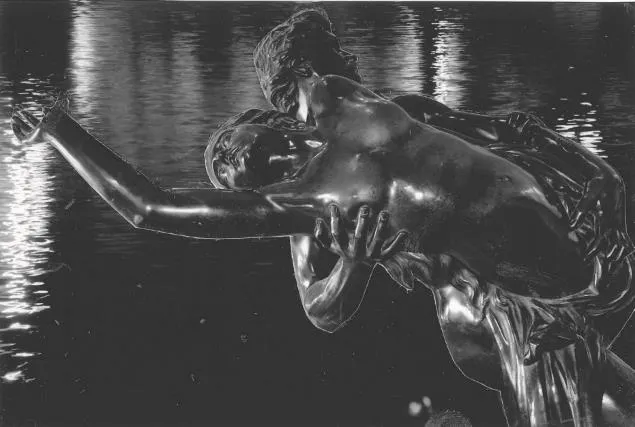
Estrildis’ drowning is depicted in this bronze life-sized effigy of Sabrina by William Calder Marshall, made in 1880, now in Worcester Art Gallery.
This princess was Estrildis. Her name, both in German and in Old English, derived from the Germanic goddess of spring, Eastre. Bede later claimed that she was also a goddess of the vernal equinox, cognate with the Sanskrit word usra, ‘dawn’.17 Thus across two continents Estridis heralded the birth of new light and life. Both her beauty and personality matched this vital role. In her German homeland she was este, ‘gracious and beautiful’, while she distributed est, ‘grace, favour and liberality’, in an este-lice, ‘kind, glad, delicate way’.18
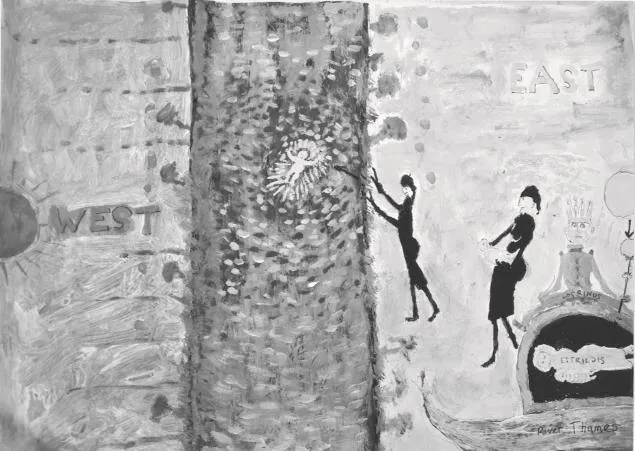
Locrinus carried Estrildis to his London capital and there, since he was already married to Queen Gwendolen of Cornwall, he concealed his new mistress in a chamber beneath the Thames, while claiming to others, during his frequent visits to her, that he was going underground to pray.19 So placed, Estrildis was engaged in an east-west fight between winter’s darkness and summer’s light, thereby reliving the hild, ‘battle’, that formed the second syllable of her German name. Thus beyond history’s narrow superimposed claim, she remained a goddess who embodied and presided over the annually repeated conflict between the seasons.
According to Geoffrey of Monmouth’s 12th-century account, the baby Habren was born to her husband’s mistress, Estrildis. Both of them are thrown into the river Severn. The Habren name relates to modern Severn and to the river goddess, Sabrina.
According to Geoffrey, when Queen Gwendolen learned of her husband’s affair, she raised a Cornish army and killed Locrinus on the River Stour, a Worcestershire tributary of the Severn. Then she threw both Estrildis and her new-born daughter, named Habren, into the Severn, drowning ...
Yes, you can cancel anytime from the Subscription tab in your account settings on the Perlego website. Your subscription will stay active until the end of your current billing period. Learn how to cancel your subscription
No, books cannot be downloaded as external files, such as PDFs, for use outside of Perlego. However, you can download books within the Perlego app for offline reading on mobile or tablet. Learn how to download books offline
Perlego offers two plans: Essential and Complete
Essential is ideal for learners and professionals who enjoy exploring a wide range of subjects. Access the Essential Library with 800,000+ trusted titles and best-sellers across business, personal growth, and the humanities. Includes unlimited reading time and Standard Read Aloud voice.
Complete: Perfect for advanced learners and researchers needing full, unrestricted access. Unlock 1.5M+ books across hundreds of subjects, including academic and specialized titles. The Complete Plan also includes advanced features like Premium Read Aloud and Research Assistant.
Both plans are available with monthly, semester, or annual billing cycles.
We are an online textbook subscription service, where you can get access to an entire online library for less than the price of a single book per month. With over 1.5 million books across 990+ topics, we’ve got you covered! Learn about our mission
Look out for the read-aloud symbol on your next book to see if you can listen to it. The read-aloud tool reads text aloud for you, highlighting the text as it is being read. You can pause it, speed it up and slow it down. Learn more about Read Aloud
Yes! You can use the Perlego app on both iOS and Android devices to read anytime, anywhere — even offline. Perfect for commutes or when you’re on the go. Please note we cannot support devices running on iOS 13 and Android 7 or earlier. Learn more about using the app
Yes, you can access Spirits of Severn by Michael Dames in PDF and/or ePUB format, as well as other popular books in Social Sciences & Folklore & Mythology. We have over 1.5 million books available in our catalogue for you to explore.