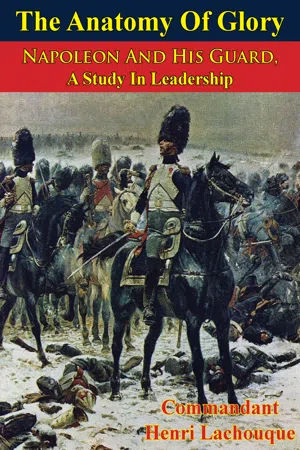
The glory of the Imperial Guard resounds above all others in the annals of war. Created, built and nurtured as a bodyguard for Napoleon, it grew from a brigade of less than two thousand men into a virtual army, and became 'a human fortress which no one but he could dominate and no enemy could penetrate'. And, on such battlefields as Austerlitz, Jena, Friedland, Wagram and Waterloo, it won the laurels of undying fame.
Written by France's foremost historian of the Napoleonic Wars, Commandant Henry Lachouque, and translated and adapted by Anne S. K. Brown, this sumptuous work is enhanced by over 180 illustrations, including 86 plates in full colour.
With its vivid narrative and lavish illustrations, The Anatomy of Glory can lay justifiable claim to be one of the most magnificent books on military history ever published. The critical acclaim that greeted it upon its first publication provides ample testimony to its reputation:
'This dramatic account of the birth, life and death of the fabulous Imperial Guard tells a stirring story in English for the first time.'-The Saturday Review of Literature.
'No one but the most presumptuous who wishes to know about the Imperial Guard can afford to ignore this astonishing compilation. The illustrations alone...are reproduced with a clarity, a beauty, and technical perfection which no one can fail to admire.' Journal of the RUSI.
'This sumptuous book ... can yield rich rewards to any reader interested in the fabric of leadership. It is a delight to look at and a pleasure to read.' -The New York Times.
`... Not the well-worn history of conquest and defeat, but of the grognards themselves, marching through readable pages.' -History Today.
'Anne S. K. Brown has used her knowledge of French history and uniforms to render Lachouque freely and vigorously. Napoleon just happened to be fallible. But the superb apparatus of his fallibility is gorgeously recalled in this volume.' The Scotsman.
eBook - ePub
The Anatomy Of Glory; Napoleon And His Guard, A Study In Leadership
- 1,062 pages
- English
- ePUB (mobile friendly)
- Available on iOS & Android
eBook - ePub
The Anatomy Of Glory; Napoleon And His Guard, A Study In Leadership
About this book
Information
Subtopic
British HistoryIndex
HistoryBOOK II — THE GUARD KEEPS WATCH
CHAPTER 1 — The Imperial Guard
THE order of the day on 10 May 1804 read as follows:
‘The Guard is informed that today the Senate proclaimed Napoleon Bonaparte Emperor of the French and vested the imperial succession in his family.
‘Long live the Emperor!...
‘Today the Guard takes the title of “The Imperial Guard”.
‘The officers will report to Saint-Cloud tomorrow at 1.30 p.m. to be presented to the Emperor.
‘The Guard will form under arms at 4.30 p.m. tomorrow in the Champ de Mars to take the oath of allegiance to the new Emperor that is required by the Senate...
Bessières,
General of the Guard in waiting upon the Emperor.’
The veterans, forage-caps in hand, listened in silence. Then the cry ‘Vive l’Empereur!’ that was to make Europe tremble for the next ten years burst from their throats.
‘You have succeeded in teaching a people whom civil effervescence had rendered impatient of all restraint and inimical to all authority’, said Cambacérès the following week, in addressing the Emperor, ‘to cherish and respect a power exercised uniquely for its glory and repose’.
The word imperator—he who commands the legions and transmits power to the empire—derives from imperare, to command or order. Thus, in one sense empire means ‘order’. The new emperor of the Republic was the heir of both Caesar and Charlemagne, the founders of Empire. Napoleon adopted as his own emblem the spread eagle of the Roman legions, which was also the emblem of Saint John the Evangelist and of Jupiter.
He needed great dignitaries of court and household to add luster to the principle of authority, a necessity for all those in power who wish to attract the ambitious and dazzle the crowd. However, these posts—though handsomely remunerated—were only sinecures. Those of marshal of the Empire (instituted in May) and colonel general were indispensable to command the conglomerate forces of French, Italian, Batavian, Swiss, and German troops that the Emperor had christened the ‘Grande Armée’ without a national designation. This was the army of a new Europe including Italy, Holland, Switzerland, and the German states allied with France, to which Bonaparte had introduced the concept of liberty and the rights of man.
Since March 1804 he had succeeded in bringing order into equality through the new civil code. The kings of Europe trembled on their thrones. Gentz, the Aulic Councillor, wrote the Austrian Emperor: ‘If the sovereigns recognize Bonaparte’s title, and those of his pretended dynasty, the magic of supreme power will be forever dissolved. Revolution will be sanctioned, if not sanctified, and thereby transmitted, with all its pernicious precedents, to our most remote posterity.’ Gentz was a prophet.
By becoming Emperor Napoleon had made the Revolution universal. Nevertheless, by August he was officially recognized by all the kings of Europe except the Tsar (with his satellite Turkey), and the King of England with whom Napoleon was at war. The ambitions of these two sovereigns could not reconcile them to a unification of Europe.
The warlike preparations at Boulogne were progressing. In Paris the Emperor was planning a journey to the Rhine to visit the tomb of Charlemagne, ‘his illustrious predecessor’. Before leaving, he decided to unite the civil and military hierarchy of France admitted to the newly-formed Legion of Honor overtly in a ceremony of investiture at the church of the Invalides, and award the new insignia.
On 14 July the Imperial Guard paraded before the Emperor in the court of the Tuileries. Then the regiments lined the route to the Invalides, and to the booming of cannon the Empress and princes with their consorts drove in carriages to the Hôtel. Then the Imperial procession set forth, led by chasseurs of the Guard, their standards already embroidered with eagles. Next came the marshals, the Emperor on horseback, the colonel generals of the Guard, and the aides-de-camp. The horse grenadiers brought up the rear.
Received at the door by the Archbishop of Paris, the Emperor occupied a throne erected near the spot where he lies today, surrounded by Invalids and Polytechnicians. At the close of the Mass the Constable of France{53} decorated Napoleon. Then the Emperor decorated each dignitary in turn, including grenadier Coignet,{54} with the order that has retained its prestige to this day, though its significance has been somewhat vitiated by the ever increasing number of its recipients.
Soldiers of the Guard, magistrates, savants, generals, dignitaries of the church, and artists bent over the dais to receive identical insignia, having first sworn on their honor to ‘devote themselves to the service of the Republic, to guard her territory, defend her government and laws...and to maintain liberty and equality’.
The Emperor was escorted back to the Tuileries with the same ceremony as before, though by now a number of officers and soldiers of the Guard wore crosses of gold or silver.
Brilliant uniforms had already transformed the members of the Consular Guard. Now the admission of its bravest men, alongside the most illustrious civilians, into the Legion of Honor completed the transformation.
We shall hear no more of those who were expelled from the corps like one ‘Laurent, chasseur of the 5th Company’, who, ‘having behaved in a manner unworthy of a soldier of the Guard, and having taken to drink in a shameful way, will be stripped of his uniform and drummed out of the Corps...Guardsmen must realize that their position requires them to set an example and behave in an irreproachable manner. .’
In July the organization of the Guard was fixed for the following year. The elite legion of gendarmes became officially part of the Guard. A magnificent troop of foot and horse, it was posted on the garden terrace of the Tuileries. Savary, now a commander of the Legion of Honor, was its chief. Quartered in the former residence of the Archbishop of Cambrai, the gendarmes were comfortably housed. Though the men still slept two in a bed, the corporals and trumpeters had beds to themselves.
The strength of the Guard was not otherwise increased. The grenadier and chasseur regiments remained at three battalions, including one of vélites, and the cavalry regiments at four squadrons. The Mameluks were attached to the chasseurs à cheval. The artillery was a separate corps which included a squadron of horse artillery and four companies of train, plus the park and artificers.
In becoming ‘Imperial’ the Guard’s prestige increased. The colonels of the four regiments now held the rank of major general and received a bonus of 6,000 francs over and above their pay which was 24,000 francs for the colonel generals.
Although the Consulate had ceased to exist, the etiquette of the Monarchy seemed hardly applicable to the new Empire. Who would be capable of reviving it? Who in the Emperor’s entourage would know its minutiae of detail? Consecrated as this etiquette was by tradition and royal precedent, was it even appropriate to a man elected by the people?
Napoleon established two categories of attendants to ornament and dignify the state and maintain his personal prestige: symbolic attendants, inspired by royal custom, and functional attendants who, while taking due account of the honor due his office, were organized to encompass the ardent life of a Napoleon. Both groups were aware of his popularity and his genius as well as of his close association with the army and affection for the Guard.
The colonel generals served a week in rotation in waiting upon the Emperor and never left his side from the time he got up until he went to bed. They marched just behind him and were responsible to him alone. (The Guard was under their orders while serving as his guard or escort.) These officers lived near him in the palace and slept in his tent in the field.
The colonel generals administered the oath to Guardsmen of all ranks and presented those newly promoted to the Emperor. At ceremonies they surrounded his carriage, marching two by two at either door. When on foot, they walked just behind him; when mounted, the Master of the Horse occupied this post. The colonel generals were entitled to the same honors as marshals of the Empire, and commanded the troops at great parades. But no one of them commanded the Guard which was never under the command of anyone but the Emperor. The four colonel generals were simply intermediaries.
A letter from Napoleon to his brother Joseph, King of Naples, dated May 1806 says: ‘Do not organize your Guard so as to have to name a single commander. Nothing is more dangerous...’
Under the new organization Napoleon was in constant contact with his Guard. He knew every incident that occurred and heard all complaints.
‘We should be paid in francs but we are paid in livres’,{55} some grenadiers wrote their chief, addressing him as ‘Monseigneur Murat, Marshal of the Empire’.
‘The Emperor must not be surprised to find us very well dressed when we appear before him...But the moment we return to barracks the clothing issued for the parade goes back to the magazine...’
Was this true?
It was. Rapp, sent to investigate, concluded his report: ‘There is general discontent and we hope that His Ma...
Table of contents
- Title page
- TABLE OF CONTENTS
- DEDICATION
- PLATES
- MAPS AND PLANS
- TRANSLATOR’S PREFACE
- PROLOGUE
- BOOK I - THE GUARD IS BORN
- BOOK II - THE GUARD KEEPS WATCH
- BOOK III - THE GUARD SUFFERS
- BOOK IV - THE GUARD IN SPLENDOR
- BOOK V - THE GUARD IN ACTION
- BOOK VI - THE GUARD TAKES CHARGE
- BOOK VII - THE GUARD AT BAY
- BOOK VIII - THE GUARD STAGGERS
- BOOK IX - THE GUARD FALLS
- BOOK X - THE GUARD DIES
- CHAPTER 7 - The Aftermath
- APPENDIX ‘A’ - Units of the Guard in Order of their Creation
- APPENDIX ‘B’ - Levies ordered by Napoleon from 1800 to 1815
- APPENDIX ‘C’ - Principal Events of Period 1799-1815
- APPENDIX ‘D’ - Armament and Tactics of the Imperial Guard
- APPENDIX ‘E’ - Description of the Military Carriage of the late Emperor Napoleon taken at the Battle of Waterloo, with an Account of its Capture
- EDITOR’S NOTES ON THE ILLUSTRATIONS
- NOTES ON ARTISTS
- BIBLIOGRAPHY
- ACKNOWLEDGMENTS
- Maps
Trusted by 375,005 students
Access to over 1.5 million titles for a fair monthly price.
Study more efficiently using our study tools.
Frequently asked questions
Yes, you can cancel anytime from the Subscription tab in your account settings on the Perlego website. Your subscription will stay active until the end of your current billing period. Learn how to cancel your subscription
No, books cannot be downloaded as external files, such as PDFs, for use outside of Perlego. However, you can download books within the Perlego app for offline reading on mobile or tablet. Learn how to download books offline
Perlego offers two plans: Essential and Complete
- Essential is ideal for learners and professionals who enjoy exploring a wide range of subjects. Access the Essential Library with 800,000+ trusted titles and best-sellers across business, personal growth, and the humanities. Includes unlimited reading time and Standard Read Aloud voice.
- Complete: Perfect for advanced learners and researchers needing full, unrestricted access. Unlock 1.5M+ books across hundreds of subjects, including academic and specialized titles. The Complete Plan also includes advanced features like Premium Read Aloud and Research Assistant.
We are an online textbook subscription service, where you can get access to an entire online library for less than the price of a single book per month. With over 1.5 million books across 990+ topics, we’ve got you covered! Learn about our mission
Look out for the read-aloud symbol on your next book to see if you can listen to it. The read-aloud tool reads text aloud for you, highlighting the text as it is being read. You can pause it, speed it up and slow it down. Learn more about Read Aloud
Yes! You can use the Perlego app on both iOS and Android devices to read anytime, anywhere — even offline. Perfect for commutes or when you’re on the go.
Please note we cannot support devices running on iOS 13 and Android 7 or earlier. Learn more about using the app
Please note we cannot support devices running on iOS 13 and Android 7 or earlier. Learn more about using the app
Yes, you can access The Anatomy Of Glory; Napoleon And His Guard, A Study In Leadership by Commandant Henri Lachouque, Anne S. K. Brown in PDF and/or ePUB format, as well as other popular books in History & British History. We have over 1.5 million books available in our catalogue for you to explore.