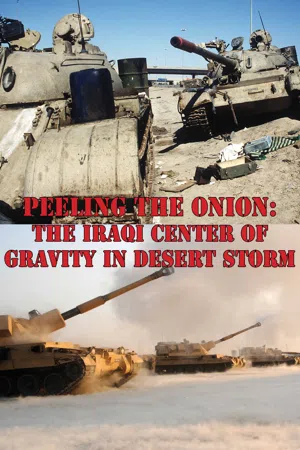
This monograph examines the concept "center of gravity" as applied by coalition forces during Operation Desert Storm. Center of gravity is an integral part of operational art and figures prominently in current U.S. doctrine.
It begins by tracing the concept's inception in Clausewitz's On War, finding several competing definitions in various sections of that landmark work. Current U.S. doctrine reveals that time has done little to alleviate the confusion. The U.S. Army definition of center of gravity as a strength is significantly and irreconcilably different from the Marine Corps' treatment as a weakness. The Air Force offers yet another slant.
Given those inconsistent definitions, it is little wonder that various participants and analysts suggest differing centers of gravity during Desert Storm. From various sources, the monograph compiles a list of a dozen contenders for the title "Iraqi Center of Gravity." It next examines coalition planning and actual combat action in search of a de facto center of gravity, concluding that the Republican Guard was the true Iraqi center.
The monograph then suggests The Onion Model as a unifying representation of the concept. Adding the terms Protectors, Connectors and Sustainers to the Center of Gravity, it graphically portrays the relationship of the other eleven contenders to the true center of gravity.
The study concludes that the center of gravity remains a valuable, if misused, concept. In Desert Storm, this misapplication of doctrine was overcome by an abundance of combat power; the center was hit because everything was attacked. In the future, U.S. forces may not enjoy the same luxury of time and resources. A future doctrine based on overwhelming force must be tempered by the Law of War's requirements for military necessity, proportionality, and avoidance of unnecessary suffering.
- 63 pages
- English
- ePUB (mobile friendly)
- Available on iOS & Android
eBook - ePub
Peeling The Onion: The Iraqi Center Of Gravity In Desert Storm
About this book
Information
Subtopic
Military & Maritime HistoryIndex
HistoryBIBLIOGRAPHY
Author’s Interviews and Correspondence
Cerri, LTC Anthony, Desert Storm ARCENT liaison officer. Interview 8 January 1992.
Purvis, COL Joseph H., Desert Storm CENTCOM planner. Correspondence dated 13 January 1992.
Purvis, COL Joseph H., Desert Storm CENTCOM planner. Correspondence dated 3 February 1992.
Briefings
AirLand Battle Future briefing to SAMS students by LTC Ricky Rowlett, Fort Leavenworth, Kansas, 27 August 1991.
Government Publications
Center for Army Lessons Learned (CALL). Newsletter 90-8 : Winning in the Desert II: Tactics, Techniques and Procedures for Maneuver Commanders. Fort Leavenworth, Kansas: U.S. Army Combined Arms Training Activity (CATA), 1990.
Department of the Navy, HQ U.S. Marine Corps. Fleet Marine Force Manual 1 (FMFM 1), Warfighting. Washington, D.C.: Government Printing Office, 1989.
Department of the Navy, HQ U.S. Marine Corps. Fleet Marine Force Manual 1-1 (FMFM 1-1), Campaigning. Washington, D.C.: Government Printing Office, 1990.
Department of Defense. Joint Publication 1: Joint Warfare of the United States Armed Forces. Washington, D.C.: National Defense University Press, 1991.
Strategic Studies Institute. Campaign Planning. Carlisle Barracks, PA: U.S. Army War College, 1988.
TRADOC Pamphlet 525-5B: AirLand Operations: The Evolution of AirLand Battle for a Strategic Army. Fort Monroe, VA: Training and Doctrine Command (TRADOC), 13 June 1991.
US Air Force. AFM 1-1, Basic Aerospace Doctrine of the United States Air Force. Washington, D.C.: Department of the Air Force, 1984.
US Army. FM 27-10, The Law of Land Warfare. Washington D.C.: Department of the Army, July 1956 with change 1 dated July 1976.
US Army. FM 34-3, Intelligence Analysis. Washington, D.C.: Department of the Army, March 1990.
US Army. FM 34-130, Intelligence Preparation of the Battlefield. Washington, D.C.: Department of the Army, May 1989.
US Army. FM 100-5, Operations. Washington, D.C.: Department of the Army, May 1986.
US Army. FM 100-5. Operations (draft). Fort Leavenworth, KS: School of Advanced Military Studies, 2 March 1992.
US Army. FM 100-7, The Army in Theater Operations (coordinating draft). Washington, D.C.: Department of the Army, 24 December 1991.
Books
Allen, Thomas B., F. Clifton Berry Jr. and Norman Polmar. War in the Gulf. Atlanta, GA.: Turner Publishing, 1991.
Blackwell, MAJ James (U.S. Army, Ret,). Thunder in the Desert. New York: Bantam Books, 1991.
Chandler, David G. The Campaigns of Napoleon. New York: McMillan, 1966.
Clausewitz, Carl Von. On War. Princeton, New Jersey: Princeton University Press, 1984.
Cohen, Eliot A. and John Gooch. Military Misfortunes: The Anatomy of Failure in War. New York: The Free Press, 1990.
Dupuy, COL Trevor N. (U.S. Army, Ret.), Curt Johnson, David L. Bongard and Arnold C. Dupuy. How to Defeat Saddam Hussein. New York: Warner Books, 1991.
Friedman, Norman. Desert Victory. Ann...
Table of contents
- Title page
- TABLE OF CONTENTS
- ABSTRACT
- I. INTRODUCTION
- II. CLAUSEWITZ’S CENTER OF GRAVITY
- III. DOCTRINE
- IV. THE IRAQI CENTER (S) OF GRAVITY
- V COALITION ACTIONS
- VI. A PROPOSED MODEL: THE ONION
- VII. CONCLUSIONS AND IMPLICATIONS
- APPENDIX A - JOMINI’S DECISIVE POINTS
- APPENDIX B - WAR COLLEGE STUDY
- APPENDIX C - INITIAL TARGET LIST
- APPENDIX D - HOW TO DEFEAT SADDAM HUSSEIN
- APPENDIX E - CAMPAIGN PLAN, 10 OCTOBER 1990
- APPENDIX F - THE ONION MODEL
- APPENDIX G - THE IRAQI ONION
- BIBLIOGRAPHY
Trusted by 375,005 students
Access to over 1.5 million titles for a fair monthly price.
Study more efficiently using our study tools.
Frequently asked questions
Yes, you can cancel anytime from the Subscription tab in your account settings on the Perlego website. Your subscription will stay active until the end of your current billing period. Learn how to cancel your subscription
No, books cannot be downloaded as external files, such as PDFs, for use outside of Perlego. However, you can download books within the Perlego app for offline reading on mobile or tablet. Learn how to download books offline
Perlego offers two plans: Essential and Complete
- Essential is ideal for learners and professionals who enjoy exploring a wide range of subjects. Access the Essential Library with 800,000+ trusted titles and best-sellers across business, personal growth, and the humanities. Includes unlimited reading time and Standard Read Aloud voice.
- Complete: Perfect for advanced learners and researchers needing full, unrestricted access. Unlock 1.5M+ books across hundreds of subjects, including academic and specialized titles. The Complete Plan also includes advanced features like Premium Read Aloud and Research Assistant.
We are an online textbook subscription service, where you can get access to an entire online library for less than the price of a single book per month. With over 1.5 million books across 990+ topics, we’ve got you covered! Learn about our mission
Look out for the read-aloud symbol on your next book to see if you can listen to it. The read-aloud tool reads text aloud for you, highlighting the text as it is being read. You can pause it, speed it up and slow it down. Learn more about Read Aloud
Yes! You can use the Perlego app on both iOS and Android devices to read anytime, anywhere — even offline. Perfect for commutes or when you’re on the go.
Please note we cannot support devices running on iOS 13 and Android 7 or earlier. Learn more about using the app
Please note we cannot support devices running on iOS 13 and Android 7 or earlier. Learn more about using the app
Yes, you can access Peeling The Onion: The Iraqi Center Of Gravity In Desert Storm by Major Collin A. Agee in PDF and/or ePUB format, as well as other popular books in History & Military & Maritime History. We have over 1.5 million books available in our catalogue for you to explore.