This monograph examines the Soviet experience in Afghanistan (1979-1988) in terms of Soviet Army tactics and organization for combat. Throughout the decade of the 1970's, U.S. perceptions of Soviet ground force tactics stressed a general lack of initiative and flexibility in their military doctrine. In the 1980's a re-evaluation of Soviet thinking occurred which saw greater flexibility at the operational and strategic levels If the experience in Afghanistan has shown that set-piece tactics will not work in all types of warfare, and the Soviets are able to incorporate higher levels of initiative and flexibility into their tactical doctrine, then the U.S. may be required to refocus its training away from the stylized Soviet enemy.
This study begins with a background discussion of Soviet historical involvement in Afghanistan to include counter-insurgency experience in their southwestern border area. It then covers the actual invasion and units employed with emphasis on their pre-deployment status and subsequent performance. The following section divides the war into four phases to ease understanding. The monograph subsequently looks at lessons learned and principles reaffirmed from both the Soviet and U.S. perspective. A key feature is the need the Soviets apparently feel for Western style initiative and flexibility at lower command levels (battalion, company and platoon), and how this is inconsistent with their culture and system of command and control.
eBook - ePub
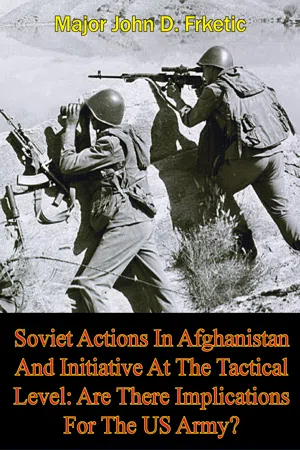
Soviet Actions In Afghanistan And Initiative At The Tactical Level: Are There Implications For The US Army?
- 46 pages
- English
- ePUB (mobile friendly)
- Available on iOS & Android
eBook - ePub
Soviet Actions In Afghanistan And Initiative At The Tactical Level: Are There Implications For The US Army?
About this book
Information
Subtopic
Military & Maritime HistoryIndex
HistoryBIBLIOGRAPHY
BOOKS
Amstutz, J. Bruce. Afghanistan. The first five Years of Soviet Occupation. National Defense University Government Printing Office. Washington, D.C., 1986.
Bennigsen, Alexandre. The Soviet Union and Muslim Guerrilla Wars. 1920-1981: Lessons for Afghanistan. Santa Monica, California Rand, 1981.
Bradsher, Harry S. Afghanistan And The Soviet Union. Durham, North Carolina: Duke University Press, 1985.
Collins, MAJ Joseph J The Soviet Invasion of Afghanistan Lexington, Massachusetts: Lexington Books, 1986.
Erickson, John and Feuchtwanger, E. J. (Edited). Soviet Military Power and Performance. Hamden, Connecticut. The Shoe String Press, Inc., 1979
English, John A On Infantry. New York: Praeger, 1984
Griffiths, John C. Afghanistan key To A continent Boulder, Colorado Westview Press, 1981.
Hammond, Thomas T Red Flag Over Afghanistan Boulder, Colorado Westview Press, 1984
Isby, David C Weapons and Tactics of the Soviet Army. London, Jane’s Publishing Company Limited, 1988
Nigel, Ryan A Hitch Or Two in Afghanistan: A Journey Behind Russian Lines London George Weidenfeld and Nicolson, LTD, 1983
Fast, Harriet and Scott, William F The Armed Forces of the USSR Boulder, Colorado Westview Press, 1984
Zey-Ferrell, Mary; Porchman, Arlene and Gaston, Jerry Initiative And Innovation in the Soviet Military Occasional Paper No 6, Occasional Papers Series, 1984.
PERIODICALS
Adams, Peter. “Retreat From Afghanistan. How The Soviets Failed”. Army Times, 16 May 1988.
Armstrong, Major Richard N. “Initiative Soviet Style”, Military Review, June 1984.
Bodansky, Yossef. “Learning Afghanistan’s Lesson”. Jane’s Defense Weekly, 20 February 1988
Bodansky, Yossef. “Soviet Net Closes In On Afghan Resistance”. Jane’s Defense Weekly, 20 February 1988.
Bodansky, Yossef. “The New Generation of the Soviet High Command”. Jane’s Defense Weekly, 31 October 1987.
Bodansky, Yossef. “General of the Army D. T. Yazov: Victor in Afghanistan”, Jane’s Defense Weekly, 31 March 1984.
Bodansky, Yossef. “New Weapons in Afghanistan”, Jane’s Defense Weekly, 9 March 1985.
Cardoza, Captain A. A. et. al. “Battle Study: The Soviet War in Afghanistan”. Marine Corps Gazette, July 1986.
Collins, Major Joseph J “The Soviet Military Experience in Afghanistan”. Military Review, May 1985.
Dick, Charles J “Catching NATO Unawares—Soviet Army Surprise and Deception Techniques”. International Defense Review, No. 1, 1986.
Dick, Charles J. “Soviet Battle Drills: Vulnerability or Strength”, International Defense Review, No. 5, 1985.
Dick, Charles J “Soviet Operational Concepts: Part 1” Military Review, September 1985.
Furlong, R D M and Winkler, Theodor “The Soviet Invasion of Afghanistan”. International Defense Weekly, No 2, 1980
Gross, Natalie “Weaknesses in Soviet Junior Leadership”. Military Review, November 1987.
Gunston, John. “Stingers Used by Afghan Rebels Stymie Soviet Air Force Tactics”. Aviation Week and Space Technology, 4 April 1988.
Hager, Major Michael. “Initiative in the Soviet Ground Forces”. Military Intelligence, October-December 1982.
Isby, David C. “Soviet Airmobile and Air Assault Brigades”. Jane’s Defense Weekly, 14 September 1985.
Isby, David C. “Soviet Tactics in the War in Afghanistan”. Jane’s Defense Weekly, Vol. 4, No. 7, 1983.
Kemp, Ian. “Abdul Haq: Soviet Mistakes in Afghanistan” Jane’s Defense Weekly, 5 March 1988.
Khalilzad, Zalmay. “Moscow’s Afghan War”. Problems of Communism, January-February, 1986.
Kosevich, LTC Richard S. “Ne Po Shablonu: Soviet Tactical Flexibility”, Military Review, August 1982.
McCormick, First Lieutenant Kip. “T...
Table of contents
- Title page
- TABLE OF CONTENTS
- ABSTRACT
- I. INTRODUCTION
- II. BACKGROUND
- III. THE INVASION
- IV. THE MILITARY EXPERIENCE
- V. LESSONS LEARNED AND PRINCIPLES REAFFIRMED
- VI. CONCLUSION
- BIBLIOGRAPHY
Trusted by 375,005 students
Access to over 1.5 million titles for a fair monthly price.
Study more efficiently using our study tools.
Frequently asked questions
Yes, you can cancel anytime from the Subscription tab in your account settings on the Perlego website. Your subscription will stay active until the end of your current billing period. Learn how to cancel your subscription
No, books cannot be downloaded as external files, such as PDFs, for use outside of Perlego. However, you can download books within the Perlego app for offline reading on mobile or tablet. Learn how to download books offline
Perlego offers two plans: Essential and Complete
- Essential is ideal for learners and professionals who enjoy exploring a wide range of subjects. Access the Essential Library with 800,000+ trusted titles and best-sellers across business, personal growth, and the humanities. Includes unlimited reading time and Standard Read Aloud voice.
- Complete: Perfect for advanced learners and researchers needing full, unrestricted access. Unlock 1.5M+ books across hundreds of subjects, including academic and specialized titles. The Complete Plan also includes advanced features like Premium Read Aloud and Research Assistant.
We are an online textbook subscription service, where you can get access to an entire online library for less than the price of a single book per month. With over 1.5 million books across 990+ topics, we’ve got you covered! Learn about our mission
Look out for the read-aloud symbol on your next book to see if you can listen to it. The read-aloud tool reads text aloud for you, highlighting the text as it is being read. You can pause it, speed it up and slow it down. Learn more about Read Aloud
Yes! You can use the Perlego app on both iOS and Android devices to read anytime, anywhere — even offline. Perfect for commutes or when you’re on the go.
Please note we cannot support devices running on iOS 13 and Android 7 or earlier. Learn more about using the app
Please note we cannot support devices running on iOS 13 and Android 7 or earlier. Learn more about using the app
Yes, you can access Soviet Actions In Afghanistan And Initiative At The Tactical Level: Are There Implications For The US Army? by Major John D. Frketic in PDF and/or ePUB format, as well as other popular books in History & Military & Maritime History. We have over 1.5 million books available in our catalogue for you to explore.