A. H. Atteridge penned many books on the subject of warfare, concentrating mainly on the Napoleonic period and the German army in the run up to the First World War. War Correspondent of the Daily Chronicle in the Sudan campaign of 1896, he was also special correspondent at manoeuvres of various foreign armies, and was an officer in the London Irish Rifles from 1893 to 1905. Some of the important military works written by him included Towards Khartoum, Wars of the Nineties, Napoleon's Brothers, Joachim Murat, and Marshal Foch. An acknowledged expert, his writing style is fluid and pacy without losing any of his authoritative knowledge.
Author- Andrew Hilliard Atteridge (1844–1941)
Text taken, whole and complete, from the edition published in New York, McBride, Nast & co. 1915.
Original Page Count – 127 pages.
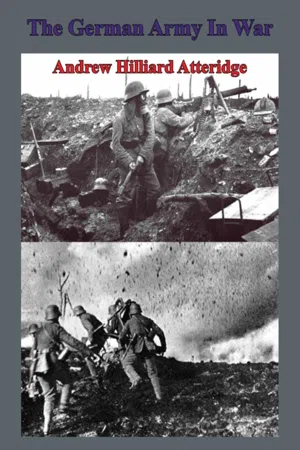
- 81 pages
- English
- ePUB (mobile friendly)
- Available on iOS & Android
eBook - ePub
The German Army In War
About this book
Trusted by 375,005 students
Access to over 1 million titles for a fair monthly price.
Study more efficiently using our study tools.
Information
Subtopic
British HistoryIndex
HistoryTHE GERMAN ARMY IN WAR
CHAPTER I—THE MAKING OF THE GERMAN ARMY—THE “NATION IN ARMS “
ON October 14th, 1806, Napoleon defeated the Prussian army at Jena. Murat’s relentless pursuit to the shores of the Baltic captured or scattered all who had escaped the rout. Nothing was left of the army, which had lived for fifty years on the fame of Frederick the Great, except the garrisons of a few fortresses. In the following winter the defeat of Prussia’s ally, the Czar, at Friedland, completed the humiliation of the House of Hohenzollern. By the Treaty of Tilsit Prussia became a tributary of the French Empire. And with a view to making this subjection permanent an article of the treaty provided that the Prussian standing army should be reduced to 42,000 men.
Thanks, however, to the clear-sighted action of a group of patriotic men this disaster became the starting point of a new epoch of national progress for Prussia. To the reorganisation of the country after Jena must be traced the making of the German army of to-day, and indeed the origin of the military systems of all the great powers of Continental Europe.
The military reorganisation of the kingdom was the work of Scharnhorst and Gneisenau. Scharnhorst, the son of a small farmer, had served in the army of Hanover, then under the British Crown, in the first war of the French Revolution. In 1801, he transferred his services to Prussia, and became Commandant of the Training School for Officers. Taken prisoner after the disaster of Jena, he was exchanged in time to fight in the Battle of Eylau. In 1807, he was put at the head of the Commission for reorganising the army. His colleague, Gneisenau, came from Prussian Saxony. He saw his first war service among the German troops who were employed against the American Colonists, under the English flag. On his return to Europe he joined the Prussian army, and fought with distinction in the campaign of Jena.
Scharnhorst was the author of the plan of reorganisation adopted in 1807. Its central idea was to make the little army of 42,000 men, which Prussia was allowed to keep with the colours, not a standing army in the old sense, but a training school through which a large number of men could be passed, who would then form a reserve that could be called up for service when the day came for a national uprising against the French domination in Germany. Short service was therefore introduced. The plan worked so successfully that in 1813, when Prussia joined the coalition against Napoleon, which ended in his downfall, the army of 42,000 men was at one, expanded to over 120,000 by calling up to the colours old soldiers and a large reserve of trained men formed since 1807.
Scharnhorst died during the War of Liberation (as the Germans call the war of 1813-14). But Gneisenau lived to be the chief director of Prussian strategy in the field during these campaigns, and during that of Waterloo. Blücher commanded; his reputation as an old soldier of Frederick the Great, his personal influence with the army, his untiring energy, made him the actual leader in the field. But Blücher was a soldier of the old school. His fierce hatred of the French inspired him with a kind of furious energy, and made the “drunken old dragoon“ (as Napoleon called him) a dangerous enemy. Gneisenau was the directing mind of the Prussian operations in his capacity of Chief of the Staff to Blücher.
After the downfall of Napoleon, it was Gneisenau who carried on and perpetuated Scharnhorst’s work of reorganisation. A third great soldier, Clausewitz, who had fought in the Prussian and Russian armies in most of the campaigns of the Revolution and the Empire from Valmy to Waterloo, gave the Prussian army, in his writings, a practical theory of war on which it has acted ever since. Clausewitz was one of the first professors of the school of war founded by Scharnhorst in 1810 for the higher training of selected officers, and he was its director from 1818 to 1830. This school, now known as the
Kriegs Akademie (War Academy), is the German Staff College. Its teaching staff is made up not only of soldiers, but also of civilian experts. Thus, for instance, Karl Ritter, one of the founders of modern scientific geography, was a professor of the War Academy for thirty-nine years, and during this time organised the remarkably efficient map department of the General Staff.
The basis of the new army organisation was universal obligation to military service. This does not mean that every man served in the army, but that on reaching the age of twenty every man had to present himself at the recruiting centre of his district, and the army authorities enlisted as many men as were required to make up the annual contingent.
The recruits thus enrolled served for three or four years. They were then passed into the reserve, and were liable to be called up on a declaration of war to bring up the first line of the army to war strength. After completing his reserve service, the Prussian soldier belonged for some years more to a second line army, known as the Landwehr (the “guards of the land“). The Landwehr, though primarily intended for home defence, could be employed for active service beyond the frontier, and were counted upon to form the garrisons and guard the line of communication of the active army.
After being dismissed from the Landwehr, the Prussian soldier passed into the Landsturm (the “rising of the country,” the “levee en masse“). This force was the third line. They could be called to arms for the defence of Prussia in a great emergency, and it was laid down that in this case they would not wear uniforms, but only badges.
For some sixty years, the Prussian army was the only one in Europe organised on the system of short service and large reserves. Every other army was formed of long-service soldiers, and it was the fashion to talk of the Prussian army as a kind of militia, largely composed of half-trained men who could not stand up against professional soldiers.
A second cardinal principle of the new Prussian system was the localisation of the army, and its permanent organisation in territorial army corps. Napoleon had organised the Grand Army in a number of corps, each usually commanded by one of his marshals. But these corps were formed by from time to time assigning a certain number of regiments to one or other of these commands, and the composition of the corps varied in each new war. The Prussian army corps was a little army complete in infantry, cavalry and artillery, recruited and permanently stationed in one or other of the provinces of the kingdom. The localisation was carried even further. Each regiment was raised in, and permanently connected with, a town or a group of villages. The result was that in every battalion and company, in every squadron and battery, the men were neighbours and kinsfolk. It was a kind of adaptation of the old tribal system to modern war, and it had the great advantage that it rendered mobilisation a fairly simple business. The men who were to fight side by side gathered in their village, went into the nearest town, where they found their friends and neighbours beside whom they were to serve, put on once more the uniform of the regiment in which they had received their training, and found themselves under a colonel and a general whom they had often seen at the head of the troops at local reviews and route marches.
The ideal of the whole organisation was that the nation should be ready in the event of war to bring its whole manhood into the field. But during the first half of the nineteenth century this ideal was far from being realised. The armies of all the powers of the Continent were kept at a figure far below that of the later years of the century, and Prussia did not possess the resources or feel the necessity to train any large proportion of the men who were each year liable to service. There was a partial mobilisation of the Prussian army in 1859, during the war between Napoleon III. and Austria. Prince William of Prussia, afterwards the King and the first of the new German Emperors, was then acting as regent of the kingdom on account of the illness of Frederic William IV. He had devoted his whole life to military affairs, and as a young man had fought against Napoleon in the campaign of 1814. He was disappointed at finding that the mobilisation took a considerable time, and did not give the numbers which had been anticipated. The fact was that during long years of peace with small numbers called up each year to the colours, the military system of the country had fallen far below the ideals of its founders.
On January 2nd, 1861, Frederic William died, and the Crown Prince became King of Prussia. He had already formed a scheme for reorganising the army, increasing its effective strength, and making the process of mobilisation more rapid and workmanlike. He meant to make Prussia the leading military power of Germany. In .carrying out this work he was assisted by three remarkable men, Von Bismarck, as head of the Ministry, Von Roon, as Minister of War, and Von Moltke, as Chief of the General Staff. The new army legislation requiring, as it did, heavy financial sacrifices and a great extension of the annual levy of men, excited a strong opposition in the Prussian Parliament. For four years Von Bismarck carried on the Government in defiance of hostile votes, and levied taxes, and called out men for service without Parliamentary warrant. “Your votes of censure are of no effect,” he once said to the Opposition. “You imagine that you are in England and that I am your minister, but you are in Prussia, and I am the minister of the King.”
The reorganisation of the army was carried out on the lines which the King had laid down with the help of Von Roon and Von Moltke. The latter had been Chief of the General Staff since King William became regent in 1858. He had made it a centre of information on which he based plans for mobilisation and concentration in the event of a quarrel with any of Prussia’s neighbours. At the same time he directed the instruction of the officers and the training of the army, and he gathered around him a singularly able group of war leaders, who were thoroughly familiar with his ideas and could be trusted to act on their own initiative in the spirit of the military doctrine he had taught them. The remarkable thing is that except for a brief and disastrous campaign with the Turkish army in Western Asia, he had never taken part in actual operations in the field, but he had made a close study of the great campaign, and under his direction the Prussian army manoeuvres became a real school of war at a time when in other armies such manoeuvres were either nonexistent or were mere theatrical displays.
Prussia was at this time a member of the old German Confederation formed in 1815, and made up of some sixty kingdoms, principalities, grand duchies, duchies and free cities whose common interests were regulated in the annual meeting of the Diet of the Confederation at Frankfurt-on-the-Main. Austria and Prussia had long been rivals for the headship of the confederation, to which Austria belonged in right of its German lands.
Bismarck’s policy was directed to excluding the Austrians from the Confederation and making Prussia the dominant power in a new Germany united under her headship. It was for this the reorganised army was wanted. In the winter of 1863 the Frankfurt Diet asserted the claim of the Confederation to. occupy .the Danish duchies of Schleswig-Holstein and entrusted the execution of this resolution to a contingent to be drawn from the armies of the minor powers. Bismarck over rode the decision, and arranged with Vienna that the occupation of the duchies should be carried out by Austrian and Prussian contingents. On the 1st of February, 1864, the Austrians under Gablenz, and the Prussians under Prince Frederic Charles, crossed the Danish frontier. The Danes were able to make only a hopeless resistance, which came to an end in the early summer. It was the first campaign of the new Prussian army, and the Prussians did most of the fighting, such as it was. But the war was a small affair. The Danes had less than 46,000 men in the field, the Allies 56,000, of whom more than 35,000 were Prussians (about the strength of a single army corps), and very few people realised how efficiently the little army had done its work. Attention was chiefly attracted by the fact that the infantry was armed with a rather clumsy kind of breech-loader adopted in 1855. The Prussian army was then the only one in Europe which possessed such a weapon, and conservative military opinion in other countries set little value on it. It was said that it was too complicated, liable to get out of order, and certain to lead to useless waste of ammunition, which might leave whole battalions without a shot to fire when the crisis of the fight arrived.
This Danish war of 1864 gave Prussia the port of Kiel, and made the future North Sea canal possible. But it was not till two years later that Prussia came into assured possession of these conquests. There was a quarrel with Austria and the South German States as to the division of the spoil. The result was the war of 1856, when for the first time Europe realised that the reorganised Prussian army was a singularly formidable fighting force.
When the challenge was thrown down by Berlin to Vienna the general opinion throughout the neutral countries of Europe was that the war would end in disaster for Prussia, despite the help of Italy as an ally. Austria, after detaching 150,000 men to hold Venetia against the Italians, would be able to put some 300,000 men in line in the north, this army including the Saxon forces which retired across the frontier of Bohemia at the outset of the war. Hanover and the South German States would be able to place another army of 120,000 men in the field. Thus at the outset of the war there would be 420,000 men mobilised by Austria and her German allies against Prussia, who could count on mobilising at the utmost some 350,000 men, and the idea still was widely prevalent that these 350,000 Prussians were little better than a short service militia force who would make but a poor stand against the Austrian armies.
Von Moltke struck swiftly and surely; 50,000 men were detached to deal with the Hanoverians and South Germans. Whatever the result here it would not decisively affect the issue. If the main Austrian army could be beaten the minor states could be subsequently disposed of; 300,000 men were concentrated in three armies on the frontiers of Bohemia, and entered Austrian territory on the convergent lines of advance that brought them into simultaneous action on the battlefield of Sadowa. On July 4th the great battle was fought that fixed the future of Germany and revealed to the world the fighting efficiency of the Prussian army. It was the greatest battle since Leipzig. The numbers engaged were fairly equal, 220,000 Prussians against 215,000 Austrians and Saxons, but in eight hours the Allies were hopelessly beaten. The victory cost the Prussians about 9,000 killed and wounded, that is 4 per cent. of the force engaged, and a trifling loss. The beaten army left more than 23,000 men killed and wounded on the field, and the Prussians made more than 12,000 prisoners and took 187 guns. There was no more serious fighting. In seven weeks from the outbreak of hostilities the war was over. Austria had agreed to withdraw from all interference in German affairs. The old German Confederation disappeared. Prussia annexed Hanover and several of the other northern states that had opposed her, and bound the rest to her policy by the formation of a “North German Confederation.” The southern states were compelled to enter into an offensive and defensive alliance with the new Confederation, and Prussia thus realised her policy of becoming the dominant power of a new Germany.
“Nothing succeeds like success.” The Bismarckian policy now became popular in Prussia, and in the rest of Germany there was a steady growth of the new theory that the future of the country depended on union under the strong headship of the Hohenzollerns linked with the preservation of a certain measure of autonomy for the minor states. The German army organisation was extended throughout the annexed territories and the northern states. In virtue of the alliance treaties, inspecting generals from Berlin introduced reforms in the Prussian direction into the armies of South Germany.
In 1867 France, then under the rule of Napoleon III., was on the verge of a quarrel with Prussia over the question of Luxemburg. The rupture was averted by a conference and an arrangement to dismantle the fortifications and neutralise the little state. But on both sides of the Rhine it was recognised that the conflict between France and the new military power created by Prussia in Germany was only deferred. The war came suddenly in July, 1870. Napoleon III. and his advisers had hoped that the South German States which had fought against Prussia four years before would now revolt against her headship. and that Austria would take the opportunity of avenging Sadowa. But all Germany rallied to the call of the aged Prussian King. The rupture with France was hailed as an occasion for cementing a new German unity. Before the French armies were ready to move the united armies of Prussia and South Germany, 384,000 strong, crossed the frontier in the first week of August. By the first week of September one of the imperial armies of France was blockaded in Metz; the other, with the Emperor at its head, had been forced to surrender at Sedan. Once more Prussia had struck swiftly and surely. In vain the war was prolonged by new levies in France until far into the end of the following winter. Germany poured more than a mil...
Table of contents
- Title page
- TABLE OF CONTENTS
- INTRODUCTION
- CHAPTER I-THE MAKING OF THE GERMAN ARMY-THE “NATION IN ARMS “
- CHAPTER II-DEVELOPMENT OF THE ARMY SYSTEM
- CHAPTER III-ARMY ORGANISATION-THE ARMY CORPS AND THE CAVALRY DIVISION
- CHAPTER IV-PREPARATION FOR WAR-THE WORK OF THE GENERAL STAFF
- CHAPTER V-ACTION ON DECLARATION OF WAR-MOBILISATION AND CONCENTRATION
- CHAPTER VI-HOW THE GERMANS FIGHT-WAR IDEALS AND METHODS OF THE GERMAN ARMY
- CHAPTER VII-GERMANY ON THE DEFENSIVE-THE FORTRESS-SYSTEM OF THE GERMAN EMPIRE
- CHAPTER VIII-THE GERMAN LAW OF WAR
- CHAPTER IX-GERMAN IDEAS ON THE INVASION OF ENGLAND
Frequently asked questions
Yes, you can cancel anytime from the Subscription tab in your account settings on the Perlego website. Your subscription will stay active until the end of your current billing period. Learn how to cancel your subscription
No, books cannot be downloaded as external files, such as PDFs, for use outside of Perlego. However, you can download books within the Perlego app for offline reading on mobile or tablet. Learn how to download books offline
Perlego offers two plans: Essential and Complete
- Essential is ideal for learners and professionals who enjoy exploring a wide range of subjects. Access the Essential Library with 800,000+ trusted titles and best-sellers across business, personal growth, and the humanities. Includes unlimited reading time and Standard Read Aloud voice.
- Complete: Perfect for advanced learners and researchers needing full, unrestricted access. Unlock 1.4M+ books across hundreds of subjects, including academic and specialized titles. The Complete Plan also includes advanced features like Premium Read Aloud and Research Assistant.
We are an online textbook subscription service, where you can get access to an entire online library for less than the price of a single book per month. With over 1 million books across 990+ topics, we’ve got you covered! Learn about our mission
Look out for the read-aloud symbol on your next book to see if you can listen to it. The read-aloud tool reads text aloud for you, highlighting the text as it is being read. You can pause it, speed it up and slow it down. Learn more about Read Aloud
Yes! You can use the Perlego app on both iOS and Android devices to read anytime, anywhere — even offline. Perfect for commutes or when you’re on the go.
Please note we cannot support devices running on iOS 13 and Android 7 or earlier. Learn more about using the app
Please note we cannot support devices running on iOS 13 and Android 7 or earlier. Learn more about using the app
Yes, you can access The German Army In War by Andrew Hillard Atteridge in PDF and/or ePUB format, as well as other popular books in History & British History. We have over one million books available in our catalogue for you to explore.