Lt.-Col. Baker was born into a family with a long history of service to Canada: his father had served in the Provincial Legislature or the Dominion Parliament for over forty years. Colonel Baker, a man of many interests, undertook law at McGill University and was called to the Bar in 1900. After a successful career, which included a stint as a member of Parliament, his military career started in the cavalry gazetted as a provisional lieutenant in the 6th Hussars, and by 1913 he was Lt.-Colonel of the 13th Scottish Light Dragoons. With the gathering of the clouds over Europe, Colonel Baker steeled himself for field service and responded to a toast to his health: "my aim is to win, if possible, the confidence of my men and to leave the rest to circumstance and the turn of events."
His military career was to be of great merit but short in duration, like many of his comrades-in-arms who travelled from the furthest Dominions to Flanders Fields. His story is told in his collection of letters, and a copy of the despatch that memorialises his death; but suffice to say that they are a telling recollection of an upright, honourable soldier, loved by his men, conscientious to his duty, who lay down his life for his country.
Author — Lt. Colonel George Harold Baker M.P. d. 1916
Text taken, whole and complete, from the edition privately published.
Original Page Count – 83
Illustrations — 3 Portraits
- 56 pages
- English
- ePUB (mobile friendly)
- Available on iOS & Android
eBook - ePub
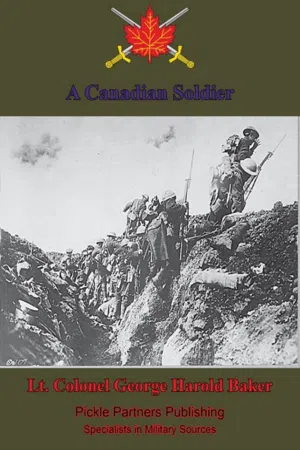
A Canadian Soldier
About this book
Information
Topic
HistoriaSubtopic
Biografías militaresA Canadian Soldier—Introduction
George Harold Baker came of a United Empire Loyalist family, which had already contributed largely to the public life of the Eastern Townships, the Province of Quebec, and the Dominion of Canada. His great-grandfather, Joseph Baker, after the acknowledgement of American independence, left Petersham, Mass., with his young wife (Polly Stevens), and settled in the Township of Dunham, Missisquoi County, in 1793. Joseph Baker’s son, William Baker, represented the County of Missisquoi in the last Parliament of Lower Canada from 1834 to 1837; he married Harriet Clap, of Montgomery, Vt., daughter of Joshua Clap and Nabby Barnard. George Barnard Baker, the third son of William Baker, took his degrees in arts and law at Bishop’s College, which subsequently conferred upon him the honorary degree of D.C.L. In 1860, he established himself in the practice of law at Sweetsburg, and early in a successful professional career, he was made a Q.C., both for the Province and the Dominion. He served either in the Provincial Legislature or the Dominion Parliament almost continuously for forty years; for some years in the seventies he was Solicitor General for the Province; he represented the County of Missisquoi in the House of Commons, 1870-1872, 1878-1887, and 1891-1896; he was called to the Senate in 1896, and was one of its most active members up to his death in 1910.
George Harold Baker’s mother, Jane Percival Cowan, was the daughter of Peter Cowan, who with his brother Andrew was attracted by the natural beauty of the Yamaska valley about the beginning of the Victorian era and settled at Cowansville, to which they gave its name. At the time of his death in 1880, Peter Cowan was Sheriff of the district of Bedford; he came from Scotland as a youth and married Jane Elizabeth Hackett, a charming Irish girl who with her brother had come to Canada not many years before.
George Harold was the only surviving son of George Barnard Baker. He was born at Sweetsburg on November 4th, 1877, and was educated at Bishop’s College School, Lennoxville, Berthier Grammar School, Berthier-en-haut, and McGill University. He graduated as a Bachelor of Civil Law in 1900 and was immediately called to the Bar. He began the practice of law with his father at Sweets-burg, and in 1907 became a member of the firm of Chauvin, Baker, and Walker in Montreal.
At the general election of 1911 he became Conservative member of the House of Commons for the County of Brome, defeating the Minister of Agriculture in the previous administration. He took an active part in political life, and served as Conservative whip for the Province of Quebec.
From boyhood he took a keen interest in military service; he was gazetted Provisional Lieutenant of the 6th Hussars on June 18th, 1903, and on the organization of the 13th Scottish Light Dragoons in the following May he was transferred to that regiment with the rank of Captain; he was gazetted Major in December, 1904, and Lieut.-Colonel of the regiment on September 29th, 1913.
Immediately on the outbreak of the war, he and the officers of his regiment offered their services to the Government, and four months later he was empowered to raise the 5th Canadian Mounted Rifles, the first mounted corps from the Province of Quebec, to the command of which he was appointed in January, 1915. Recruiting began in February, enlistments coming mainly from the Eastern Townships, although men were attracted from Montreal, where Colonel Baker lived and practised his profession, and from other centres. A large number of university students, both from McGill and from Bishop’s College, Lennoxville, joined the regiment, which went into training at Sherbrooke early in the spring. On June 9th, Colonel Baker’s friends of Brome County gave him a farewell dinner at Knowlton. Responding to the toast of his health, he said:
I make no professions as a soldier, I lay claim to no special mission; my aim is to win, if possible, the confidence of my men and to leave the rest to circumstance and the turn of events.
The memory of this gathering will follow me; you have strengthened my hand, and if ever I am in a tight place I shall try to acquit myself as you would have me.
The regiment was moved to Valcartier Camp on June 8th and embarked for England on July 17th, landing at Plymouth on the 29th. The cavalry formation was retained during further training at Shorncliffe Camp and for some time after the crossing to France on October 24th; but Colonel Baker and his men had agreed to respond to the demand for infantry and in January, 1916, a reorganization took place whereby the 1st, 2nd, 4th, and 5th C. M. R. became the 8th Infantry Brigade under Brigadier-General Victor Williams, forming part of the 3rd Canadian Division under General Mercer’s command. Colonel Baker’s experiences during these eventful months were, of course, closely bound up with those of the Regiment (afterwards the Battalion) he commanded and of the Division to which he was attached. His fortunes and those of his men during their period of training at Shorncliffe Camp and on service in France and Belgium are best told in his letters home, from which the following extracts are made, partly for their interest as a contemporary record of the events they narrate, partly for the light they throw on the character and point of view of the writer:
A Canadian Soldier—Letters
I
Shorncliffe Camp Dibgate
August 1st, 1915
I will begin at Devonport. We disembarked in tenders and went up to Plymouth and took train at 11:30 a. m. We arrived here at 8:30 p. m. Look at the map and you will see that we went all across the South of England. The country is beautiful beyond description, the finest thing I have ever seen. The land, of course, is highly cultivated and it looks like a garden—beautiful hillsides, trees, streams and picturesque houses, splendid cattle, horses and sheep. I didn’t see one single poor cow, only two old horses all the day through. Women and wounded soldiers were the only inhabitants; I only saw two men capable of bearing arms. The enthusiasm is wonderful: the women waved madly and threw kisses through-out the route old and young alike. They must have seen scores of like trains that same day, yet the smiles were all fresh and original. At Exeter, where we arrived at 12:30, a committee of ladies served every man with a lunch, water bottle full of tea, orange and package of cigarettes. Our men were very happy and appreciative; I felt it to be a great day and I am sure they did, too. I never enjoyed a day’s travel more. We had the little compartment cars and they afforded amusement to the men; the speed of the train though was quite modern.
This is a fine place with miles of beach. We can see the outline of France; when I tell you that a detachment of the 23rd left here at 8 p. m. and were in the trenches before daylight, you will know we are not far away.
II
Dibgate
August 19th, 1915
The hours are long; first parade 6 a. m. to 6:45; 8:30 to 11:45; 1:30 p. m. to 5 p. m.; lectures in addition. We had one night out with the Regiment and they behaved wonderfully well; the men are splendid. I am getting a good grip of things. I have learned such a lot here and I am learning every day. To-morrow we have a route march—out all day.
We are to retain our cavalry organization and be attached to the Canadian Army Corps. Army Corps troops garrison the city where the Army Headquarters are located and do odd jobs; discipline is very necessary. They never take over sections of trenches; they get fighting when a big show is on, but are brought out immediately afterwards. We shall not be in any division, but kept in reserve under General Alderson and sent wherever needed. There is no news about our going forward, but I should not be surprised if we went to France to complete our training.
III
Caesar’s Camp Folkestone, Kent
October 3rd, 1915
We are settled in our new camp here. Old Caesar’s high hill is at our back and the city is at our feet. It is picturesque.
We have made a great record as a brigade in discipline at the rifle ranges. The best yet, the report says. We have our men well in hand.
I motored to Dover today with the Brigade Major. Just as we arrived a sea-plane was taking off. I wish you could have seen the graceful machine skim along the water like a huge bird and then rise into the air; it is a wonderful machine. You have seen a large waterfowl have some difficulty in leaving the water and finally rise into the air and increase its speed: that is exactly what a sea-plane looks like and does.
I quite often go to Dover and meet the naval officers; they are splendid men and most friendly. Their favourite haunt is at the Grand Hotel. There is a nice room there with a big open fire with a bar and barmaid in one end. They sit there and sip their whiskey and soda—in moderation. The maid is called “Bubbles;” she is pretty, modest, educated and as clever as the very devil. I have very seldom heard such wit: she can always go anybody one better—never coarse, never vulgar, and the men all respect her. It is really a treat to hear her talk. The whole surroundings are such a contrast to the American bar with the beast of a bartender, sawdust on the floor, and the guzzling public. This custom of barmaids is one of the strangest in this country. I don’t see how they get such girls to do the job.
It is now 9:10—bedtime. I shall get up at 5 a. m. to-morrow to take the Regiment to the new Lydden Spout Rifle Ranges; they are nearer here than the Hythe Ranges, where we were before our move. The new ranges are about five miles from here on the high chalk cliffs, half way to Dover—a beautiful view, 480 feet above the sea and it is straight down.
IV
Shorncliffe
October 10th, 1915
The Brigade was inspected today; the General says that it is the best, steadiest and neatest one he has seen. The men are really wonderful, steady as rocks; we could move out tonight within an hour, we are equipped to the last strap; everything is ready.
V
France
October 26th, 1915
“We’re here because we’re here.” Where? Very comfortable in billets—farmhouse, staff together, each squadron in separate places.
The passage across the Channel was not too bad, much worse though than anything I have experienced, but I was not too ill. I will tell you something of where we landed—under canvas for two nights and very cold. The Salvation Army provided most comforts; they were splendid.
On arrival here we saw an air-fight—down came the German plane.
Everybody is happy and well, looking forward to further progress. Things are quiet here, and likely to be. A French farm wagon is just passing. It looks like a ship on wheels—high at the back, curving to nothing just over the front wheels, and the horses are harnessed at the end of a long pole.
Our food is excellent; we are warm and have good sleeping accommodation. In front of the farmhouse are manure pits—within four or five yards from the front door. The Germans were all over this country some time ago. I am just going off now to visit the Squadrons; my horse is at the door. I wish I could write more fully, but I won’t be able to. Everybody is cheerful and confident; we have just received our maps and are locating ourselves.
VI
Under Canvas France,
October 31st, 1915
A week has passed very quickly; we are most comfortable. You no doubt saw my letter telling about crossing the Channel. The first two nights were cold under canvas; since then our quarters have been most comfortable, nine officers in three small rooms with two stoves; the large French windows let in good fresh air. These awful manure pits in front of the houses are unsightly; these people place too much importance on fertilizer.
The weather is wet and the mud deep, but the food is excellent and the men’s spirits high. I censor the letters: one devil said he had been out all night burying the dead! I cut it out.
We were inspected by the General and he was pleased. We move tomorrow—up front; there is no other move in this game. It is a great game, and as we advance it becomes natural and easy. I rode six miles up and back to see where we were to be located; the new accommodations are good, considering. I don’t know how long we shall be there—probably ten days.
Don’t believe that all the organization is on the German side. This is wonderful—everything at hand and no red tape. The class of officers we encounter is splendid; they will do anything for us.
We have a set of dishes—aluminium—which we use. The Sergt.-Cook prepares the meals and Hardy serves them—that is, the meals of the staff. The three squadrons are in different places within a radius of four miles. It is more difficult to handle the force scattered, but everybody is doing his job.
We had a little dinner party last night: the guests were the squadron commanders and two young ordnance officers who have done much for the Regiment’s comfort.
This is not nearly as bad as you think: it is a question of chance and the chances are by no means all against you. I would not have missed this for anything: this is real life.
I have a bed—my sleeping kit on the top of the feathers. The Second in Command is on the floor on my right and the Adjutant on my left, the Medical Officer on the floor at my feet; the Veterinary Officer sleeps in the little office under the desks, the Paymaster, the Signalling Officer and Quartermaster in the dining-room on the floor.
The old woman’s chickens are good; eggs 70 cents a dozen, butter 60 cents a pound, very good. However, the rations are ample and good.
The women here are not beautiful—very like our lower French Canadian types; the beauties must have fled. However, there are other things to occupy our attention. The little donkeys with fuzzy-haired long ears are interesting. I think I shall know how to speak Fr...
Table of contents
- Title page
- TABLE OF CONTENTS
- A Canadian Soldier-Introduction
- A Canadian Soldier-Letters
- I
- II
- III
- IV
- V
- VI
- VII
- VIII
- IX
- X
- XI
- XII
- XIII
- XIV
- XV
- XVI
- XVII
- XVIII
- XIX
- XX
- XXI
- XXII
- XXIII
- XXIV
- XXV
- XXVI
- XXVII
- XXVIII
- XXIX
- XXX
- XXXI
- A Canadian Soldier-Mentioned In Dispatches
Trusted by 375,005 students
Access to over 1.5 million titles for a fair monthly price.
Study more efficiently using our study tools.
Frequently asked questions
Yes, you can cancel anytime from the Subscription tab in your account settings on the Perlego website. Your subscription will stay active until the end of your current billing period. Learn how to cancel your subscription
No, books cannot be downloaded as external files, such as PDFs, for use outside of Perlego. However, you can download books within the Perlego app for offline reading on mobile or tablet. Learn how to download books offline
Perlego offers two plans: Essential and Complete
- Essential is ideal for learners and professionals who enjoy exploring a wide range of subjects. Access the Essential Library with 800,000+ trusted titles and best-sellers across business, personal growth, and the humanities. Includes unlimited reading time and Standard Read Aloud voice.
- Complete: Perfect for advanced learners and researchers needing full, unrestricted access. Unlock 1.5M+ books across hundreds of subjects, including academic and specialized titles. The Complete Plan also includes advanced features like Premium Read Aloud and Research Assistant.
We are an online textbook subscription service, where you can get access to an entire online library for less than the price of a single book per month. With over 1.5 million books across 990+ topics, we’ve got you covered! Learn about our mission
Look out for the read-aloud symbol on your next book to see if you can listen to it. The read-aloud tool reads text aloud for you, highlighting the text as it is being read. You can pause it, speed it up and slow it down. Learn more about Read Aloud
Yes! You can use the Perlego app on both iOS and Android devices to read anytime, anywhere — even offline. Perfect for commutes or when you’re on the go.
Please note we cannot support devices running on iOS 13 and Android 7 or earlier. Learn more about using the app
Please note we cannot support devices running on iOS 13 and Android 7 or earlier. Learn more about using the app
Yes, you can access A Canadian Soldier by Lt. Colonel George Harold Baker M.P. in PDF and/or ePUB format, as well as other popular books in Historia & Biografías militares. We have over 1.5 million books available in our catalogue for you to explore.