This research project studies the employment of airpower by the Fifth Air Force, under Gen George C. Kenney, in the Southwest Pacific Theater during World War II. The research began with two basic assumptions. First, it assumed that the strategic bombardment theory developed by the Air Corps Tactical School in the 1930s was the definitive doctrine of the Air Corps upon entry into World War II. Second, it assumed that General Kenney and his staff were required to develop a new doctrine for airpower employment since the situation in the Southwest Pacific did not lend itself to strategic bombardment of the Japanese industrial web. The research process proved both of these assumptions invalid.
Study of historical records, personal accounts, and subsequent historical writings in several areas revealed that there was no clear and consistent doctrine for the employment of airpower...
General Kenney assumed command of the Fifth Air Force with a clear vision of how to employ air forces to defeat the enemy. His diverse background gave him a balanced view of the roles airpower should play, and he was not convinced by the strategic bombardment theory that claimed invincibility for the bomber. His World War I experiences and teachings at the Air Corps Tactical School provided a strong belief in the importance of air superiority and attack aviation. He was innovative in modifying tactics and equipment, and in developing new roles for airpower as the situation dictated...
This study surveys the development of airpower doctrine beginning with World War followed by major developments during the interwar period in several arenas. It then looks at the varied aspects of Gen George C. Kenney's career which prepared him to command the Fifth Air Force in the Southwest Pacific Theater during World War II. Finally, it considers General Kenney's employment of airpower in light of the pre-war doctrine development.
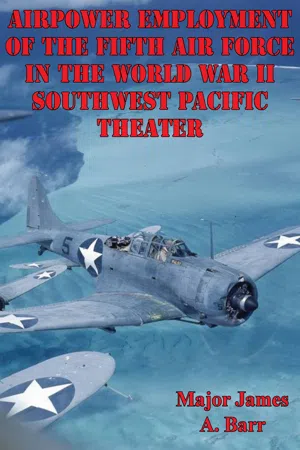
eBook - ePub
Airpower Employment Of The Fifth Air Force In The World War II Southwest Pacific Theater
- 43 pages
- English
- ePUB (mobile friendly)
- Available on iOS & Android
eBook - ePub
Airpower Employment Of The Fifth Air Force In The World War II Southwest Pacific Theater
About this book
Trusted by 375,005 students
Access to over 1.5 million titles for a fair monthly price.
Study more efficiently using our study tools.
Information
Subtopic
European HistoryIndex
HistoryCHAPTER 1 — PRE-WORLD WAR II AIR DOCTRINE DEVELOPMENTS
World War I Developments
When the United States entered World War I, it was ill-prepared to support the war effort with airpower. It had not developed or produced any modern combat aircraft since the war had begun in Europe. Maj Raynal C. Bolling, heading an aeronautical commission, went to Europe to identify aircraft requirements. The report, filed on 15 August 1917, established the doctrinal and force structure basis for building the Air Service. Major Bolling reported that aircraft were required for training, support of ground forces in the field, and an air force component used independently of the ground forces.
General Pershing convened a board in 1919, under Maj Gen Joseph T. Dickman, to provide lessons learned from each branch of the American Expeditionary Forces (AEF). The Dickman Board reported that Air Service AEF had evolved into the four roles of observation, distant reconnaissance and bombing operations, aerial combat, and combat against ground troops. The board stated that air combat against ground troops had not been sufficiently developed, but that it could be made more important than independent distant bombing operations. The air leaders of the time almost unanimously expressed that the Air Service should be subordinate to the ground forces. In his Final Report of the Chief of Air Service A.E.F., Gen Mason M. Patrick claimed that separating air forces from other components of the army would “sacrifice the cohesion and unity of effort which alone distinguishes an army from a mob.” Even the manual of operations that Gen William Mitchell issued in December 1918 as Air Service Commander, US Third Army, visualized aviation in a support role for the infantry rather than as an independent force.{1}
Although air forces were not independent, it is evident that most airpower missions used by Gen George C. Kenney in World War II had been identified in World War I.
Political Post-War Environment
While the Army was trying to incorporate lessons learned from World War I, popular opinion toward the military in the United States following the war was similar to that experienced worldwide. There was strong anti-war sentiment following the years of trench warfare, and the general consensus of the American public was for a return to isolationism. After the crusade was over in 1918, Americans for the most part wanted to return to refuge behind the protection of the Atlantic and Pacific oceans. As a result, research and development were greatly affected, and World War I aircraft technology was state-of-the-art in the United States military into the early 1930s. War Department plans emphasized maintaining a small force with a balance of air and ground forces, depending on a full mobilization if the United States was attacked.{2} The publicly stated policy up to the advent of the United States entry into World War II was one of defense of American continental shores and overseas possessions.{3} Consequently, a study of the development of airpower doctrine and technology must consider this strategic environment, where offensive operations went against national policy.
Limited budgets continued to plague the air forces into the late 1930s. In 1938, when the Air Corps was advocating strategic bombardment and wanted to procure long-range heavy bombers, Gen Malin C. Craig, Chief of Staff of the US Army, directed it to restrict its purchases to light, medium, and attack aircraft types. He reasoned that the funds required to procure 67 B-17s could purchase nearly 300 attack bombers.{4} This order was a product of limited budget, and disagreement between the War Department General Staff and Air Corps leadership as to the primary role of airpower.
The strategic environment and budget limitations changed dramatically on 14 November 1938, when President Roosevelt announced that the airplane, not ground forces, would have the most impact on Hitler’s operations.{5} Roosevelt was keenly mindful of the isolationist attitude following the high casualties of World War I. He hoped that a bombing campaign would keep American casualties low and reduce the cost of ground warfare, helping him to gain support for the war effort.{6} The Air Corps grew substantially after Roosevelt ordered its expansion, but the Office of the Chief of Air Corps (OCAC) did not have a staff ready to determine what the force structure of the growing air forces should be. Gen Henry H. Arnold brought experienced Air Corps officers such as Lt Cols Carl Spaatz, Joseph McNarney, and Ira Eaker, Maj Muir Fairchild, Capt George Kenney, and Capt Larry Kuter, to determine how big of an air force was needed and how it should be used. Brig Gen George C. Marshall was named as Deputy Chief of Staff of the Army and, following President Roosevelt’s lead, helped the Air Corps. He placed the General Headquarters (GHQ) Air Force under the Chief of the Air Corps rather than the Chief of Staff, supported B-17 procurement, and brought Major General Andrews as G-3. Andrews rescinded the restrictions on Army aircraft that prevented them from operating more than 100 miles from the United States coastline.{7}
The overall lack of fiscal support to the military establishment in the interwar period was partially responsible for the inadequate development of aircraft technologies, especially in pursuit aviation design. This deficiency affected how air warriors, such as General Kenney, could employ forces early in World War II.
Air Corps Tactical School
The Air Corps Tactical School (ACTS) was arguably the most active participant in developing doctrine for the use of airpower in the 1920s and 1930s. During the early 1920s the Air Service Tactical School instruction was based primarily on World War I experiences and, therefore, emphasized observation and pursuit aviation in support of ground forces. Throughout the 1920s, most officers in key positions at the school were war veterans, so their combat experiences were a major influence upon the teaching of tactics and techniques.{8} ACTS had influence beyond just the classroom, however. The Air Service Board, redesignated the Air Corps Board in 1926, was established in 1922 to address doctrine and aircraft development issues. The commandant of the tactical school and several of its staff members doubled as members of the Air Corps Board.{9}
Early in the 1920s ACTS closely followed the official policies of both air and ground leaders in Washington that minimized the concept of bombardment which had emerged toward the end of the war. With Mitchell’s encouragement, attack and pursuit aviation were given considerable attention.{10}
ACTS theory began to shift after General Mitchell was forced to resign in 1925. Mitchell, as a civilian, and Giulio Douhet influenced the new theory by teaching more radical ideas of supremacy of a bomber force and mission, believing in bypassing armed forces while sending large air attacks deep into the enemy’s interior. This led many ACTS instructors, headed by Maj Donald Wilson, into endorsing the theory that the bomber was invincible. Superior range and speed of bomber aircraft of the period when compared to pursuit aircraft supported that theory.{11} Unfortunately, ACTS accepted Mitchell and Douhet’s mistake of neglecting the importance of escort a...
Table of contents
- Title page
- ACKNOWLEDGMENTS
- TABLE OF CONTENTS
- ABSTRACT
- CHAPTER 1 - PRE-WORLD WAR II AIR DOCTRINE DEVELOPMENTS
- CHAPTER 2 - GENERAL KENNEY’S QUALIFICATIONS
- CHAPTER 3 - SOUTHWEST PACIFIC THEATER
- CHAPTER 4 - EFFECTIVENESS OF AIRPOWER IN THE SOUTHWEST PACIFIC
- CHAPTER 5 - CONCLUSIONS
- BIBLIOGRAPHY
Frequently asked questions
Yes, you can cancel anytime from the Subscription tab in your account settings on the Perlego website. Your subscription will stay active until the end of your current billing period. Learn how to cancel your subscription
No, books cannot be downloaded as external files, such as PDFs, for use outside of Perlego. However, you can download books within the Perlego app for offline reading on mobile or tablet. Learn how to download books offline
Perlego offers two plans: Essential and Complete
- Essential is ideal for learners and professionals who enjoy exploring a wide range of subjects. Access the Essential Library with 800,000+ trusted titles and best-sellers across business, personal growth, and the humanities. Includes unlimited reading time and Standard Read Aloud voice.
- Complete: Perfect for advanced learners and researchers needing full, unrestricted access. Unlock 1.5M+ books across hundreds of subjects, including academic and specialized titles. The Complete Plan also includes advanced features like Premium Read Aloud and Research Assistant.
We are an online textbook subscription service, where you can get access to an entire online library for less than the price of a single book per month. With over 1.5 million books across 990+ topics, we’ve got you covered! Learn about our mission
Look out for the read-aloud symbol on your next book to see if you can listen to it. The read-aloud tool reads text aloud for you, highlighting the text as it is being read. You can pause it, speed it up and slow it down. Learn more about Read Aloud
Yes! You can use the Perlego app on both iOS and Android devices to read anytime, anywhere — even offline. Perfect for commutes or when you’re on the go.
Please note we cannot support devices running on iOS 13 and Android 7 or earlier. Learn more about using the app
Please note we cannot support devices running on iOS 13 and Android 7 or earlier. Learn more about using the app
Yes, you can access Airpower Employment Of The Fifth Air Force In The World War II Southwest Pacific Theater by Major James A. Barr in PDF and/or ePUB format, as well as other popular books in History & European History. We have over 1.5 million books available in our catalogue for you to explore.