Avid readers of WWII air combat will find the Eighth AAF's strategic bombing mission #84 (the Schweinfurt-Regensburg raid on Aug. 17th, 1943) and mission #115 (the Schweinfurt raid on Oct. 14th, 1943) to be tremendous setbacks to the daylight strategic bombing campaign of Germany. As a result of the heavy losses the Luftwaffe inflicted upon Eighth Bomber Command's heavy bombers, the daylight strategic bombing campaign was halted for over four months. The Eighth AAF could not sustain such heavy losses, in both aircraft and aircrew, and remain an effective force. During the halt in the daylight strategic bombing campaign, only targets within fighter escort range were selected so Eighth Bomber Command could receive replacement crews, upgraded aircraft, revise its strategic bombing tactics, and review its daylight strategic bombing doctrine.
...Initially, the heavy losses incurred during the Aug. Schweinfurt-Regensburg raid were explained away as justified due to the "heavy" damage to both targets, the number of German fighters "shot down," and the weather which prevented 300 heavy bombers from being sent as one force - the number required for self-sustainment on deep penetration missions. This was the same mood immediately after the Oct. Schweinfurt raid but changed drastically once monthly loss statistics were released and further examination forced the USAAF leadership into a rude awakening: unescorted bombers took seven times the loss plus two-and-a-half times the damage and the final assessment revealed Eighth Bomber Command experienced the loss of one-third of its heavy bombers each month...
What were the implications? America's daylight strategic bombing campaign came within limits of defeat but the Eighth AAF was able to pause, adjust its strategic bombing doctrine, and obtain its objective of neutralizing the Luftwaffe and destroying German wartime industry.
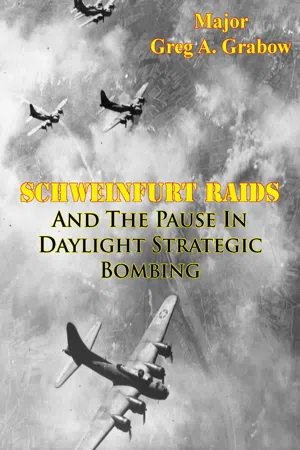
- 80 pages
- English
- ePUB (mobile friendly)
- Available on iOS & Android
eBook - ePub
Schweinfurt Raids And The Pause In Daylight Strategic Bombing
About this book
CHAPTER 1— INTRODUCTION
Background
By the end of summer in 1943, Germany was pushed back on two fronts: the Soviets blunted a massive German armored thrust intended to pinch off the Kursk salient while in the Mediterranean the Allies took Sicily and prepared for an amphibious assault on the Italian mainland. Italy faced unrest as Mussolini’s fascist government barely held on to power and then only with Hitler’s assistance. In the Atlantic, Allied convoy operations were beginning to have an effect on German “wolf pack” tactics while in England the Allies steadily built up troops and logistical support for the expected cross-channel invasion. The initiative was wrestled from the Axis but Germany was far from beaten.
Meanwhile, the Eighth AAF faced criticism at home and abroad for its inaction or slow pace of operations against German industrial targets. Considerable pressure came from top levels for the Eighth AAF Commander, Major General Ira Eaker, to fulfill the POINTBLANK Directive and mount a sustained aerial offense against German industrial targets. The Commanding General of the Army Air Corps, General Henry Harley “Hap” Arnold, and many of the USAAF leadership felt that a successful daylight strategic bombing campaign against Germany would certainly minimize the exposure of Allied ground forces to the Wehrmacht and may even negate the need for a costly cross-channel invasion.{1}
The Casablanca Conference, in early 1943, almost saw the extinction of the Eighth AAF as aircraft and aircrew were nearly allocated elsewhere. Prime Minister Churchill convinced President Roosevelt that, due to the lack of any major combat operations on the part of the Americans, the Eighth AAF would be more useful if integrated into British Bomber Command.{2} Upon hearing this, Eaker immediately flew down to Casablanca and met with Churchill to persuade him into giving the Eighth AAF more time. Though Churchill was not thoroughly convinced that daylight strategic bombing was feasible, he spoke again with Roosevelt and together they decided to grant Eaker more time. Eaker adamantly believed that the daylight strategic bombing campaign was the least costly and most efficient path to destroy the Axis center of gravity, their industrial infrastructure, and bring Germany to her knees. Eaker was thus under tremendous pressure to use the Eighth AAF or watch its resources reassigned elsewhere.
Throughout the summer of 1943, the Eighth AAF was building in strength and waiting for good weather to begin missions.{3}By mid-August, with adequate resources built for a three hundred heavy bomber raid and favorable weather conditions, the Eighth AAF was ready for a deep penetrating strike. The August 17, 1943 Schweinfurt- Regensburg raid was the first time in which a large American heavy bomber force would strike a target, deep in Germany, unescorted as the P-47s at the time did not have sufficient range beyond Eupen, Belgium. Mission #84 became known as the “double strike mission” because it entailed two large heavy bomber forces totaling 376 B-17 Flying Fortresses, which was nearly the entire heavy bomber strength of the Eighth AAF at the time, to attack two separate targets in order to disperse fighter reaction by the Luftwaffe.{4} To confuse German defenders, the original plan called for the Regensburg force to fly through to southern Europe and eventually land in North Africa with the Schweinfurt bomber force returning to their bases in southern England after the target was hit. The Regensburg bomber force spearheaded the assault to fight the way into Germany’s defenses while the trailing Schweinfurt bomber force would fight the way out. The targets selected for this mission were the Messerschmitt works in Regensburg, Germany, and the nearby ball-bearing factories concentrated in Schweinfurt, Germany. The force amassed to attack these targets were 376 B-17s with 268 P-47 sorties and 191 Spitfire sorties flown as escort.{5} The 1st Bombardment Wing, led by Brigadier General Robert Williams, consisted of 230 Flying Fortresses organized into three combat groups to strike the Schweinfurt target. Once the fighter escort turned back the B-17 bombers were savaged by the Luftwaffe, with 60 bombers and 605 crewmen lost (a majority as POWs) plus an additional eleven B-17s damaged beyond economical repair.{6} Though the aerial gunners claimed 288 fighters shot down and escorts claimed a further 32, Luftwaffe records showed only 27 fighters were lost.{7} Despite USAAF attempts to strictly control accounting procedures, as claims were inflated due to the confusion of combat and multiple gunners claiming the same aircraft, the loss ratio was closer to three to one or three bombers lost for every German fighter.
It took nearly two months for the Eighth AAF to recover so it wasn’t until the first week of October the Eighth AAF was ready to once again hit industrial targets inside Germany. In a series of missions, during what became known as the “Black Week,” the Eighth AAF launched over one thousand bomber sorties against industrial targets in the German cities of Marienburg, Gdynia, and Munster with the loss of 88 bombers and almost 900 aircrew.{8}
The second Schweinfurt raid, Mission # 115, took place on October 14th when 291 B-17s from the Eighth AAF repeated the attack on the Schweinfurt ball-bearing factories. Again, once most of the P-47 fighter escorts reached their range limit near the German border and turned back, the Luftwaffe savaged the B-17 formations. The raid ended with the loss of 77 B-17 Flying Fortresses, with 642 crewmen, while German records showed the loss of 32 fighters.{9} Luftwaffe fighter pilots defended Germany with the same tenacity as their British counterparts did three years earlier during the Battle of Britain. Also, since the first Schweinfurt-Regensbug raid, the German homeland defenses were upgraded and better coordinated, with established defense sectors, plus an additional three hundred flak guns positioned near the city of Schweinfurt. A majority of the bombers were lost once the Allied fighter escort turned back at the German border. October 14, 1943, became known as “Black Thursday” due to the losses incurred by the Eighth AAF; this was the costliest single raid in Eighth AAF history and became the last heavy daylight strategic bombing raid into Germany by unescorted bombers.
Strategic bombing mission #84 and mission #115 were tremendous setbacks to the daylight strategic bombing campaign of Germany. As a result of heavy losses the Luftwaffe inflicted upon Eighth Bomber Command, the daylight strategic bombing campaign on Germany was put on hold for over four months as the Eighth AAF could not continue to sustain such heavy losses, in both aircraft and aircrews, and effectively mass to destroy German industrial targets. By autumn of 1943, the Eighth AAF was losing 30% in aircrews each month and this had an effect on morale. Morale plummeted within the Eighth AAF as aircrews calculated the odds to finish the twenty-five mission requirement (needed to rotate home) to be seven percent.{10} During the four month halt in the daylight strategic bombing campaign, the Eighth AAF received replacement aircrews and upgraded aircraft, revised its strategic bombing tactics, and reviewed its daylight strategic bombing doctrine. The culmination of heavy losses incurred by the Eighth AAF during the past three months made it a costly operation to launch heavy daylight strategic bombing raids into Germany by unescorted bombers. What was the USAAF leadership’s reaction to the Schweinfurt raids?
Issue
Up to October 1943, one of the premises the American strategic bombing doctrine rested upon was “a well-planned and well-conducted air bombardment attack, once launched, cannot be stopped.”{11} Both Schweinfurt raids proved that formations of unescorted bombers were no match for German fighters; a huge doctrinal shift in the USAAF’s daylight strategic bombing strategy. The current theory of strategic bombardment was developed from the AWPD-1, which was drafted in 1941, and guided Eighth AAF doctrine into October of 1943. Did this doctrine contribute to the tremendous loss during the 1943 Schweinfurt raids or was a better German plan fought by the Luftwaffe at the operational and tactical levels? To answer this question, the next chapter focuses on the development and events which shaped America’s strategic bombing doctrine up to October 1943. This thesis also looks at the USAAF and RAF coordination for the “round the clock bombing” strategy to see what effect the Schweinfurt raids had on joint operations.
The third chapter will examine the formation of the Eighth AAF from a leadership perspective, explore the budding relationship between the USAAF and the RAF, identify constraints and resource problems for the Eighth AAF, and set the stage for the Schweinfurt raids. This chapter also investigates the operational environment Eaker faced, when he activated and formed the Eighth AAF, and considerations that may have been beyond his control and could have effected his strategic plan.
Fallout
Though many military historians seek to define the lessons learned from the 1943 Schweinfurt raids, many agree it led to the resetting of the daylight strategic bombing doctrine but they rarely discuss the implications. The focus of this thesis is to answer why the Eighth AAF leadership discounted strategic bombing lessons from earlier in the war, why the USAAF leadership was wed to a failed doctrine for so long, how a doctrine change was accepted by the USAAF, and finally identify the implications. Rarely before has such a large organization been withdrawn from combat, without any replacement unit to carry on the fight, reorganize, and sent back to complete the same mission. The fallout from the Eighth AAF strategic bombing pause is debated by military historians so this thesis will help shed light on the four month pause and give a better understanding of events often not covered in the history books.
CHAPTER 2 — USAAF STRATEGIC BOMBING THEORY AND DOCTRINE
The advent of air power, which can go straight to the enemy’s vital centers and entirely neutralize or destroy them, has put a completely new complexion on the older system of war. {12} — Brigadier General William Mitchell, 1926
Birth of the Strategic Bombing Theory
Schweinfurt made the primary USAAF target list and was the target that the 1943 daylight strategic bombing doctrine was designed to neutralize or destroy.{13} Did a faulty strategic bombing doctrine contribute to the tremendous Eighth AAF loss during the fall of 1943 or was a better plan fought by the Luftwaffe at the operational and tactical level? The remainder of this chapter will focus on the development of strategic bombing, the source of the USAAF strategic bombing theory, and outline the USAAF daylight strategic bombing doctrine in the summer of 1943. This chapter also looks at the German plan to counter the USAAF’s penetration into its airspace and provide an analysis of the coordination between the USAAF and RAF for “round the clock bombing.”
Air power advocates, from both sides, saw the excessive 9,000,000 plus casualties in World War I as the end result of static trench warfare and strategic bombing promised to break that stalemate and deliver victory in a shorter time with considerably less casualties. Air power advocates developed a strategic bombing theory that held the enemy’s infrastructure and population as the center of gravity supporting the war effort. The old Clausewitzian wisdom of the defense, as a stronger form of warfare, was focused on the enemy’s army as the center of gravity; this was now replaced by air power which was capable of taking the war directly into the heart of the enemy’s homeland, targeting its cities and population, thus shifting the center of gravity.{14} Air power advocates theorized this new center of gravity could be destroyed by strategic bombing thus negating the need for costly trench warfare. For this purpose, long range bombers could carry out the strategic bombing so out of World War I came the theory of strategic bombing, which was the basis for many nations to build their own air doctrine.
The first strategic bombing mission of World War I occurred when German aircraft dropped five bombs on the Gare L’Est in Paris on August 30, 1914. Within a year, specialized aircraft and dedicated bomber squadrons were in service on both sides. These were generally used for tactical bombing: the aim was that of directly harming enemy troops, strong points, or equipment, usually within a relatively small distance from the front line. Eventually, attention turned to attacking vital rear-area resources. The first- ever dirigible aerial bombardment of a city occurred January 19th, 1915, when two German Zeppelins raided London with the intention of breaking British morale. The German Zeppelin and the later Gotha bomber raids against London caused light damage and relatively few casualties while the British retaliatory raids against Cologne had the same results. But in both cases, defending fighters seemed powerless to stop the attacking bombers due to the difficulty in locating and gaining altitude in time to intercept the bombers. This experience led the British military to accept the findings of the 1921 Field Marshal Jan Christian Smut committee which recommended an air doctrine of counterattack was better than air defense so an independent air arm, the Royal Air Force (RAF), was created with the specific aim of bombing targets in Germany.{15} As chief of the world’s first independent air force, Air Chief Marshall Sir Hugh “Boom” Trenchard organized the RAF from the ground up and established a central flying school to set and maintain standards. Trenchard dominated British air doctrine and believed the RAF must be an offensive force so he backed the development of th...
Table of contents
- Title page
- TABLE OF CONTENTS
- ABSTRACT
- ACKNOWLEDGMENTS
- ACRONYMS
- CHAPTER 1- INTRODUCTION
- CHAPTER 2 - USAAF STRATEGIC BOMBING THEORY AND DOCTRINE
- CHAPTER 3 - FORMATION OF THE EIGHTH AAF
- CHAPTER 4 - THE SCHWEINFURT RAIDS AND THE USAAF LEADERSHIP’S REACTION
- CHAPTER 5 - THE PAUSE IN DAYLIGHT STRATEGIC BOMBING
- CHAPTER 6 - CONCLUSION
- REQUEST FROM THE PUBLISHER
- BIBLIOGRAPHY
Trusted by 375,005 students
Access to over 1.5 million titles for a fair monthly price.
Study more efficiently using our study tools.
Information
Publisher
Lucknow BooksYear
2014Topic
HistorySubtopic
European HistoryeBook ISBN
9781782893882
Index
HistoryFrequently asked questions
Yes, you can cancel anytime from the Subscription tab in your account settings on the Perlego website. Your subscription will stay active until the end of your current billing period. Learn how to cancel your subscription
No, books cannot be downloaded as external files, such as PDFs, for use outside of Perlego. However, you can download books within the Perlego app for offline reading on mobile or tablet. Learn how to download books offline
Perlego offers two plans: Essential and Complete
- Essential is ideal for learners and professionals who enjoy exploring a wide range of subjects. Access the Essential Library with 800,000+ trusted titles and best-sellers across business, personal growth, and the humanities. Includes unlimited reading time and Standard Read Aloud voice.
- Complete: Perfect for advanced learners and researchers needing full, unrestricted access. Unlock 1.5M+ books across hundreds of subjects, including academic and specialized titles. The Complete Plan also includes advanced features like Premium Read Aloud and Research Assistant.
We are an online textbook subscription service, where you can get access to an entire online library for less than the price of a single book per month. With over 1.5 million books across 990+ topics, we’ve got you covered! Learn about our mission
Look out for the read-aloud symbol on your next book to see if you can listen to it. The read-aloud tool reads text aloud for you, highlighting the text as it is being read. You can pause it, speed it up and slow it down. Learn more about Read Aloud
Yes! You can use the Perlego app on both iOS and Android devices to read anytime, anywhere — even offline. Perfect for commutes or when you’re on the go.
Please note we cannot support devices running on iOS 13 and Android 7 or earlier. Learn more about using the app
Please note we cannot support devices running on iOS 13 and Android 7 or earlier. Learn more about using the app
Yes, you can access Schweinfurt Raids And The Pause In Daylight Strategic Bombing by Major Greg A. Grabow in PDF and/or ePUB format, as well as other popular books in History & European History. We have over 1.5 million books available in our catalogue for you to explore.