Since the early stages of World War II, militaries in general, and the U.S. Army in particular, have studied the German way of war, specifically as practiced in the 20th century. While acknowledging that Germany—and before that nation came into existence, Prussia—produced some excellent armies, major problems with the German way of war must not be ignored.
Even the casual observers should have noted that, despite the military prowess of Germany, it lost both of the major wars of the 20th century. This Letort Paper, authored by Dr. Samuel J. Newland, explores the reasons why a nation with such a strong military reputation was unable to win its wars and achieve its goals. He emphasizes that military power, tactical and operational brilliance, and victories in the field can easily be squandered if a nation has failed to set achievable goals and develop strategies to reach them. This failure, which led to Germany's defeat in these wars, should not be lost on modern nations as they proceed into the 21st century.—Douglas C. Lovelace, Jr., Director, Strategic Studies Institute
- 103 pages
- English
- ePUB (mobile friendly)
- Available on iOS & Android
eBook - ePub
Victories Are Not Enough: Limitations Of The German Way Of War
About this book
Information
Subtopic
British HistoryIndex
HistoryCHAPTER 1—IMPERIAL ROOTS OF THE PROBLEMS
“Two great soldiers, Helmuth von Moltke, the Elder, and Alfred von Schlieffen, dominated Prusso-German military thinking from the mid-19th century into the First World War and beyond. They taught and practiced a mode of offensive warfare that adapted to the industrial age Napoleon’s precept to seek prompt decision by battle, and in battle seek to destroy the enemy.”—Gunther E. Rothenberg{12}
The roots of German military greatness and the basis for its failures lie deep in the 19th, rather than the 20th century. When the subject of military failures is discussed, many Germans quickly gravitate to the 20th century and a discussion of Hitler, whose progressive interference in military matters becomes a classic example of how the military was led to failure.{13} Granted, from the earliest stages of World War II, Hitler, with only the perspective of an enlisted soldier, meddled in matters far above his capabilities. Conversely, it is far too easy to blame an obviously evil dictator, a madman, for Germany’s military failures rather than to analyze the root causes of these failures. To blame one man, who’s “Thousand Year Reich” only endured for 13 years, is far too simplistic. To understand the origins of Germany’s military failures, one must first understand at least some rudiments of modern German history and its military and political traditions.
This paper will refer to a “German way of war,” a term that begs definition. The German way of war owes much to Napoleonic warfare. Key elements in Napoleon’s practice of warfare were rapid movement of his forces followed by the concentration of large bodies of troops to seek a quick decision on the battlefield, using tactical and operational excellence to destroy the enemy force. In the last half of the 19th century, German military leaders significantly enhanced Napoleonic offensive warfare. This enhancement consisted of using railroads, telegraph, and repeating rifles—products of the new industrial age—to make this type of warfare more rapid and lethal, more decisive. This German way of war emerged in the 1860s during the Wars of Unification, and would continue to be used until the waning stages of World War II.
Germany, among the major European powers, is a distinctly modern creation. In the immediate post-medieval world when modern nation-states such as Britain and France emerged, Germany was a series of fragmented states that seemed to have little opportunity to unify as a nation-state under a single sovereign. Prior to 1871, some 300 states and fiefdoms existed, ruled by princes and, at best, minor nobility, rather than a nation. Thus, while a people called Germans have existed as an identifiable group for thousands of years, Germany, the nation-state, has existed only for approximately a century-and-a-half, making it a decided newcomer among the modem nation-states. Complicating this problem of multiple political entities, these semi-feudal states also were economically autonomous, thereby restricting, if not stifling, economic intercourse.{14} Since as a unified nation-state it is, in many ways, still in its infancy, Germany’s recent emergence on the world scene may explain some immaturity on the world stage.
Complicating any effort to unify these states, at the beginning of the 19th century two countries vied for the leadership of the German people. The largest and most influential of Europe’s German-speaking countries was the Hapsburg Empire, dominated by Austria. This empire was ruled and administered by a veneer of German officials, but its population included a number of other peoples who conceivably could not claim German origins. Czechs, Slovaks, Slovenes, Poles, and Croats were included in this number, to name only a few. Though it was an essentially polyglot state, the Hapsburg Empire tended to dominate central European politics and, to a large extent, the politics of the German states. In fact, from the 1815 Congress of Vienna, which forged the agreements ending the Napoleonic Wars, until the Revolutions of 1848, its leader’s (Prince Klemens von Metternich) brand of conservative politics dominated Europe.
In the same period, to the north of the Hapsburg domain, the second leading German state and the Hapsburg’s direct competitor was the increasingly influential Prussia. This state was noted for its military prowess rather than its cultural or commercial excellence. The Prussian military had enhanced its reputation in the wars waged by Frederick the Great and most recently in the Napoleonic Wars. In fact, the German army, relying heavily on Prussian traditions, retained this aura of military pre-eminence into the early 20th century. The reader should note, however, that the Prussian army was in many respects a dual-purpose entity. It had, in addition to its role to defend the state, a significant domestic role, i.e., preserving the existing social order and the Hohenzollern-led state.{15} Still, the roots of a unified Germany’s military greatness, and at the same time its failures, emerge in the post-Napoleonic period from Prussia rather than from the Hapsburg Empire.
The movement for a unified Germany emerged in the late Napoleonic era. In the wave of nationalistic feeling that swept Europe in the wake of the Napoleonic wars, German nationalists were significant among the discontented European groups who believed their aspirations had been ignored by the reactionary settlements forged by the Congress of Vienna during 1814-15.{16} While acknowledging their grievances, the many divisive issues that separated the various principalities in the first half of the 19th century were so numerous that Germany seemed more of a dream for dreamers, for visionaries, rather than a realistic possibility.
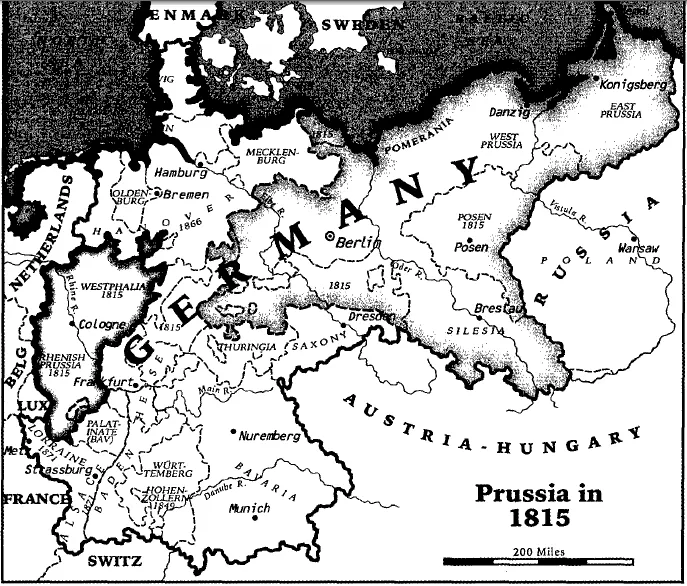
The creation of a modern, unified Germany and the philosophical and experiential basis for the German way of war resulted from a series of wars (1864-71) initiated by Prussia. Unification was not accomplished through a political or diplomatic process.{17} As its critics frequently point out, war forged the German state, rather than a diplomatic or political process.{18} The leading military officer of the Prussian army, Helmuth Von Moltke, justified this approach, widely accepted in Prussia, stating:
“A world historical transformation of German condition, such as that which occurred in 1866, could not have come about by peaceful conventions and decrees. Action was required—pressure on the inside, war on the outside. One of the many German states had to become powerful enough to carry along the rest of them.”{19}
In short, rather than through diplomacy and politics, revolutions and revolutionaries, German unification would have to be forced, not negotiated, and would be led by those more comfortable in uniform, instead of those wearing coat and tails.
Ultimately Prussia, which was actually an on again-off again supporter of German unification, would take the lead in the effort to unify the German states. Understanding Prussia, the core influence on Germany’s political and military traditions from the mid-19th century until 1945, and its role in the unification of Germany is essential to understanding the German way of war. Prussian military thought, particularly in the wake of the Wars of Unification (1864-70) and its military campaigns during the same period, is the foundation of both modern Germany and German military thought.{20}
The largest obstacle to unifying the German states was opposition from neighboring European nations. For various reasons, strong opposition to a unified Germany under Prussian leadership existed. Prussia, after all, was synonymous with militarism as well as autocratic rule. France, already a major power and for several centuries a unified nation, opposed the formation of a strong German nation-state on its eastern flank. France’s mid-19th century emperor, Louis Napoleon, also had hopes of extending his nation’s borders to its “natural” boundary, that is, the Rhine River. That obviously would place a substantial number of Germans under French rule.{21} Such a move placed France in conflict with Prussia, which had expanded westward toward that same river and, by this time, included a province on the west bank, the Rhineland, which was coveted by Louis Napoleon.
Even more serious for German nation-state proponents was the opposition of the Hapsburg Empire. This empire and its dominant German elite strongly opposed the emergence of a German nation-state; that is, one that was led by Prussia and excluded or minimized the participation of the Hapsburgs. Even within German nationalistic circles, there was a sharp divide about what should be included in a unified Germany and who should lead it. This question resulted in a serious rivalry between the two major German states, Prussia and the Hapsburg Empire. With two of the three major continental empires (the other being Russia) in opposition to the formation of a united Germany, establishing a German nation-state, again, was no small task.
An abortive attempt to unify Germany under a constitutional government occurred during the Revolution of 1848, but reactionary forces stopped this.{22} The unification of 1848 was led by liberal political leaders. Since the liberal elements had limited experience with the political process, had limited power, and faced enormous political obstacles, their attempt to create a unified and more democratic state ultimately failed. Given the significant obstacles preventing unification, it was unlikely that it would have been accomplished in a timely fashion using the traditional diplomatic or political processes. In particular, the opposition of the major continental powers, particularly France and the Hapsburg Empire, made a diplomatic solution to this process somewhat dubious. As a further complication, between 1848 and assumption of William I to the throne in 1861, the popular enthusiasm for German unification cooled considerably.
The successful unification, the extension of Prussian power, and many of the elements of the German way of war have their origins in the new Prussian leadership that came to power in 1858. In that year, William I assumed the role of Regent for the Emperor of Prussia.{23} As regent, William ruled Prussia for the physically and mentally ailing Frederick Wilhelm IV. Curiously, upon ascending the throne, William’s primary interest was not focused on the issue of unification. Rather, he was most concerned in reforming and expanding the Prussian Army, a factor that ultimately would be key in the unification process.{24} His interest in the military was likely due to the fact that, despite his political position as King of Prussia, William was, by education and nature, a soldier, a position for which he had been well-trained. Nonetheless, he should not be dismissed as being indifferent or opposed to the unification of the German states. In reality, some of his early comments indicate he recognized that unification was important, and that Prussia would have a leading role in it. As early as 1849, he wrote:
“Whoever wishes to rule Germany must conquer it... That Prussia is destined to lead Germany is shown by our whole history, but it is a matter of when and how.”{25}

The writer is quick to point out that prior to becoming Emperor, William’s proposed “conquest” was through example and strong leadership, not military campaigns. The above-cited quote is significant because it best shows his real interest, the promotion of Prussian power. Prussian strength and leadership would then bring about the unification of Germany and at the same time would enhance Prussia’s power. Whatever the motivation, Prussia had set a clear azimuth; its Emperor intended to lead the Germans, or more clearly dominate the German unification process.
Upon becoming King, William was faced with a significant problem in achieving his primary goal for Prussia, i.e., military reform. To accomplish his plan for expanding and strengthening the Prussian army, he had to contend with dedicated and organized o...
Table of contents
- Title page
- TABLE OF CONTENTS
- STRATEGIC STUDIES INSTITUTE
- ACKNOWLEDGMENTS
- FOREWORD
- SUMMARY
- INTRODUCTION
- CHAPTER 1-IMPERIAL ROOTS OF THE PROBLEMS
- CHAPTER 2-LEADERS IN GERMAN UNIFICATION: FOUNDERS OF TRADITIONS
- CHAPTER 3-A RUDDERLESS SHIP OF STATE: GERMAN SECURITY POLICY AFTER BISMARCK
- CHAPTER 4-THE EDUCATION OF AN OFFICER CORPS
- CHAPTER 5-CHARTING THE COURSE FOR DISASTER
- CHAPTER 6-CONCLUSION
- ABOUT THE AUTHOR
Trusted by 375,005 students
Access to over 1.5 million titles for a fair monthly price.
Study more efficiently using our study tools.
Frequently asked questions
Yes, you can cancel anytime from the Subscription tab in your account settings on the Perlego website. Your subscription will stay active until the end of your current billing period. Learn how to cancel your subscription
No, books cannot be downloaded as external files, such as PDFs, for use outside of Perlego. However, you can download books within the Perlego app for offline reading on mobile or tablet. Learn how to download books offline
Perlego offers two plans: Essential and Complete
- Essential is ideal for learners and professionals who enjoy exploring a wide range of subjects. Access the Essential Library with 800,000+ trusted titles and best-sellers across business, personal growth, and the humanities. Includes unlimited reading time and Standard Read Aloud voice.
- Complete: Perfect for advanced learners and researchers needing full, unrestricted access. Unlock 1.5M+ books across hundreds of subjects, including academic and specialized titles. The Complete Plan also includes advanced features like Premium Read Aloud and Research Assistant.
We are an online textbook subscription service, where you can get access to an entire online library for less than the price of a single book per month. With over 1.5 million books across 990+ topics, we’ve got you covered! Learn about our mission
Look out for the read-aloud symbol on your next book to see if you can listen to it. The read-aloud tool reads text aloud for you, highlighting the text as it is being read. You can pause it, speed it up and slow it down. Learn more about Read Aloud
Yes! You can use the Perlego app on both iOS and Android devices to read anytime, anywhere — even offline. Perfect for commutes or when you’re on the go.
Please note we cannot support devices running on iOS 13 and Android 7 or earlier. Learn more about using the app
Please note we cannot support devices running on iOS 13 and Android 7 or earlier. Learn more about using the app
Yes, you can access Victories Are Not Enough: Limitations Of The German Way Of War by Dr. Samuel J. Newland in PDF and/or ePUB format, as well as other popular books in History & British History. We have over 1.5 million books available in our catalogue for you to explore.