The initial combat experience of the 90th Infantry Division in World War II demonstrates the leadership and training problems faced by many new divisions throughout the war.
Like all newly activated World War II Divisions, the 90th had a turbulent two-year training period fraught with problems of resources and personnel. During the interwar years, the Army's readiness was allowed to stagnate below such an acceptable level that when crisis called there was little to build upon. Consequently, the larger priority of rapidly fielding 90 divisions outweighed considerations for how well those divisions were trained. Thus, the 90th Division was forced into combat by the exigencies of war with many factors working against it: untested officers, unfamiliar doctrine, limited training on advanced combat skills, and the detrimental effects of constant personnel turnover, including commanders.
As the 90th went ashore on Normandy, a period of ineffectiveness ensued as soldiers were forced to learn the lessons of training under fire and unsuccessful leaders were replaced. Furthermore, the 90th Division's period of ineffectiveness seemed extraordinary because it occurred under the spotlight of the Normandy invasion where insufficient planning for the difficulties of hedgerow combat severely slowed the expected pace of advance. Undoubtedly, the performance of the 90th Division's senior leadership was abysmal, but its uncoordinated attacks were the product of training deficiencies experienced by all new divisions. Additionally, critical evaluation reveals the 90th's early contribution much higher than historically credited and far from the total failure some have labeled it.
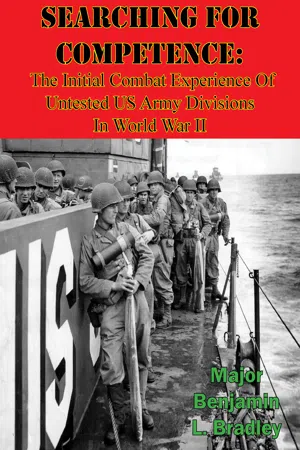
eBook - ePub
Searching For Competence: The Initial Combat Experience Of Untested US Army Divisions In World War II
- 62 pages
- English
- ePUB (mobile friendly)
- Available on iOS & Android
eBook - ePub
Searching For Competence: The Initial Combat Experience Of Untested US Army Divisions In World War II
About this book
Information
Subtopic
European HistoryIndex
HistoryANNOTATED BIBLIOGRAPHY
Primary Sources
By far, the best primary source was Brownlee and Mullen’s oral history interview with General William DePuy. As the first commander of the Army’s Training and Doctrine Command (TRADOC) and the father of the Army’s Air-Land Battle doctrine, DePuy is an authoritative source who provides detailed insight regarding the training and leadership of the 90th Division from activation to 1945. Next, the four rolls of archived microfilm from the Combined Arms Research Library provided the facts as written by the men of the 90th Division as known to them at the time. Unfortunately, the June Operations report was weakly written and vague. Moderately informative, the two volumes of general orders provide information on the rotation of division personnel and training at Camp Barkley; however, it does not cover the Louisiana or California-Arizona maneuvers. Constantine Blastos’ Student Paper from the Command and Staff School provides little useful information. On the contrary, the transcripts of his interviews with General George Barth and Colonel Joseph Rustmeyer are outstanding perspectives from regimental division leader. General Bradley and General Collins autobiographies provide are good sources for the senior leader perspective, but the discussion is limited to a few pages per book. Finally, the oral history interview with General Collins provided little information on the 90th Division other than a statement about his close relationship and respect for the fourth division commander, General Raymond McLain.
90th Infantry Division. Monthly Reports of Operations, June 1944-May 1945. Microfilm nos. M-N-1091-A/B/C, Rolls 1, 2, & 3. Combined Arms Research Library Archives, Fort Leavenworth, Kansas.
General Orders Vol. I & II, 25 March 1942–21 December 1943. Microfilm no. MN-1092-B, Roll 2. Combined Arms Research Library Archives, Fort Leavenworth, Kansas.
Annual Report of The General Service Schools, 1924-1925. Fort Leavenworth, Kansas: The General Service Schools Press, 1925. Combine Arms Research Library Online. URL:<http://www.cgsc.army.mil/carl/download/reports/rep1925.pdf>. Accessed 6 April 2005.
Blastos, Constantine, Major. Unpublished student research paper and associated transcribed interviews for the United States Army Command and General Staff College, 1966. Archive no. N8224.8. Combined Arms Research Library Archives, Leavenworth, Kansas.
Bradley, Omar N. A Soldier’s Story. New York: Henry Holt and Company, 1951.
Brownlee, Romie L. and William J. Mullen III. Changing an Army: An Oral History of General William E. DePuy, USA Retired. Washington, D.C.: GPO, n.d.
Collins, J. Lawton, General (USA). Lightning Joe: An Autobiography. Baton Rouge: Louisiana State University Press, 1979.
Combat Studies Institute. Report No. 5: Conversations with General J. Lawton Collins. Transcribed by Major Gary Wade. Leavenworth, Kansas: U. S. Army Command and General Staff College, 1983.
Unit Histories
By far the most comprehensive unit history is John Colby’s War from the Ground Up. He compiled many first person accounts to tell the soldiers’ story in tactical detail. He also spent considerable time discussing the failure of certain leaders within the division and makes a point to contest General Bradley’s assertion that the division was the worst-trained in the European theater. The Stars and Stripes book appears to primarily be written for public affair purposes as a “feel-good” news story for the American public and division members. It, along with the other five unit histories, contains disparate information about the facts of training and employment without critical...
Table of contents
- Title page
- TABLE OF CONTENTS
- EXECUTIVE SUMMARY
- LIST OF ILLUSTRATIONS
- PREFACE
- PRELUDE TO NORMANDY: RAISING A DIVISION
- THE 90TH’S BAPTISM OF FIRE-JUNE 1944
- DEVASTATING CASUALTIES AND A DISASTROUS COLLAPSE-JULY 1944
- THE 90TH DIVISION IN PERSPECTIVE
- APPENDIX A: 90TH DIVISION CHRONOLOGY, 25 MARCH 1942-30 JULY 1944
- ANNOTATED BIBLIOGRAPHY
Trusted by 375,005 students
Access to over 1.5 million titles for a fair monthly price.
Study more efficiently using our study tools.
Frequently asked questions
Yes, you can cancel anytime from the Subscription tab in your account settings on the Perlego website. Your subscription will stay active until the end of your current billing period. Learn how to cancel your subscription
No, books cannot be downloaded as external files, such as PDFs, for use outside of Perlego. However, you can download books within the Perlego app for offline reading on mobile or tablet. Learn how to download books offline
Perlego offers two plans: Essential and Complete
- Essential is ideal for learners and professionals who enjoy exploring a wide range of subjects. Access the Essential Library with 800,000+ trusted titles and best-sellers across business, personal growth, and the humanities. Includes unlimited reading time and Standard Read Aloud voice.
- Complete: Perfect for advanced learners and researchers needing full, unrestricted access. Unlock 1.5M+ books across hundreds of subjects, including academic and specialized titles. The Complete Plan also includes advanced features like Premium Read Aloud and Research Assistant.
We are an online textbook subscription service, where you can get access to an entire online library for less than the price of a single book per month. With over 1.5 million books across 990+ topics, we’ve got you covered! Learn about our mission
Look out for the read-aloud symbol on your next book to see if you can listen to it. The read-aloud tool reads text aloud for you, highlighting the text as it is being read. You can pause it, speed it up and slow it down. Learn more about Read Aloud
Yes! You can use the Perlego app on both iOS and Android devices to read anytime, anywhere — even offline. Perfect for commutes or when you’re on the go.
Please note we cannot support devices running on iOS 13 and Android 7 or earlier. Learn more about using the app
Please note we cannot support devices running on iOS 13 and Android 7 or earlier. Learn more about using the app
Yes, you can access Searching For Competence: The Initial Combat Experience Of Untested US Army Divisions In World War II by Major Benjamin L. Bradley in PDF and/or ePUB format, as well as other popular books in History & European History. We have over 1.5 million books available in our catalogue for you to explore.