"Before the war, and still more during the conquest of the West, Hitler came to appear a gigantic figure, combining the strategy of a Napoleon with the cunning of a Machiavelli and the fanatical fervour of a Mohomet. After his first check in Russia, his figure began to shrink, and towards the end he was regarded as a blundering amateur in the military field, whose crazy orders and crass ignorance had been the Allies' greatest asset. All the disasters of the German Army were attributed to Hitler; all its successes were credited to the German General Staff." - B. H. Liddell Hart
Liddell Hart goes on to say that while this description of Adolf Hitler may not be entirely true, there is certainly some truth to it. While conducting the research for this project, it became increasing apparent that in the late 1930s Hitler was indeed a successful military leader. The impetus behind this success was partly due to Hitler's political decision making process which, in effect, laid the foundation for World War II. However, as his success continued to mount, he became more and more involved in the intricacies of battlefield tactics and strategy. This is where Hitler's and Germany's eventual downfall for the conquest of Europe began. Upon examining Hitler's strengths, weaknesses, and decision making processes as a military leader one can begin to fully appreciate how the infamous "stop" order at Dunkirk and his "no retreat" policy at Stalingrad are often referred to as Hitler's greatest blunders of World War II.
- 40 pages
- English
- ePUB (mobile friendly)
- Available on iOS & Android
eBook - ePub
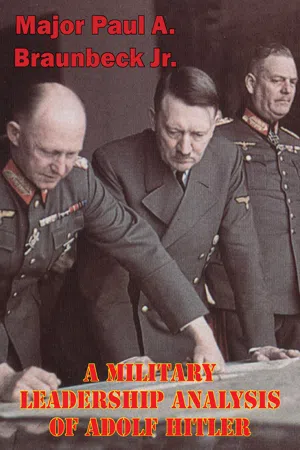
A Military Leadership Analysis Of Adolf Hitler
About this book
Information
Subtopic
European HistoryIndex
HistoryChapter 1 — Hitler’s Political Decision Making Process
Personality and Goals
In order to perform a leadership analysis of Adolf Hitler, one must understand the compelling aspects of his personality. First and foremost, Hitler saw himself as “an agent of Providence, a man of Destiny, whose vision of the future was infallible.”{2} Hitler was convinced beyond any doubt that it was he, and he alone, who possessed the vision, the will power, and the political and military insight to restore Germany to her rightful place among the other nations of the world. This awe-inspiring self-confidence did, however, have its drawbacks as demonstrated by Hitler’s inability to accept criticism from those who may not have agreed with his enlightened opinions, views, or decisions. It was not uncommon for Hitler to break into a violent rage and behave much like a spoiled child who didn’t get his way whenever his judgment was questioned. This type of personality made it extremely hard for Hitler to change his mind once he had reached a decision or to modify the goals he felt destined to achieve.{3}
Hitler’s career was characterized by the awesome power he achieved over the German people and how he was able to use it to attain his political goals. His power over the people was partly due to his extraordinary talent as an orator. “His speeches were an instrument of political intoxication that inspired a degree of fervor in his listeners that seems to defy definition and explanation. Hitler was a master at the use of the spoken word and a genius at the art of manipulating mass propaganda for his political ends. His uncanny ability to appeal to the subconscious and irrational needs of his audience and to solicit the desired response made him a formidable political figure.”{4} Walter Langer best describes what it was like to attend one of Hitler’s inspirational rallies:
“Hitler was a showman with a great sense for the dramatic. Not only did he schedule his speeches late in the evening when his audience would be tired and their resistance lowered through natural causes, but would always send an assistant ahead of time to make a short speech and warm up the audience. Storm troopers always played an important role at these meetings and would line the aisle through which he would pass. At the psychological moment, Hitler would appear in the door at the back of the hall. Then with a small group behind him, he would march through the rows of S.A. men to reach the speaker’s table. He never glanced to the right or to the left as he came down the aisle and became greatly annoyed if anyone tried to accost him or hampered his progress. Whenever possible he would have a band present, and would strike up a lively military march as he came down the aisle.{5}”
It was not uncommon for women to faint or for the crowd’s emotions to range from tears to an overwhelming frenzy to the point they were ready and willing to believe almost anything he told them. Hitler was one of the first politicians to utilize the modern technology of his time such as floodlights, public address systems, radio broadcasts, and air transportation to keep the public constantly aware of his political views. Time and time again, he bombarded the German people with the same underlying message: the crucial moment was at hand for Germany to face her destiny, that her problems were unique, and they required new and demanding solutions, and above all it was he and he alone who could provide Germany with the leadership she needed to achieve her destiny.{6}
Hitler was convinced Germany’s destiny necessitated the need for more living space or lebensraum to the east in order to maintain their living standards and support Germany’s ever increasing population. He believed Germany was no longer capable of providing the food supply necessary to sustain the masses within her own borders and could not afford to purchase what was needed from foreign countries. This would also make Germany dependent on others for survival and, more importantly, vulnerable to starvation in case of war. According to Liddell Hart, German documents reveal that Hitler was visited in November 1937 by Lord Halifax, who held the position of Lord President of the Council and ranked second in the Cabinet to the Prime Minister. During their conversation, Lord Halifax led Hitler to believe that Britain would allow him free hand in Eastern Europe to pursue his desire for lebensraum. “As these documents show, these events precipitated Hitler’s action. He thought that the lights had changed to green, allowing him to proceed eastward. It was a very natural conclusion.”{7} Hitler was convinced that with the controlled will of the people and the “green light” from Britain, nothing could prevent his dream of lebensraum from becoming a reality.
Hitler’s Grand Strategy?
Hitler’s political maneuvers prior to the Second World War highlight the question: Did all of these actions represent a premeditated grand strategy or were they just situations that presented themselves with a low risk of confrontation with other nations? Without a doubt, Hitler wanted to dismantle the Treaty of Versailles. “Every power-seeking politician in the country, including Adolf Hitler, spokesman of the upstart National Socialist German Workers’ (Nazi Party), attacked the treaty.”{8} This platform, combined with Hitler’s almost hypnotic talent as an orator, facilitated his rise to power and control over Germany’s destiny which he felt he, and he alone, should control. H. R. Trevor-Roper best captures Hitler’s belief in himself as the only one with the capability to restore the lost German empire to her greatness when he states:
“Hitler distrusted his successors, as he distrusted his predecessors, who had been too soft. Only he, he believed, ‘the hardest man in centuries’, had the qualities for such a ‘Cyclopean task’: the vision, the will-power, the combination of military and political, political and ‘world-historical’ insight. Therefore the whole programme of conquest, from beginning to end, must be carried through by him, personally. Nor could it be left to his subordinates, his generals. He distrusted his generals too. Like all professional soldiers, they disliked the prospect of great wars. Military parades, quick victories in limited campaigns—these were part of their business; but a major war of revenge against the West, or a major war of conquest against the East, was a prospect that alarmed them. It alarmed them as soldiers; it also alarmed them as conservatives....
Table of contents
- Title page
- TABLE OF CONTENTS
- Preface
- Abstract
- Chapter 1 - Hitler’s Political Decision Making Process
- Chapter 2 - Hitler As A Military Leader
- Chapter 3 - Hitler’s Military “Mistakes”/“Blunders”
- Chapter 4 - Conclusion
- REQUEST FROM THE PUBLISHER
- Bibliography
Trusted by 375,005 students
Access to over 1.5 million titles for a fair monthly price.
Study more efficiently using our study tools.
Frequently asked questions
Yes, you can cancel anytime from the Subscription tab in your account settings on the Perlego website. Your subscription will stay active until the end of your current billing period. Learn how to cancel your subscription
No, books cannot be downloaded as external files, such as PDFs, for use outside of Perlego. However, you can download books within the Perlego app for offline reading on mobile or tablet. Learn how to download books offline
Perlego offers two plans: Essential and Complete
- Essential is ideal for learners and professionals who enjoy exploring a wide range of subjects. Access the Essential Library with 800,000+ trusted titles and best-sellers across business, personal growth, and the humanities. Includes unlimited reading time and Standard Read Aloud voice.
- Complete: Perfect for advanced learners and researchers needing full, unrestricted access. Unlock 1.5M+ books across hundreds of subjects, including academic and specialized titles. The Complete Plan also includes advanced features like Premium Read Aloud and Research Assistant.
We are an online textbook subscription service, where you can get access to an entire online library for less than the price of a single book per month. With over 1.5 million books across 990+ topics, we’ve got you covered! Learn about our mission
Look out for the read-aloud symbol on your next book to see if you can listen to it. The read-aloud tool reads text aloud for you, highlighting the text as it is being read. You can pause it, speed it up and slow it down. Learn more about Read Aloud
Yes! You can use the Perlego app on both iOS and Android devices to read anytime, anywhere — even offline. Perfect for commutes or when you’re on the go.
Please note we cannot support devices running on iOS 13 and Android 7 or earlier. Learn more about using the app
Please note we cannot support devices running on iOS 13 and Android 7 or earlier. Learn more about using the app
Yes, you can access A Military Leadership Analysis Of Adolf Hitler by Major Paul A. Braunbeck Jr. in PDF and/or ePUB format, as well as other popular books in History & European History. We have over 1.5 million books available in our catalogue for you to explore.