Crucial themes and issues explored by a premier missiologist
Johan Herman Bavinck (1895-1964) was a prominent twentieth-century Dutch Calvinist missiologist who wrestled with the tension between religious absolutism and relativism, as many Christians do in today's pluralistic context.
The J. H. Bavinck Reader gathers together a choice selection of Bavinck's significant writings that are essential for understanding his theology of missions, his approach to world religions, and his religious psychology. His treatment of religious consciousness and Christian faith expands on the brief treatment of it in his own work
The Church Between Temple and Mosque. The concluding chapters show how Bavinck's theoretical reflection on religious consciousness was rooted in his close observation during his years as a missionary in Indonesia.
Offering a constructive way forward, Bavinck affirms both the particularity of salvation in Christ and the universality of the Christian hope. A substantial introduction enhances the book with the most thorough biographical sketch of Bavinck available.
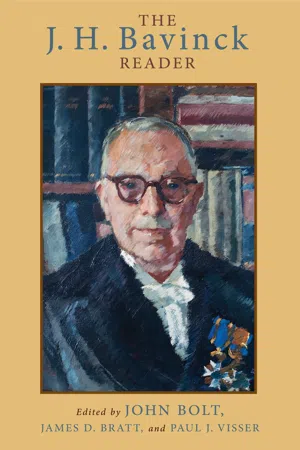
eBook - ePub
The J. H. Bavinck Reader
- 429 pages
- English
- ePUB (mobile friendly)
- Available on iOS & Android
eBook - ePub
The J. H. Bavinck Reader
About this book
Information
Topic
Theology & ReligionSubtopic
Christian DenominationsII.
Religious Consciousness and Christian Faith
3
Defining Religious Consciousness: The Five Magnetic Points
§1. The Real Question
There are good reasons for considering the question addressed here and paying attention to that cluster of problems with which the Western European world has wrestled so intensely in this postwar era. The question has always interested us whether a definite connection exists between a vague, general religious consciousness that pervades human thought and inquiry like a kind of aura on the one hand and the Christian faith that has played such an enormous role in the history of our part of the world on the other. How should we regard these two major forces: religious consciousness and the Christian faith? Are they partners, related in their deepest essence and flowing into and out of one another? Or, are they actually grim antagonists that cannot tolerate one another? That question has definitely acquired new relevance in the contemporary context.
This is prominently connected to the fact that the problem of religion itself has received new attention in recent decades. At one time during the previous century it seemed as though the culture in our part of the world was increasingly distancing itself from religion and turning to what people considered “pure science.” Naturally, in those days there were certainly also religious movements, but it seemed as if the whole direction of cultural development was clearly defined by the tendency to loosen itself from the religious ties of previous generations. Those groups or circles in which strong religious life developed became increasingly isolated and were considered in broader circles as backward and not understanding the heartbeat of history. They were seen as standing on the sidelines, while everything else was moving forward. Not a few were deeply persuaded in those days that the sun of religion was slowly setting and that a new day was dawning, a day in which the old myths and dogmas of religion would no longer be taught, but one when a more discerning and cooler reason would take in hand the reins guiding education. Secularism increased exponentially. In all aspects of life and thought a thoroughgoing worldliness set in. Concepts like “God” and “eternal life” became totally remote. People fixed their attention on what could be seen, on natural laws and mathematical formulas. They concentrated on the persistent abilities of those preoccupied with storming the remaining trenches of the Great Mystery that secularism appeared to have grabbed in its throttling fingers, intent on choking off once and for all everything that passed as religious. “Once one said God when one looked upon distant seas; but now I have taught you to say: overman.”1 This is the way Nietzsche instructed people to understand the course of culture. “Once one said God.” But that “once” seemed to be an unendingly long time ago!
We would be guilty of a fatal illusion if we imagined that the course of our culture since the inception of this century has taken a radical change of direction. The process of the “Entgötterung” of our worldview (emptying it of any sense of God) and of secularizing life is still going on full force. But it can also definitely be said that the question of religion has been taken up by our generation once again and with irresistible force. The dramatic events of recent decades, particularly the two world wars that rapidly followed one another and were accompanied by the countless problems and concerns flowing from them, insofar as they have brought about any change, have caused people today to lose something of their inner certainty. To be sure, they experience the irresistible push toward objectivity and a godless lifestyle that drives our culture, but they are inclined to experience this push as a tragic development that they are incapable of withstanding and of whose force and pain they are fully aware. Here and there is even revealed something of the nostalgia in people’s hearts for the old, tried religious truths that increasingly slip away but that they relinquish with such great difficulty. It is just as though all kinds of sentiments are awakened in them that have a typically religious cast. When they realize that they have been caught up in the great and fatal events of history, they experience this as their struggle with the inevitable, with the fate that mercilessly tosses them on paths that they had no voice in choosing. They experience their humanity as something tragic, mysterious, confining, compelling, liberating, and conflicting. They recognize the problem of solitude versus community as a religious problem, as a tension, as insoluble conflict. In short, they feel that their entire lives in all their relationships and circumstances exist in a thoroughly perplexing reality. Emotions are evoked within them that are laden with religious tensions. Even when they push back against the ideas and religious propositions of previous generations, they press on with a keen and brusque bitterness that resonates with them as religious. In whatever form people identify with modern life — as existentialism, as humanism, as neo-vitalism, as the myth of national socialism, or as communistic faith in the future — they trip over the unique reality of religious sentiment that fills and quivers in all of it. Contemporary people certainly understand that they are pressed forward by a totally factual world, but they no longer experience this as a process in which they are willingly involved because it no longer accords with the sentiments of their hearts; much more, they submit to it as a kind of fate, such as they clearly witnessed in the terrible circumstances of those who have died.
In general, therefore, we can say that religious consciousness has made itself master of our generation. This is a religious consciousness that assuredly is thoroughly vague and lacks concreteness, but one that nevertheless reverts to deep undercurrents of human thought and inquiry. Such religious consciousness now finds itself in juxtaposition with that other reality of the Christian faith. Clearly, the discussion that needs to happen between these two is one of the most remarkable topics of contemporary history. That conversation addresses the many questions with which we need to wrestle in shaping the new culture for which we yearn. In most countries of the world, a new lifestyle is growing, one that is striving for a new ordering of social relationships and new forms of society. That striving is substantially carried by religious sensitivities and intuitions that vaguely arise from the mists of contemporary spiritual life. The discussion being held between these sensitivities and the clear, defined content of the Christian faith is in large measure important for the further development of our civilization. This is why thoughtfully investigating the relationships between these two is of such enormous significance.
§2. What Is Religious Consciousness?
We now face the necessity of giving a further account of what we understand by “religious consciousness.” We have already seen that this religious consciousness is a rather persistent force that can continue operating even after the connection with a given religion has ceased. In our western world there are countless people who no longer call themselves Christian but who are still definitely sustained by that undefined something that we have designated as religious consciousness.2 In the same way, in Asia and other parts of the world there are millions that no longer place any emphasis on the name Muslim or Hindu or Buddhist, but who are similarly not yet free from a vague, indefinite religious consciousness. “Religion, as I saw it practiced and accepted even by thinking minds, whether it was in Hinduism or Islam or Christianity,” said Nehru, the current president of India, “did not attract me.” He certainly believed that something mysterious lies behind our human existence. “What that mysteriousness is I do not know. I do not call it God because God has come to mean much that I do not believe in.”3 Religion as the belief in precise doctrines and propositions has died out, and what has remained is a misty religious awareness. That religious consciousness can at any time take shape in various movements. It can be embodied in existentialism, humanistic activity, socialism, or nationalism; it can color all those movements with a wonderfully bright appeal so that they cease being discerning and factual and exercise a compelling fascination. And while through all of this some sort of religious consciousness remains, it is not yet a religion; it is comparable to the last shimmering of the setting sun which continues for quite awhile, and it still holds its power for a number of generations.
As a rule, we clearly encounter this religious consciousness in the several religions4 that have existed among us for many centuries. The relationship of a vague, nebulous religious consciousness and these concrete religions will occupy our attention later. Here we will only make a few provisional remarks on the subject. It is transparently obvious that religious consciousness burns in these religions with a flame that cannot be doused; this is the fascination that all of these religions have for their adherents.
In all these religions we face the fact that in all of them is found a distinct set of ideas that are regarded as revelation; certain ideas and propositions rise above any discussion since they are considered to have come directly from the gods or from godly ancestors. In the large group of religions that we generally designate as primitive religions, we usually find numerous oral traditions and legacies that hark back to ancestors or that were addressed to divine figures who previously lived on earth. These deities have established the order and laid down the rules by which nature and human life are thought to function; therefore that which is regarded as adat or divine order is worthy of being honored.
In Hinduism, the distinction has been made from ancient times between Shruti — revelation — and Smriti — tradition.5 The Vedas or ancient books of the gods were always regarded as revelation, and as such they were considered to be the norm for life and action. Buddhism recognizes its own canon of sacred writings. The ancient Chinese possessed their books from the great teachers, Kong Fuzi (K’ung Fu-tzu, known in English as “Confucius”) and others; these were revered as revelation. Every Muslim believes in the Qurʾan as the book given by Allah. Thus, each of these religions recognizes a book or a collection of books, sometimes also only a set of oral traditions that are regarded as revelation. The religion is then accountable to that revelation in its totality of convictions, sentiments, morals, and patterns of behavior that are passed down from generation to generation. By the nature of the case, each of these religions is sometimes a very deficient reflection of what is considered to have been revealed. Sometimes the religion as a complex set of religious ideas and practices is much richer than what is prescribed in the book honored as revelation. For example, the massive phenomenon that we identify as Islam is definitely not explainable as being derived directly from the Qurʾan. In the course of the centuries, Islam has absorbed so many religious tendencies from other peoples and made room in its traditions for so many additional ideas and considerations, that it is impossible to explain this religion solely from the Qurʾan. Therefore, a kind of tension always exists between what is regarded as revealed and the realm of religious phenomena requiring accountability.
In fact, what is religion, really? During the last century, we often experienced how totally impossible it is clearly to describe the content of this concept. Religion, said Schleiermacher, is in the deepest sense “a feeling of absolute dependence.”6 But soon it became obvious that this definition was totally unsatisfactory. Religion, said Edward B. Tylor in his pioneering book on Primitive Culture, is “the belief in spiritual beings.”7 But this description could not stand up either, since people discovered that in some religions like Buddhism, for example, this belief is not at all central. Religion, said others, is “the fruit of a sense of the holy,”8 or essentially, “the idea of the Holy.”9 But even this definition seemed too impoverished to explain the confusing complexity of religious phenomena. Time and again, it became apparent that the various religions of the human race are so endlessly diverse, so complex, so rich in ideas and experiences, that it is completely impossible to explain them satisfactorily in just a single word. Now, after many years of work in the science of comparative religions, we realize that we are only at the beginning of a long journey in determining what is most essential about religion.
Meanwhile, one thing is becoming increasingly clear. Despite the variation among the various religions that range widely over what they regard as revelation, they also display unusually remarkable parallels. It appears that humanity always and everywhere has fallen back on definite ideas and presumptions, and that these ideas and presumptions always resurface in surprising ways whenever they may have been temporarily repressed for various reasons. According to Kraemer, something like a “universal religious consciousness in man” still exists.10 This is a universal religious consciousness that remains indestructible in the midst of all disturbing and confusing developments. It is this universal religious consciousness that seems to be the driving force behind all we encounter in the different religions and is what makes the religious issue so intensely interesting as well as difficult.
§3. The Content of Religious Consciousness (a)11 — Experience of Totality
At this point, we must delve more deeply into the content of religious consciousness. We have already observed that it is vague and ephemeral, but that does not detract from the fact that it must be possible to bring its essential elements to the forefront. We will demonstrate that specifically with respect to five elements that are, in our judgment, embedded in this mysterious larger reality. In order to avoid all misunderstanding, we want to make it perfectly clear here that in this investigation we will, for the time being, leave the biblical revelation outside our consideration. We will limit ourselves, therefore, exclusively to the residue of what has grown out of religious sensitivity outside the realm of biblical revelation.
The first of the five we designate as an experience of totality. This experience I can describe no more clearly than by appealing to what was once told me by someone who had made a trip from Japan to Java. He wrote me how one evening he ...
Table of contents
- Title Page
- Copyright Page
- Contents
- Editors’ Preface
- Acknowledgments
- Introduction: The Life and Thought of Johan Herman Bavinck (1895-1964), by Paul J. Visser
- I. God’s Revelation to the Nations
- II. Religious Consciousness and Christian Faith
- III. Christ and Asian Mysticism
- Proper Name Index
- Subject Index
- Scripture Index
Trusted by 375,005 students
Access to over 1.5 million titles for a fair monthly price.
Study more efficiently using our study tools.
Frequently asked questions
Yes, you can cancel anytime from the Subscription tab in your account settings on the Perlego website. Your subscription will stay active until the end of your current billing period. Learn how to cancel your subscription
No, books cannot be downloaded as external files, such as PDFs, for use outside of Perlego. However, you can download books within the Perlego app for offline reading on mobile or tablet. Learn how to download books offline
Perlego offers two plans: Essential and Complete
- Essential is ideal for learners and professionals who enjoy exploring a wide range of subjects. Access the Essential Library with 800,000+ trusted titles and best-sellers across business, personal growth, and the humanities. Includes unlimited reading time and Standard Read Aloud voice.
- Complete: Perfect for advanced learners and researchers needing full, unrestricted access. Unlock 1.5M+ books across hundreds of subjects, including academic and specialized titles. The Complete Plan also includes advanced features like Premium Read Aloud and Research Assistant.
We are an online textbook subscription service, where you can get access to an entire online library for less than the price of a single book per month. With over 1.5 million books across 990+ topics, we’ve got you covered! Learn about our mission
Look out for the read-aloud symbol on your next book to see if you can listen to it. The read-aloud tool reads text aloud for you, highlighting the text as it is being read. You can pause it, speed it up and slow it down. Learn more about Read Aloud
Yes! You can use the Perlego app on both iOS and Android devices to read anytime, anywhere — even offline. Perfect for commutes or when you’re on the go.
Please note we cannot support devices running on iOS 13 and Android 7 or earlier. Learn more about using the app
Please note we cannot support devices running on iOS 13 and Android 7 or earlier. Learn more about using the app
Yes, you can access The J. H. Bavinck Reader by John Bolt, James D. Bratt, Paul J. Visser, John Bolt,James D. Bratt,Paul J. Visser in PDF and/or ePUB format, as well as other popular books in Theology & Religion & Christian Denominations. We have over 1.5 million books available in our catalogue for you to explore.