Many know of the French army that marched under Napoleon's eagles to triumph after triumph before the Emperor's last gamble failed at Waterloo. However, the army that drove the French all the way to Moscow was victorious in many battles in previous wars, and at its heart were the noble officers. The theories and insights of the officer corps shaped the thinking of all of Europe, not least the strategic thinking of Napoleon. Professor Wilkinson charts the advances in tactics and the progression of thought within the military circles of France that would dominate not only the French themselves, but all of their opponents.
Professor Spenser Wilkinson had a long and illustrious career as a military historian including holding the seat of Chichele Professor of Military History of Oxford.
Author — Professor Spenser Wilkinson (1853-1937)
Text taken, whole and complete, from the edition published inOxford, Clarendon press, 1915.
Original Page Count — 151 pages.
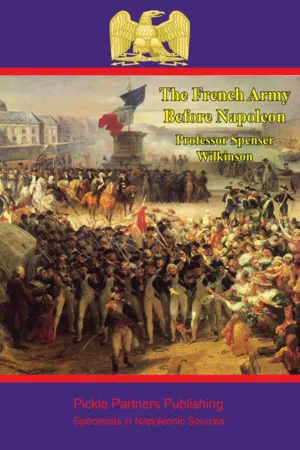
eBook - ePub
The French army before Napoleon
lectures delivered before the University of Oxford in Michaelmas term, 1914
- 94 pages
- English
- ePUB (mobile friendly)
- Available on iOS & Android
eBook - ePub
The French army before Napoleon
lectures delivered before the University of Oxford in Michaelmas term, 1914
About this book
Information
Topic
StoriaSubtopic
Storia britannicaI—THE HISTORY OF THE STUDY OF NAPOLEON
THE story which I shall attempt to tell you this term has no direct relation to the conflict in which the chief nations of Europe are now fighting one another to vindicate their opposite ideals of right, of human life, and of society. It is but a contribution to the attempt to understand the process of war. I have tried to focus into a few brief chapters the light which the inquiries of others have thrown upon the origin of modern generalship and modern armies. It is a fragment of history which at first sight may seem as remote from our present lives as the story of Thermopylae, of Leuctra, or of Cannae. It might perhaps have the attraction of novelty, for the field which it covers has hardly been explored by English writers. The lectures were written substantially in their present form in the spring of this year, when the ordeal into which we are now plunged was little more than the foreboding of a few observers who were but too conscious of their likeness to Cassandra. But if the historian’s work is sincere it may have the quality of truth, which illuminates not only the past but the present and the future. So I have taken courage in this crisis to submit to you the results of my labours in the hope that the picture of the past may illustrate the struggles of to-day, and that while our nation is trying to arm itself we may derive encouragement and instruction from the records of the like effort successfully made in another age by those French neighbours with whose fate the weal and woe of England are now indissolubly associated.
War is an affair of the spirit, of what, in the imperfection of our analysis, we call the intelligence and the will. The first word of the military vocabulary—attention—belongs to the spiritual region. The most fertile source of success or disaster is a spiritual factor, surprise, the contrast between attention and inattention, between a mind alert and a mind in lethargy, between forethought and neglect. Everyone is familiar with the handicap which arises when troops that are led with decision come upon troops unready and a leader without a plan. The workings of surprise are seen on a grander scale when a Government finds itself unexpectedly plunged into a war of which it has not foreseen the conditions, and in regard to which it has failed to make a true estimate of the forces which will confront it and of those with which it can oppose them. This phenomenon was illustrated by the war of the First Coalition against Revolutionary France.
On the 10th of April, 1792, the legislative assembly at Paris gave its vote in favour of a declaration of war against the King of Hungary and Bohemia. The Englishman, Arthur Young, was just then correcting the proofs of his Tour in France. He had spent several years travelling in that country for the purpose of studying French agriculture, and was therefore, perhaps, better acquainted than any other observer with the state of the country and with the temper of its people. Six days after the declaration of war he wrote a postscript to his volume.
‘In the last moment‘, he says, `which the preparation for publication allows me to use, the intelligence is arrived of a declaration of war on the part of France against the House of Austria; the gentlemen in whose company I hear it, all announce the destruction of France—they will be beat;—they want discipline;—they have no subordination;—and this idea I find general. So cautiously as I have avoided prophetic presumption through the preceding pages, I shall scarcely assume it so late in my labours; but this I may venture,—that the expectation of destruction to France has many difficulties to encounter.’
The event was to prove that Arthur Young had seen deeper into the situation than the gentlemen in whose company he heard the declaration of war and even than the Governments which rushed or were hurried into it. After four years’ struggle against Austria, Prussia, and Sardinia, reinforced in the second year by England, Spain, and Holland, France, so far from having been destroyed, had extended her frontier to the left bank of the Rhine and induced Prussia, Spain, and Holland to make peace and acquiesce in her expansion.
The factor which had evaded the observation of the Governments of the Coalition was the real nature of the Revolution. Louis XIV had said, ‘L’ État c’est moi‘ —‘The State—why I am the State‘. Fifty years of reflection and discussion of discontents had given the French people its reply, which was, ‘L’ État c’est nous‘ —’We are the State‘. They had constituted the whole people into the State and given it the name of the nation. Thus reconstituted, France developed an energy which none of her adversaries could rival. But the source of this power was hidden from the statesmen of Austria, Prussia, and Sardinia, brought up as they had been to the very conception which the French had rejected. As soon as the Coalition had become dangerous to France her Government concentrated its powers in the hands of a ‘Committee of Public Safety’ of which the mere name was a sufficient indication that the energy of the whole people would be concentrated on the war.
If the Governments of the Coalition were unable to perceive that the Revolution was a transformation, like that which occurs when the chrysalis breaks and sets free a winged creature, still less could their generals be aware that a similar process had taken place in the French army, in which twenty years of strenuous work and thought had made possible a new organization, a new method of making war, and a new generalship.
This new development was not fully revealed until after the Treaty of Basle of 1795, when the war against Austria and Sardinia was taken over by the Directory. In 1796 both the French and Austrian Governments expected the decision in Germany, where the Directory entrusted its armies to two generals, Moreau and Jourdan, both already distinguished by success. The Austrian Court gave the command to the Archduke Charles, a young prince who had shown capacity for command, and now justified his appointment by defeating his adversaries one after the other. In Italy the outlook for France seemed desperate. The French army of Italy was unshod, clothed in rags, half-starved. It lacked transport; it had no money. Under the stress of privations its discipline was beginning to fail. Its experienced commander, Schérer, though he had won in the autumn the battle of Loano, declared himself helpless unless he could be supplied with reinforcements, provisions, and funds. But the Directory was penniless; it could not create transport out of nothing nor raise troops in a country exhausted by the exactions of the Terror. The Directors risked the hazard of giving the command to the young general, Bonaparte, who had confidence in himself, and had rendered some service in the suppression of a dangerous riot.
Bonaparte reached Nice and took over the command on the 27th of March. He set to work to organize the scanty equipment of the army, and sent on troops from the line of communications to reinforce the divisions at the front. In a fortnight he was ready for the field and made his first move. Five days later he had already four times defeated Austrians. Then he turned upon the Sardinia in another five days were in helpless and hopeless retreat on Turin. A month after his arrival at Nice he sent to the Directory the terms which he had dictated at Cherasco to the King of Sardinia (April 28). Before the approval of the Directory could reach him he had chased the Austrians across Lombardy and completed their expulsion by the battle of Lodi (May 10). A few days only were needed to organize his communications and arrange a new administration of Lombardy. He then set out for a fresh campaign, but was interrupted by a revolt at Milan and Pavia. After five days, however, he was again at the front, and when he attacked the Austrians at Borghetto they retired into the Tyrol. He then arranged the investment of Mantua, and while it was proceeding made an expedition with a small force to Leghorn, exacting a contribution from that city and extorting a truce and 21,000,000 francs from the Pope. On the 3rd of July he was again before Mantua, of which he began to press the siege. The Austrian Emperor had collected a fresh army to relieve Mantua. On the 29th of July it attacked Bonaparte’s troops, still dispersed. Bonaparte raised the siege to turn against this new army, which he defeated at Castiglione on the 5th of August, and by the 12th it was back in the Tyrol. Three fresh Austrian armies one after another attempted to crush Bonaparte and relieve Mantua. They are remembered by their defeats at Bassano, at Arcole, and at Rivoli. The battle of Rivoli was fought on the 14th of January, 1797. On the 2nd of February the garrison of Mantua capitulated; on the 11th Bonaparte was at Ancona, and on the 19th dictated at Tolentino a treaty by which the Pope ceded Avignon, Bologna, and Ferrara, and paid another fifteen millions to the French Government. On the 10th of March Bonaparte set out with his army towards Vienna. The Emperor Francis had recalled the victorious Archduke Charles from Germany to interpose between the French army and his capital. But on the 16th Bonaparte brushed aside the Archduke at the Tagliamento, and continued his advance through Carinthia into Styria. On the 18th of April the Archduke agreed to the preliminaries of Leoben, and the war was over.
If the success of the French in the revolutionary war from 1792 to 1795 had been due to the exertions of a united nation under a determined Government, their success in the Italian campaigns of 1796-7 sprang from a fresh source, the personality of Napoleon and the new generalship of which he alone had the secret.
We may then regard the failure of the old monarchies in their conflict with the Revolution as due to the political surprise arising from their inability to appreciate the force that springs from the national spirit of a people. We may see too in their failure in presence of Napoleon the military surprise arising from inability to appreciate the force that springs from a transformation of the methods of conducting war. Men found it hard to grasp that Napoleon represented a new art of war. It required the startling campaign of Marengo. in 1800, the great disasters of Ulm and Austerlitz in 1805, and the tremendous catastrophe of Jena and Auerstädt in 1806 to make his adversaries realize that their only hope lay in adopting new methods appropriate to the new conditions. The best they could do was to copy Napoleon.
To appreciate a great metamorphosis, political or military, is not the work of a moment and is hardly possible for those outside of it. Napoleon himself was unable to modify the ideas that had lifted him to supremacy. His fall repeats the conditions of his rise, but with the rôles exchanged. He had been created in the effort of a nation in arms against a group of absolute monarchies; he was undone by a group of nations in arms to upset his own absolute monarchy. Here was the political surprise turned against him, for he failed to perceive that while he had been conquering Europe he had also been forcing upon its peoples the very conception of nationhood which had transformed France and given him his opportunity. He was the victim, too, of the military surprise, for though he may have perceived that his victories had compelled his antagonists to transform their methods of conducting war, his own methods remained unchanged. He had inspired no disciples to develop his ideas, and the spirit of initiative had fled. The flexibility and mobility of the army of Boulogne could not be given, on the endless plains of Russia, to the immense army of 1812. The manoeuvre which separated the Austrians and the Sardinians in 1796, when they had no idea of uniting, was frustrated in 1815 by the determination of Wellington and Blücher at all cost to stand together.
After Napoleon was gone men found themselves in a new Europe, and recognized that in the changes which had taken place he had been the principal agent. The experience of his contemporaries, however, supplied them with no standard by which they could measure him; they could see only that he transcended them all. The word ;genius’ served to absolve them from the attempt at explanation, for it suggests an incomprehensible power. Not until after a century of the efforts of historians has it become possible to trace the working of Napoleon’s mind in the conception and execution of his work as a general.
The history of Napoleonic studies, so far as they are concerned with the art of war, falls roughly into three periods, of which the first ends with the publication (1858 to 1869) of Napoleon’s correspondence, and the third begins in 1888.
The first period was dominated by the passions and prejudices that had accompanied the events. The Bonapartists sought to glorify Napoleon; their adversaries to vilify him. Foreigners could write the history of their own armies, but had only limited means of following the history of the French army or the workings of Napoleon’s mind. The chief contributions of this epoch to the appreciation of Napoleon came from two great students of the theory of war, Jomini and Clausewitz. Each of them was under the spell of the conception of genius.
To Jomini Napoleon was the compeer of Caesar, of Hannibal, and of Alexander. To Clausewitz he was ‘the very god of war’. Each of them prepared himself for his theory by writing the history of campaigns both of Napoleon and of his predecessors. But their ways of regarding their subject were different.
Jomini’s object was to find out by comparison between Napoleon’s campaigns and those of Frederick the principles of action which were common to them both and might therefore be of universal validity. He analysed their operations and classified them according to their geometrical form. The base of operations, the direction of an army’s advance and that of its front can each be represented as a line. Jomini examined the relation between these three kinds of lines. The base and the front can both be divided into three parts, a centre and two extremities. Any line of advance must start from one of these three parts or points of the base to reach one of the three points of the enemy’s front. A single line of advance will bring the army either to the enemy’s centre or on to one of his flanks. If the enemy has his forces scattered it will be effective to pierce his front and so to divide his forces; in any other case it is better to strike upon one of his flanks or to pass it and move upon his communications. To advance upon a single line keeps the army united and is better than an advance by two lines, which divides it and exposes it to be beaten in detail.
Jomini’s analysis and classification of operations, in spite of its artificial terminology, was correct and useful. It was the first scientific exposition of strategy as a system of principles, and it has been used by all the subsequent strategical thinkers. Willisen in Germany and Hamley in England are Jomini’s disciples, and the appreciation of Napoleon’s campaigns has been for the most part little more than the application to them of Jomini’s categories. The formal lore of strategy has been advanced but little since Jomini published his Nouveau Précis de l’ Art de la Guerre in 1837.
Accordingly the military literature of the nineteenth century is hardly intelligible without a study of Jomini’s chapter on strategy. But Jomini’s work was not begun until long after 1796. Its terminology and its categories were unknown to General Bonaparte, though its analysis was read with approval and admiration by Napoleon as Emperor. In the attempt to follow the course of Napoleon’s thoughts in his early campaigns it would be an anachronism to bring in the terminology or ideas of Jomini. It is safer to study Napoleon’s own letters and papers.
If Jomini sought for the common element in the generalship of Napoleon and his predecessors, Clausewitz dwelt on the difference between them. Jomini sought for principles as precepts for guidance in action. Clausewitz thought general principles in the shape of precepts or rules of little avail in the presence of the infinite variety of the situations of war.
The question which Clausewitz put to himself was how it came about that Napoleon’s wars were so fundamentally different from most of those which had preceded them. His answer was that the energy with which a war is carried on is a product of two factors, the strength of the motive which actuates the belligerents and the degree to which that motive appeals to the population of the States concerned. The French Revolution had called a nation to arms. France therefore acted with the utmost energy. On the other hand, the cause for which the Governments of the Coalition were fighting was by no means vital to them and scarcely interested their people. The success of France was therefore predetermined. When the French forces came under the control of Napoleon, ‘the very god of war‘, the overthrow of the old monarchies was inevitable. But the pressure of the French Empire upon the populations then aroused such bitter resentment that the nations one after another rushed to arms, and thus the overthrow of Napoleon was as much predetermined as had been his unprecedented conquests.
This portion of the theory of Clausewitz is, however, not derived from the generalship of Napoleon. Its root idea comes from an essay in which Scharnhorst in 1797 reviewed the revolutionary war of 1792-5, in which Napoleon had not yet had a command. Scharnhorst attributed the success of the French to the energy and unity of the French nation, and the failure of the Allies to their discord and their inadequate efforts. The subsequent exertions of Prussia in and after 1813 confirmed Clausewitz in his view of the importance of the distinction between national and dynastic w...
Table of contents
- Title page
- TABLE OF CONTENTS
- DEDICATION
- I-THE HISTORY OF THE STUDY OF NAPOLEON
- III-GUIBERT AND DU TEIL
- IV-A NEW SYSTEM OF WARFARE
- V-REFORMS
- VI-THE OFFICERS AND THE NATION
- VII-REGULARS, VOLUNTEERS, CONSCRIPTS
- APPENDIX-EXTRACTS FROM BOURCET
- NOTE
Trusted by 375,005 students
Access to over 1.5 million titles for a fair monthly price.
Study more efficiently using our study tools.
Frequently asked questions
Yes, you can cancel anytime from the Subscription tab in your account settings on the Perlego website. Your subscription will stay active until the end of your current billing period. Learn how to cancel your subscription
No, books cannot be downloaded as external files, such as PDFs, for use outside of Perlego. However, you can download books within the Perlego app for offline reading on mobile or tablet. Learn how to download books offline
Perlego offers two plans: Essential and Complete
- Essential is ideal for learners and professionals who enjoy exploring a wide range of subjects. Access the Essential Library with 800,000+ trusted titles and best-sellers across business, personal growth, and the humanities. Includes unlimited reading time and Standard Read Aloud voice.
- Complete: Perfect for advanced learners and researchers needing full, unrestricted access. Unlock 1.5M+ books across hundreds of subjects, including academic and specialized titles. The Complete Plan also includes advanced features like Premium Read Aloud and Research Assistant.
We are an online textbook subscription service, where you can get access to an entire online library for less than the price of a single book per month. With over 1.5 million books across 990+ topics, we’ve got you covered! Learn about our mission
Look out for the read-aloud symbol on your next book to see if you can listen to it. The read-aloud tool reads text aloud for you, highlighting the text as it is being read. You can pause it, speed it up and slow it down. Learn more about Read Aloud
Yes! You can use the Perlego app on both iOS and Android devices to read anytime, anywhere — even offline. Perfect for commutes or when you’re on the go.
Please note we cannot support devices running on iOS 13 and Android 7 or earlier. Learn more about using the app
Please note we cannot support devices running on iOS 13 and Android 7 or earlier. Learn more about using the app
Yes, you can access The French army before Napoleon by Professor Spenser Wilkinson in PDF and/or ePUB format, as well as other popular books in Storia & Storia britannica. We have over 1.5 million books available in our catalogue for you to explore.