What could have made the Military Police (MP) and Marine Security Guard (MSG) response more effective, averting negative media coverage and public opinion? The Tet Offensive has been widely acknowledged as the turning point of the United States (U.S.) effort in Vietnam. The Viet Cong and North Vietnamese forces attacked over 100 cities and towns on 31 January 1968, during the Tet holiday. At the epicenter of this cataclysmic event was the attack on the U.S. Embassy. Although this was a platoon level action, the publicity generated would be wildly disproportionate to the value of the Embassy as a military target. Controversy has continued unabated four decades later. The media role in conveying the outcome of the attack is still a subject of debate. The fact that the U.S. forces that successfully defended the Embassy were greatly outnumbered and not organized or equipped as combat troops was not portrayed in media reports.
This thesis first examines the attack on the U.S. Embassy during the Tet Offensive of 1968, and what factors turned a tactical victory into a political defeat. The Marine Security Guards (MSGs) and Military Police (MP) were effective at preventing the enemy from entering and holding the Chancery. The MSGs and MPs at the Embassy achieved a clear tactical victory, yet the action was portrayed as a political defeat. Two sets of factors contributed to this portrayal: the political situation, including shifting public opinion and declining media-military relations; and actions taken by the State Department that directly affected the conduct of the action at the Embassy.
eBook - ePub
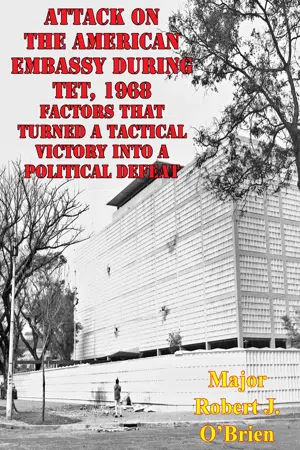
Attack On The American Embassy During Tet, 1968: Factors That Turned A Tactical Victory Into A Political Defeat
- 77 pages
- English
- ePUB (mobile friendly)
- Available on iOS & Android
eBook - ePub
Attack On The American Embassy During Tet, 1968: Factors That Turned A Tactical Victory Into A Political Defeat
About this book
Information
Subtopic
Military & Maritime HistoryIndex
HistoryCHAPTER 1 — INTRODUCTION
On 31 January 1968, the Tet Offensive began, and as historian, Dr. James H. Willbanks, notes it “was the pivotal event of the long Vietnam War.”{1} Retired Ambassador David F. Lambertson, a political officer at the Saigon Embassy echoes this appraisal, stating “it was a shock to American and world opinion. The attack on the Embassy, the single most powerful symbol [of U.S. presence] signaled that something was badly wrong in Vietnam. The Tet Offensive broke the back of American public opinion.”{2}
The forces that responded to the attack on the American Embassy, United States Marine Security Guards (MSGs) and United States Army Military Police (MPs) achieved clear victory over the enemy. Their actions are even more significant due to their role as non-tactical units.
The purpose of this thesis is to explore the factors that set the conditions for the battle and the psychological impact of the Embassy Battle on the American public. The unique confluence of factors originating from the disparate quarters of military, political, allied, enemy, and U.S. media unwittingly synchronized all elements to maximize the psychological impact on the American people. The marines and MSGs could not have done anything to avert negative effect on public opinion, the political defeat. Thus, a tactical victory became a strategic defeat.
The Tet Offensive of 1968 had dramatic repercussions politically and in the court of public opinion. The media centered their focus on the occurrence of the American Embassy battle because they had ready access to the buildings, not because of the military importance of the battle. Media reports inflamed the already shifting American public and world opinion. The strained relationship between military command and reporters resulted in skewed journalism and less-than-honest press releases by the government. The media reports of the embassy battle bombarded the public with images that helped to destroy the credibility of the information reported by government officials, resulting in genuine public outrage. This was perhaps the most decisive point in the Vietnam conflict.{3}
Don Oberdorfer, writing the preface of his updated edition of TET! states, “at the dawn of the twenty-first century it is clear that the Tet Offensive of 1968 was the turning point of the U.S. war in Vietnam, and thus a historic event of lasting importance.”{4}
Perhaps the most significant impact of the Tet Offensive on political and military leaders was the realization that the United States could not solve a political problem solely through the application of military might. The U.S. military could not win the hearts and minds of the South Vietnamese without a legitimate reliable and partner state.{5}
The impact on the American public’s psyche was profound. Author Keith W. Nolan states that “the Tet offensive was the watershed event of the Vietnam War” and that the first day of the offensive was “the day the war was lost in the hearts and minds of the American people.” The public could not reconcile the good news campaign of their leaders with news images of U.S. soldiers “engaged in a full blown firefight with Viet Cong sappers at the United States Embassy Compound in downtown Saigon.”{6}
The events at the embassy during the first hours of the Tet Offensive would receive worldwide attention; since the building symbolized American power and prestige in Vietnam. Perhaps more significantly, the embassy was a place that Americans could relate to, as Don Oberdorfer noted, “the first understandable battle of the war.”{7} Accessibility of the battle to reporters played a key role in the amount of print and television coverage the media gave to the embassy battle. All of the television networks, wire services, and print media maintained offices and residences in downtown Saigon, mere blocks away.{8}
While the Tet Offensive in general and the embassy battle in particular are significant for their military characteristics, more compelling is the psychological effect on the American public and resulting political consequences.{9} Peter Braestrup, a reporter at the time of the attack writes in Big Story that “. . . our very preoccupation with the embassy fight that first morning exaggerated the event’s importance and ‘psychological effect.’”{10} Reporters devoted far less attention to cover more significant battles such as the attack on Ton Son Nhut airport, the Phu Tho Racetrack, or the attack on the South Vietnamese Joint General Staff Headquarters across from Bachelor’s Officer’s Quarters (BOQ) #3. Braestrup goes on to say, “the embassy fight became the whole Tet Offensive on TV and in the newspapers during the offensive’s second day . . . newsmen did not warn their audiences it was . . . only one, inconclusive part of the whole.”{11}
Public Opinion
The Tet Offensive, though it is the one discernible event that has been labeled the “turning point,” occurred after a number of events set the conditions for maximum public impact. Public opinion started to shift in the fall of 1967.{12} This shift occurred following the President’s announcement of a proposed 10 percent surcharge on the tax returns of corporations and individuals.{13}
The Johnson Administration, aware of the crisis of confidence brewing with the American public, engaged in an aggressive public relations campaign designed to bolster support for the war effort. This good news campaign would actually create the conditions for the “shock” experienced by the American public in the aftermath of Tet. The juxtaposition of the administration assertions that the enemy had been dealt a severe blow with the images of destruction in Saigon and Hue were just too much for most people to reconcile.
Alert Issued
Much has been written about the intelligence failure that preceded the Tet offensive. David T. Zabecki writing for the Vietnam Magazine, 40th Anniversary of Tet issue, writes that “even after the first full day of nationwide fighting, the allied command still didn’t have a clear picture of what was happening.”{14} General William E. Westmoreland maintained in a press conference the evening of 31 January 1968, that the attacks on cities were a diversion for the main attack that was still to come at Khe Sanh.{15}
The allies at Khe Sanh were facing massed North Vietnamese Army (NVA) regular troops backed by artillery whereas the cities were attacked by Viet Cong that were relatively lightly armed. The South Vietnamese General Staff, trained by their American counterparts, focused on capabilities when analyzing intelligence, not on the enemy’s intentions or desires. It was abundantly clear to the allies that the enemy could not hold on to the cities even if he managed to take them.{16} The allies accordingly oriented forces to the more pressing military threat.
The press drew a parallel between Khe Sanh and Dien Bien Phu. Although there were many differences, not the least of which was the United States’ ability to supply Khe Sanh via air corridor, the analogy haunted President Johnson; who then insisted that his generals sign a pledge that Khe Sanh would not fall.{17} The President made his conviction clear saying, “I don’t want any damn Dinbinphoo [sic].”{18}
General William E. Westmoreland, Commander of Military Assistance Command Vietnam (MACV), although convinced that the enemy’s main effort was focused on Khe Sanh and the demilitarized zone (DMZ), took steps to protect the capital of Saigon in case of attack. Lieutenant General Frederick C. Weyand, “a former intelligence officer and future Chief of Staff of the Army,”{19} was the Commander of the II Field Forces, in the III Corps Tactical Zone. General Weyand had 39 of 53 combat battalions deployed to the Cambodian border. Alarmed by the intelligence he was receiving he telephoned General Westmoreland on 10 January 1968 and requested permission to redeploy battalions to double the number in the Saigon defensive belt. General Westmoreland made a critical and fortuitous decision by agreeing to General Weyand’s request.{20} This deployment of troops prevented the communist second wave of attack from striking, and ensured the survival of the Military Police (MPs) in Saigon and Air Force Security Police (SPs) at Ton Son Nhut.{21} Since the MPs and SPs were the only American organized resistance at the time, this action quite probably prevented the fall of Saigon.
The Americans had yielded the responsibility for the security of Saigon to the ARVN the previous December. This left only the 1,000 man 716th Military Police (MP) BN, and attached companies, which guarded 130 installations in the city, and provided police patrols, to defend the city proper.{22} Many MPs rode in jeeps armed with M1911A1 pistols and twenty-one rounds. For the increased alert status prior to Tet, all carried M-16 rifles. Their day-to-day duties primarily consisted of traditional military law enforcement and security guard duties at American installations.
General Westmoreland then personally alerted three key officials in Saigon. On 24 January, he briefed Ambassador Ellsworth Bunker about his mounting concerns of an enemy offensive and suggested the cancellation of the planned ceasefire. After consulting with Washington, Bunker and Westmoreland approached Nguyen Van Thieu, the President of South Vietnam with their concerns.
President Thieu agreed to a complete cancellation of the truce in the North (I Corps). He previously agreed to shorten the truce countrywide to 36 hours. However, the announcement that should have come from the government press office did not materialize. The office was closed for the Tet holiday at the time. As Don Oberdorfer in TET! observes, “. . . to the Americans, this was a telling indication of Vietnamese priorities between the holiday and the war, Tet won easily.”{23}
The day after the night attacks on I and II Corps, President Thieu agreed to cancel the truce throughout the country. However, the president did not return to Saigon. It did not seem that the South Vietnamese government made a great effort to recall troops from leave.{24}
General William Westmoreland telephoned Brigadier General Albin F. Irzyk, the Headquarters Area Commander, on the morning of Tuesday, 30 January 1968. General Irzyk had operational control of the 716th Military Police (MP) Battalion (BN); although a Combat Service Support (CSS) element, it was the only unit capable of countering enemy attacks in the city. General Westmoreland stated, “I have strong indications that sappers may be operating in town tonight. Accordingly, I want your command on maximum alert.”{25} General Westmoreland made these notifications personally. He did not delegate the responsibility to a deputy or staff officer. He personally conveyed the alert to Ambassador Ellsworth Bunker, President Nguyen Van Thieu, and to Brigadier General Albin F. Irzyk. Alerts however, were a part of everyday life for soldiers in Vietnam. Most frequently, alerts came and went with no significant activity. Much of the intelligence prior to Tet was believed to be propaganda designed to boost the morale of enemy troops rather than an actual operational plan. One intelligence officer described his disbelief of the intelligence indications of a massive offensive saying, “if we’d gotten the whole battle plan, it wouldn’t have been believed. It wouldn’t have been credible to us.”{26}
An American embassy had not been the target of an organized armed attack by hostile forces since the Chinese Boxer Rebellion of 1900.{27} Captain Robert J. O’Brien (no relation to the author), Officer in Charge (OIC) of the Marine Security Guard Detachment at ...
Table of contents
- Title page
- TABLE OF CONTENTS
- ABSTRACT
- ACKNOWLEDGMENTS
- ACRONYMS
- EXECUTIVE SUMMARY
- CHAPTER 1 - INTRODUCTION
- CHAPTER 2 - BACKGROUND
- CHAPTER 3 - POLITICAL SITUATION
- CHAPTER 4 - THE BATTLE AT THE AMERICAN EMBASSY
- CHAPTER 5 - CONCLUSION AND RELEVANCE TODAY
- ILLUSTRATIONS
- APPENDIX A - TIMELINE
- APPENDIX B. - RANK ABBREVIATIONS CONFORM TO THE SERVICE, ARMY OR MARINE CORPS
- BIBLIOGRAPHY
Trusted by 375,005 students
Access to over 1.5 million titles for a fair monthly price.
Study more efficiently using our study tools.
Frequently asked questions
Yes, you can cancel anytime from the Subscription tab in your account settings on the Perlego website. Your subscription will stay active until the end of your current billing period. Learn how to cancel your subscription
No, books cannot be downloaded as external files, such as PDFs, for use outside of Perlego. However, you can download books within the Perlego app for offline reading on mobile or tablet. Learn how to download books offline
Perlego offers two plans: Essential and Complete
- Essential is ideal for learners and professionals who enjoy exploring a wide range of subjects. Access the Essential Library with 800,000+ trusted titles and best-sellers across business, personal growth, and the humanities. Includes unlimited reading time and Standard Read Aloud voice.
- Complete: Perfect for advanced learners and researchers needing full, unrestricted access. Unlock 1.5M+ books across hundreds of subjects, including academic and specialized titles. The Complete Plan also includes advanced features like Premium Read Aloud and Research Assistant.
We are an online textbook subscription service, where you can get access to an entire online library for less than the price of a single book per month. With over 1.5 million books across 990+ topics, we’ve got you covered! Learn about our mission
Look out for the read-aloud symbol on your next book to see if you can listen to it. The read-aloud tool reads text aloud for you, highlighting the text as it is being read. You can pause it, speed it up and slow it down. Learn more about Read Aloud
Yes! You can use the Perlego app on both iOS and Android devices to read anytime, anywhere — even offline. Perfect for commutes or when you’re on the go.
Please note we cannot support devices running on iOS 13 and Android 7 or earlier. Learn more about using the app
Please note we cannot support devices running on iOS 13 and Android 7 or earlier. Learn more about using the app
Yes, you can access Attack On The American Embassy During Tet, 1968: Factors That Turned A Tactical Victory Into A Political Defeat by Major Robert J. O'Brien in PDF and/or ePUB format, as well as other popular books in History & Military & Maritime History. We have over 1.5 million books available in our catalogue for you to explore.