The War in Burma is all too frequently forgotten as a source of relevant military experience. Admittedly it did not have the strategic importance of other theatres such as the Pacific or North West Europe, but it did witness some of the hardest and most bitter fighting of the War. Because of the nature of the terrain, limited allied resources and the type of dispersed operations conducted by the enemy, Allied forces were forced to adapt a new method of warfighting to counter these difficulties. The aircraft and the radio revolutionised the way that the campaign was to be conducted. It was discovered for the first time that formations could be dispersed across the battlespace and could fight independently of a ground line of communication.
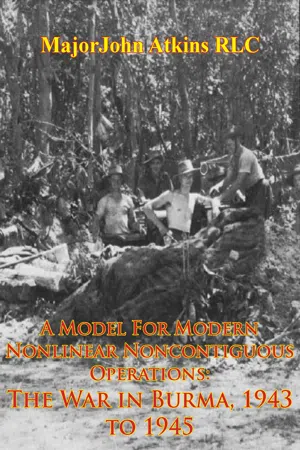
The first formation to prove that this approach was possible was the 77th Brigade, later to earn the title of Chindits and commanded by Brigadier Orde Wingate. Employing Wingate's theories of Long Range Penetration for the first time, the Chindits travelled hundreds of miles behind the enemy's forward positions and attacked his rear areas and lines of communication. Throughout the operation, they received all their supply requirements from transport aircraft and were never in physical contact with friendly forces. The Chindits conducted a truly joint, mobile, nonlinear and noncontiguous operation. Within a year, conventional brigades, divisions and corps of the British Fourteenth Army and the American/Chinese forces in northern Burma were conducting similar operations, this time supported by many more aircraft for both logistic sustainment and fires. Field Marshall William Slim called it a new way of fighting and suggested that four elements contributed to the new concept: joint operations, the use of mission command, the reduction of the logistic footprint of the force to increase tempo, and the conduct of operations by dispersed forces which are tactically independent but focused on operational-level objectives.
eBook - ePub
A Model For Modern Nonlinear Noncontiguous Operations: The War In Burma, 1943 To 1945
- 70 pages
- English
- ePUB (mobile friendly)
- Available on iOS & Android
eBook - ePub
A Model For Modern Nonlinear Noncontiguous Operations: The War In Burma, 1943 To 1945
About this book
Information
Subtopic
European HistoryIndex
HistoryCHAPTER ONE — LIGHT FORMATIONS ON THE DISPERSED BATTLEFIELD: THE LONG RANGE PENETRATION GROUPS, 1943 TO 1944
The operations of the Long Range Penetration Groups in 1943 and 1944 provided an early example of the characteristics of the nonlinear and noncontiguous operations. These formations, raised using guidelines established by the British General Orde Wingate, were seen by many contemporary officers as “unconventional” or guerrilla forces, to be sent on deep raiding missions into the enemy’s rear. That their operations were unconventional is beyond doubt, especially when they are compared with other regular Allied formations operating in the European theatre. General Slim, amongst others, compared them to the cavalry raiders of the American Civil War. Wingate himself may have been inspired by the exploits of Mosby’s or Grierson’s raiders. He had already conducted counter-terrorist operations in pre-War Palestine, and large-scale guerrilla-type operations in Ethiopia before he was sent to Burma in 1942. But to suggest that the Long Range Penetration Groups conducted guerrilla operations is too simplistic a view of their operations. The term “Long Range Penetration” might also suggest that their activities were simply “Deep” operations and that they would therefore fit into the “linear, contiguous” spatial model described in chapter 4 of FM 3-0.{17} Although formation boundary lines were drawn on the map of Burma the formations did not operate contiguously. They were spread over a 700-mile arc form the coast of Burma to the border with China. Within the LRPGs themselves there were a number of noncontiguous “columns” and formations (companies, battalions and brigades) operating independently of one another against separate objectives, or decisive points, but with a common purpose. The framework for studying the LRPG’s operations is based on Slim’s description of the “new kind of warfare” but using the terminology of FM 3-0: the application of Joint Operations, the use of “mission command” and extension of tactical freedom to subordinate commanders, dispersed but operationally coordinated tactical operations without mutually protected flanks (and the problems associated it with it such as the maintenance of morale) and the reduction of the “logistic footprint” to enhance mobility and manoeuvre. Any study of the LRPGs will necessarily require a brief examination of the military experience of their creator, Major General Orde Wingate, and a little background on the situation in Burma in 1943 and 1944.
Orde Wingate (1903 to 1944) had already become somewhat of a military celebrity in Britain prior to 1943. He had a leading role in liberating Ethiopia from the Italians in 1941. He had raised and trained a force of Ethiopian patriots and lead them in a campaign against Italy’s colonial forces. What Wingate had in mind in Burma was, according to Bierman and Smith, “something more akin to the cavalry raids of the American Civil War whereby regular troops penetrated enemy territory to wreak havoc behind his lines.”{18} Bernard Fergusson{19}, who was a member of the Joint Planning Team in Delhi, met Wingate prior to the acceptance of Wingate’s initial plan. Fergusson was later to command a column during the first “Chindit” expedition and a brigade in the second. He explained in his memoirs the basis of Wingate’s theory: the enemy’s vulnerable rear areas were to be attacked by groups of conventional light forces. The groups would disperse in order to bypass the enemy’s strengths (his manoeuvre units). Reconnaissance would be conducted, usually in conjunction with locally raised forces, to precisely locate the target. The force would then concentrate to attack the enemy’s weaknesses, his lines of communication, command and control centres and supply bases. If these small groups met larger enemy formations they would disperse again rather than attempt to fight. The small groups would then withdraw into complex jungle terrain to avoid discovery and to reconstitute. Most importantly the dispersed groups would be supplied by air, therefore removing their vulnerable ground LOCs and allowing them to move independently of the road network.{20} It is interesting that this theoretical approach to conventional nonlinear operations was “rediscovered” in 1991, although not as a result of studying operations in Burma. During the development of the doctrinal concept of AirLand Battle Future, US Army Training and Doctrine Command (TRADOC) conducted a wargaming process that produced a “Battlefield Cycle” of 5 stages: Disperse, Mass, Fight, Re-disperse, Reconstitute.{21} This cycle is almost identical to the Chindit approach to operations.
Ideally, the operations of the LRPGs should be coordinated with a “main force”. Mike Calvert, one of Wingate’s column commanders in the first expedition, provides a vivid “bicycle wheel” analogy of the LRPG’s operational concept:
We were a well-balanced fighting force...going to the hub of the situation in order that we might cut some of the spokes. Then with pressure on the rim, the whole structure might break down. Thus [the LRPG] in itself was only part of the grander design.{22}
Wingate had already begun writing about his ideas on the theory of long-range penetration and submitted two papers to GHQ India in 1942. Ultimately Wingate was able to persuade the C-in-C India (General Wavell) to provide him with resources for this type of operation.{23} This first expedition, consisting of 3000 British, Gurkha and Burmese troops, and 1000 animals, penetrated Burma on foot in February 1943. The operation, codenamed LONGCLOTH, was broken down into separate company and battalion-sized “columns” that manoeuvred independently of one another. Wingate established the Joint nature of the operation from the outset. Air support was vital and was to be provided by the Royal Air Force (RAF). To provide the essential link with the Air HQ in India for resupply and close air support, Wingate had insisted on taking RAF officers and signallers who had knowledge of such missions and of ground-to-air communications. He wanted the RAF air-ground liaison teams to be seconded to him early so that they could be incorporated in the training programme.{24}
The force withdrew after four months, again on foot, for the loss of approximately one third of its strength. “Withdrew” is perhaps a little generous; the columns were actually ordered to disperse by Wingate, under pressure from the enemy, and made their own way back to India. The material effects of the operation appeared to be limited; a few bridges destroyed, railway lines damaged and a number of Japanese killed. Many of the survivors were physically and mentally exhausted from operating for such a long period geographically separated from the main body of the Army. Many had contracted infections from which they would take months to recover. Wingate, however, made a favourable report on the expedition, concluding that a new force should be raised.{25} The new C-in-C India who received Wingate’s report was General Auchinlek.{26} The report that he submitted was also reasonably favourable, but it was written after Wingate’s report had been distributed.{27} Auchinlek warned that the LRPs should only be used to support the main effort, and that the commander of the force should be working towards achieving the strategic aim of the entire force. He did suggest, however, that the effect on the morale of the rest of the force in Burma and India was extremely positive. Most importantly, as far as the “theory” was concerned, it had effectively been proven that ground forces could operate independently within the enemy’s rear areas, using radio to communicate with the rear HQ and between the columns and supplied and supported by airpower. It had been vitally important to receive support early from the RAF, both in the form of the air-ground liaison teams and the aircraft necessary to conduct the training.{28}
Winston Churchill also saw Wingate’s report and its impact on him was profound. Churchill understood that he finally had a British success story in the Far East to show off to the Americans. It went some way to prove that the British were taking serious offensive action in that theatre in an effort to reopen the Burma Road and take the pressure off the Americans in the Pacific. After reading Wingate’s recommendations, he planned to take him along to the next inter-Allied conference,{29} in a bid to gain American assistance for mounting the next expedition.
The Americans offered whole-hearted moral and generous physical support to Wingate’s enterprise. It was clear to the Americans that the first Chindit expedition had lacked substantial air support. General Henry ‘Hap’ Arnold ordered that an “Air Commando” was to be formed specifically to support Wingate’s “Special Force”. It would contain transport aircraft for the necessary lift of men and supplies; it would also have bombers and fighters to provide offensive support and light aircraft for use in liaison, reconnaissance and the evacuation of casualties.{30} This blatantly went against the US Air Force’s principle of Centralised Control. Patrick O’Brien, an Australian RAF officer attached to Special Force, described this dedicated air support as “unprecedented”. Not even American units received such support. In addition to this dedicated American support, the force could also “occasionally” count on, “All the resources of the US and British Air Forces in India. To supply whole armies in this munificent scale would have taxed even the immense resources of the United States.”{31} In the following year, Allied forces would successfully supply entire armies as they advanced further into Burma.
The Air Commando did not fit easily into the Allied Joint command structure. Both General Arnold and General Marshall (US Army Chief of Staff) had written to Mountbatten insisting that the Air Commando should report directly to General Arnold and not through the Theatre chain of command.{32} The Air Commando was not to come under the command of Special Force, but was dedicated to it. There were two plausible reasons for this unorthodox command situation; the first was so that the Air Commando could be protected as a single entity and not broken up and reallocated for other tasks. It should be remembered that there were fewer air assets in Burma than were available to commanders in other theatres. Secondly, this command structure would ensure that Special Force received support where and whenever it was needed. The command structure was made to work, partly because of the personalities of the commanders of the Air Commando and Special Force (Colonel Cochrane and Major General Wingate respectively). Fortunately for Special Force, the Air Commando came under the protection of, but did not receive interference from, General Arnold.
Ironically, it was while travelling on one of the American aircraft, that Wingate met his death. Wingate had been conducting liaison visits to his brigades some six weeks into Operation THURSDAY. The B-25 on which he was travelling was caught in one of the violent and unpredictable storms that occur over the jungles of Burma. The pilot lost control of the aircraft and it crashed into a jungle hillside. Brigadier Lentaigne, one of the subordinate Brigade commanders, was appointed by Slim to take over command of Special Force.
It is not clear if there was a “Joint doctrine” for the employment of the Air Commando alongside Special Force. Wingate certainly wished this to be the case, and had stated as much in his report after the first Chindit expedition.{33} The command structure was also made to work because of the close ties, understanding and high degree of trust that developed between the airmen and soldiers of the two organisations. This trust was developed because the British soldiers and American aircrew trained together. In the types of operations that are envisaged in the immediate future, where rapid deployments by Interim Brigade Combat Teams are deemed necessary within 96 hours, there may not be time to develop such a degree of trust unless units have already conducted Joint training. Doctrine, training and command relationships, if not coordinated in advance, will potentially lead to problems of poor integration at the tactical and operational levels. If the ground forces are to rely on the air forces for their tactical and operational lift and for subsequent logistic and close air support, there must be continuous joint training and integration.
In his memoirs, Brigadier Mike Calvert reiterated the importance of airpower to the ground troops. Calvert stated that, “above all we placed our reliance on air.”{34} Airpower was not only important for supply, casualty evacuation (which will be examined below) and manoeuvre but also for offensive air support to the troops on the ground. Close Air Support (CAS) was practised extensively during the Joint training of the Chindits and Air Commandos. The pilots flying CAS sorties could drop HE within 100 to 300 yards of friendly troops.{35} It is not surprising that Calvert is so “air-minded” in his approach to operations.{36} His own brigade was inserted by air into Burma and so avoided the long, debilitating march-in that the first Chindit expedition had to endure. Air supremacy was therefore vital to the LRPG’s operations. The Japanese in Burma from 1943 onwards had vastly inferior air forces when compared to the Allies, both in terms of quantity and quality of aircraft. They also lacked anti-aircraft assets and those they did hold were not employed efficiently. The remote positioning of the Chindits’ defensive bases, known as “Strongholds”, made it difficult if not impossible to bring anti-aircraft weapons to bear on the air LOCs. Any modern enemy, however, might be able to procure hand-held surface-to-air missiles (SAMS). Weapons, such as the Stinger SAM are ideal for use in complex terrain because of their relatively low weight and small size. They are also highly suitable for an enemy who has had limited training. What is surprising is that FM 3-0 does not fully examine the requirement for air support when it discusses noncontiguous and nonlinear operations. Admittedly air supremacy is not an overwhelming requirement if the enemy does not have an anti-air capability, but agility and tempo will be difficult to achieve, especially in complex terrain, without some form of air support. As was recently discovered in Afghanistan, a ground force that does not have its own integral fire support assets has to rely heavily on close air support. The “pre...
Table of contents
- Title page
- TABLE OF CONTENTS
- Abstract
- Acknowledgements
- INTRODUCTION
- CHAPTER ONE - LIGHT FORMATIONS ON THE DISPERSED BATTLEFIELD: THE LONG RANGE PENETRATION GROUPS, 1943 TO 1944
- CHAPTER TWO - OPERATIONS BY CONVENTIONAL FORMATIONS IN A NONLINEAR, NONCONTIGUOUS AREA OF OPERATIONS
- CHAPTER THREE - A BETTER MODEL? THE BURMA CAMPAIGN COMPARED TO OPERATIONS JUST CAUSE AND DESERT STORM.
- CONCLUSIONS
- REQUEST FROM THE PUBLISHER
- BIBLIOGRAPHY
Trusted by 375,005 students
Access to over 1.5 million titles for a fair monthly price.
Study more efficiently using our study tools.
Frequently asked questions
Yes, you can cancel anytime from the Subscription tab in your account settings on the Perlego website. Your subscription will stay active until the end of your current billing period. Learn how to cancel your subscription
No, books cannot be downloaded as external files, such as PDFs, for use outside of Perlego. However, you can download books within the Perlego app for offline reading on mobile or tablet. Learn how to download books offline
Perlego offers two plans: Essential and Complete
- Essential is ideal for learners and professionals who enjoy exploring a wide range of subjects. Access the Essential Library with 800,000+ trusted titles and best-sellers across business, personal growth, and the humanities. Includes unlimited reading time and Standard Read Aloud voice.
- Complete: Perfect for advanced learners and researchers needing full, unrestricted access. Unlock 1.5M+ books across hundreds of subjects, including academic and specialized titles. The Complete Plan also includes advanced features like Premium Read Aloud and Research Assistant.
We are an online textbook subscription service, where you can get access to an entire online library for less than the price of a single book per month. With over 1.5 million books across 990+ topics, we’ve got you covered! Learn about our mission
Look out for the read-aloud symbol on your next book to see if you can listen to it. The read-aloud tool reads text aloud for you, highlighting the text as it is being read. You can pause it, speed it up and slow it down. Learn more about Read Aloud
Yes! You can use the Perlego app on both iOS and Android devices to read anytime, anywhere — even offline. Perfect for commutes or when you’re on the go.
Please note we cannot support devices running on iOS 13 and Android 7 or earlier. Learn more about using the app
Please note we cannot support devices running on iOS 13 and Android 7 or earlier. Learn more about using the app
Yes, you can access A Model For Modern Nonlinear Noncontiguous Operations: The War In Burma, 1943 To 1945 by Major John Atkins RLC in PDF and/or ePUB format, as well as other popular books in History & European History. We have over 1.5 million books available in our catalogue for you to explore.