This study attempts to determine when commanders of battalions and lower units should be relieved during combat. The investigation analyzed actual reliefs during the Vietnam era to determine why the commanders were relieved, the availability of replacements, the role of counselling, and the effect on the unit.
Investigation reveals that most reliefs were not caused by a single deficiency but rather by a combination of perceived shortcomings. Mission failure was not a significant reason for relief. Captains and lieutenants were more likely to be relieved than were lieutenant colonels. Replacements for the relieved commanders were usually available. Most reliefs were effected without prior counselling. The effect of the relief on the unit depended primarily on the unit's evaluation of the relieved commander's leadership and popularity.
Further examination of the causes and effects of reliefs produced guidelines for commanders to consider before relieving a subordinate commander.
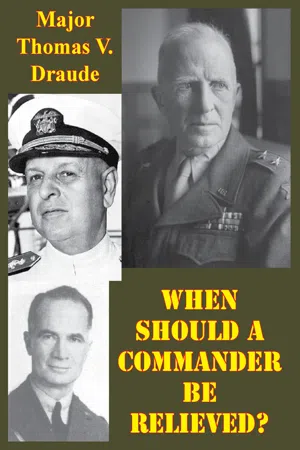
eBook - ePub
When Should A Commander Be Relieved?
A Study Of Combat Reliefs Of Commanders Of Battalions And Lower Units During The Vietnam Era
- 50 pages
- English
- ePUB (mobile friendly)
- Available on iOS & Android
eBook - ePub
When Should A Commander Be Relieved?
A Study Of Combat Reliefs Of Commanders Of Battalions And Lower Units During The Vietnam Era
About this book
Trusted by 375,005 students
Access to over 1.5 million titles for a fair monthly price.
Study more efficiently using our study tools.
Information
Subtopic
Military & Maritime HistoryIndex
HistoryCHAPTER I — INTRODUCTION
When should a commander be relieved? This question is one that arises in the study of military history or in the course of many professional officers' careers. Some specific examples of the relief of senior commanders are available, but the lower level reliefs are often treated as "military gossip"—the facts are not clear, the information is at best second-hand, and it happened to someone else, justly or unjustly.
My interest in this subject began as a platoon commander in 1963. As our battalion joined the Third Marine Division in anticipation of future deployment in Vietnam, I wondered how my platoon and I would perform in combat. If we performed poorly, that is, did not accomplish the assigned mission, then I would unquestionably and rightfully be relieved. But in 1966, as a company commander, I perceived that relief was not being used as the solution for the problem of mission failure. Three occasions arose where I was nearly relieved. One was over a mission failure. The second was a personality conflict with my Battalion Commander (in which the Assistant Division Commander intervened) and the third was a disagreement in tactics with the III MAF Commander (in which my new Battalion Commander intervened). On each occasion, it was a judgment call on the part of my seniors which saved me. Many of my peers and some seniors were not as fortunate.
The attitude of "relief is the solution to any problem" seemed to infect many of my peers in the Marine Corps. During a class on Battalion Tactics at the Marine Corps Amphibious Warfare School in 1968, a scenario was depicted in which one of the rifle companies was late in crossing the line of departure and in securing its objective. When the instructor asked us our reaction to this situation, many captains automatically said, "Relieve the Company Commander!" Perhaps, in an actual situation their response would have been different, but at the time they reflected what they had seen (or experienced) in Vietnam.
My interest in and frustration with this problem continued through my last assignment. As a Marine Security Guard Company Commander, I commanded thirty-five detachments throughout Europe, each led by a Staff Non-Commissioned-Officer (E-6 through E-9). These Non-Commissioned-Officers-in-Charge (NCOIC's) worked for the state Department in providing, through their detachments of five to thirty Marines, protection for classified material, U.S. property, and security for the U.S. personnel at their respective posts. Each NCOIC had been thoroughly screened before attending a rigorous six week course with a fifty percent attrition rate. Despite the thorough screening, training, and testing process, I relieved eight of them in my two years of command. Though not under combat conditions, these reliefs were traumatic for the Marines affected and the results of agonizing decisions for me—agonizing because mine were totally matters of judgment, without established guidelines. I do not regret my decisions. I do regret that many commanders must make such decisions based totally on their own judgment and, perhaps, without considering the effects on the mission, the unit, and the individual.
This thesis is an attempt to answer the question of when to relieve a commander. It has provided me with the guidelines I must consider when I am faced with this problem again.
At one time when Army Chief of Staff, General Creighton Abrams was introduced to a group of Army officers, he startled them by stating that there was no such person as General Abrams. He explained that although there had once been a Second Lieutenant Abrams, the man standing in front of them was actually a combination of all of the senior officers who influenced him throughout his career. He assumed responsibility for what had developed, but he was not the real contributor to the end product.
This thesis is much like General Abrams' example. I bear full responsibility for it, but the real contribution came from others.
First, the response from my fellow-students in Division A in completing and returning questionnaires and in granting interviews was most gratifying. The best example of this was a note from one student whom I had not yet met. "Sorry I can't help you—I've had no such experience (in the combat relief of a commander). However, if I can help you in any way on this study, please let me know."
Next, the other officers on post were totally supportive. No officer, from major general to captain, was too busy to see me.
In the interviews with students and post personnel, the Army officers were as frank as my fellow Marines in sharing with me their personal and professional embarrassment over the incidents they related. In some cases the narration of these incidents was obviously painful to the officer involved, whether he did the relieving or was himself relieved. In other cases, the participation in the relief of another officer had left an adverse effect on the narrator or on his record, yet his answers were clear and straightforward.
The members of my MMAS committee, Colonel Glover, Colonel Suranyi-Unger, and Lieutenant Colonel Abramowitz provided encouragement as well as guidance throughout the project. Their enthusiasm and expertise maintained my momentum at critical points in the year.
Finally, my wife who suffered through my self-doubts, moods of depression, and bursts of impatience through every assignment and duty station, deserves special thanks. Besides enduring the above, she also typed and edited my thesis drafts.
To all of these fine people, I am grateful.
CHAPTER II — THE PROBLEM
BACKGROUND
In the evolution of warfare the implements of violence have changed significantly. From Cain's bludgeon to today's variety of nuclear and laser weapons, the means of destruction appear to be limited only by imagination and the current technological sophistication. The manager of violence, man, still remains the decisionmaker. The history of warfare often shows that the men who made more correct decisions were usually the victors. The evolution of warfare brought with it the requirement for an increasing number of decisionmakers. The greater sophistication of weapons and numbers of combatants using these increasingly lethal weapons required more controllers to decide when, Where, and how the implements of violence and their managers would be employed.
With this increase in men and weapons came systems for their control. Chains of command were established to ensure the proper employment of a commander's assets. The links in the chain, the intermediate commanders, achieved greater importance as the complexities of combat grew, and the requirement for decisions at the intermediate level became more apparent.
The importance of combat commanders is well documented. The fact that the call to arms is recognized by many as a profession supports the justification for training, testing, and selecting the best professionals for positions of command. Their decisions in combat affect not only the men they command but also the security of the nation or cause for which they fight.
Although much is written, taught, and practiced in the training and testing of commanders, there is a scarcity of information on their actual selection. Specifically, there is almost nothing written on the "selecting out" or relief of combat commanders at the critical level of battalion or below. The decision of a higher commander to retain or reject his leaders at the fighting level is left to the higher commander's personal judgment. In this case, his judgment is not a matter of interpreting standard orders, guidelines, or principles as there are virtually none.
IMPORTANCE
The reasons for relief and the attendant effects on involved personnel needs to be examined. Only by analyzing these reasons and effects can "good" reliefs be used as a general standard for future decisions. The documentation to provide data for such a study does not exist to the knowledge of this writer, but conversations with commanders and with students, staff, and faculty at the Command and General Staff College support this requirement of relief analysis. There is much information concerning the reliefs of higher commanders. President Truman's relief of General MacArthur, Eisenhower's actions with Patton, General H. M. Smith's (USMC) relief of General Ralph Smith (USA) are all illustrations of how this problem was dealt with on a high command level, but almost no informative guidelines exist for relief of commanders at a lower strata. Elements of the required information on reliefs at battalion and below (the "What, Why and When") are contained in the relieved officer's Army Officer Efficiency Report (OER), or its equivalent form for other branches of service. This information from official personnel records is available only to the rated officer.
Because of this difficulty, I believe the study is of value to combat commanders of all services. The purpose of the study is to provide guidelines to commanders for the relief of battalion commanders and below during combat conditions. I intend to do this by examining the causes and effects of selected reliefs. The questions to be' answered by this study are:
a. Why are commanders of battalion or lower units relieved?
b. Was a replacement for the relieved commander readily available?
c. What were the effe...
Table of contents
- Title page
- TABLE OF CONTENTS
- ABSTRACT
- DEDICATION
- CHAPTER I - INTRODUCTION
- CHAPTER II - THE PROBLEM
- CHAPTER III - METHODOLOGY
- CHAPTER IV - FINDINGS AND CASE STUDIES
- CHAPTER V - CONCLUSIONS, OBSERVATIONS, RECOMMENDATIONS
- ANNOTATED BIBLIOGRAPHY
Frequently asked questions
Yes, you can cancel anytime from the Subscription tab in your account settings on the Perlego website. Your subscription will stay active until the end of your current billing period. Learn how to cancel your subscription
No, books cannot be downloaded as external files, such as PDFs, for use outside of Perlego. However, you can download books within the Perlego app for offline reading on mobile or tablet. Learn how to download books offline
Perlego offers two plans: Essential and Complete
- Essential is ideal for learners and professionals who enjoy exploring a wide range of subjects. Access the Essential Library with 800,000+ trusted titles and best-sellers across business, personal growth, and the humanities. Includes unlimited reading time and Standard Read Aloud voice.
- Complete: Perfect for advanced learners and researchers needing full, unrestricted access. Unlock 1.5M+ books across hundreds of subjects, including academic and specialized titles. The Complete Plan also includes advanced features like Premium Read Aloud and Research Assistant.
We are an online textbook subscription service, where you can get access to an entire online library for less than the price of a single book per month. With over 1.5 million books across 990+ topics, we’ve got you covered! Learn about our mission
Look out for the read-aloud symbol on your next book to see if you can listen to it. The read-aloud tool reads text aloud for you, highlighting the text as it is being read. You can pause it, speed it up and slow it down. Learn more about Read Aloud
Yes! You can use the Perlego app on both iOS and Android devices to read anytime, anywhere — even offline. Perfect for commutes or when you’re on the go.
Please note we cannot support devices running on iOS 13 and Android 7 or earlier. Learn more about using the app
Please note we cannot support devices running on iOS 13 and Android 7 or earlier. Learn more about using the app
Yes, you can access When Should A Commander Be Relieved? by Major Thomas V. Draude in PDF and/or ePUB format, as well as other popular books in History & Military & Maritime History. We have over 1.5 million books available in our catalogue for you to explore.