eBook - ePub
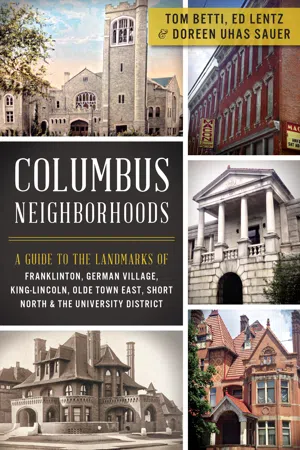
Columbus Neighborhoods
A Guide to the Landmarks of Franklinton, German Village, King-Lincoln, Olde Town East, Short North & the University District
- 192 pages
- English
- ePUB (mobile friendly)
- Available on iOS & Android
eBook - ePub
Columbus Neighborhoods
A Guide to the Landmarks of Franklinton, German Village, King-Lincoln, Olde Town East, Short North & the University District
About this book
Discover the stories behind historic Columbus neighborhoods and their engaging landmarks.
The community centers that locals call home aren't just points of interest but places that have shaped history beyond their communities and even Ohio. This encyclopedia of Columbus neighborhoods gives voice to the rich heritage residing in the bell towers, parks and streetscapes of Franklinton, German Village, King-Lincoln, Olde Town East, Short North and the University District. Along with WOSU's award-winning Columbus Neighborhoods series, Tom Betti, Doreen Uhas Sauer and Ed Lentz curate the stories tracing the lines from your neighborhood to the Manhattan Project, the Underground Railroad, Abraham Lincoln and the Tuskegee Airmen.
Trusted by 375,005 students
Access to over 1.5 million titles for a fair monthly price.
Study more efficiently using our study tools.
Information
NEAR EAST SIDE, KING-LINCOLN, BRONZEVILLE AND OLDE TOWN EAST
ALPHA HOSPITAL SITE (893 EAST LONG STREET)
It was a coffee shop with a bright future and a little-known past. When Urban Spirits Coffee Shop opened, its history came tumbling out. The renovated building at the corner of East Long and Seventeenth Street had been, for many, hiding a secret past as the Alpha Hospital created by Drs. W.A. Method and R.M. Tribbitt as a private institution in 1920. It was the first of its kind, a hospital in which an African American doctor could fully practice his professional skills, and it was therefore named “alpha” by a contest conducted in the African American community. No hospital in Columbus at that time would permit an African American physician to do so.
African American doctors could practice only privately with fee rates set by the Columbus Academy of Medicine (office calls ranging from one to five dollars) but were not allowed to practice surgical skills in hospitals. Doctors took chickens for fees and saw patients at the Isabelle Ridgway Old Folks’ Home and the Phyllis Wheatley Home (once known as the Mary Price Home) for unwed mothers for free. The Drs. Method (who married Isabelle Ridgway’s daughter) and Tribbitt purchased an old residence of six rooms and a bath with the intention of remodeling it but soon realized it made more sense to purchase the adjoining property.
The result was offices, consultation rooms, operating rooms, a small laboratory, separate small women’s and men’s wards, nurses’ quarters, baths, a diet kitchen to prepare special meals, a dining room, a clinical laboratory and a heating plant—all within two stories and a basement.

Alpha Hospital was the first hospital where an African American doctor could practice his skills as a physician.
During the first thirteen weeks of opening, the Alpha Hospital received forty-two cases, thirty-two of which were operative, and many emergency cases. The timing of its opening was critical to the community—flu epidemics were rampant, and many in the community were newcomers from the South. Those on the Great Migration during World War I did not come equipped to deal with Ohio winters. In addition, the hospital provided employment in the community. An art gallery and bookstore now occupy the site.
BROAD STREET
Broad Street, growing eastward from downtown, was the city’s “Street of Dreams,” where the middle class and working classes hoped one day to live. In the mid-nineteenth century, a few homes were already established. Some were spectacular, like the Kelley homestead, a Greek Revival–style mansion (mentioned in the Introduction). Others were more modest but venerated for their history, like the Taylor mansion, built by the Taylors, who acquired their land as part of the Refugee Tract (land donated by the United States government to help compensate residents in Nova Scotia and Canada who lost property for siding with the Americans during the American Revolution). The name “Broad Street” seemed most fitting since a wide street with tree-lined inside carriage lanes was said to be the inspiration of William Deshler, prominent Columbus businessman, who visited Havana, Cuba, and marveled at the broad, tree-lined streets and brought the idea home. The carriage lanes lasted until the twentieth century and the age of the automobile, though there are periodic discussions about bringing them back.
The fine residences reflect the prosperity and civic mindedness of the later nineteenth-century Columbus families, like the Queen Anne–style Shedd-Dunn (965 East Broad Street), the Hanna home (1021 East Broad Street), the Godman home (1031 East Broad Street) and the Lindenberg home (1234 East Broad Street). Respectively, these homes were owned by families who helped to found Players Theater; founded a paint company that specialized in ready-mixed paint colors; built a shoe empire and the city’s oldest settlement house (that still exists); and made a fortune in manufacturing regalia and paraphernalia for organizations, secret societies, fraternities and lodges. The latter building, the Lindenberg home, became an Ohio governor’s residence in 1919 (ten governors lived there over a thirty-six-year period) and is the home of the Columbus Foundation today. From downtown to Franklin Park, the street is a study of architectural styles from neo-Classical Revival to the art deco Royal York Apartments and a lesson in urban history and social changes.
BROAD STREET PRESBYTERIAN CHURCH (760 EAST BROAD STREET)
In the early 1880s, downtown churches (those between High and Fourth Streets) wrestled with the matter of members moving out of the increasingly commercial city core. First Presbyterian, the oldest congregation in Columbus, decided to stay in its 1830 edifice facing the Capitol, but it opened a mission on Long Street, east of Garfield in 1884. In 1887, 104 people from the mission organized as Broad Street Presbyterian Church, with 85 percent of them living within walking distance between Washington and Ohio Avenues.
They began a permanent edifice with plans by Elah Terrell—a chapel finished in 1888 and the sanctuary in 1894. In less than twenty years, the congregation was much larger than originally anticipated, and Frank Packard was engaged for plans to expand the sanctuary and to change the interior appearance from Romanesque to Classical Revival. The expanded sanctuary opened in 1908, and expanded social facilities were completed in 1923. Later additions and remodeling were required as the congregation grew to 2,200.
By the 1960s, though there were many residences surrounding the church, houses had become offices, and fewer members lived close. Membership diminished somewhat. The mission was broadened to serve those both near and far in their particular need. Alterations to the church in 2004–05 more effectively addressed the change of people entering the building from the parking lot in the rear.
BROAD STREET UNITED METHODIST CHURCH (501 EAST BROAD STREET)
Joseph Warren Yost, a well-known Columbus architect, designed the exterior of the church in 1885 in High Victorian Gothic style, a style that was very popular for religious and public buildings in the late nineteenth century. The church used polychromatic masonry materials, contrasting textures, pointed arches and complex gable roofs with dormers, but it is the green serpentine stone that is notable enough to have people often refer to it as the “Green Church.” When the original stonework was badly deteriorating, the church undertook the Herculean task of finding replacement artificial stone used along with Columbus limestone and Berea sandstone to mimic the original look of the church.
Victorian woodwork and art glass (some of which was saved from the older Central Church located at East Broad and North Fourth) dominate the interior. The east window was designed and installed in 1908 by the Von Greichten Studios of Columbus, memorializing one of the church’s founding members, Mrs. David Gray, who lived in the former Snowden Mansion (now Kappa Kappa Gamma) on East Town Street. President William McKinley was a member, and after his assassination, the memorial funeral service was conducted here. The church is noted for its outreach to the disenfranchised, such as “Bethlehem on Broad Street,” a program of shelter and services for homeless families.
BRYDEN ROAD (BETWEEN PARSONS AVENUE AND NELSON ROAD)
Bryden Road starts with a name change at Parsons Avenue: on one side, it is Town Street as it leaves downtown; on the other side is continues as Bryden Road. The same street with two different names supposedly came about to thwart the expansion of the streetcar. Just as the mansions of Bryden Road were being built, new homeowners found out that the city had signed a contract to expand a streetcar line eastward on Town Street and into their neighborhood. They felt the presence of such a contraption would devalue their properties, but the contract clearly stated the streetcar was to be built on Town Street. Therefore, the residents had the name of the street changed. Both sides are known for their spectacular homes from different eras of prosperity. Original homes on Town Street reflect Columbus’s prosperity from the 1840s through the 1870s. Bryden Road’s homes reflect the later nineteenth century, an age of prosperity and opulence, housing the former “Silk Stocking District,” built on increasingly well-established fortunes. Bankers, architects, manufacturers and politicians chose to showcase their wealth with castle-like homes on Bryden Road. It is said that nearby Broad Street was Judges’ Row, but lawyers lived on Bryden Road. Alice Schille, the watercolor artist; James Thurber’s grandfather; and Joseph Yost, famed architect, lived on the street. Wealth was gradually moving east.

Bryden Road’s spectacular homes have given it historic designation.
More than fifty architectural styles can be found along Bryden Road, and many exhibit French, German and Renaissance detailing. The Myers house (1330 Bryden Road) is perhaps the most ornate nineteenth-century home in Columbus, built in 1896 on the fortunes of buggy and carriage manufacturing. The homes have third-floor ballrooms, dining rooms to seat more than thirty people, elaborate entranceways, tall chimneys and taller turrets, meticulously detailed stone and woodwork (both interior and exterior) and the ever-requested French-influenced conical roof (especially if the house was at an intersection). Though some houses do have sizeable front porches, many exteriors were designed to impress—the fruits of one’s labor was in the showcase effect for passersby—not to suggest lemonade on the porch.
The street appears to have been somewhat more democratic than middle-class neighborhoods, in the sense that only wealth mattered and there were apparently no deed restrictions for Jewish families. As wealth continued to move eastward from downtown by the 1960s, the large homes were occupied as rooming houses, nursing homes and businesses. For the past two decades, the preservation of the street’s architectural heritage by its neighbors has taken precedence over the social growing pains of a past generation’s preoccupation with racism, homophobia or classism.
CARTER SCHOOL OF MUSIC (199 HAMILTON AVENUE)
Helen Carter, an active member of Shiloh Baptist Church, as well as an accomplished pianist, organist and composer of spirituals and choral music, opened a school in 1929. In the 1940s, the Carter School of Music boasted a program of “interracial cooperation” and offered lessons in piano and violin, as well as voice—and lessons in language, history, chorus, conducting and more. Carter died in 1973, but near the corner of East Spring and Hamilton Park, a historic marker tells of the music heritage of the schools, places of entertainment, music shops and music studios of this neighborhood that Helen Carter helped establish as a center of the musical arts in the area once known as Bronzeville.
COLUMBUS URBAN LEAGUE (788 MT. VERNON AVENUE)
In 1910, the National League on Urban Conditions among Negroes was formed to create, in the words of the league, “Not Alms, but Opportunity” for African Americans migrating north. The northern branch in New York and the southern branch in Nashville were committed to emphasizing cooperation with social welfare agencies, training and employment skills specifically for urban life and securing playgrounds and boys’ and girls’ clubs to help curb delinquency. By 1917, editorials in New York said the group had made significant progress.

Built in 1994, the Columbus Urban League was founded in 1918.
The following year, the Columbus Urban League became a branch of the National Urban League at the request of R.H. Bondy, secretary of the social service bureau of the chamber of commerce, who noted that the National Urban League was created because “far-seeing white and colored people observed in the great influx of Negroes in cities North and South, the creation of serious social problems which required the study and attack of sympathetic individuals.”
The Columbus Urban League is one of the oldest branches in the country. Its first board was composed of Columbus leaders with well-known surnames like Beatty, Jeffrey, Method and (King) Thompson, who focused on finding employment for the unemployed, reducing turnover in workers and providing schools for adults. By 1926, Nimrod Allen, the executive director of the Urban League, reported that the first presidents of the Urban League board were ministers from First Congregational Church and Indianola Methodist Episcopal Church, followed by the chairman of the Race Relations Committee at Ohio State.
Not merely an organization that coordinated social services, in 1924, the Urban League conducted an investigation of the Columbus Police Department and the City Workhouse and studied three Columbus newspapers and the 1556 articles in them that reported African American news (39 percent of the total space of the papers was devoted to only negative and often highly sensationalized reports). From this study, the Columbus Citizen and the Columbus Dispatch newspapers ...
Table of contents
- Front Cover
- Title Page
- Copyright
- Dedication
- Contents
- Acknowledgements
- Introduction
- Franklinton
- Short North: Victorian and Italian Villages, Harrison West
- University District
- German Village
- Near East Side, King-Lincoln, Bronzeville and Olde Town East
- List of Sites Within Neighborhoods
- About the Authors
Frequently asked questions
Yes, you can cancel anytime from the Subscription tab in your account settings on the Perlego website. Your subscription will stay active until the end of your current billing period. Learn how to cancel your subscription
No, books cannot be downloaded as external files, such as PDFs, for use outside of Perlego. However, you can download books within the Perlego app for offline reading on mobile or tablet. Learn how to download books offline
Perlego offers two plans: Essential and Complete
- Essential is ideal for learners and professionals who enjoy exploring a wide range of subjects. Access the Essential Library with 800,000+ trusted titles and best-sellers across business, personal growth, and the humanities. Includes unlimited reading time and Standard Read Aloud voice.
- Complete: Perfect for advanced learners and researchers needing full, unrestricted access. Unlock 1.5M+ books across hundreds of subjects, including academic and specialized titles. The Complete Plan also includes advanced features like Premium Read Aloud and Research Assistant.
We are an online textbook subscription service, where you can get access to an entire online library for less than the price of a single book per month. With over 1.5 million books across 990+ topics, we’ve got you covered! Learn about our mission
Look out for the read-aloud symbol on your next book to see if you can listen to it. The read-aloud tool reads text aloud for you, highlighting the text as it is being read. You can pause it, speed it up and slow it down. Learn more about Read Aloud
Yes! You can use the Perlego app on both iOS and Android devices to read anytime, anywhere — even offline. Perfect for commutes or when you’re on the go.
Please note we cannot support devices running on iOS 13 and Android 7 or earlier. Learn more about using the app
Please note we cannot support devices running on iOS 13 and Android 7 or earlier. Learn more about using the app
Yes, you can access Columbus Neighborhoods by Tom Betti,Ed Lentz,Doreen Uhas Sauer in PDF and/or ePUB format, as well as other popular books in History & Architecture General. We have over 1.5 million books available in our catalogue for you to explore.